Articles · Research and consent
The rooms are named and the consent procedure is not, NSF award 2535195
A federally funded UT Austin center plans to study robots in occupied homes, workplaces and care settings. Its consent and opt-out procedures were still to be developed.
Read the story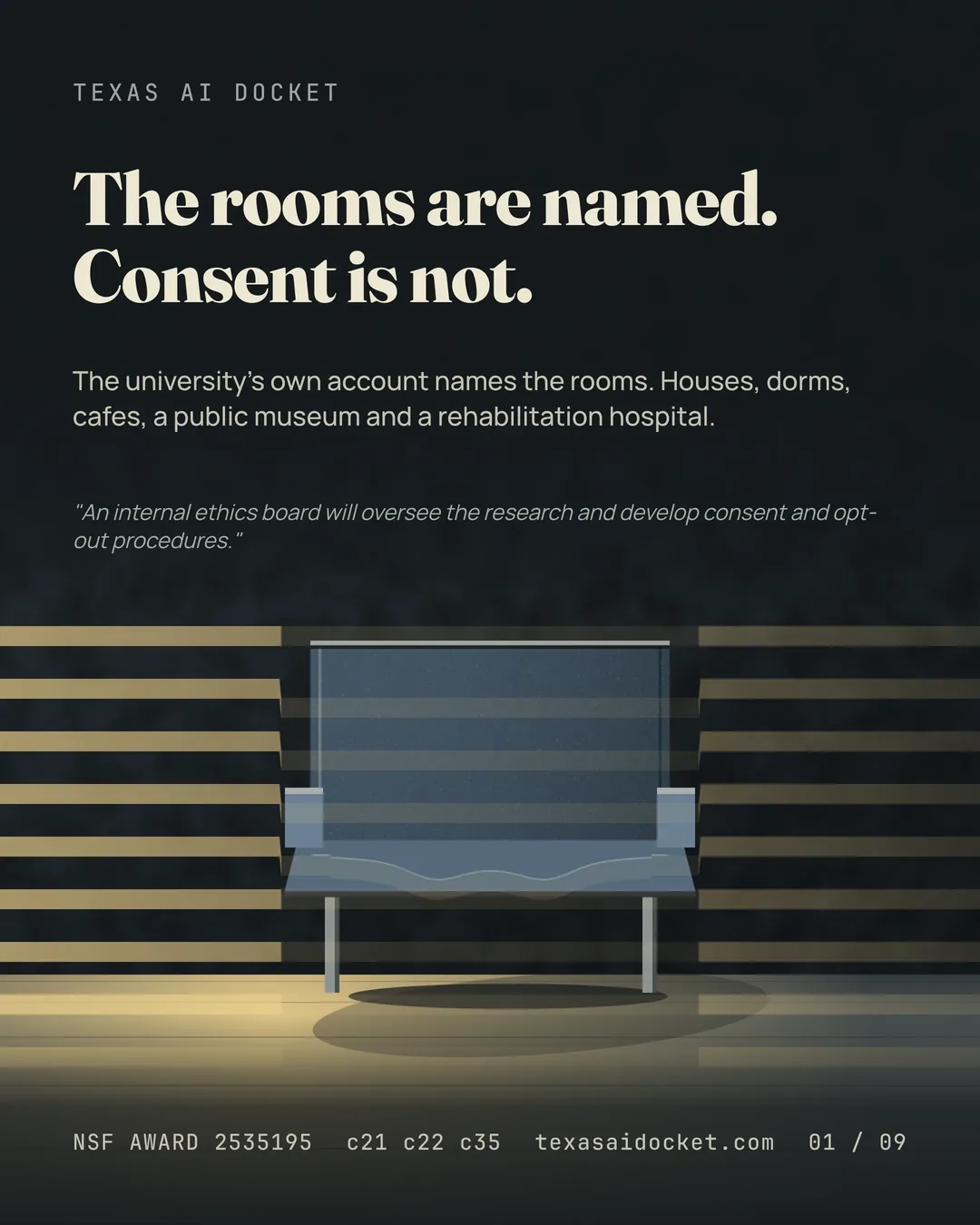
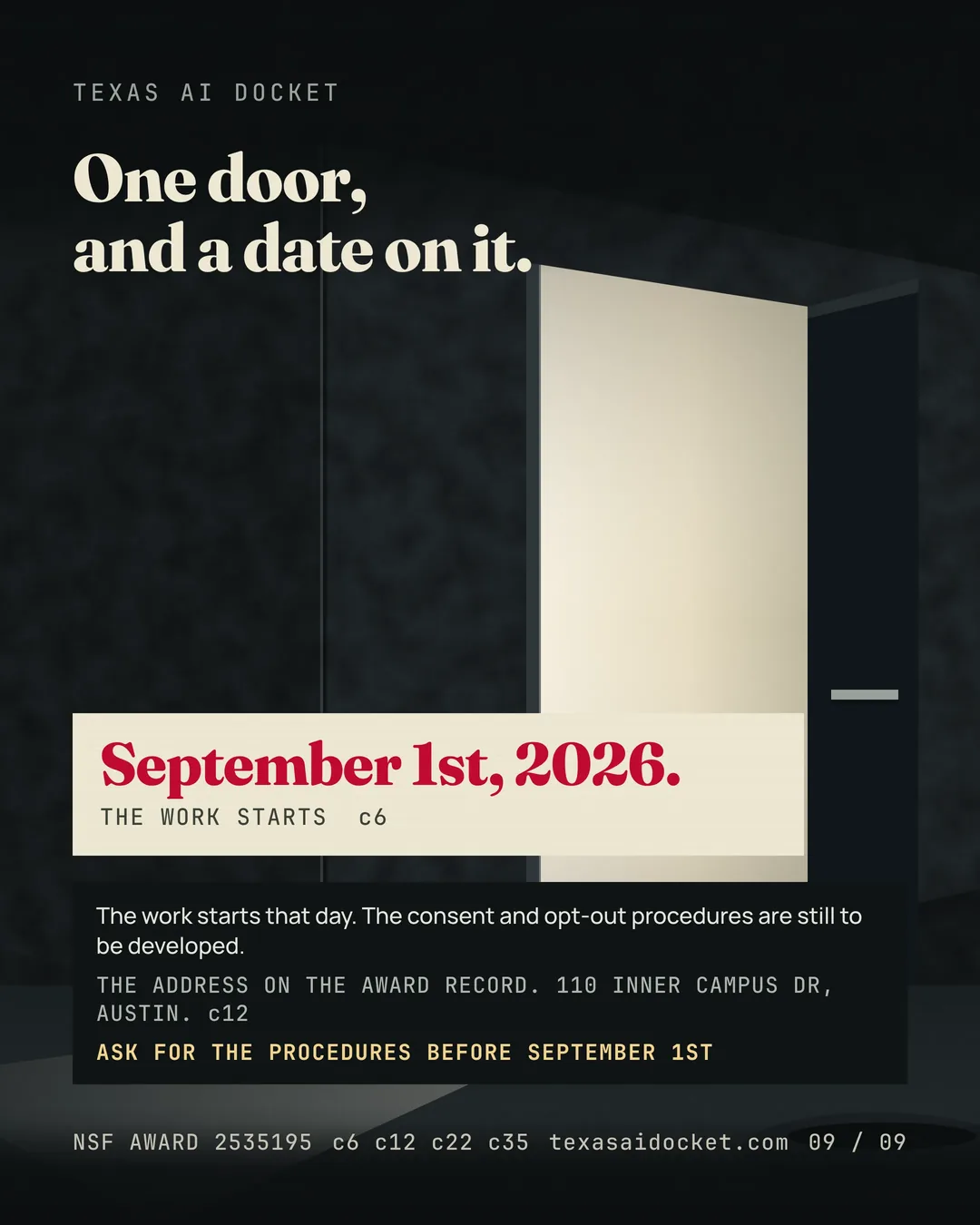
UT Austin's new human-and-robot research center is designed to move beyond the laboratory. The federal award abstract describes participatory living laboratories inside residential, commercial and healthcare facilities.
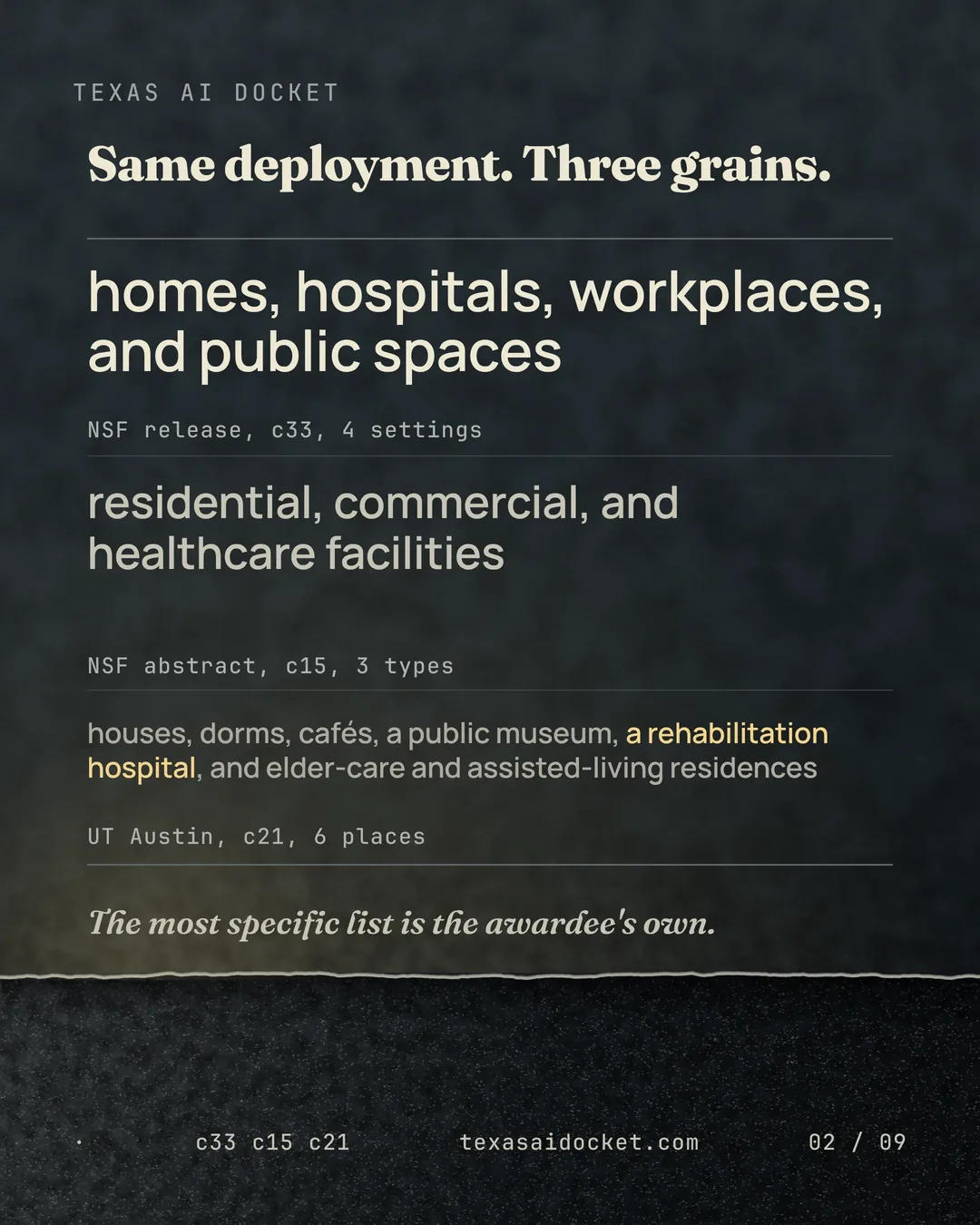
The university's account names houses, dorms, cafes, a museum and care facilities as deployment settings. These are places where people already live or work. The same account says an internal ethics board will develop consent and opt-out procedures.
An award is not a deployment result
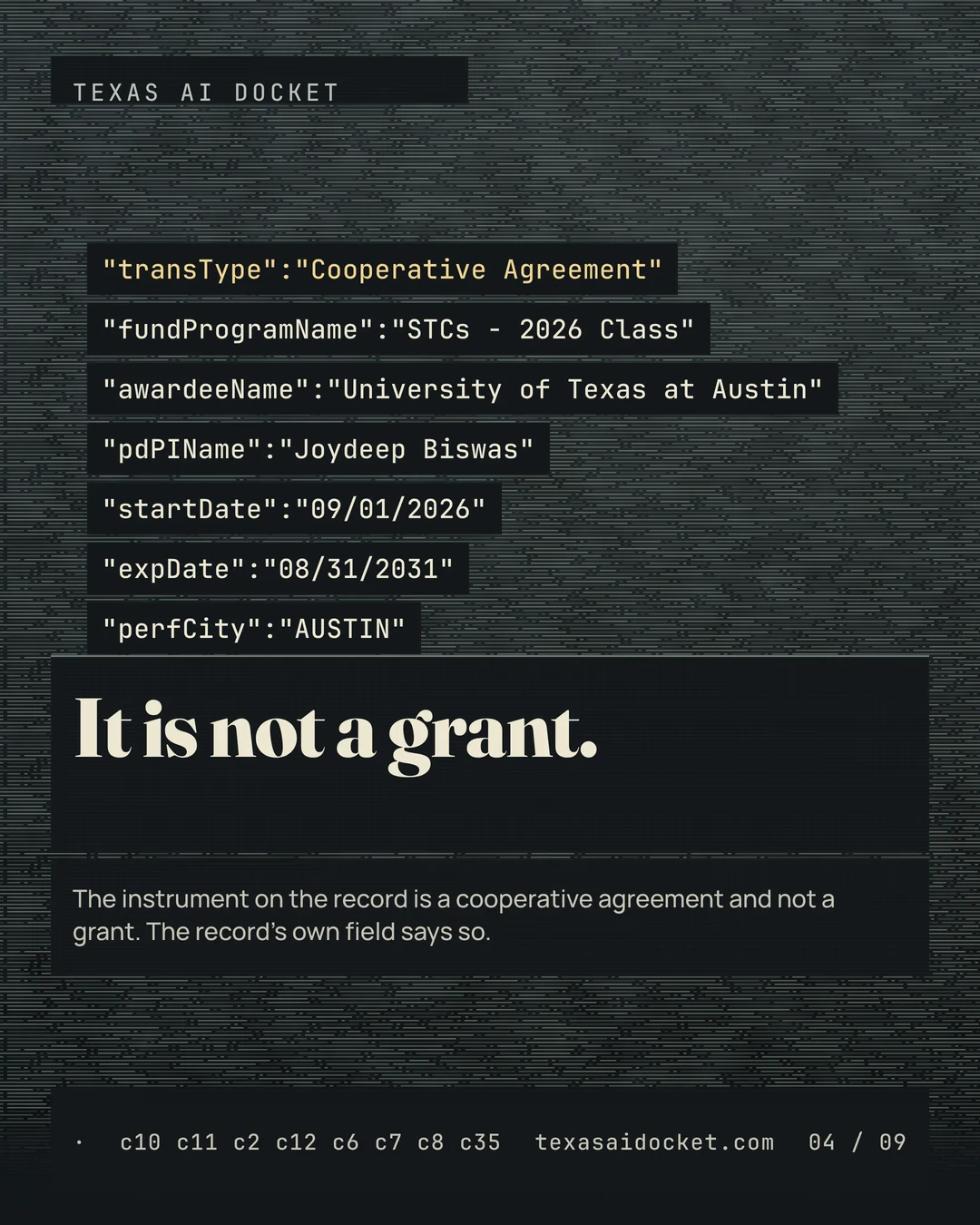
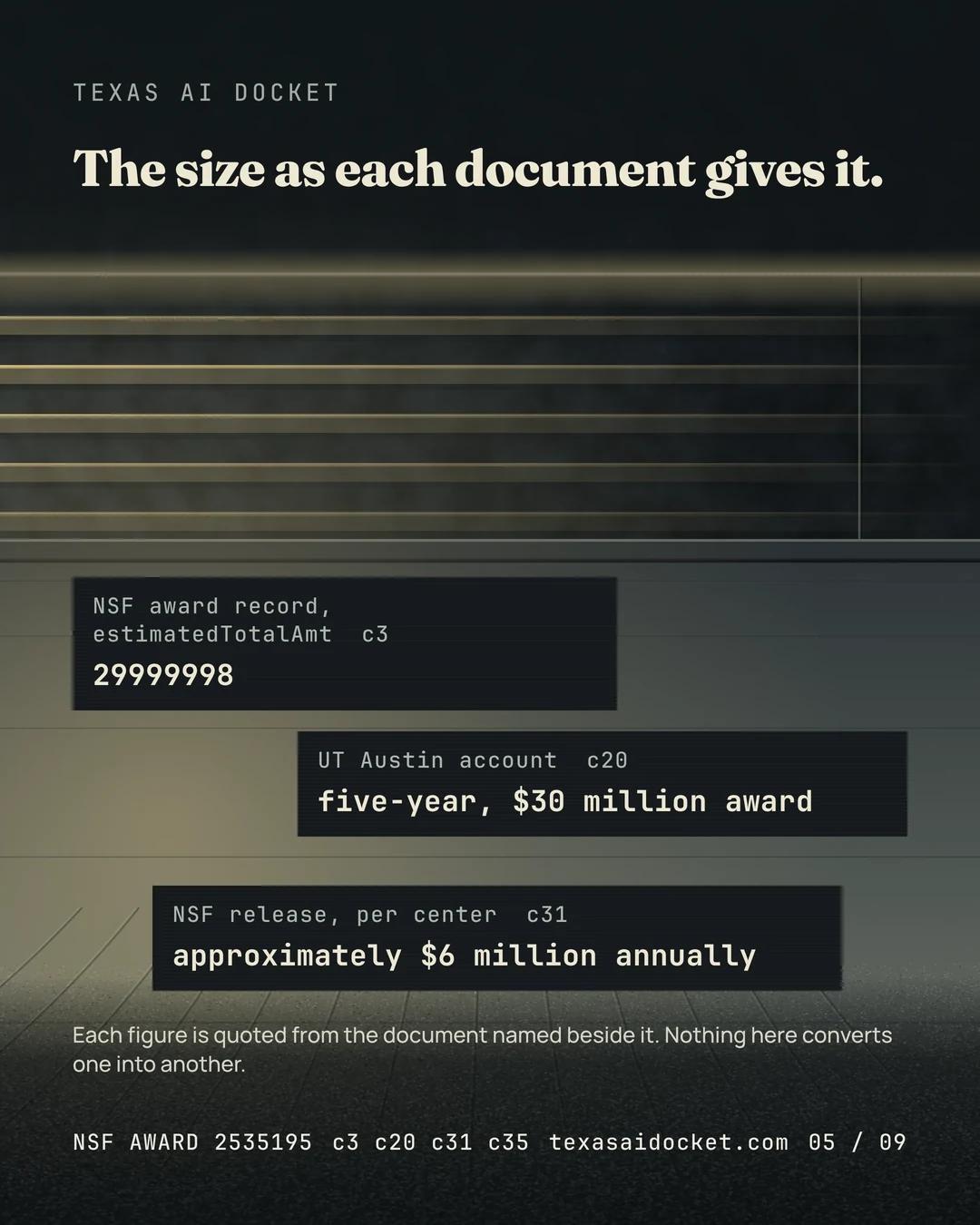
The federal instrument is a cooperative agreement. Its record distinguishes an estimated total from funds already obligated. The university's rounded description of the award should not erase that distinction or imply all funding has already been spent.
The research concerns how people and robots adapt to one another. The Texas Advanced Computing Center is assigned simulation, machine learning, storage and digital twins of the deployment sites. These are described research roles, not reported findings.
The consent question is concrete
The university says community members will be able to influence where and how robots are deployed. Its future-tense description does not establish an operating consent process or show how someone in a shared space would decline participation.
The next document that matters
Published consent and opt-out procedures would make that promise inspectable. Until those procedures are available, the named settings establish the scope of the plan, not the protections already in place at each site.
Sources for this story
- National Science Foundation, award record 2535195, Center for Human and Robot Co-Adaptation
- UT News, UT to lead NSF center that will study how robots and people learn to live and work together
- National Science Foundation, NSF launches three new Science and Technology Centers
Claim-by-claim verification · 35 claims
The National Science Foundation award record for award number 2535195 titles the project a Science and Technology Center for Human and Robot Co-Adaptation.
"title":"STC: Center for Human and Robot Co-Adaptation"
The agency names the University of Texas at Austin as the awardee.
"awardeeName":"University of Texas at Austin"
The agency award record carries an estimated total amount of 29999998.
"estimatedTotalAmt":"29999998"
The agency award record carries funds obligated of 5999999.
"fundsObligatedAmt":"5999999"
The award record lists the obligation against fiscal year 2026.
"fundsObligated":["FY 2026 = $5,999,999.00"]
The award record gives a start date of 09/01/2026.
"startDate":"09/01/2026","title":"STC: Center for Human and Robot Co-Adaptation"
The award record gives an expiration date of 08/31/2031.
"estimatedTotalAmt":"29999998","expDate":"08/31/2031"
The award record is dated 08/25/2026 and carries the estimated total beside it.
"date":"08/25/2026","dirAbbr":"O/D","divAbbr":"OIA","estimatedTotalAmt":"29999998"
The award record lists the initial amendment date and the latest amendment date as the same day.
"initAmendmentDate":"08/25/2026","latestAmendmentDate":"08/25/2026"
The instrument is a cooperative agreement rather than a grant.
"transType":"Cooperative Agreement"
The award sits in the agency's 2026 class of Science and Technology Centers.
"fundProgramName":"STCs - 2026 Class"
The principal investigator on the award record is Joydeep Biswas, and the performance address is on the Austin campus.
"pdPIName":"Joydeep Biswas","perfAddress":"110 INNER CAMPUS DR","perfCity":"AUSTIN"
The performance location on the award record is in Texas.
"perfLocation":"University of Texas at Austin","perfStateCode":"TX"
The award abstract frames the work as moving robots out of research laboratories and into homes, hospitals, workplaces and public spaces.
For robots to transition from research laboratories to effective collaborators in homes, hospitals, workplaces, and public spaces, they must be able to understand, interact with, and adapt to people over time.
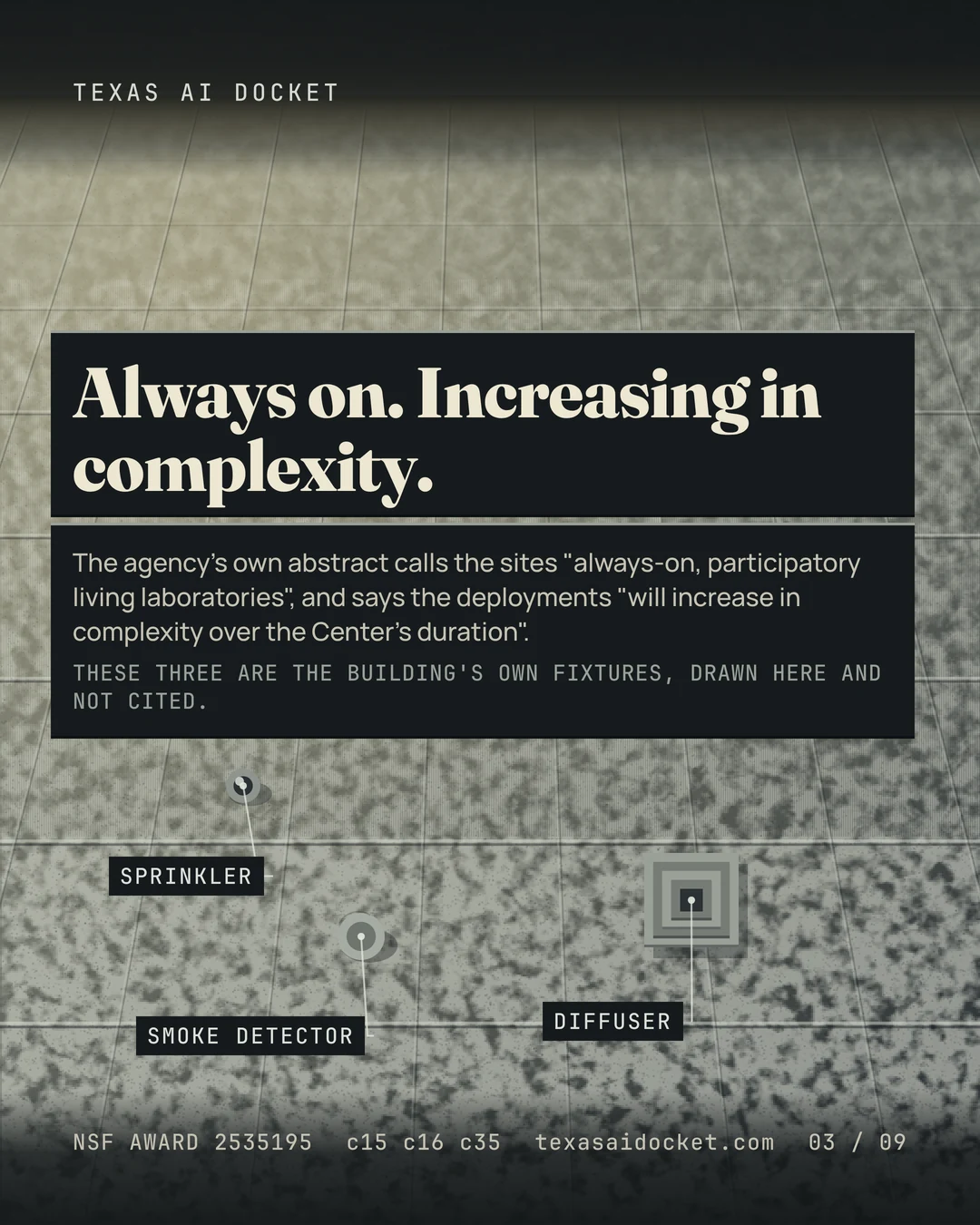
The award abstract describes the research sites as always on, participatory living laboratories inside residential, commercial and healthcare facilities.
Research activities will be grounded, tested, and refined through the Human Environment with Robots (HERO) Facility Network, an ecologically valid testing ground comprising always-on, participatory living laboratories in residential, commercial, and healthcare facilities across the partner institution network.
The award abstract says the deployments will grow more complex over the life of the center.
These deployments will increase in complexity over the Center's duration, supporting the development of generalizable principles, algorithms, and evaluation methods for long-term human-robot co-adaptation.
The university's own account says the center will bring together 39 researchers from six universities and multiple industry partners.
The forthcoming Center for Human and Robot Co-Adaptation will bring together 39 researchers from six universities and multiple industry partners
The university names five partner universities outside Texas.
Partner universities are the Massachusetts Institute of Technology, Yale University, Indiana University Bloomington, the University of Utah, and Tufts University.
The university names eight industry collaborators.
Industry collaborators include Amazon, Apptronik, Diligent Robotics, Google DeepMind, Hello Robot, MassRobotics, NVIDIA and Robust AI.
The university describes the award in its own account as a five-year, $30 million award.
The five-year, $30 million award will bring together researchers from disciplines spanning artificial intelligence, robotics, cognitive science and social science
The university lists the real world deployment sites as houses, dorms, cafes, a public museum, a rehabilitation hospital, and elder-care and assisted-living residences.
The research will be grounded in findings from the Human Environment with Robots (HERO) Facility Network, a set of real-world deployment sites hosted at UT and the partner institutions: houses, dorms, cafés, a public museum, a rehabilitation hospital, and elder-care and assisted-living residences.
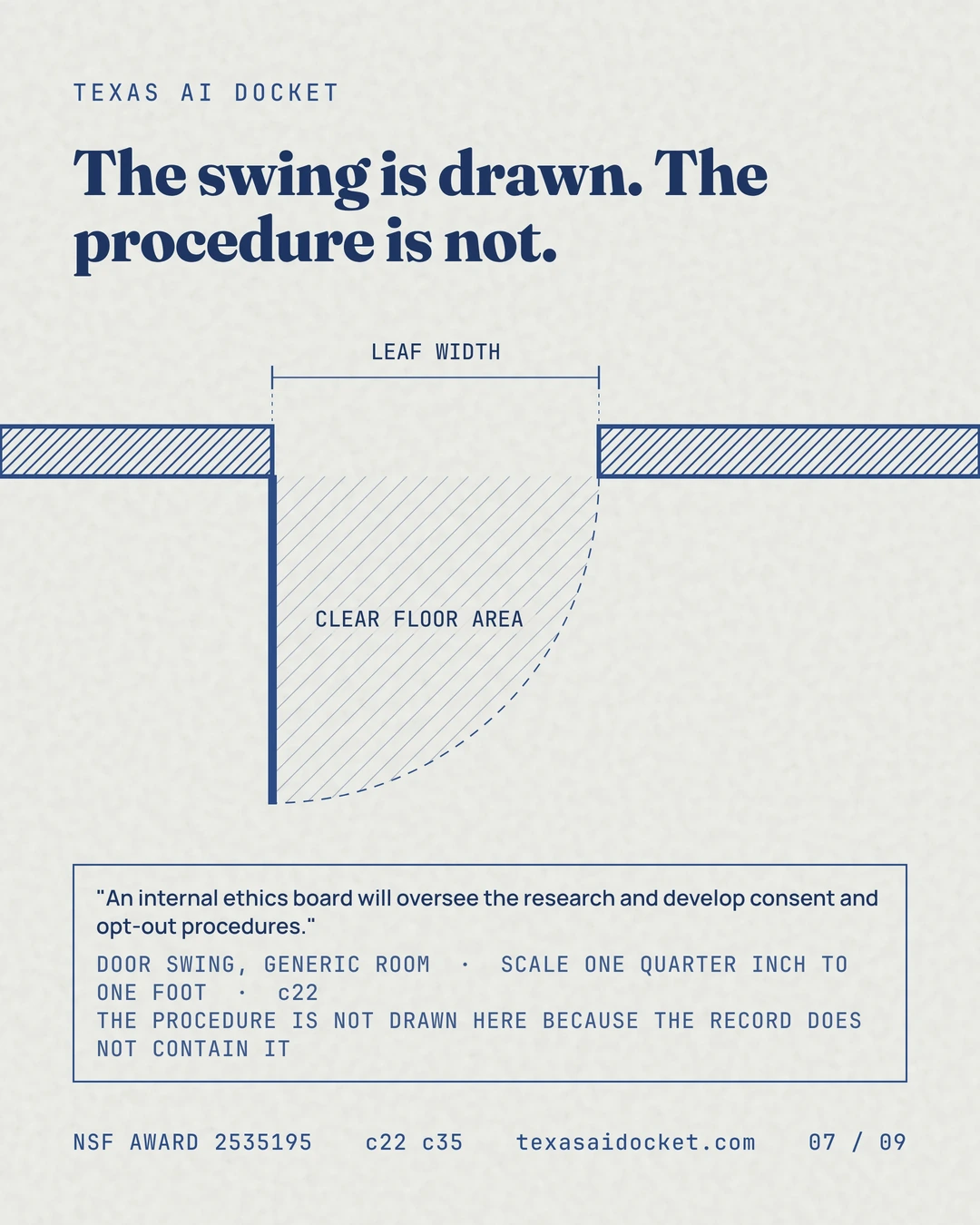
The university states that an internal ethics board will develop the consent and opt-out procedures.
An internal ethics board will oversee the research and develop consent and opt-out procedures.
The university says community members will get an opportunity to influence how, when and where robots are deployed.
Every step of the way, community members will have an opportunity to influence how, when and where robots get deployed
The university's release describes the work as enabling robots to understand the needs and preferences and values and constraints of the people around them. It says people adapt their behavior too. The fetched span carries no speaker, so this deck attributes the sentence to the document rather than to a person.
It is enabling robots to understand the people around them: their needs, preferences, values and constraints, while recognizing that people also adapt their behavior when they integrate robots into their environment.
The university names Joydeep Biswas an associate professor of computer science.
Joydeep Biswas, an associate professor of computer science
The university traces the center back to Good Systems, its research grand challenge on ethical artificial intelligence.
The center grew from a core project of Good Systems
The university says the Texas Advanced Computing Center will run simulation, machine learning, data storage and digital twins of the deployment sites.
will provide the computational muscle for the simulation, machine learning, data storage and digital twins of HERO sites
The university states the award is one of three center grants recently announced by the agency.
It is one of three center grants recently announced by NSF.
The agency announced three new Science and Technology Centers in one release.
NSF launches three new Science and Technology Centers with $90M investment in transformative research
The agency puts $90 million over five years behind the three centers together.
The U.S. National Science Foundation is investing $90 million over five years to support three new NSF Science and Technology Centers (NSF STC).
The agency says each center gets approximately $6 million annually for an initial five-year period and may compete for up to five more years.
Each center will receive approximately $6 million annually for an initial five-year period, with the opportunity to compete for up to five additional years of support.
The agency release says the Texas center will study how people and robots can securely and effectively adapt to one another.
led by The University of Texas at Austin, will study how people and robots can securely and effectively adapt to one another
The only settings the agency release names for the Texas center are homes, hospitals, workplaces and public spaces.
service and assistive robots become more common in homes, hospitals, workplaces, and public spaces
The agency release describes the method as combining robotics, artificial intelligence and human factors so robots learn from people.
Researchers will combine robotics, AI, and human factors to develop new methods that help robots with embodied intelligence learn from people, understand their needs and preferences
The award record's own id field carries the award number 2535195. Its initial and latest amendment dates are both 08/25/2026.
"id":"2535195","initAmendmentDate":"08/25/2026","latestAmendmentDate":"08/25/2026"