Articles · Border technology
Tested on the faces walking out.
Federal officials tested facial-image capture on pedestrians leaving Texas at Progreso. Their account describes the equipment and an opt-out lane, but publishes no accuracy or error rates.
Read the story
Pedestrians walking out of the United States at Progreso became part of a federal biometric technology assessment. The Homeland Security account describes work performed for Customs and Border Protection at the international bridge in Texas.
The goal was to capture facial images as people walked past, without requiring them to stop. Officials praised the results. The published account does not give the measurements needed to independently assess that praise.
What was tested
Selected systems from NEC and a Paravision-AiFi partnership moved from demonstrations in Maryland to operational data collection at Progreso. The assessment included different camera configurations and testing after dark with external lighting.
The account credits AI and other technologies with modeling the capture area, observing pedestrian movement and assessing facial images for matching. It does not isolate the contribution of AI from the other components.
Who could decline
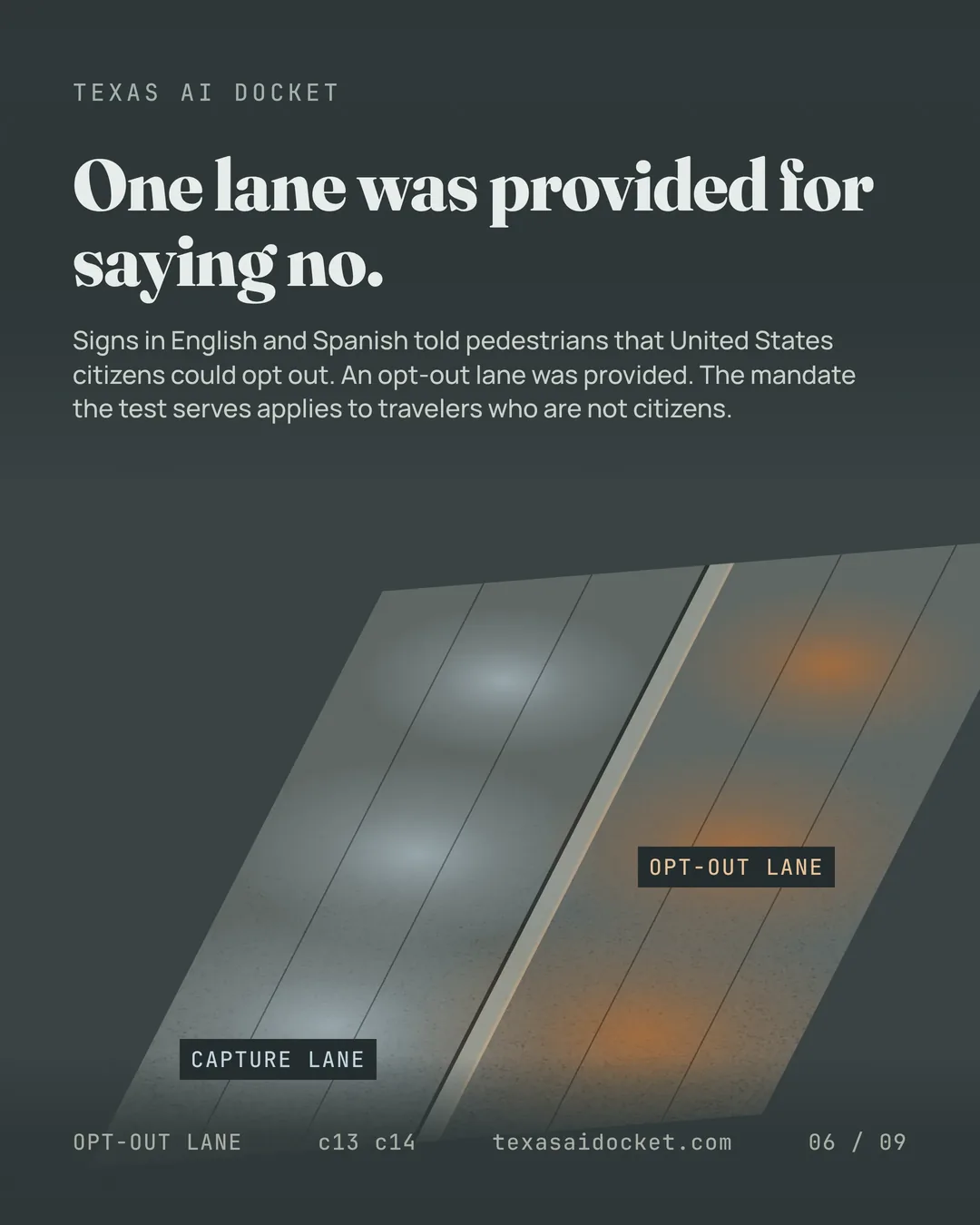
Signs in English and Spanish told United States citizens they could opt out. A separate lane served citizens who declined image collection. The account describes that option specifically for citizens, not as a universal opt-out for every traveler.
The missing results
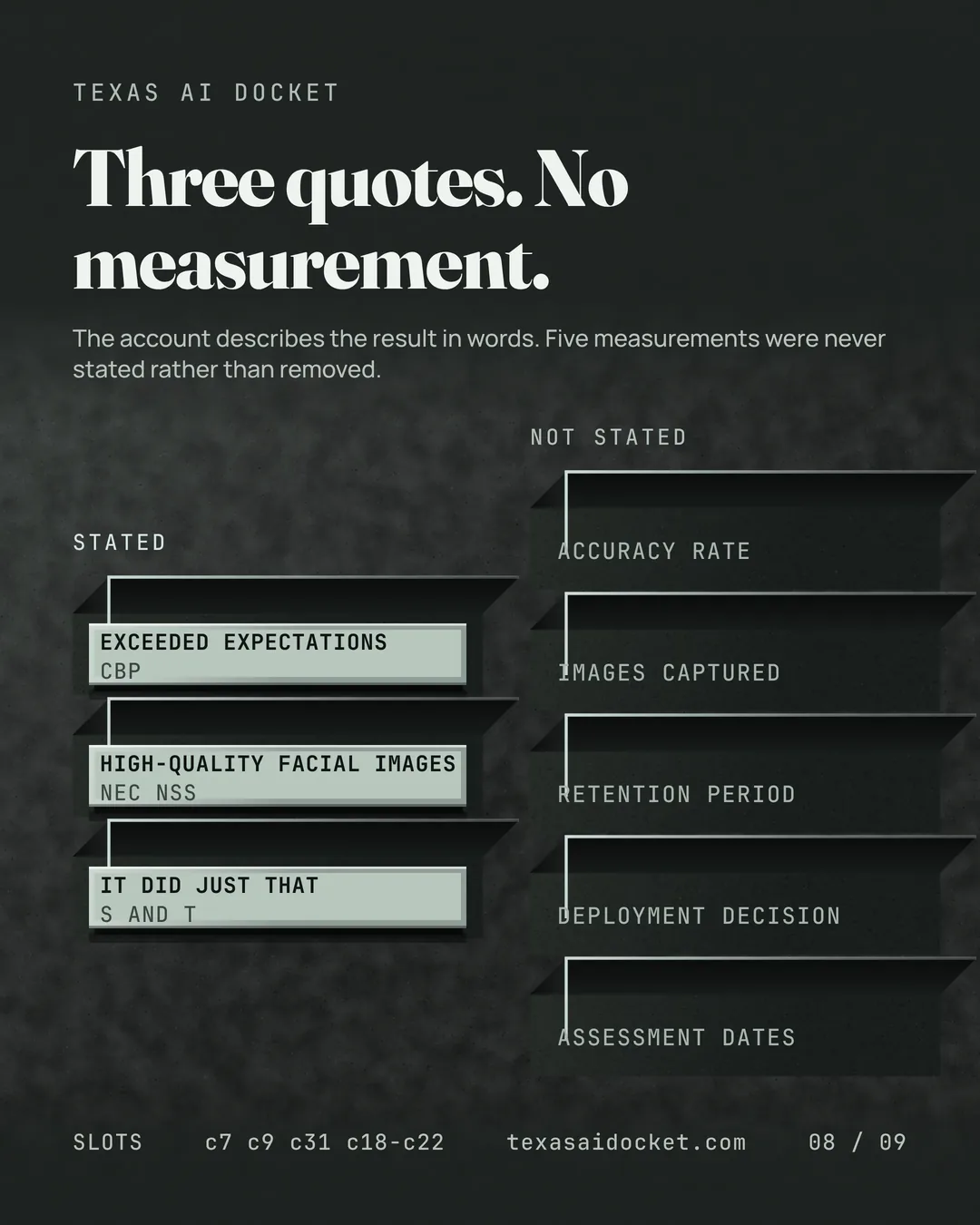
The account publishes no match rate, error rate or participant count. It also gives no image-retention or deletion timeline. Its praise therefore can't be translated into a measured reliability or privacy result.
No purchase or deployment decision is announced. The evidence establishes an assessment, not permanent adoption of a system at the crossing.
Sources for this story
Claim-by-claim verification · 32 claims
The account is published by the Science and Technology Directorate and describes work it carried out for U.S. Customs and Border Protection at the Progreso International Bridge crossing in Texas.
The Science and Technology Directorate (S&T) recently brought industry partners to the Progreso International Bridge border crossing in Texas to demonstrate facial biometric capabilities for U.S. Customs and Border Protection (CBP).
The work began with a CBP request to the directorate in October 2025 for solutions to confirm the departure of pedestrians leaving the United States using biometrics.
"In October 2025, CBP approached S&T with a request for solutions that could securely, efficiently, and accurately confirm the departure of pedestrians exiting the U.S. at border crossings using biometrics," said Arun Vemury, S&T Senior Advisor for Biometrics and Identity.
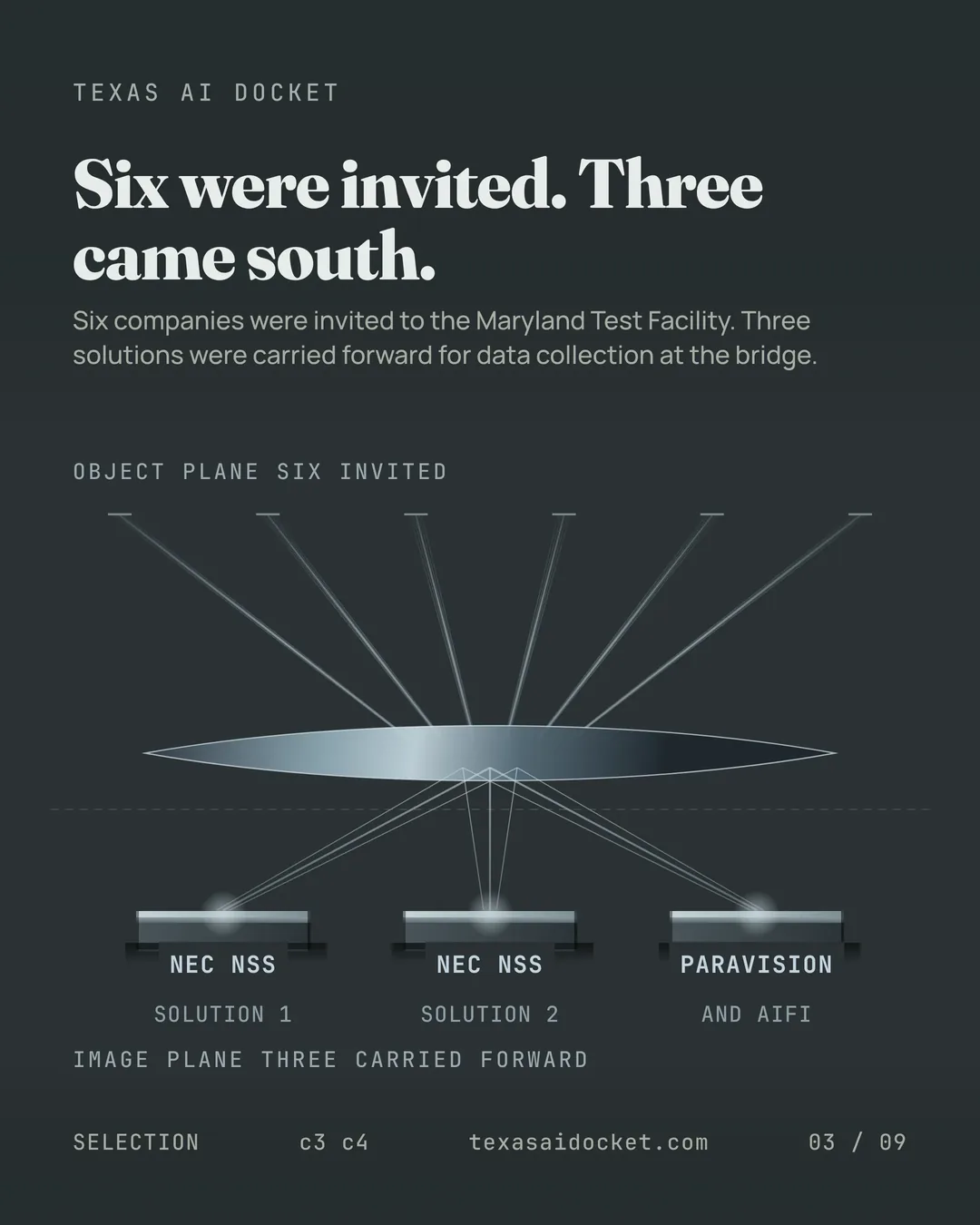
Six companies were invited to the Maryland Test Facility in early 2026 for capability demonstrations that decided which solutions would be tested operationally.
In early 2026, S&T invited six companies to the Maryland Test Facility (MdTF) for basic capability demonstrations to determine which solutions should be operationally tested.
CBP and the directorate selected three solutions for further data collection, two from NEC National Security Systems and one joint solution from Paravision and AiFi.
These demonstrations led CBP and S&T to select three solutions for additional data collection: two from NEC National Security Systems (NSS) and one joint solution from Paravision and AiFi.
The industry partners arrived at the Progreso International Bridge in May and set up for an operational assessment meant to support CBP's planning.
When the industry partners arrived at the Progreso International Bridge in May, they began setting up for the operational assessment that would support CBP's planning.
CBP's verdict on the assessment is delivered as an adjective by the director of its Biometrics Program Office.
"We were extremely impressed with the technology and the vendors that S&T brought down to Progreso on our behalf," said Larry Panetta, Director of CBP's Biometrics Program Office.
Larry Panetta, Director of CBP's Biometrics Program Office, says image capture exceeded expectations in daylight and after dark. It was verified twice. The sentence sits inside his quotation, opening directly after the attribution in c6's paragraph, and it appears nowhere else on the page. It is the nearest thing the account offers to a result.
The image capture capabilities of pedestrians walking through the border exit area exceeded expectations in both day and night conditions.
The pace from concept to operational data collection is characterised as a few months and called amazing.
The fact that this went from concept to operational data collection in just a few months is amazing.
NEC describes its own two products working outdoors in weather, in a statement from its president carried inside the government's account.
"We were able to demonstrate NEC's SmartID Express and Neoface Express in real-world outdoor conditions and weather, successfully capturing high-quality facial images of thousands of pedestrians a day," said Todd Morris, President of NEC NSS.
The director of the directorate's Biometric, Identity, and Advanced Computing Division frames the difficulty of the site in adjectives rather than in measurements.
"It is one thing for a technology to work in a lab like MdTF, but it is significantly more difficult when the tech is deployed operationally at the border. At Progreso, it had to work with limited infrastructure, in a challenging environment, and do it autonomously," said Dr. Cameron Whitelam, director of S&T's Biometric, Identity, and Advanced Computing Division.
Paravision describes the joint solution with AiFi as a seamless and contactless biometric experience.
Together, AiFi and Paravision enable a seamless, contactless biometric experience by understanding how people move through a space and helping ensure that only high-quality facial images are used for matching.
The only hard quantity in the account belongs to the crossing rather than to the technology, an annual figure for pedestrians exiting to Mexico given by the bridge director.
"Over 1.1 million pedestrians exit the U.S. to Mexico annually, and it is imperative to keep them safely moving," said Bridge Director Marga A. Lopez.
Signs in English and Spanish told pedestrians that United States citizens could opt out, on the stated ground that the mandate applies to travelers who are not citizens.
As pedestrians approached the border exits, signs in English and Spanish informed them that U.S. citizens could opt out of biometric exit collection if they did not wish to have their picture taken, since the biometric Entry/Exit mandate applies to non-U.S. citizen travelers.
A separate lane was provided for United States citizens who chose not to take part in the image collection testing.
U.S. citizens were provided an opt-out lane if they chose not to participate in the image collection testing.
The account names three things artificial intelligence was used to do. It built a digital model of the image capture zone, observed how pedestrians moved through it, and analyzed faces for whether they were suitable for matching. The account credits artificial intelligence and other technologies together and never separates them.
The partners leveraged artificial intelligence (AI) and other technologies to perform tasks such as constructing a 3D digital environment of the image capture zone, observing pedestrian movement, and analyzing facial images to determine whether they were suitable for biometric matching in CBP's Traveler Verification Service.
Testing was also run after dark with external lighting, because ports of entry operate around the clock.
Because ports of entry operate day and night, tests were also conducted after dark using external lighting configurations.
The described design has pedestrians walk past cameras for identity verification as they cross, without stopping.
With this new technology, pedestrians can walk past the cameras for identity verification as they cross the border.
The account publishes no accuracy rate, no match rate and no error rate for any of the three solutions. Accuracy appears once, as an adjective rather than a measurement.
This combination supports accurate biometric verification while allowing travelers to continue through the exit process naturally.
The account publishes no count of pedestrians encountered or images captured during the assessment. The nearest quantity is an unnumbered daily rate inside a vendor's own statement.
successfully capturing high-quality facial images of thousands of pedestrians a day
The account publishes no retention period, storage duration or deletion timeline for the facial images. The only thing it says about where images go is that they were judged for matching in a CBP service.
analyzing facial images to determine whether they were suitable for biometric matching in CBP's Traveler Verification Service
The account announces no decision to deploy, buy or adopt any of the three solutions. The nearest thing to a next step is a conditional phrase from CBP.
This technology could prove to be a force multiplier and allow CBP to maximize deployment of resources.
The account gives no day, no date range and no duration for the May assessment. The month is the whole of what it publishes.
When the industry partners arrived at the Progreso International Bridge in May
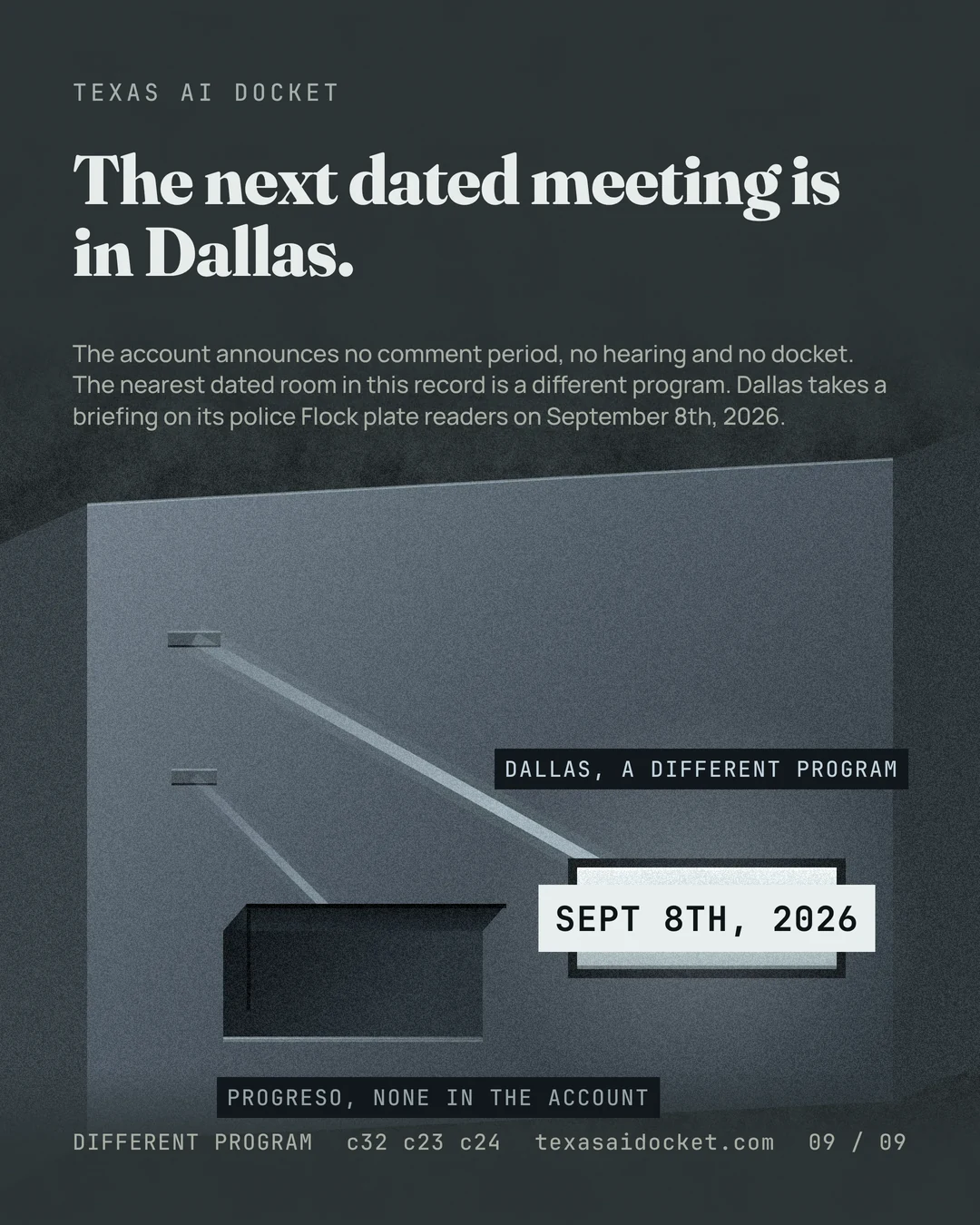
Dallas's nearest dated public room on automated recognition is a briefing item on the Flock automated license plate reader program.
Dallas Police Flock Automated License Plate Reader Program Update - September 2026
The item is set for the Public Safety Committee on September 8th, 2026 and was introduced on August 13th, 2026. It is typed as a briefing item with a status of agenda ready.
"MatterTypeName": "BRIEFING ITEMS", "MatterStatusId": 80, "MatterStatusName": "Agenda Ready", "MatterBodyId": 304, "MatterBodyName": "Public Safety Committee", "MatterIntroDate": "2026-08-13T00:00:00", "MatterAgendaDate": "2026-09-08T00:00:00"
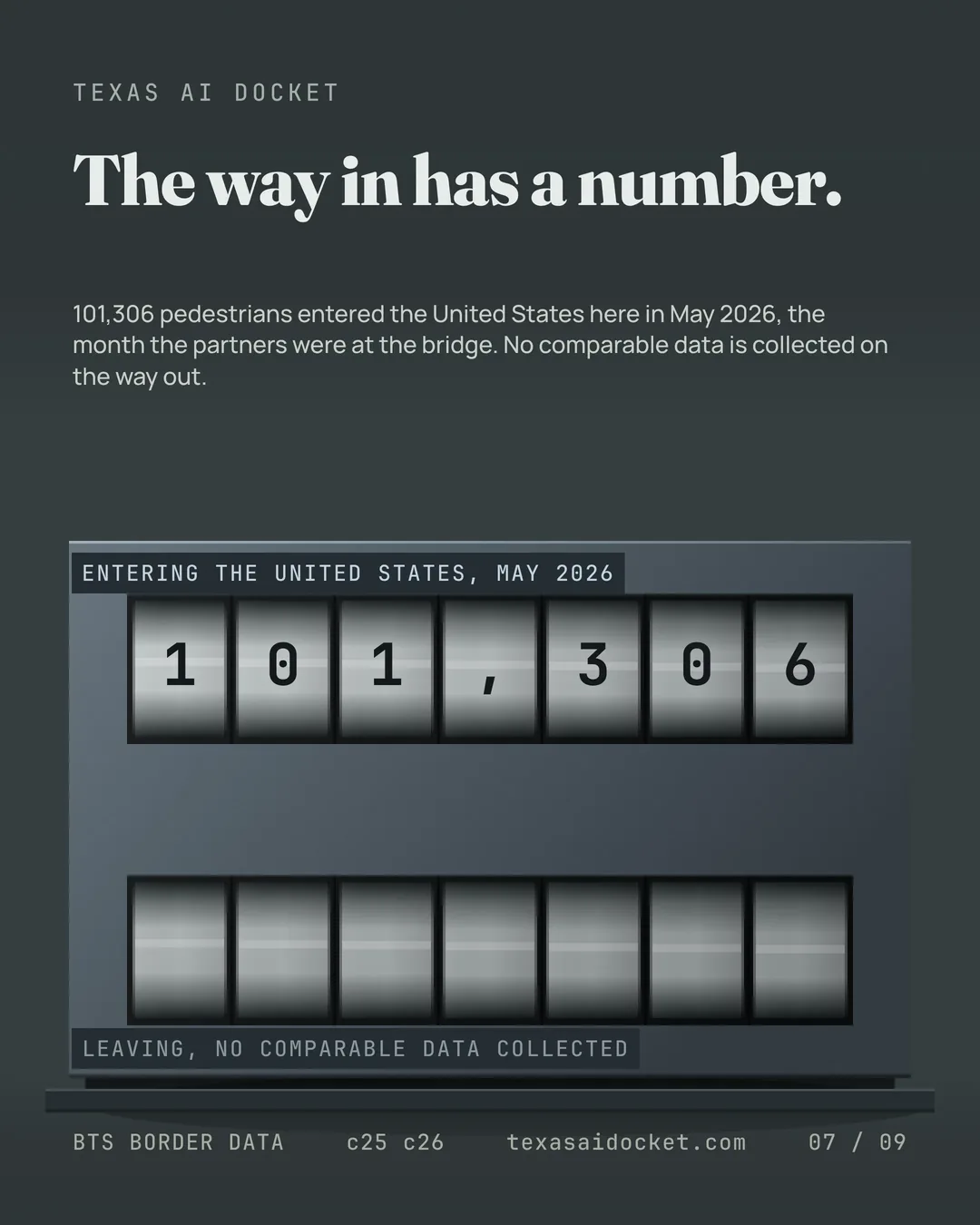
The federal border crossing series counts people entering the United States, and the agency that runs the ports states it collects no comparable data on the way out.
The data reflect the number of vehicles, passengers or pedestrians entering the United States. CBP does not collect comparable data on outbound crossings.
The published inbound pedestrian count at the Progreso port of entry for May 2026, the month the partners were at the bridge.
{"port_name":"Progreso","state":"Texas","port_code":"2309","border":"US-Mexico Border","date":"2026-05-01T00:00:00.000","measure":"Pedestrians","value":"101306"
The Census Bureau resolves the port of entry's own published coordinates to Hidalgo County.
"NAME": "Hidalgo County", "GEOID": "48215", "BASENAME": "Hidalgo"
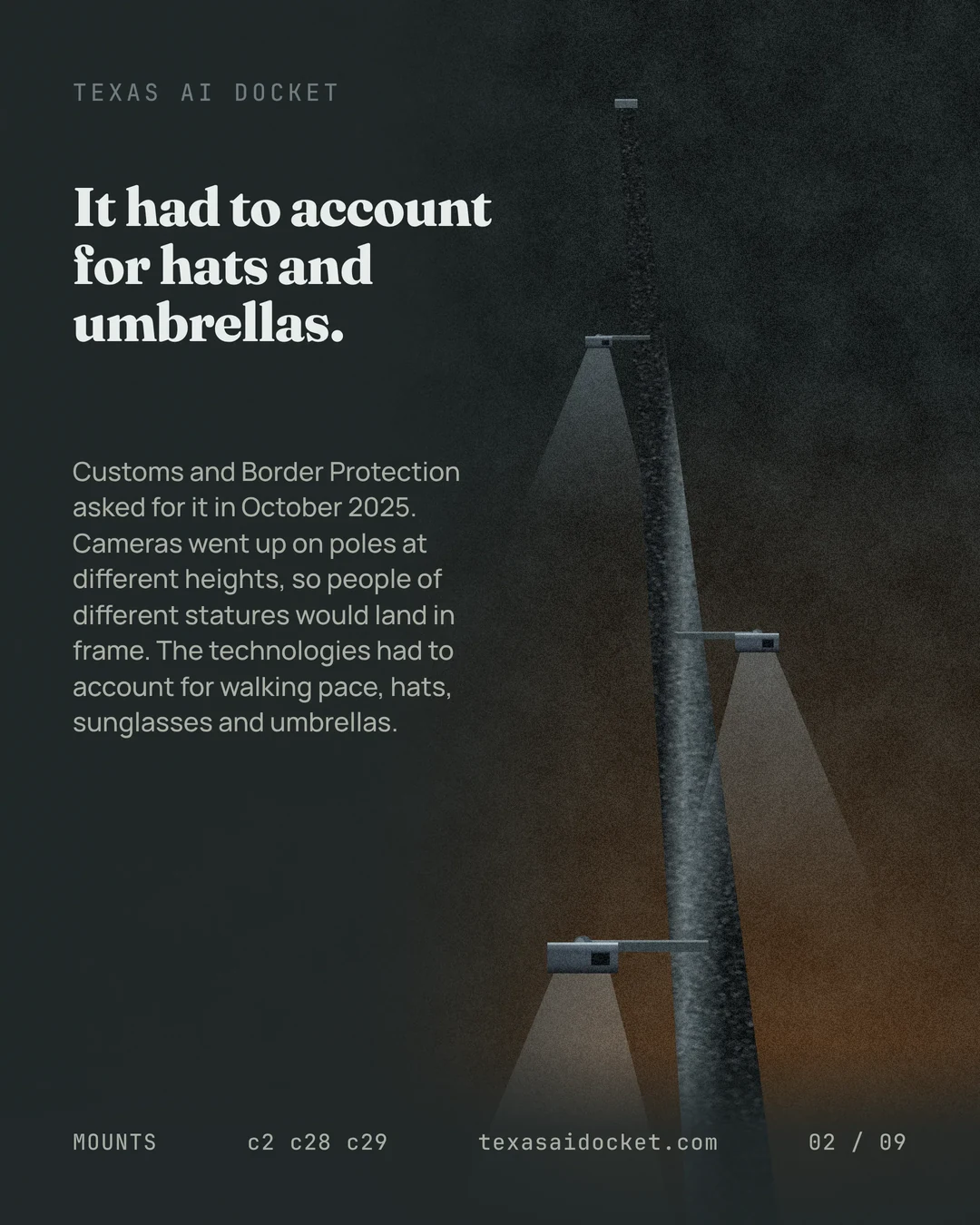
The partners installed their products in different configurations, with some cameras on poles at different heights so people of different statures would be captured.
The industry partners installed their products in various configurations. Some cameras were mounted on poles at different heights to account for individuals of different statures.
The technologies had to account for walking pace and for what pedestrians wear and carry.
For the testing to be successful, the technologies had to account for human factors such as travelers' walking pace, as well as hats, sunglasses, umbrellas and other items people use or carry.
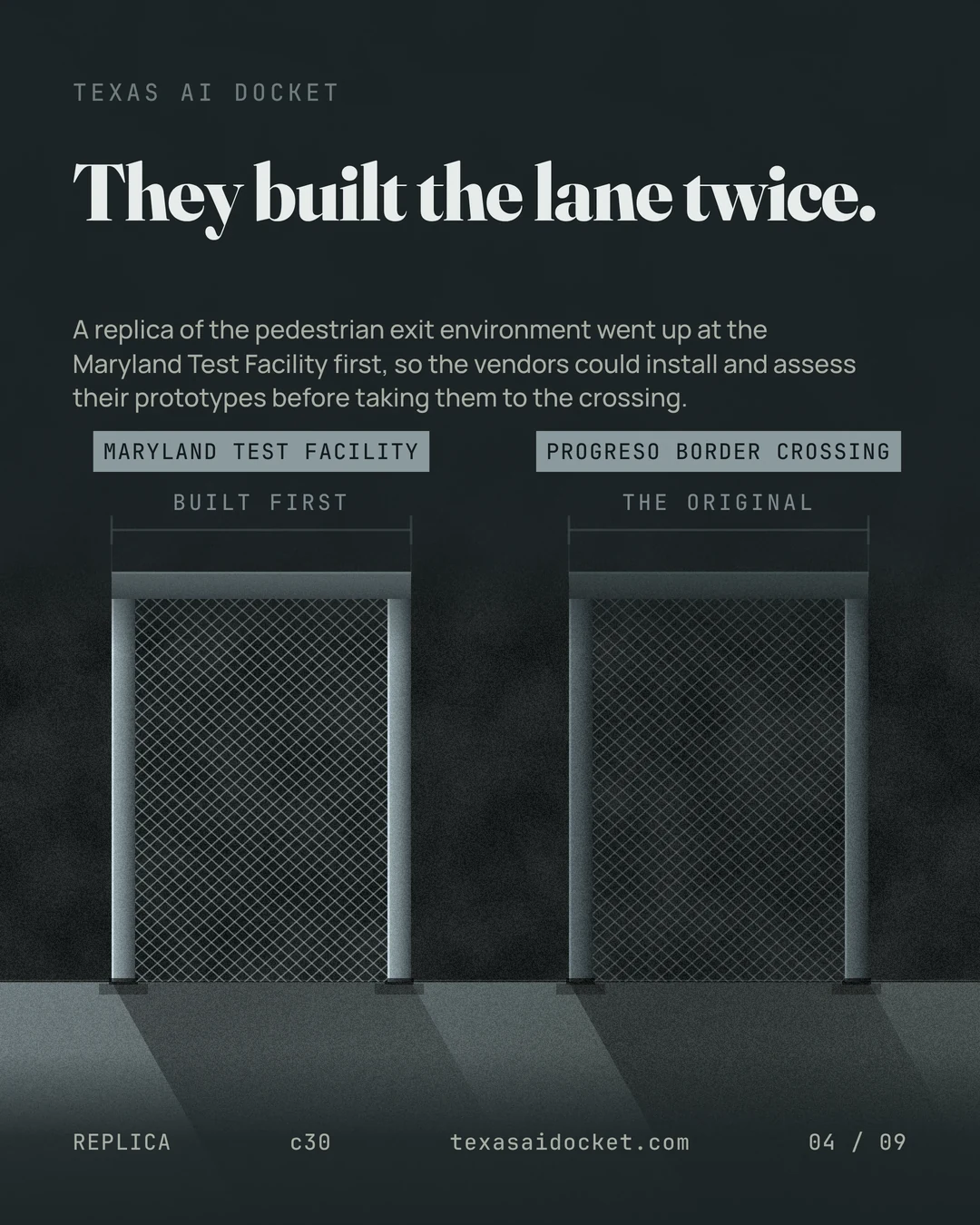
A replica of the pedestrian exit environment was built at the Maryland Test Facility so the vendors could install and assess their prototypes before going to the crossing.
Before deployment, S&T built a replica of the pedestrian exit environment at MdTF so vendors could install and assess their prototypes before taking them to the Progreso border crossing.
The division director's verdict on whether the technology worked at the crossing, the sentence that closes his quotation.
And it did just that.
The account announces no comment period, no hearing and no docket. The nearest thing it offers to a next step is an intention to work together again.
It was a pleasure working with S&T and we're looking forward to more collaborations with them in the near future.