Articles · Grid reliability
This room can move a generator.
ERCOT warns that rapid changes in AI training loads could fatigue generators. Its proposed limit on power swings was still a draft, distinct from reliability requirements already in force.
Read the story
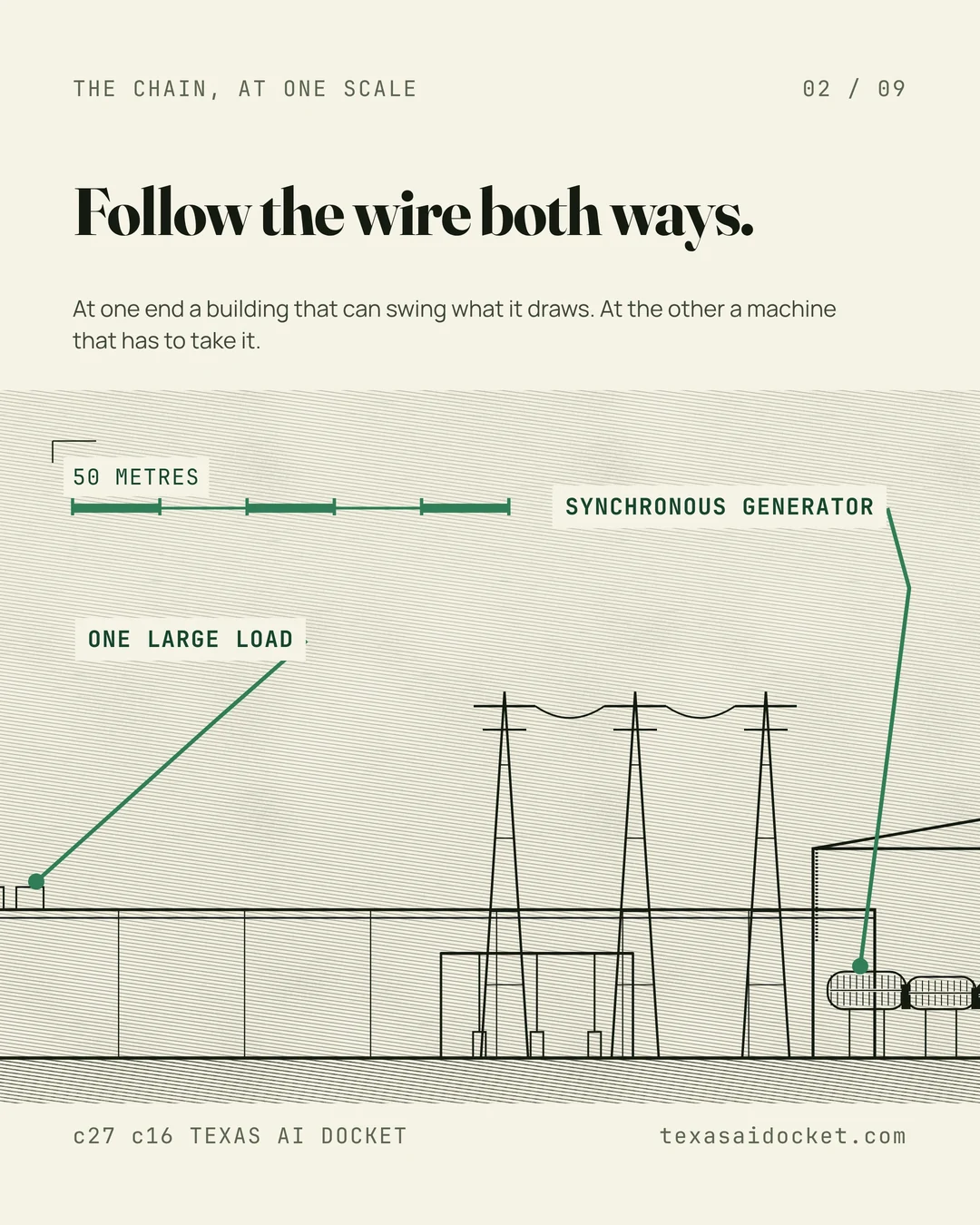





A data center can affect the grid through the speed of its changing demand, not just its maximum draw. ERCOT's board presentation warns that fluctuations associated with AI training can disturb generator shafts and potentially cause fatigue or damage.
The presentation identifies a risk, not a named Texas generator already damaged by a named data center. It supplies neither company's identity. Its proposed response was a draft operating-guide revision, not an adopted rule.
Different risks have different rule statuses
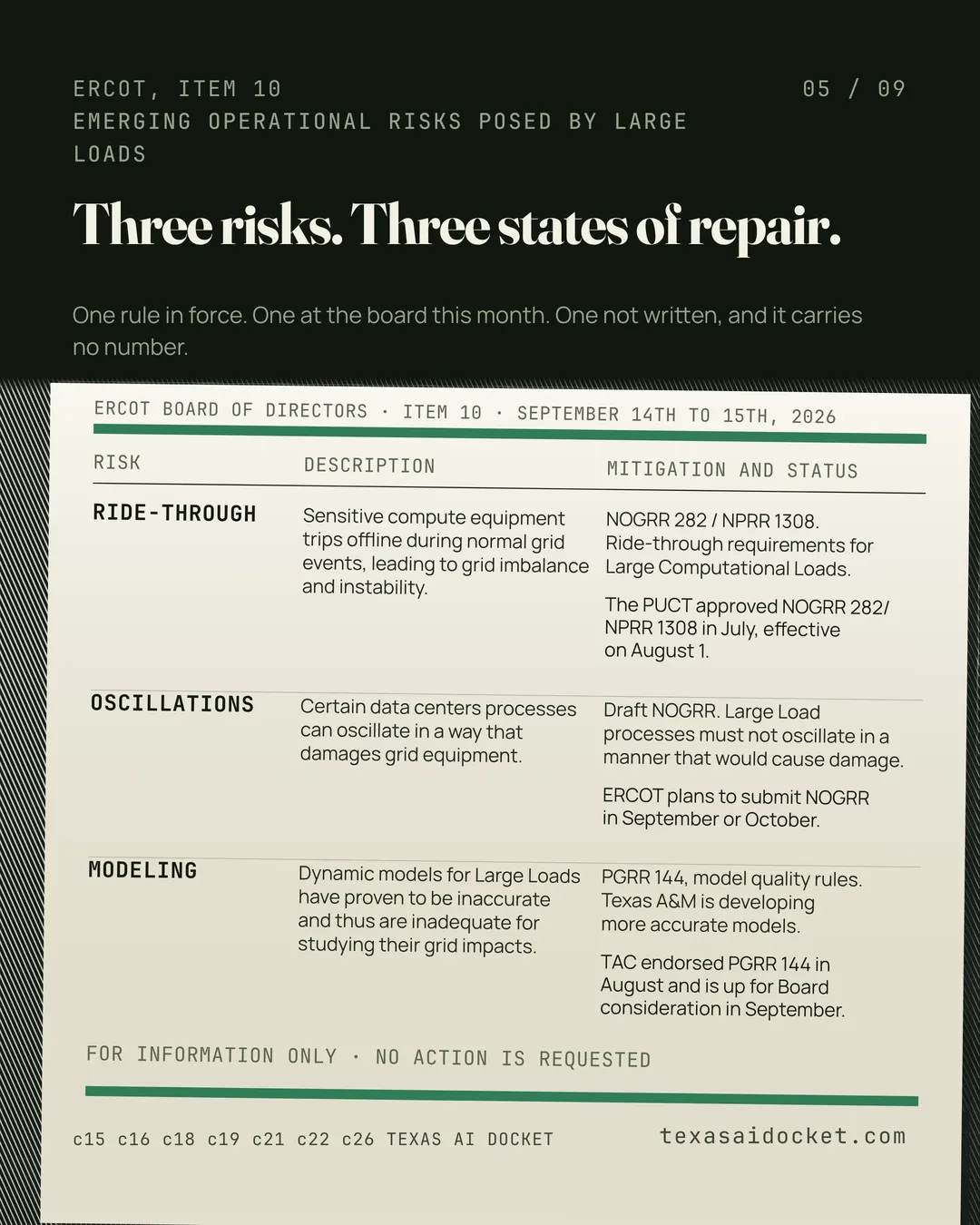
Ride-through requirements address equipment disconnecting during normal grid events. ERCOT described those requirements as already effective. The oscillation limit, by contrast, had not yet been filed and carried only a planned submission window.
The grid operator also identified inaccurate models as an obstacle to studying large-load impacts. It described work with Texas A&M and a separate model-quality revision headed for board consideration.
Models must describe the actual facility
The model-quality proposal calls for compatible data formats and quality tests. It also requires updated models before initial energization, documenting differences from earlier studies and attesting that the data reflect actual field settings.
A technical committee recommendation is part of that proposal's history. The revision record still marked it pending board consideration when checked. A recommendation should not be reported as the board's final approval.
The next decision is still ahead
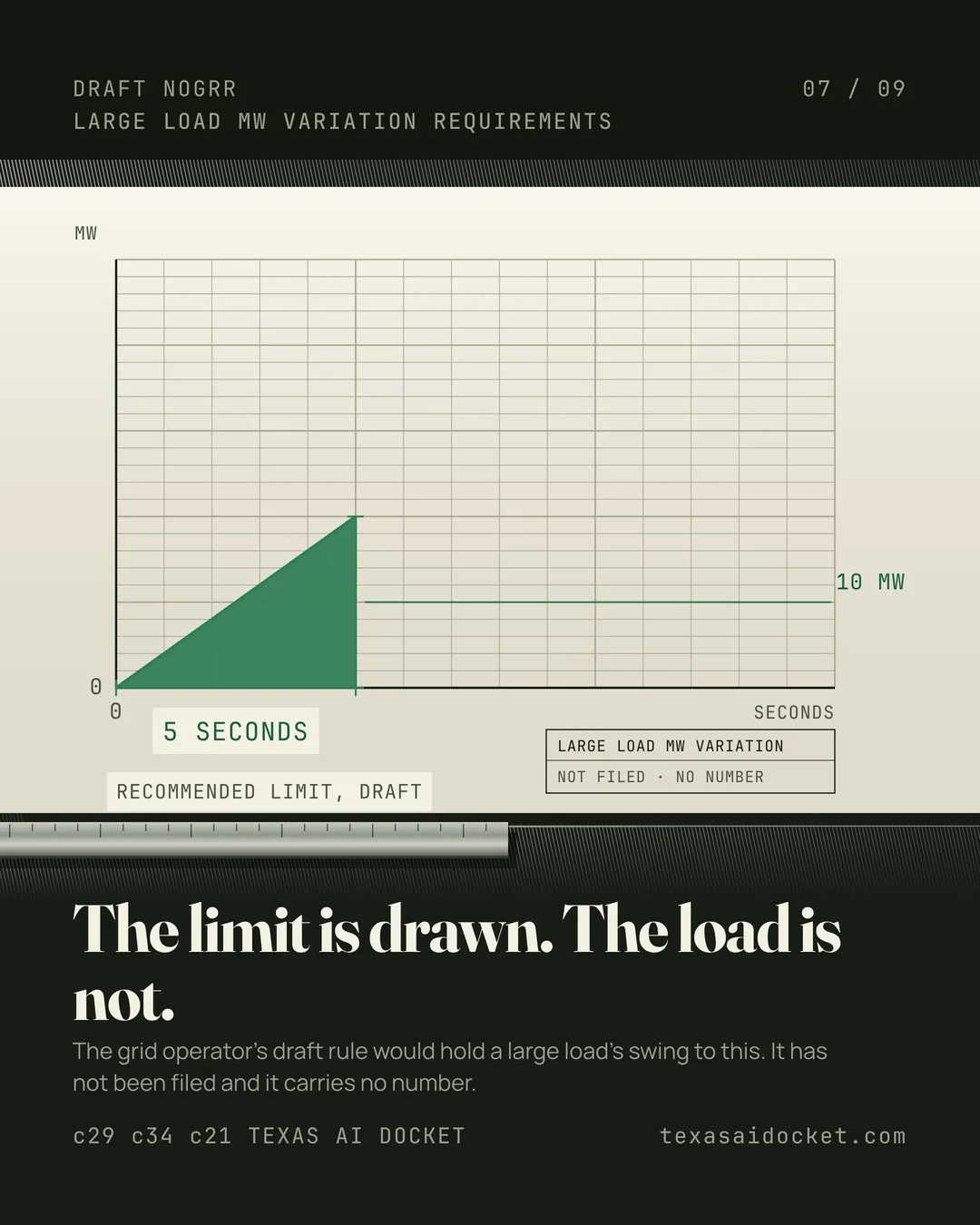
The draft would limit power variation to 10 megawatts per 5 seconds. The presentation asked the board for no action. Filing the proposal and recording subsequent approvals would establish its operative terms. Until then, the planned limit is not an enforceable rule.
Sources for this story
- ERCOT, Item 10: Interconnection and Grid Analysis Update, Board of Directors Meeting, September 14-15, 2026
- ERCOT Market Rules, PGRR144
Claim-by-claim verification · 44 claims
The presentation is Item 10, Interconnection and Grid Analysis Update, given by Jeff Billo, Vice President, Interconnection and Grid Analysis.
Item 10: Interconnection and Grid Analysis Update
The presentation was made to the ERCOT Board of Directors meeting of September 14th to 15th, 2026.
Board of Directors Meeting September 14-15, 2026
The presentation was for information only and asked the Board to take no action.
No action is requested; for discussion only.
ERCOT told the Board that Large Load interconnection information was in a separate presentation, Item 14, the Batch Zero Update.
Large Load interconnection information is provided in a separate presentation, Item 14: Batch Zero Update.
ERCOT told the Board that solar and battery still represent the majority of interconnection requests. It also told the Board that gas generation interconnection requests are up 23 percent, now 80 GW, since the June Board update.
Solar and Battery still represent the majority of interconnection requests, however, Gas generation interconnection requests are up 23% (now 80 GW) since the June Board update.
The queue slide states that gas generation interconnection requests are 80 GW, up from 65 GW in the June Update.
Gas generation interconnection requests are 80 GW, up from 65 GW in the June Update
The queue slide gives the totals by fuel type, and it excludes capacity associated with projects designated as inactive.
Totals: Solar 158 GW (34.6%), Wind 49 GW (10.7%), Gas 80 GW (17.6%), Battery 166 GW / 398 GWh (36.3%), Other 4 GW (0.9%)
The recent activity slide states that there were 26 new gas generation interconnection requests in the last 60 days.
26 new gas generation interconnection requests in the last 60 days
ERCOT's stated takeaway is that gas generation interconnection requests outnumbered other types over the last 60 days, while solar and battery requests remain strong.
Key Takeaway: Gas generation interconnection requests outnumbered other types over the last 60 days. Solar and battery requests remain strong.
ERCOT is targeting completion of the NOGRR 245 extension and exemption analysis in the fourth quarter of 2026.
ERCOT is targeting to complete NOGRR 245 extension/ exemption analysis in Q4 2026.
The presentation explains that NOGRR 245 set forth certain reliability requirements for inverter based resources. Resource entities could ask for extra time to meet them or for an exemption from them.
NOGRR 245 set forth certain reliability requirements for Inverter Based Resources (IBRs). • Resource Entities (REs) could submit requests for an extension of time to meet the requirements and/or an exemption from the requirements.
The NOGRR 245 slide states two different dates for the same submission statuses. The status block is headed as of August 24th, 2026 and the bullet list beneath it is headed as of May 14th, 2026.
Extension and/or Exemption Submission Status as of August 24, 2026
The statuses are pending determination, extension approved, denied and pending reliability assessment. The figures are 37 Resources and 3,001 MW, 93 Resources and 11,049 MW, 25 Resources and 2,688 MW, and 116 Resources and 13,305 MW.
Pending Determination Extension Approved Denied Pending Reliability Assessment 37 Resources 3,001 MW 93 Resources 11,049 MW 25 Resources 2,688 MW 116 Resources 13,305 MW
ERCOT states that it denied extension or exemption requests for 25 inverter based resources, primarily due to deficient dynamic model data. It granted extension requests for 93 and has a reliability assessment underway for 116.
• ERCOT has denied extension and/or exemption requests for 25 IBRs, primarily due to deficient dynamic model data. • ERCOT has granted extension requests for 93 IBRs. • The Reliability Assessment to determine the impact of an RE’s exemption request is underway for 116 IBRs.
ERCOT told the Board it is pursuing targeted mitigations for addressing emerging risks posed by Large Loads.
Key Takeaway: ERCOT is pursuing targeted mitigations for addressing emerging risks posed by Large Loads.
The first risk on ERCOT's table is ride-through. ERCOT describes it as sensitive compute equipment tripping offline during normal grid events, which leads to grid imbalance and instability.
Sensitive compute equipment trips offline during normal grid events, leading to grid imbalance and instability.
The mitigation ERCOT names for the ride-through risk is NOGRR 282 and NPRR 1308, which implement ride-through requirements for Large Computational Loads.
NOGRR 282/ NPRR 1308: Implement ride-through requirements for Large Computational Loads.
ERCOT records the ride-through mitigation as already in force. The utility commission approved NOGRR 282 and NPRR 1308 in July, effective on August 1st.
The PUCT approved NOGRR 282/ NPRR 1308 in July, effective on August 1.
The second risk on ERCOT's table is oscillations. ERCOT's description is that certain data center processes can oscillate in a way that damages grid equipment.
Certain data centers processes can oscillate in a way that damages grid equipment.
The mitigation ERCOT names for the oscillations risk is a draft NOGRR that ensures Large Load processes do not oscillate in a manner that would cause grid damage.
Draft NOGRR: Ensures Large Load processes do not oscillate in a manner that would cause grid damage. [More details on next slide.]
ERCOT records the oscillations mitigation as not yet filed. It plans to submit the NOGRR in September or October, and that submission window is the only timing the presentation gives for this risk.
ERCOT plans to submit NOGRR in September or October.
The third risk on ERCOT's table is modeling. ERCOT states that dynamic models for Large Loads have proven to be inaccurate and are therefore inadequate for studying their grid impacts.
Dynamic models for Large Loads have proven to be inaccurate and thus are inadequate for studying their grid impacts.
ERCOT states that it is working with Texas A&M University on developing more accurate models.
ERCOT is working with Texas A&M University on developing more accurate models.
The second mitigation ERCOT names in the modeling row is PGRR 144, which introduces model quality requirements for Large Loads.
PGRR 144: Introduces model quality requirements for Large Loads.
ERCOT states that Texas A&M has released a new model for crypto mining facilities and is working on a data center model.
Texas A&M has released a new model for crypto mining facilities and is working on a data center model.
ERCOT records the modeling mitigation as at the Board this month. TAC endorsed PGRR 144 in August and it is up for Board consideration in September.
TAC endorsed PGRR 144 in August and is up for Board consideration in September.
ERCOT states that Large Loads, particularly those associated with data center AI training processes, can produce rapid fluctuations in active power consumption. It states that those variations can induce perturbations on synchronous generator shafts and potentially result in equipment fatigue or damage.
Large Loads, particularly those associated with data center AI training processes, are capable of producing rapid fluctuations in active power consumption. These variations can induce perturbations on synchronous generator shafts and potentially result in equipment fatigue or damage.
ERCOT states that several industry events and actual load profiles have highlighted the concern. It states that since July 2025 it has collaborated with industry experts and engaged stakeholders to investigate these risks.
Several industry events and actual load profiles have highlighted this concern. Since July 2025, ERCOT collaborated with industry experts and engaged stakeholders to investigate these risks.
ERCOT states that its draft NOGRR, named Large Load MW Variation Requirements, will recommend a limit of 10 MW per 5 seconds for power variation in Large Loads. It states the proposal aims to manage reliability risks while facilitating Resource and Large Load interconnections.
Consequently, ERCOT’s draft NOGRR, Large Load MW Variation Requirements, will recommend a limit of 10 MW per 5 seconds for power variation in Large Loads. This proposal aims to manage reliability risks while facilitating Resource and Large Load interconnections.
ERCOT's stated takeaway is that it plans to propose a NOGRR. Its purpose is to lower the risk of fatigue or damage to synchronous generators that may be caused by Large Load power fluctuations.
Key Takeaway: ERCOT plans to propose a NOGRR to lower the risk of fatigue or damage to synchronous generators that may be caused by Large Load power fluctuations.
ERCOT states that continuous monitoring and enhanced situational awareness are also essential, and that additional NOGRRs may be submitted to strengthen monitoring requirements.
Continuous monitoring and enhanced situational awareness are also essential. Additional NOGRRs may be submitted to strengthen monitoring requirements.
The chart on the final slide is credited to a paper on the arxiv preprint server.
Source: https://arxiv.org/abs/2508.14318
The chart on the final slide is captioned as showing an actual data center in ERCOT, and the presentation names that data center nowhere. It names no company and no generator anywhere in its six pages.
An actual data center in ERCOT
The slide describing the draft rule heads it Draft NOGRR, and the presentation identifies that rule by its name rather than by a number anywhere in the document.
Draft NOGRR: Large Load MW Variation Challenges
The presentation states the equipment fatigue or damage as something the power variations can potentially cause, and never as something that has happened on the ERCOT system. What it points to instead is several industry events and actual load profiles that highlighted the concern.
Several industry events and actual load profiles have highlighted this concern.
PGRR 144 is titled Dynamic Model Submission and Review Requirements for Large Loads including Large Computational Loads.
Title Dynamic Model Submission and Review Requirements for Large Loads including Large Computational Loads
The revision request's status is pending, its next group is the Board, and its next step is Board for consideration.
Next Group BOARD Next Step Board for consideration Status Pending
The revision request was posted on February 18th, 2026, its sponsor is ERCOT and it is not marked urgent. It addresses Planning Guide sections 6.2, 9.2.1, a new 9.2.1.5 and 9.6.
Date Posted: Feb 18, 2026
The Technical Advisory Committee voted on August 26th, 2026 to recommend approval of PGRR144. The recommendation is the one the Reliability and Operations Subcommittee made in its August 6th report, and the motion passed.
08/26/2026 TAC To recommend approval of PGRR144 as recommended by ROS in the 8/6/26 ROS Report Passed
The revision request states that it clarifies requirements for submitting dynamic model data for Large Loads to ensure accurate representation of each Large Load in ERCOT's models.
This Planning Guide Revision Request (PGRR) clarifies requirements for submitting dynamic model data for Large Loads to ensure accurate representation of each Large Load in ERCOT's models.
The revision request requires dynamic model data to be submitted in formats compatible with the software platforms described in the Dynamics Working Group Procedure Manual. It names those platforms as PSS/E, PSCAD and TSAT.
The PGRR requires submission of this data using formats compatible with the software platforms described in the Dynamics Working Group Procedure Manual (i.e., PSS/E, PSCAD, and TSAT).
The revision request requires model quality tests demonstrating voltage ride-through capability for all Large Loads. It also requires converter model validation reports benchmarking PSCAD models against actual hardware tests for all Large Computational Loads.
This PGRR also requires model quality tests demonstrating voltage ride-through capability for all Large Loads and converter model validation reports benchmarking PSCAD models against actual hardware tests for all Large Computational Loads (LCLs), ensuring high-quality and accurate models.
The revision request requires the interconnecting entity to submit updated dynamic models for the as-built facility before requesting initial energization. Those models carry documentation of any differences from the model data used in the quarterly stability assessment, and an attestation that the as-built data reflect the actual field settings.
Finally, the PGRR requires the ILLE to submit updated dynamic models for the "as-built" LCL facility prior to requesting Initial Energization along with documentation identifying any differences from previously submitted model data used in the ERCOT quarterly stability assessment ("QSA") and an attestation that the as-built data reflect the actual field settings.
The revision request was tabled on March 5th, 2026 and referred to the Dynamics Working Group and the Planning Working Group. The Reliability and Operations Subcommittee then recommended approval on July 9th, 2026 and endorsed it to the Technical Advisory Committee on August 6th, 2026.
03/05/2026 ROS To table PGRR144 and refer the issue to the Dynamics Working Group (DWG) and the Planning Working Group (PLWG) Passed