Articles · Education and public safety
It was built to not tell you.
UT Arlington is developing an AI tutor designed to prompt reasoning instead of supply answers. Related police training has separate funding, and reported capabilities are not yet outcome measurements.
Read the story

![Two agencies pay for this. The release names the National Science Foundation up top. The Department of Justice is a footnote. Deb has already begun testing the system with the Fort Worth Police Department*, helping to develop training using real-life scenarios with prompts based on the principles of de-escalation. The AI can tell when an officer is being kind and listening, when the officer picks up on something the person wants to talk about and follows that conversation, and when the officer doesn't connect with the person. Then, the AI steers the interaction accordingly, giving officers perspective and practice in an environment where they can learn the skills they need for those high-pressure interactions. *This work is sponsored by the Fort Worth Police Department and funded by the U.S. Department of Justice under Grant No. 15PBJA-23-GG-06172-NTCP "fundsObligated":["FY 2026 = $749,999.00"] award 2539663 National Science Foundation](../../media/articles/2026-09-16/slide-07-1080-edb6403b26c2.webp)
UT Arlington's planned AI tutor is built around withholding the answer. The federal project abstract describes structured reasoning conversations, personalized feedback and revision intended to help engineering students work through a problem.
The university also describes testing related technology with Fort Worth police on de-escalation scenarios. The shared account connects the methods, but its footnote identifies separate Justice Department funding for the police work.
A tutor inside the homework
Instructors would continue teaching the courses. The AI tutor would be integrated into assignments, offering instructions and hints within simulated workplace settings. Students would receive performance analysis and opportunities to revise their work.
The federal abstract describes language models grounded in course material and an assessment process requiring students to critique AI-generated drafts. The stated educational objective is reasoning, not simply faster assignment completion.
Police testing is not a measured result
The university release says the police system can recognize listening and other conversational behavior, then steer the interaction. Those are descriptions of intended or reported capabilities. They do not supply an independent measure of better field outcomes.
Keep the projects and dates distinct
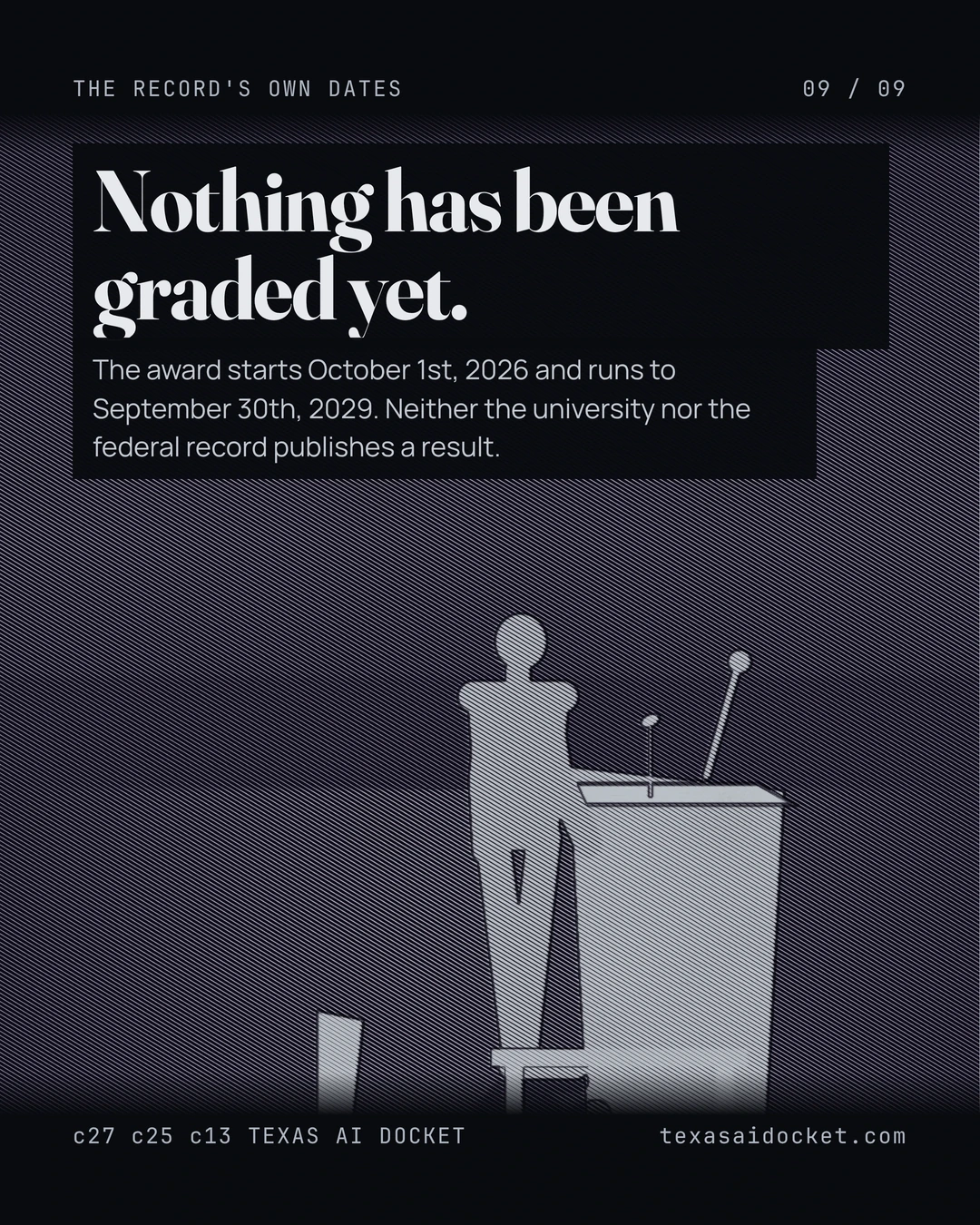
The engineering education award's start date follows the university's announcement. Police testing had already begun under its separate funding. Neither timing establishes that the federal education project had already completed the learning outcomes it proposes to study.
Sources for this story
- The University of Texas at Arlington, UTA develops AI tutor that teaches, not tells
- National Science Foundation Award Search API, award 2539663
Claim-by-claim verification · 35 claims
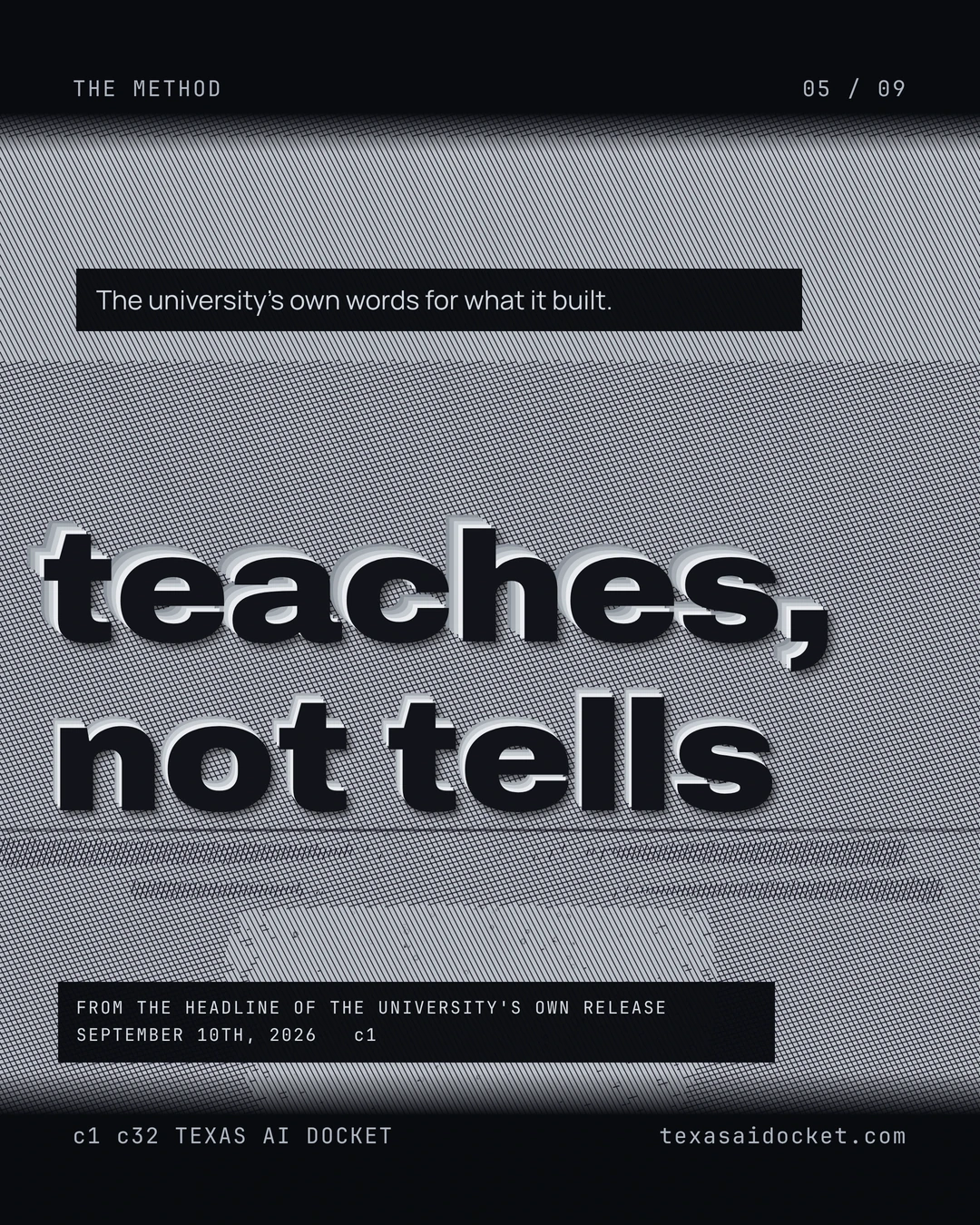
The university published the account under the headline UTA develops AI tutor that teaches, not tells.
UTA develops AI tutor that teaches, not tells
The release's own summary line says the project is funded by the National Science Foundation and that the technology is also being tested with Fort Worth police.
NSF-funded project guides student learning; technology is also being tested with Fort Worth police
The release is dated September 10th, 2026 and carries Brian Lopez as its media contact byline.
Thursday, Sep 10, 2026 • Brian Lopez
The release states the researchers are using a $750,000 National Science Foundation grant to create an AI conversational tutor that guides students through situational assignments.
are using a $750,000 National Science Foundation grant to create an AI conversational tutor to guide students through situational assignments
The release names the researcher as Shuchi Deb and as Dr. Deb, an associate professor in the university's Department of Industrial, Manufacturing and Systems Engineering.
Dr. Deb, associate professor in The University of Texas at Arlington
The release names one collaborator outside her department, Mohammad Islam, an associate professor in the Department of Computer Science and Engineering.
Mohammad Islam, associate professor in the Department of Computer Science and Engineering
The release states that testing with the Fort Worth Police Department has already begun, on training that uses real life scenarios with prompts based on the principles of de-escalation.
Deb has already begun testing the system with the Fort Worth Police Department*, helping to develop training using real-life scenarios with prompts based on the principles of de-escalation.
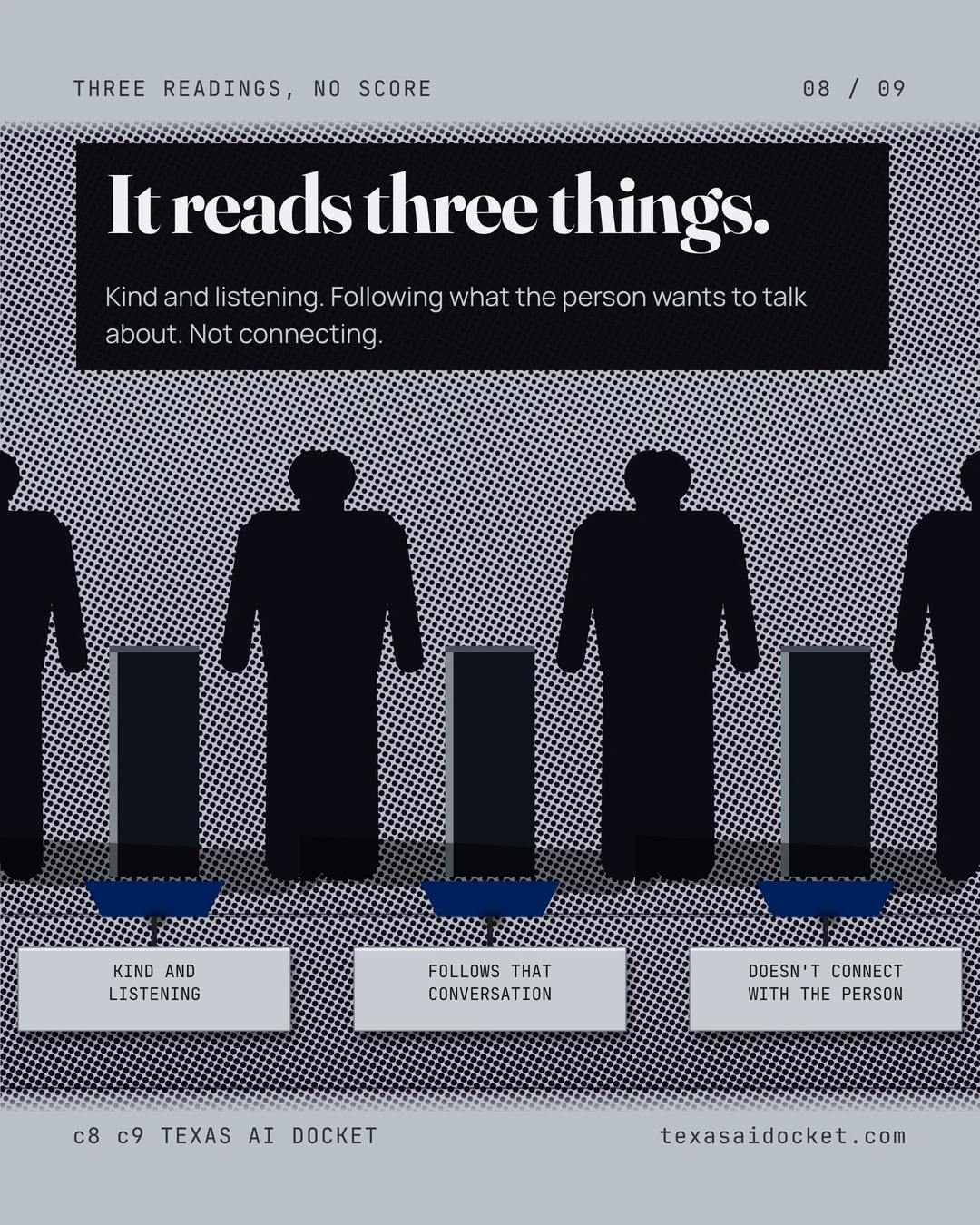
The release states the system can tell when an officer is being kind and listening. It also reads when the officer follows what the person wants to talk about, and when the officer fails to connect.
The AI can tell when an officer is being kind and listening, when the officer picks up on something the person wants to talk about and follows that conversation, and when the officer doesn't connect with the person.
The release states the system then steers the interaction, to give officers perspective and practice in an environment where they can learn the skills they need for high pressure interactions.
Then, the AI steers the interaction accordingly, giving officers perspective and practice in an environment where they can learn the skills they need for those high-pressure interactions.
The release states the tutor will not provide answers. It will instead prompt students with questions so they discover the answers on their own, in the way a classroom teacher helps a student at a desk.
her AI tutor will not provide answers. Instead, it will interact with students and prompt them with questions to help them discover the answers on their own, much like a classroom teacher helping a student at their desk.
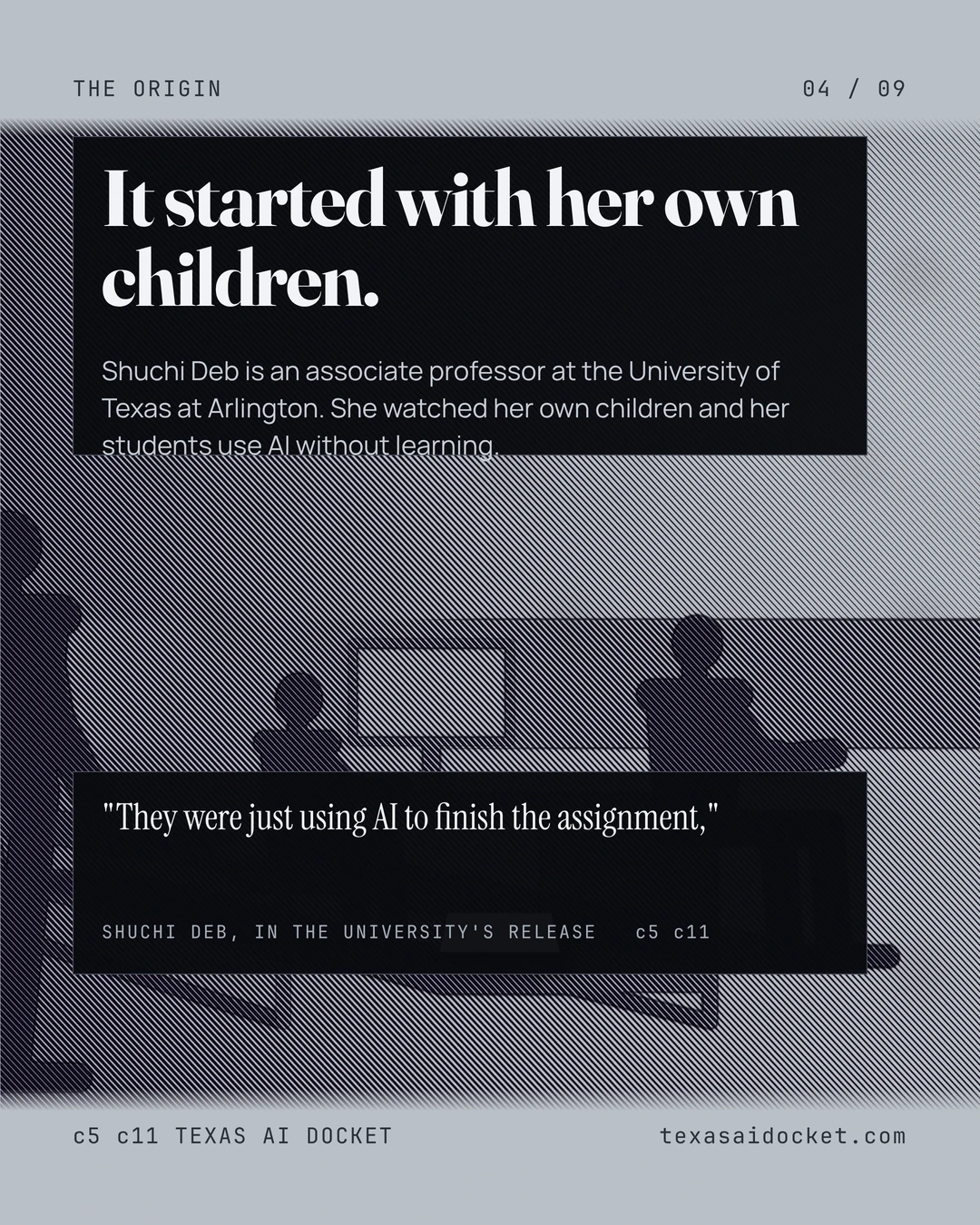
Deb is quoted saying she watched her children and her students use AI without learning, and that they were using it to finish the assignment.
I saw my children and my students using AI, and I could see that they were not learning. They were just using AI to finish the assignment,
Deb is quoted saying that engineering students who do not learn basic skills are likely to make mistakes that could be costly or in some cases cost people their lives.
they are likely to make mistakes that could be costly or, in some cases, cost people their lives.
The release states the courses will be taught traditionally by the instructor, and that the AI tutor is integrated into the homework assignments rather than the teaching.
The courses will be taught traditionally, with the instructor teaching skills and concepts, while the homework assignments will integrate the AI tutor.
The release states the tutor will combine two dimensional and virtual reality platforms, walking students through a workplace or industrial setting where they must work with others to prioritize tasks.
It will combine two-dimensional and virtual reality platforms to walk students through a workplace or industrial setting where they must work with others to prioritize tasks and complete the assignment.
The release states the AI will provide instructions for each step and will offer hints if students make a mistake.
The AI will provide instructions for each step and will offer hints if students make a mistake.
The release states the tutor returns a completed document with a performance analysis that students can use to revise their work. That happens only within the same platform, so they can't use a separate AI to find answers.
At the end, it will provide a completed document with a performance analysis that students can use to revise their work, but only within the same platform so they cannot use a separate AI to find answers.
The release states the project aims to strengthen students technical skills, build their capacity for ethical AI engagement and prepare them for an AI enabled workforce.
build their capacity for ethical AI engagement and prepare them for an AI-enabled workforce
Deb is quoted saying AI has limitations and that students need an actual understanding of the skills and concepts they will use in their careers.
AI has limitations, and we want students to understand how to use it, but they also need to gain an actual understanding of the skills and concepts that they will use in their careers,
A footnote on the release states the police work is sponsored by the Fort Worth Police Department and funded by the United States Department of Justice under Grant No. 15PBJA-23-GG-06172-NTCP.
This work is sponsored by the Fort Worth Police Department and funded by the U.S. Department of Justice under Grant No. 15PBJA-23-GG-06172-NTCP
The same footnote names three Fort Worth Police Department people on the work. They are a grant writer and point of contact, a project manager, and an instructor who designed the training contents.
(Angela Love, grant writer and point of contact; Sergeant Nathan Owens, project manager; Officer Jorge Lopez, instructor and designer of training contents)
The university describes itself as a public research university in the heart of Dallas-Fort Worth.
The University of Texas at Arlington is a growing public research university in the heart of Dallas-Fort Worth.
The federal award record titles the grant Context-Aware Conversational Tutors for Longitudinal Learning in Engineering Education and records it as a standard grant.
"title":"Context-Aware Conversational Tutors for Longitudinal Learning in Engineering Education","transType":"Standard Grant"
The federal award record names the awardee as University of Texas at Arlington, in Arlington, Texas.
"awardeeName":"University of Texas at Arlington"
The federal award record gives the funds obligated as FY 2026 = $749,999.00 and the funds obligated amount as 749999.
"fundsObligated":["FY 2026 = $749,999.00"]
The federal award record gives the estimated total amount as 749999 and the expiration date as 09/30/2029.
"estimatedTotalAmt":"749999"
The federal award record dates the award 07/29/2026 and has not been amended since.
"date":"07/29/2026","dirAbbr":"EDU","divAbbr":"DUE"
The federal award record gives a start date of 10/01/2026, which falls after the date the university published its account of the project.
"startDate":"10/01/2026","title":"Context-Aware Conversational Tutors
The federal award record names the principal investigator as Shuchisnigdha Deb, where the university release calls her Shuchi Deb.
"piFirstName":"Shuchisnigdha"
The federal award record lists four co-principal investigators, Bonnie S Boardman, Susan Ferreira, Mohammad A Islam and Maysaa Hamdan.
"coPDPI":["Bonnie S Boardman
The federal award record gives the funding program as IUSE, inside the Directorate for STEM Education.
"fundProgramName":"IUSE","fundsObligated":["FY 2026 = $749,999.00"]
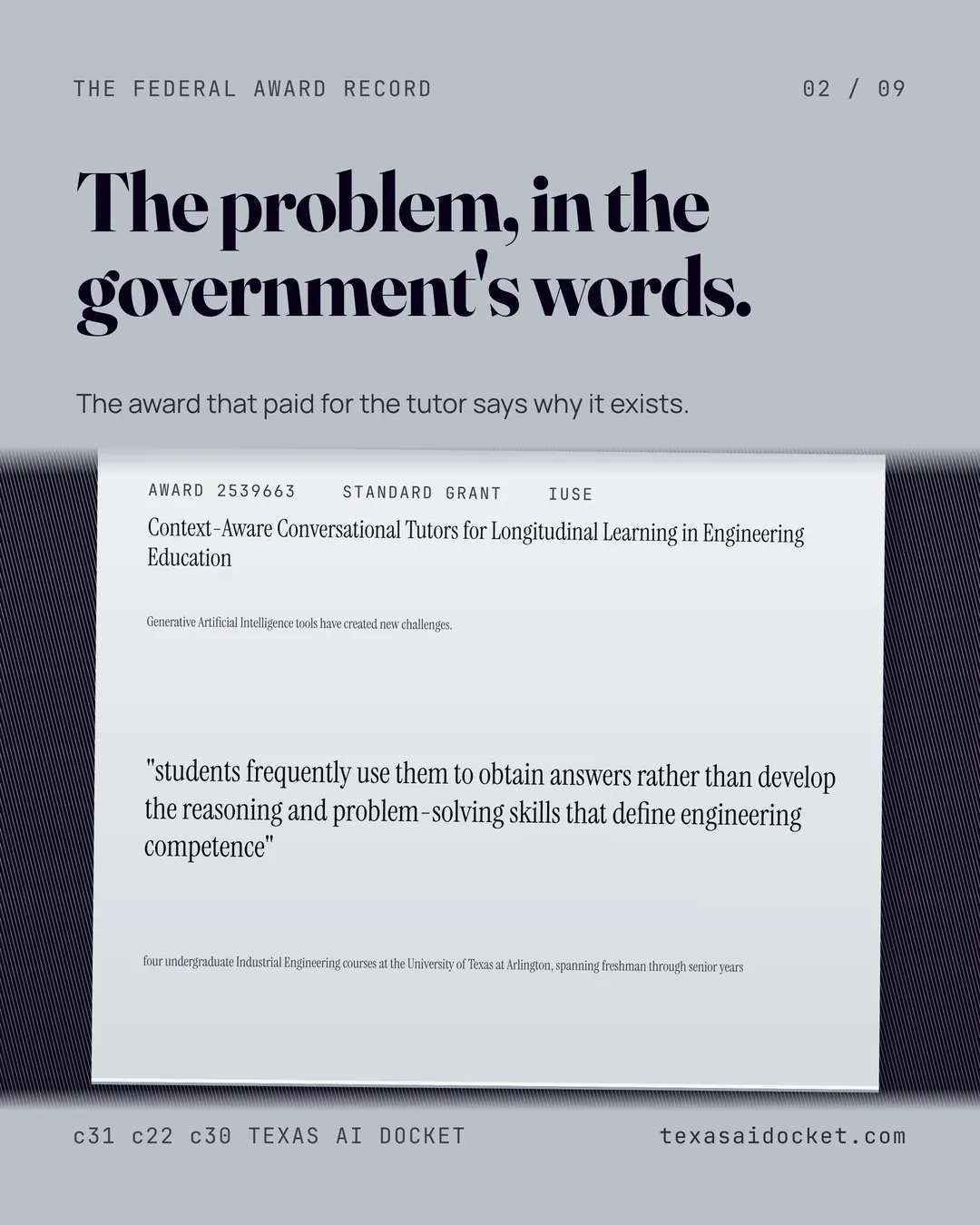
The federal abstract states that generative AI tools created a new challenge. It is that students frequently use them to obtain answers rather than develop the reasoning and problem solving skills that define engineering competence.
students frequently use them to obtain answers rather than develop the reasoning and problem-solving skills that define engineering competence
The federal abstract states that rather than providing answers, the AI tutor will guide students through structured reasoning conversations with personalized feedback and revision opportunities that mirror expert mentorship.
Rather than providing answers, the AI tutor will guide students through structured reasoning conversations, offering personalized feedback and revision opportunities that mirror expert mentorship.
The federal abstract states the platform will run across four undergraduate Industrial Engineering courses at the University of Texas at Arlington, spanning freshman through senior years.
four undergraduate Industrial Engineering courses at the University of Texas at Arlington, spanning freshman through senior years
The federal abstract states the tutors are built on large language models and are placed within immersive environments across five levels of Bloom's Revised Taxonomy.
within immersive environments across five levels of Bloom's Revised Taxonomy, creating a longitudinal, multi-course AI tutoring intervention
The federal abstract states the system will employ retrieval-augmented generation for course specific responses, and that a dual-phase assessment model will require students to critically revise AI-generated drafts.
The system will employ retrieval-augmented generation to produce course-specific and assignment-aligned responses, while a dual-phase assessment model will require students to critically revise AI-generated drafts, thereby reinforcing metacognition.