Articles · Land, water and permitting
Aimed at small systems. Texas has 4,749.
A federal award aims predictive digital twins at small and mid-sized water systems. Texas has 4,749 active community water systems and 3,579 of them serve fewer than 3,301 people.
Read the story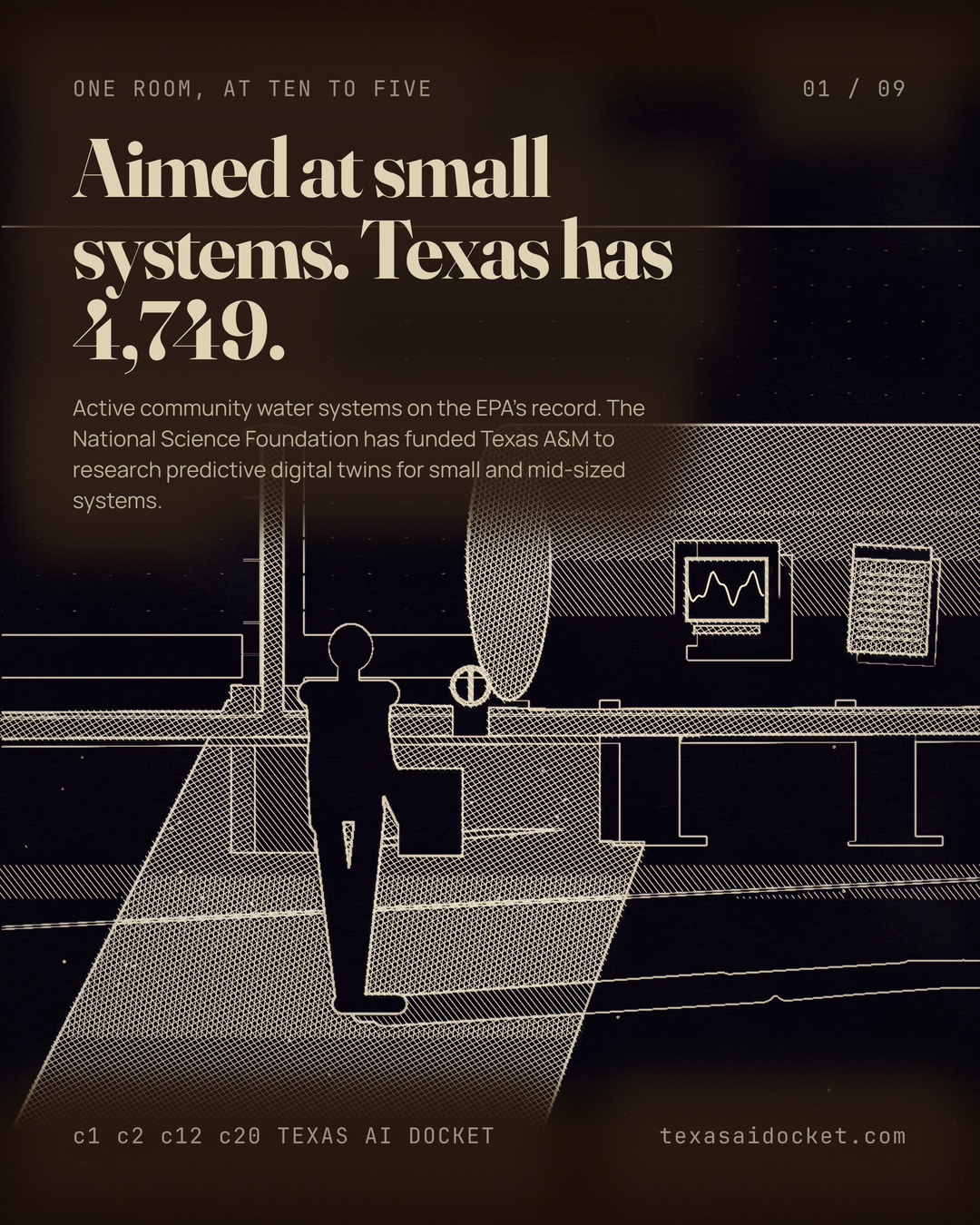
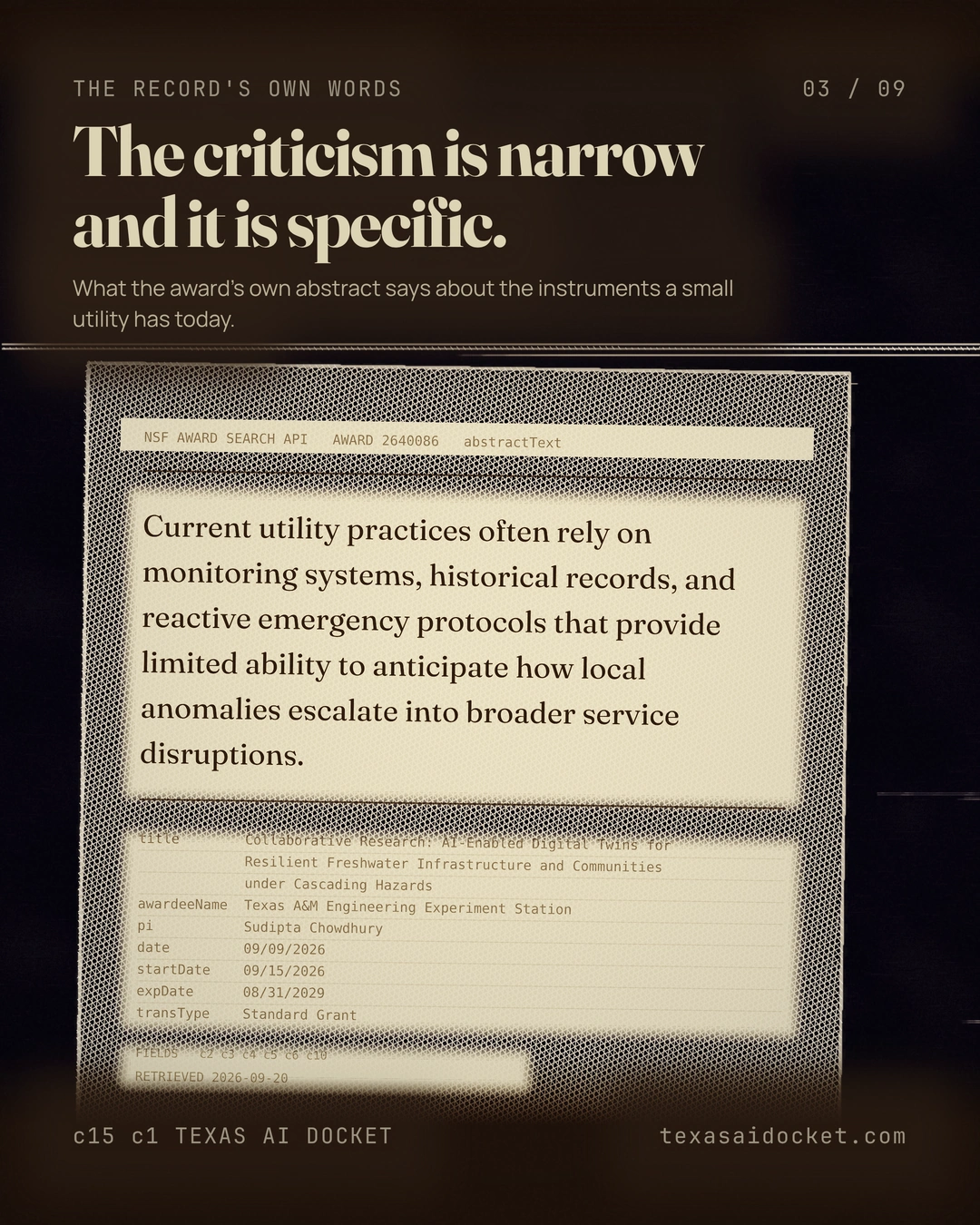


On September 9th, 2026 the National Science Foundation made a standard grant to the Texas A&M Engineering Experiment Station for AI-enabled digital twins of freshwater infrastructure under cascading hazards. The principal investigator is Sudipta Chowdhury. Work began September 15th, 2026 and the award expires August 31st, 2029.
The interesting line is not the money. It is the first of the three directions the abstract lists. That direction aims the work at small and mid-sized freshwater infrastructure systems rather than at the large utilities that already employ engineers to model themselves.
What a small system has today
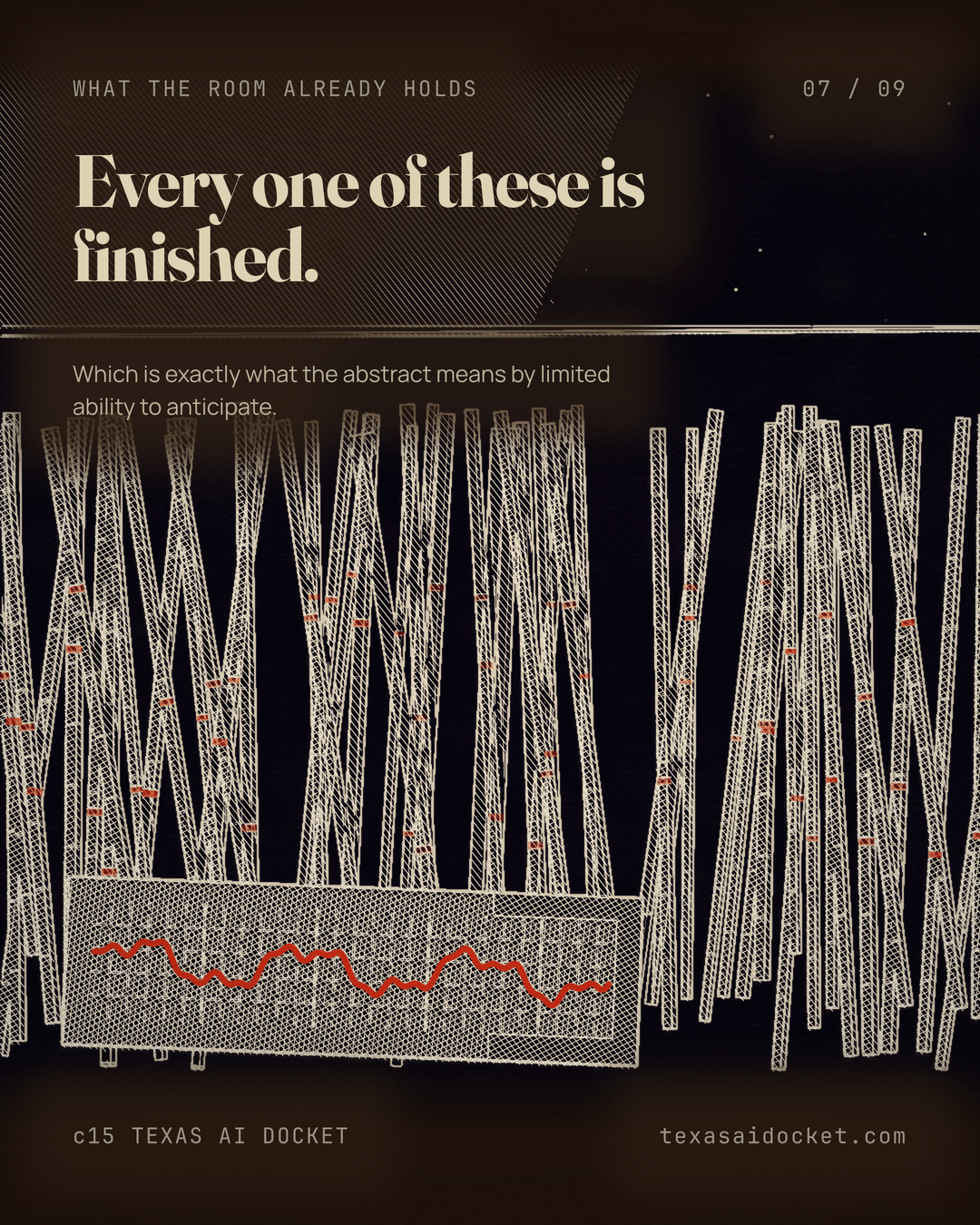
The abstract is specific about the instruments. It says utility practice often relies on monitoring systems, historical records, and reactive emergency protocols that provide limited ability to anticipate how local anomalies escalate into broader service disruptions. That is a criticism of what an instrument can do rather than of the people operating it.
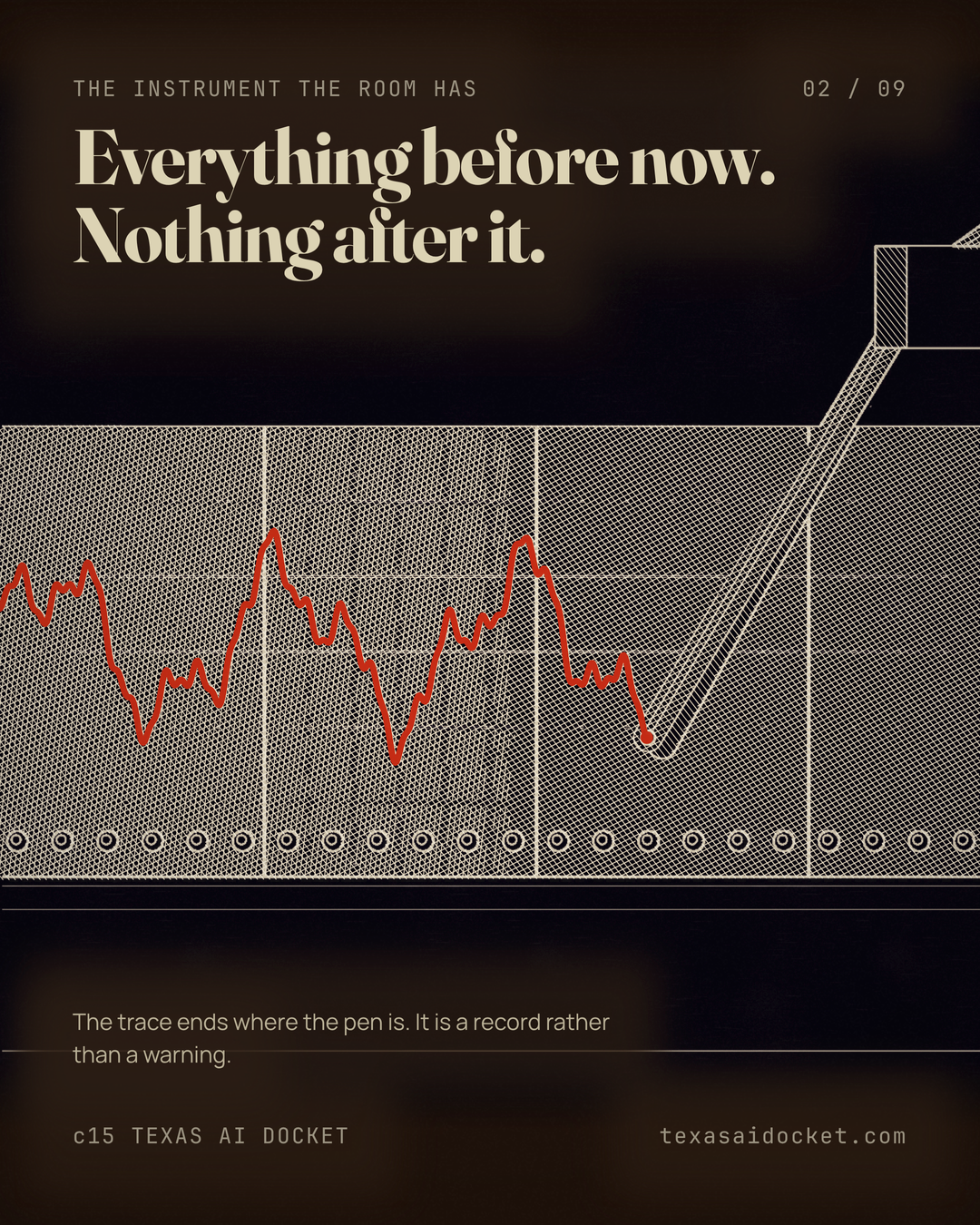
The distinction matters because a record and a warning are different machines. A chart recorder and a bound logbook answer what already happened, completely and in order. Neither is built to say what is about to.
Why a local failure becomes a wide one
The abstract describes the mechanism in its own words. Disruptions that begin in one component, such as an intake, pump station, or treatment unit, can propagate through connected infrastructure and service networks. The verb is conditional. Nothing in the record says a Texas system has failed this way.
The same sentence names what the infrastructure is made of. Among the things getting harder to manage it lists intakes, treatment facilities, storage assets, distribution networks, sensing platforms, and utility operations.
How many systems this points at
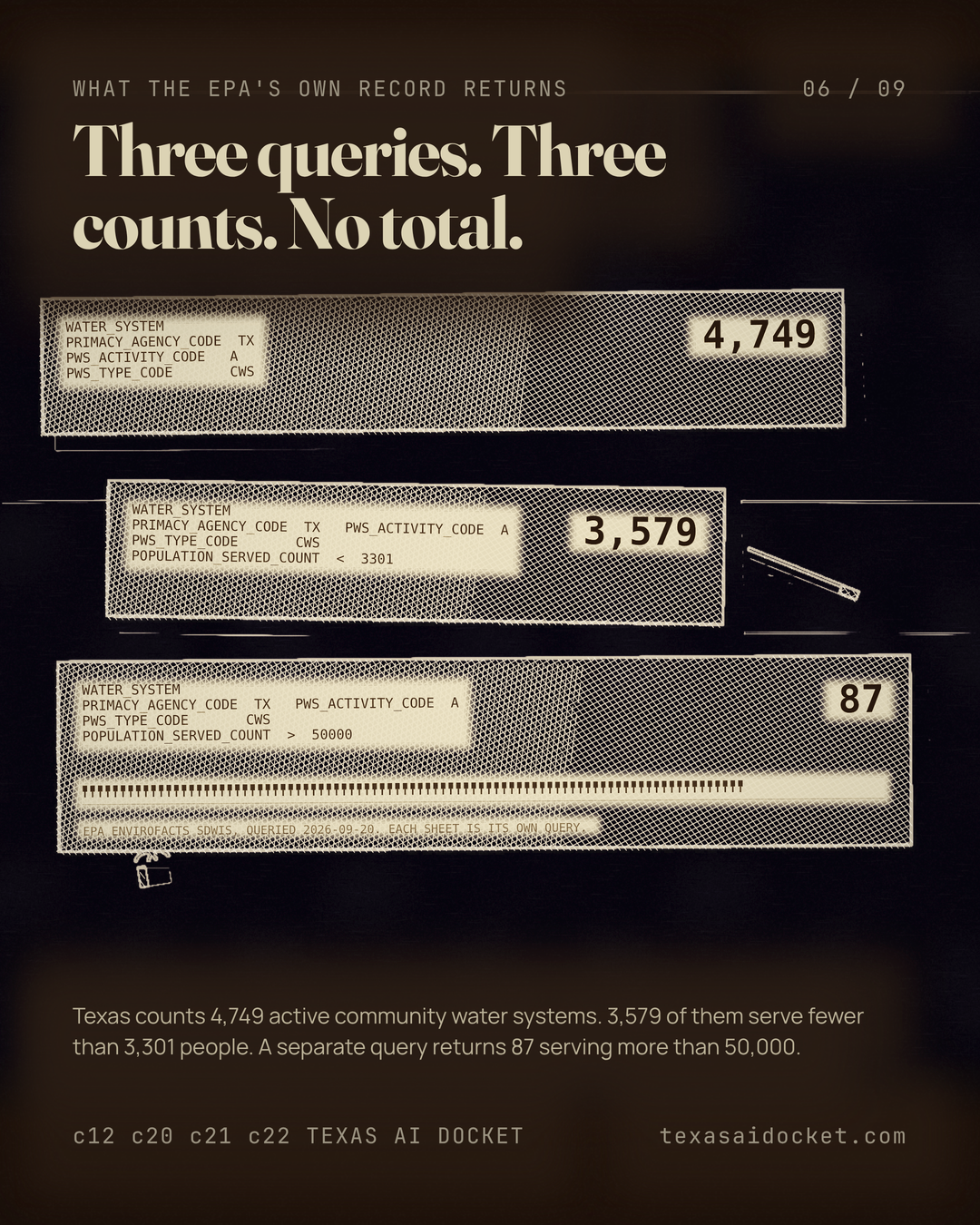
The EPA's Safe Drinking Water Information System returns 4749 active community water systems in Texas. A second query adds a population predicate to the same three filters. It returns 3579 serving fewer than 3,301 people. A third returns 87 serving more than 50,000.
Those are three separate measurements rather than three tiers of one. The population filters may exclude records where the served population is null. That was not tested. The three counts are not a partition and this account does not subtract any of them from any other.
Four other states were independently re-queried on the same day. California returns 2812. Washington returns 2311. New York returns 2250. Florida returns 1593. Forty four states were not re-queried, so no national ranking is claimed here.
What the record does not establish
No deployment is recorded. The award is days old and runs to August 31st, 2029, and the abstract states what the project can support rather than what it has achieved. A reader should treat every outcome in that sentence as a research aim.
The EPA queries count systems and filter on population served. They carry nothing whatever about condition, compliance or violations. None of the figures above says anything about whether any Texas water system is in good repair.
The award title begins with the words Collaborative Research, which in foundation practice means this record is one institution's share of a multi-institution project. The record names no partner institution and no project-wide total, so the figure on it is not the whole project's funding.
What a Texan can read today
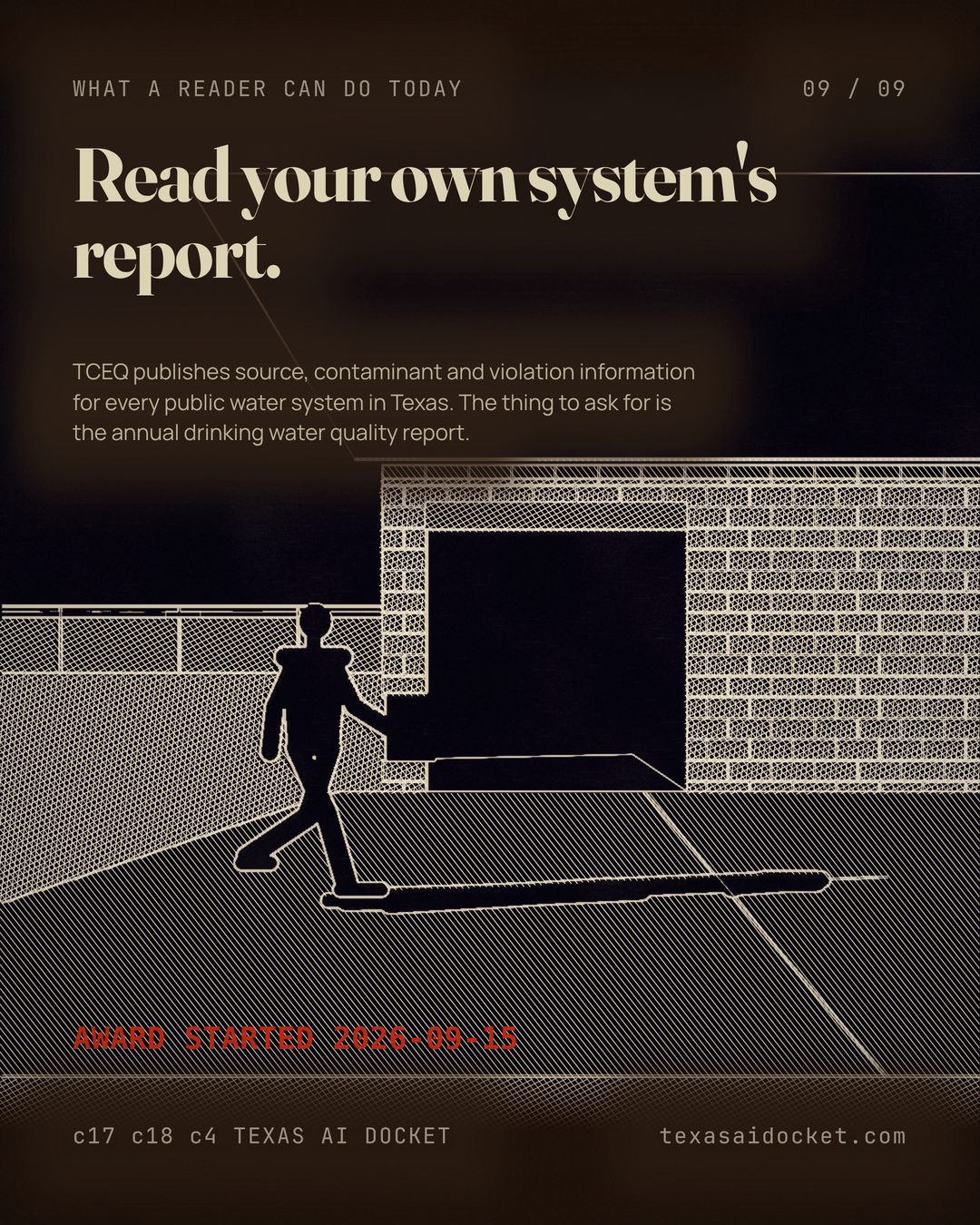
The state's own answer to the question this raises is older than the award. TCEQ says a resident can learn about the quality of your drinking water by reading your water system's annual drinking water quality report, also called a Consumer Confidence Report.
The agency also publishes a viewer that contains information on sources, contaminants, and violations for all public water systems in Texas. It describes that viewer as a tool that drinking water operators and the public can use.
Sources for this story
- NSF Award Search API record for award id 2640086, title field
- How is my Drinking Water Quality? Texas Commission on Environmental Quality
- Instructions for Texas Drinking Water Viewer, Texas Commission on Environmental Quality
- EPA Envirofacts SDWIS WATER_SYSTEM count, active Texas community water systems
- EPA Envirofacts SDWIS WATER_SYSTEM count, Texas community water systems serving under 3,301
- EPA Envirofacts SDWIS WATER_SYSTEM count, Texas community water systems serving over 50,000
- EPA Envirofacts SDWIS WATER_SYSTEM count, active California community water systems
- EPA Envirofacts SDWIS WATER_SYSTEM count, active Washington community water systems
- EPA Envirofacts SDWIS WATER_SYSTEM count, active New York community water systems
- EPA Envirofacts SDWIS WATER_SYSTEM count, active Florida community water systems
Claim-by-claim verification · 26 claims
NSF award 2640086 is a collaborative research award on AI-enabled digital twins for resilient freshwater infrastructure and communities under cascading hazards.
Collaborative Research: AI-Enabled Digital Twins for Resilient Freshwater Infrastructure and Communities under Cascading Hazards
The award recipient named on the NSF record is the Texas A&M Engineering Experiment Station.
Texas A&M Engineering Experiment Station
The principal investigator named on the award record is Sudipta Chowdhury.
"piFirstName":"Sudipta","piId":"270084523","piLastName":"Chowdhury"
The award start date on the NSF record is September 15th, 2026, and it sits immediately beside the title in the record.
"publicAccessMandate":"1","startDate":"09/15/2026","title":"Collaborative Research: AI-Enabled Digital Twins
The award expiration date on the NSF record is August 31st, 2029.
"estimatedTotalAmt":"122169","expDate":"08/31/2029","fundAgencyCode":"4900"
The award date on the NSF record is September 9th, 2026.
"cfdaNumber":"47.041","date":"09/09/2026","dirAbbr":"ENG","divAbbr":"CMMI"
The funds obligated to this award record are stated by NSF for fiscal year 2026 as the figure quoted.
FY 2026 = $122,169.00
The estimated total amount field on the NSF record carries the same value as the funds obligated amount field.
"divAbbr":"CMMI","estimatedTotalAmt":"122169","expDate":"08/31/2029"
The NSF funding program named on the award record is the one quoted, spelled as NSF's own record spells it.
ISP-Infrastructre Systms & Ppl
The award instrument type recorded by NSF is a standard grant rather than a cooperative agreement.
"transType":"Standard Grant","ueiNumber":"QD1MX6N5YTN4"
The stated objective is research on an AI-enabled approach to predicting and mitigating cascading disruptions in freshwater infrastructure systems.
The objective of this project is to support research on a new AI-enabled cyber-physical-social paradigm for predicting, managing, and mitigating cascading disruptions in freshwater infrastructure systems.
The first of the three directions the abstract lists is predictive digital twins aimed specifically at small and mid-sized freshwater infrastructure systems.
enabling AI-driven predictive digital twins for small and mid-sized freshwater infrastructure systems
The abstract attributes rising difficulty to aging assets, deferred maintenance, climate-driven hazards, power outages and water-quality variability.
Freshwater infrastructure, including intakes, treatment facilities, storage assets, distribution networks, sensing platforms, and utility operations, is becoming increasingly difficult to manage due to aging assets, deferred maintenance, climate-driven hazards, power outages, and water-quality variability.
The abstract describes a failure in one component such as an intake, pump station or treatment unit spreading through connected networks.
Disruptions that begin in one component, such as an intake, pump station, or treatment unit, can propagate through connected infrastructure and service networks, producing operational instability and uneven community impacts.
The abstract characterises current utility practice as monitoring, historical records and reactive emergency protocols, with limited ability to anticipate escalation.
Current utility practices often rely on monitoring systems, historical records, and reactive emergency protocols that provide limited ability to anticipate how local anomalies escalate into broader service disruptions.
The abstract states what the project CAN support if it succeeds, using the conditional rather than claiming an achieved result.
By enabling earlier warning of system vulnerabilities and cascading disruptions, the project can support more effective operational decisions, reduce service interruption duration, improve public communication, protect households during hazard events, prioritize vulnerable service areas, and strengthen human well-being through safer, more reliable water service.
TCEQ tells the public the way to learn about their drinking water is to read their own water system's annual report.
You can learn about the quality of your drinking water by reading your water system's annual drinking water quality report, also called a Consumer Confidence Report (CCR).
TCEQ publishes a viewer holding source, contaminant and violation information for every public water system in Texas.
TCEQ's Texas Drinking Water Viewer (DWV) contains information on sources, contaminants, and violations for all public water systems in Texas.
TCEQ describes that viewer as a tool for operators and for the public alike.
a data viewer that drinking water operators and the public can use to find information about public water systems
The EPA Envirofacts SDWIS count of active Texas community water systems is 4,749.
{ "TOTALQUERYRESULTS": 4749 }
The same query filtered to POPULATION_SERVED_COUNT below 3,301 returns 3,579 systems.
{ "TOTALQUERYRESULTS": 3579 }
The same query filtered to POPULATION_SERVED_COUNT above 50,000 returns 87 systems.
{ "TOTALQUERYRESULTS": 87 }
The EPA Envirofacts SDWIS count of active community water systems in California, on the same three filters used for Texas, is 2,812.
{ "TOTALQUERYRESULTS": 2812 }
The EPA Envirofacts SDWIS count of active community water systems in Washington, on the same three filters used for Texas, is 2,311.
{ "TOTALQUERYRESULTS": 2311 }
The EPA Envirofacts SDWIS count of active community water systems in New York, on the same three filters used for Texas, is 2,250.
{ "TOTALQUERYRESULTS": 2250 }
The EPA Envirofacts SDWIS count of active community water systems in Florida, on the same three filters used for Texas, is 1,593.
{ "TOTALQUERYRESULTS": 1593 }