Articles · Cities, policing and public services
Once a month, a truck takes a picture of your house.
Dallas put AI cameras on its brush trucks and said in December what the program would not be. The friction is a letter that is formally not a warning and reads like one.
Read the story
On December 9th, 2025 a City of Dallas Finance Committee briefing proposed to implement 100 AI-enabled cameras on Sanitation brush trucks. It was a staff presentation ahead of a council decision rather than an approval. The item went to the City Council the next day.
Nine months on, the cameras are running. The city has issued its first citations to homeowners for violations that the city says AI cameras first detected and humans later confirmed. The question the record raises is not whether Dallas broke a promise. It is what a letter means to the person who opens it.
What the city said it would not be
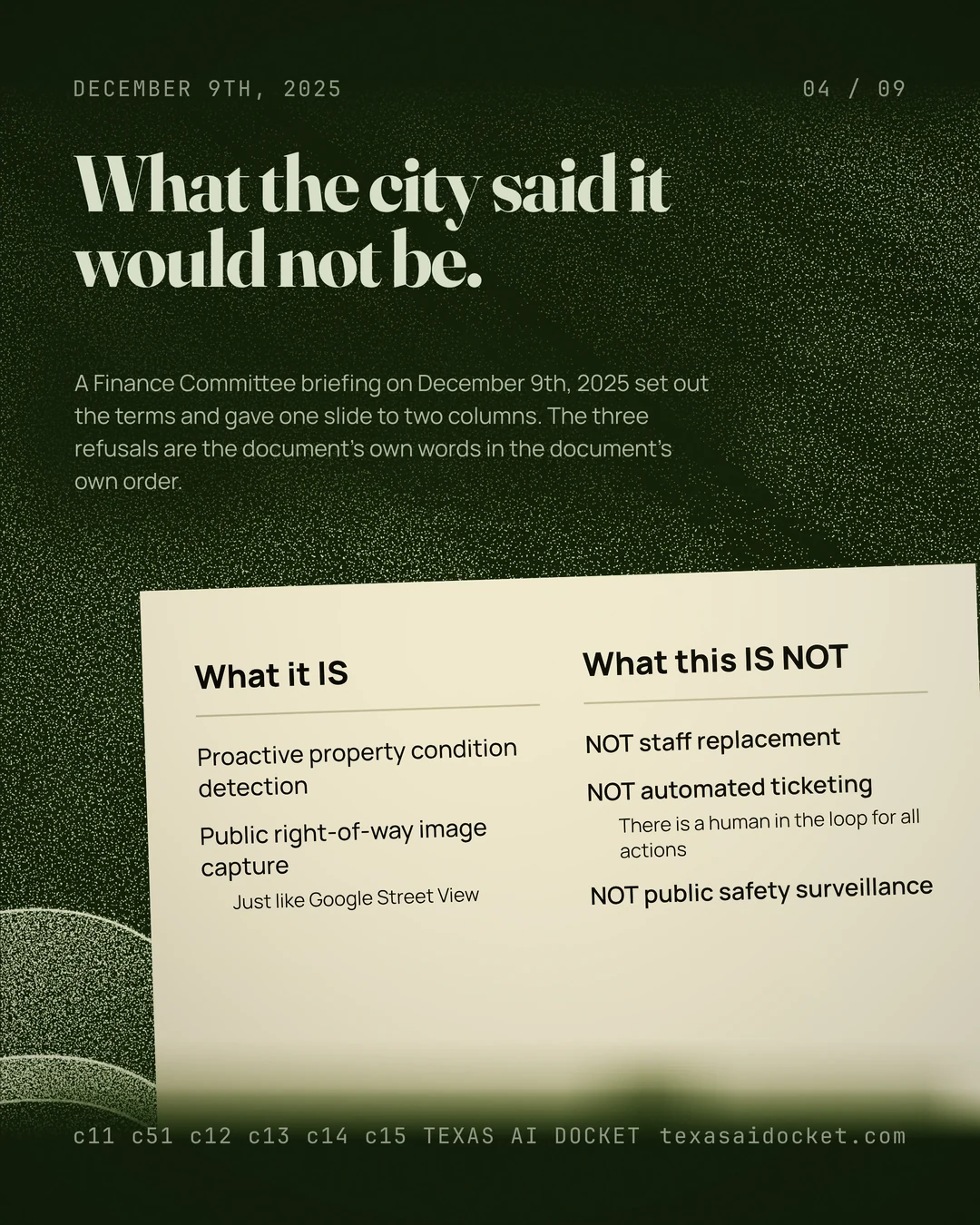
The December briefing gave one slide to two columns, one headed What it IS and one headed What this IS NOT. Three items in the right column each open with the word NOT. They are NOT staff replacement, NOT automated ticketing, and NOT public safety surveillance.
Two lines on that slide are sub points rather than refusals, and reading them as a fourth promise would misstate the document. The briefing answered its own automated ticketing line by saying there is a human in the loop for all actions. The phrase Just like Google Street View sits in the left column, under public right-of-way image capture, and carries no NOT at all.
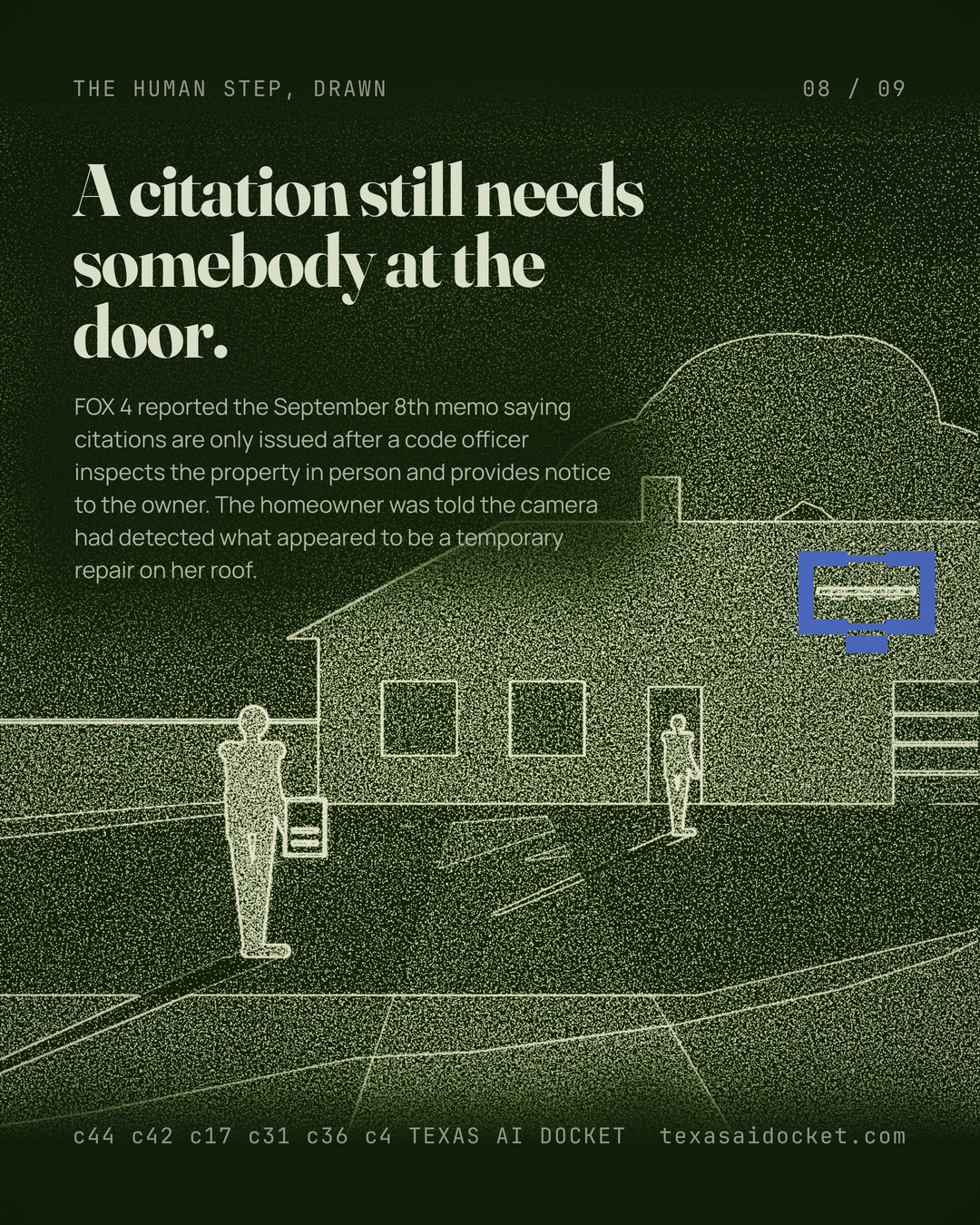
Every check on whether those terms held is the city's own account of itself, which is worth saying before the account. FOX 4 reports the September memo saying citations are only issued after a code officer inspects the property in-person and gives notice to the owner. The city says the images are kept for one year, that the system does not connect to any law enforcement database and that faces and license plates are blurred. No independent audit of any of it is public.
The hardware, in the briefing's own numbers
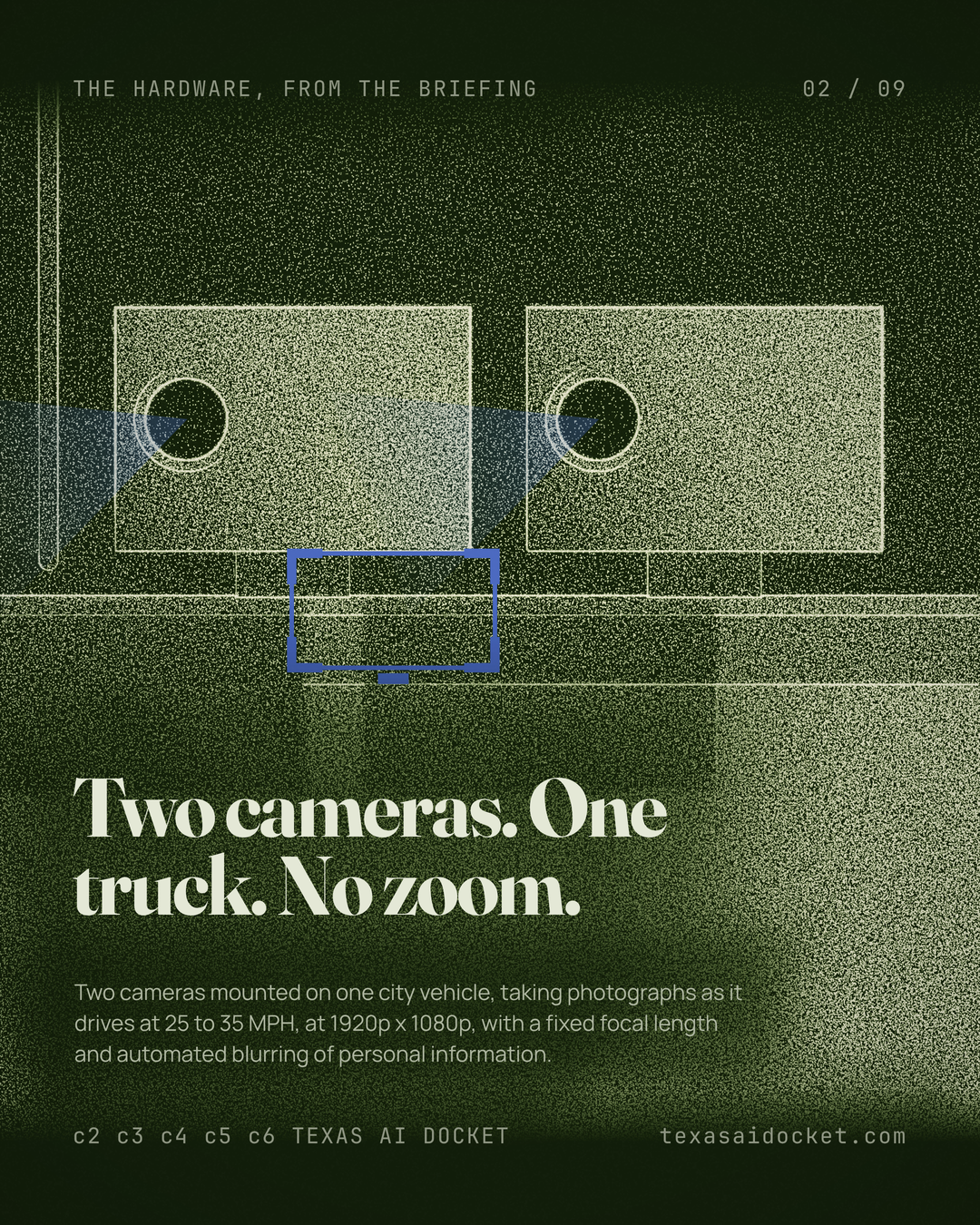
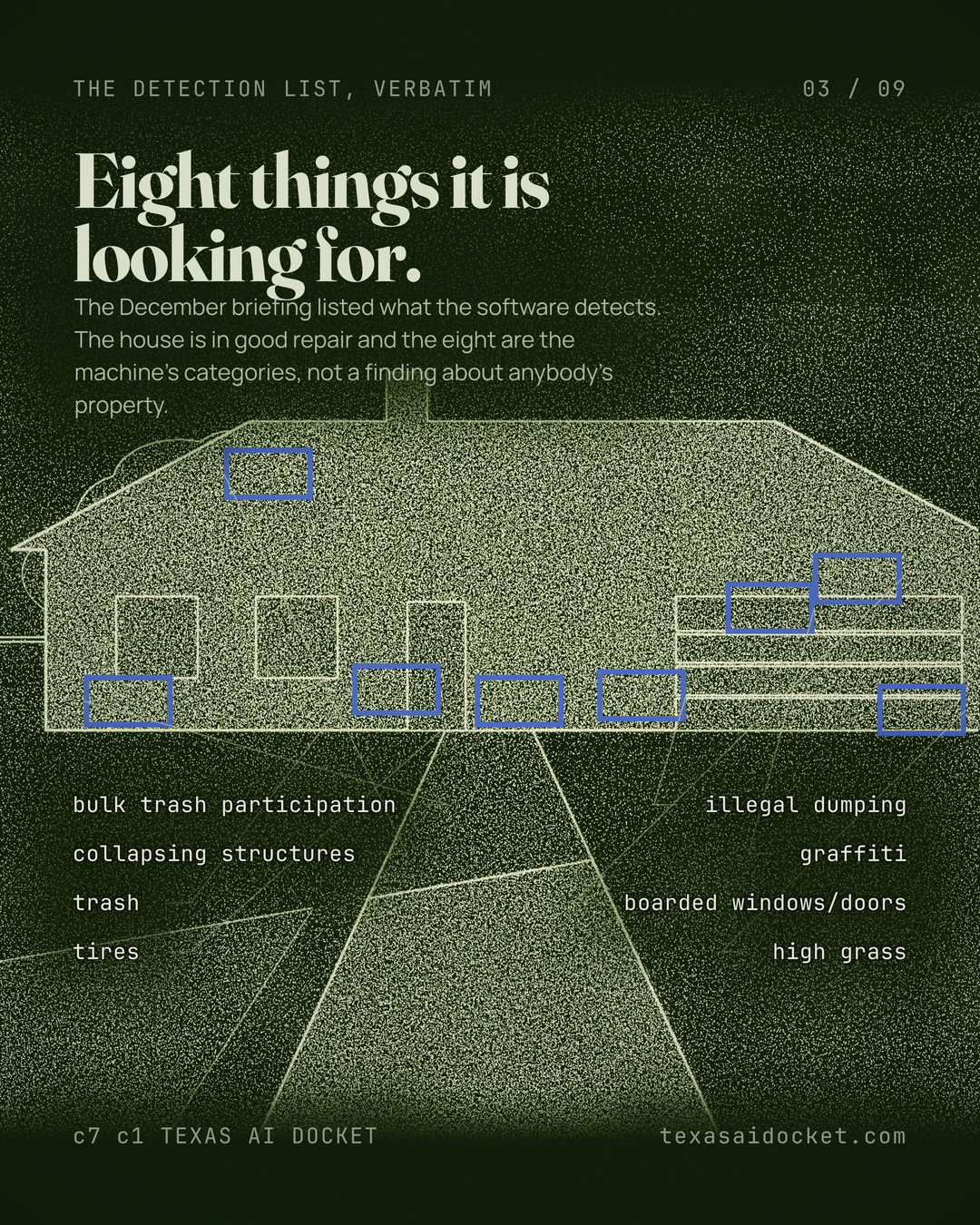
The briefing described 2 cameras mounted on 1 city vehicle, photographing while the truck drives at 25 to 35 MPH. The capture is 1920p x 1080p at a fixed focal length. It promised automated blurring of personal information. The software was set to detect a list of property conditions that begins with bulk trash participation and runs through illegal dumping, graffiti and boarded windows to high grass.
The contract went to the committee as a three-year agreement with an estimated value of $2,556,000 and an annual cost of $852,000, covering the cameras and the associated technology. The City may end it on 10 days' written notice at any time, without penalty. FOX 4 gives the same annual figure nine months later.
One hundred cameras at two per vehicle does not give a fleet size, and this account does not estimate one. Code Compliance does state the coverage. It told NBC 5 it's likely the cameras will photograph every residential property in the city once a month on bulk trash pickup days.
A letter that is not a warning
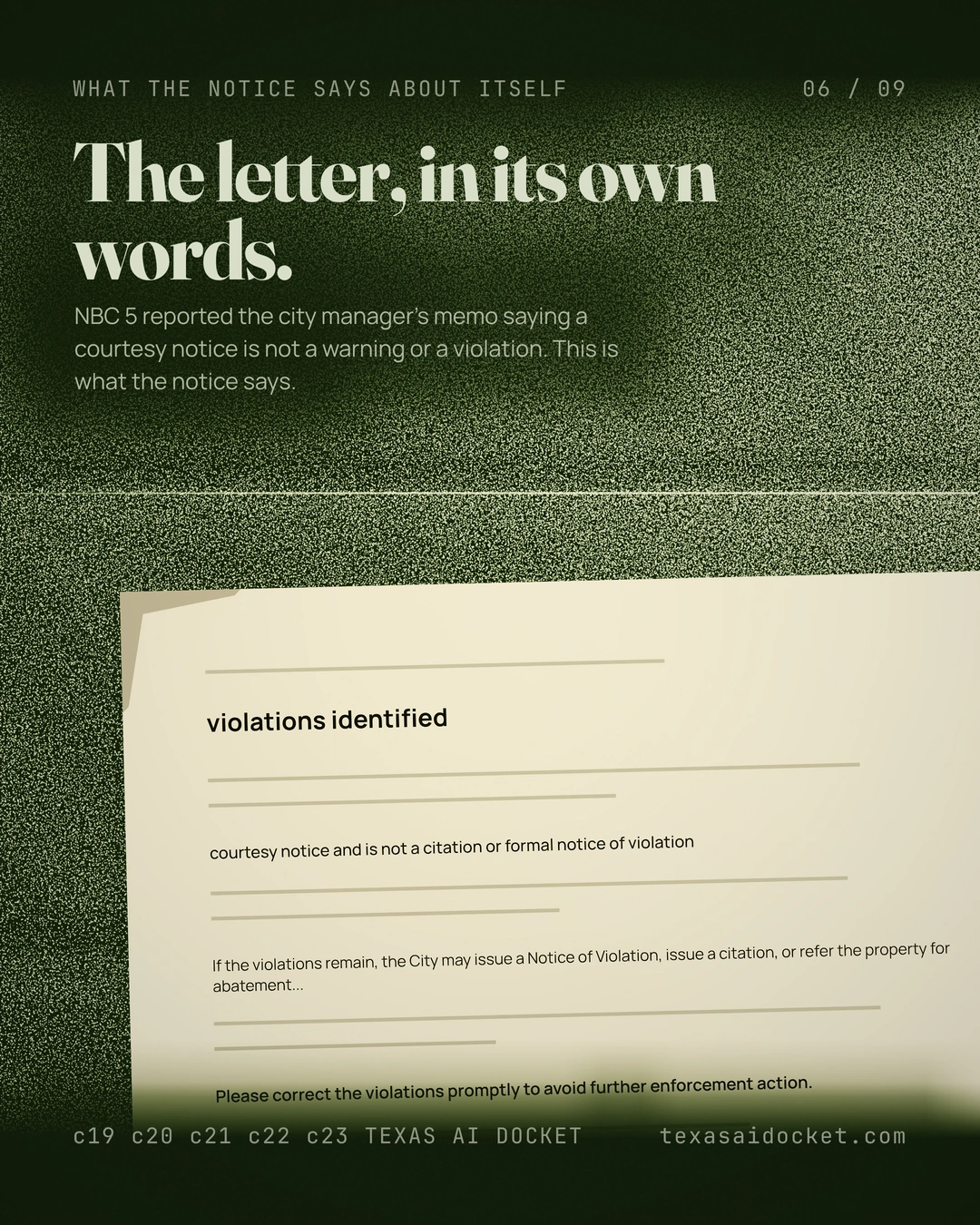
The city manager's memo, as NBC 5 reports it, states that A courtesy notice is not a warning or a violation. Code Compliance told the station in a statement that the notices do not require anything of the property owners.
The notice an Oak Cliff homeowner received carries violations identified in bold near the top. It describes itself as a courtesy notice and is not a citation or formal notice of violation. It then says that if the violations remain, the City may issue a Notice of Violation, issue a citation, or refer the property for abatement. It closes by asking the owner to correct the violations promptly to avoid further enforcement action.
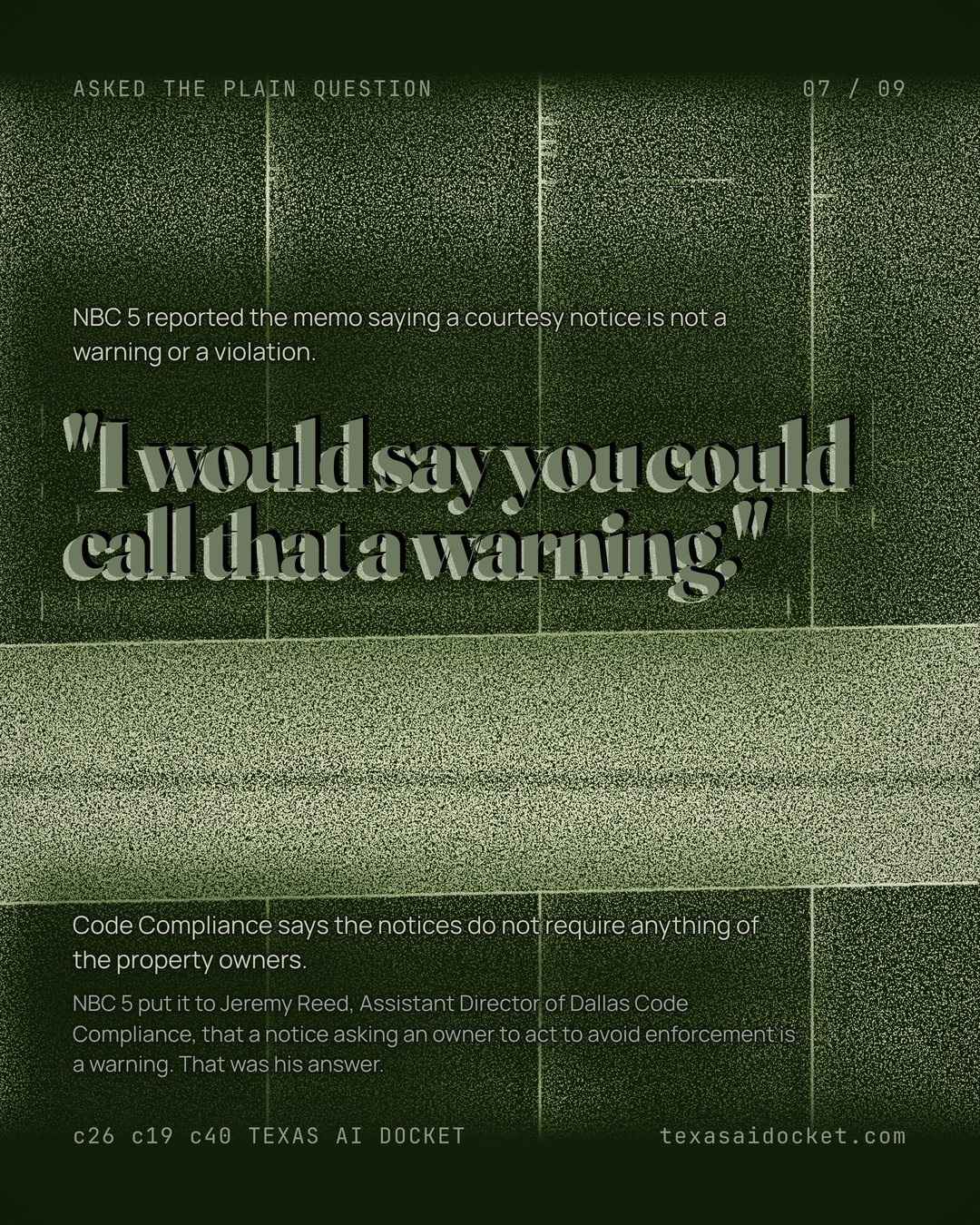
NBC 5 asked Assistant Director of Code Compliance Jeremy Reed about the gap between the memo's wording and the notice's. He answered that you could call that a warning. Both statements are the city's. Neither is false. They describe the same piece of paper from two sides of a counter.
Sarrah Morrison received one and told the station the wording just seems really slimy and manipulative. She worries about people who do not understand what it does not carry. The city told her the camera had detected what appeared to be a temporary repair on her roof.
Where the enforcement has landed
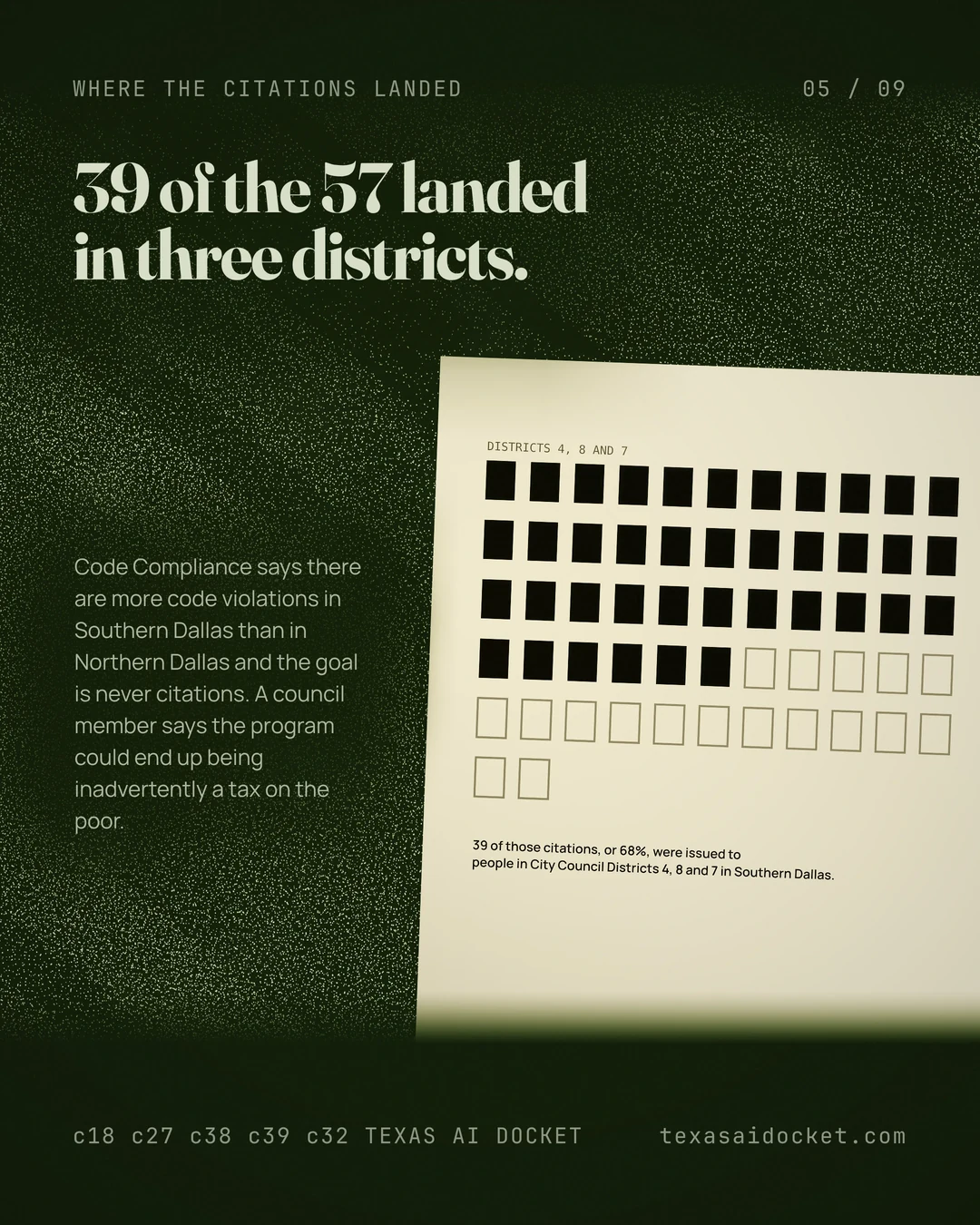
NBC 5 reports the memo stating that 57 citations have been issued at 34 properties for non-compliance. Of those, NBC 5 reports, 39 of those citations, or 68%, were issued to people in City Council Districts 4, 8 and 7 in Southern Dallas. NBC 5 separately reports that records show most went to Southern Dallas owners in three City Council districts where a majority of residents are Black and Hispanic.
Reed's explanation is that there are more code violations in Southern Dallas than in Northern Dallas and that the goal is never citations. He also says the city looks at code violations at properties and does not profile residents or look at demographics. Councilmember Chad West's concern is that the program could end up being inadvertently a tax on the poor.
West gave FOX 4 a different figure, saying 70% of the citations issued from what the cameras have identified come from predominantly African American neighborhoods. That is his own characterization of a different grouping and it is not the 68 percent NBC 5 reports. This account states both and reconciles neither, because the record does not establish that they measure the same thing.
What the record does not establish
The September memo is quoted by two outlets and published at no city URL this run could find. So every figure here names the outlet that reported it rather than the document. Two outlets quoting one unpublished memo are two sources for what it says and not two for the memo itself.
Three counts appear in the reporting and none of them contains another. Records show the cameras spotted potential violations at 21,000 addresses in four months. FOX 4 reports the memo saying the cameras have scanned 10,000 properties. The city says it has sent courtesy notices to 3,700 property owners. Three sources, three measures, three windows, so no difference between them is computed here.
Nothing in the record establishes how many of the roughly 300 cases the city has opened began with a camera rather than a complaint. Nothing establishes how often a human inspector has overruled a detection. The privacy protections are the city's description of its own system and no audit of them is public.
What happens next
West proposed pulling funding for the camera program and withdrew the request after the city manager agreed to a briefing. FOX 4 carries the date, putting the briefing on October 19th, 2026 and attributing it to City Manager Kim Tolbert. A Dallas Morning News report names the committee as Quality of Life, Arts and Culture.
That meeting is the next thing on this record with a date on it. The council item a Texan can read today is the December briefing itself, which remains the clearest statement of what the program was said to be.
Sources for this story
- Update on the Use of AI-Powered Camera Technology, Code Compliance and Sanitation briefing to the Dallas City Council Finance Committee
- Dallas AI code enforcement cameras lead to first homeowner citations, NBC 5 Dallas-Fort Worth
- AI-powered cameras on Dallas trash trucks result in almost 4,000 notices, 57 citations, FOX 4 Dallas-Fort Worth
- AI Flagged 20,000 Code Violations in Dallas, Only 57 Were Cited, Government Technology
Claim-by-claim verification · 51 claims
A City of Dallas Finance Committee briefing dated December 9th, 2025 proposed putting 100 AI enabled cameras on Sanitation brush trucks. It was a staff presentation ahead of a council decision and not itself an approval.
Implement 100 AI-enabled cameras on Sanitation
The December 2025 briefing described the hardware as two cameras mounted on one city vehicle.
2 cameras mounted on 1 city vehicle
The briefing said the cameras photograph while the truck is driving at 25 to 35 MPH.
Take photos as it drives (25-35 MPH)
The briefing put the capture resolution at 1920p x 1080p.
The cameras capture images at 1920p x 1080p resolution
The briefing said the cameras have a fixed focal length. The same sentence runs onto the next line of the slide to say they do not support any zoom capability.
They have a fixed focal length, which means they do not support
The briefing promised automated blurring of personal information. The slide's next line names license plate numbers and faces.
Automated blurring of personal information
The briefing listed the property conditions the software detects. They are bulk trash participation, collapsing structures, trash, tires, illegal dumping, graffiti, boarded windows/doors and high grass.
Detection of property conditions
The briefing put the contract to the committee as a three-year agreement with an estimated value of $2,556,000 that stays subject to annual City Council appropriations.
This is a three-year contract for an estimated amount of $2,556,000
The briefing gave the annual cost as $852,000 per year, covering 100 cameras and the associated technology, installation, data services, maintenance, warranty and replacement support.
The contract cost is $852,000 per year, which includes 100 cameras
The briefing told the committee the City may end the contract on 10 days' written notice at any time, without penalty.
The City may terminate the contract with 10 days’ written notice
The briefing gave one slide to two columns, one headed What it IS and one headed What this IS NOT.
What it IS What this IS NOT
The items on that slide written as refusals each begin with the word NOT. Two of them are NOT staff replacement and NOT automated ticketing.
NOT staff replacement • NOT automated ticketing
The third refusal on that slide is NOT public safety surveillance, answered by a sub point about the ability to blur faces and license plates for privacy.
NOT public safety surveillance
The briefing answered its own NOT automated ticketing line with a sub point saying there is a human in the loop for all actions. That was a promise made to a committee in December 2025 and not a measurement of anything.
There is a human in the loop for all actions
The phrase Just like Google Street View sits on that same slide under the bullet Public right-of-way image capture. It carries no NOT and belongs to what the briefing said the system IS rather than to the refusals.
Just like Google Street View
The briefing closed by telling the committee the item would be considered by the City Council on December 10th, 2025.
Council on December 10, 2025
NBC 5 Investigates reported that Dallas has issued its first citations to homeowners for violations the city says the AI cameras detected first and humans confirmed afterwards.
The records show the city has issued its first citations to homeowners for violations that the city says AI cameras first detected and humans later confirmed.
A City Manager memo reported by NBC 5 states that 57 citations have been issued at 34 properties for non-compliance. The memo is not published at a URL this run could find, so the figure is carried as reported and never as read from the memo.
In a memo written last week addressing questions about the cameras, City Manager Kimberly Bizor Tolbert wrote that "57 citations have been issued at 34 properties for non-compliance," so far.
NBC 5 reported the same memo stating that a courtesy notice is not a warning or a violation.
And in the city manager's recent memo, Tolbert wrote, "A courtesy notice is not a warning or a violation."
The courtesy notice a homeowner received carried the words violations identified in bold near the top, according to NBC 5.
Near the top of the notice, in bold letters, it said "violations identified."
The notice describes itself as a courtesy notice and not a citation or formal notice of violation.
It does go on to say the letter is a "courtesy notice and is not a citation or formal notice of violation."
The same notice goes on to tell the owner what happens if the violations remain. The City may issue a Notice of Violation, issue a citation, or refer the property for abatement.
But after that it said, "If the violations remain, the City may issue a Notice of Violation, issue a citation, or refer the property for abatement..."
The notice also asks the owner to correct the violations promptly to avoid further enforcement action.
It also said, "Please correct the violations promptly to avoid further enforcement action."
Jeremy Reed, Assistant Director of Dallas Code Compliance, told NBC 5 the city has opened about 300 cases where priority dictates that a code officer visit the property.
"We have opened about 300 cases where we believe that priority dictates that a code officer is out there and that the issue get resolved soon," said Jeremy Reed, Assistant Director of Dallas Code Compliance.
Reed described the courtesy notice to NBC 5 as an education for the property rather than a step toward enforcement.
"I would say it's an education for the property that any code violation on a property that's not dealt with could result in enforcement, but it's not going to happen because they received a courtesy notice," Reed said.
Pressed by NBC 5 on the gap between the memo's wording and the notice's wording, Reed said you could call that a warning.
After NBC 5 Investigates reminded Reed the notice asks the homeowner to do something to avoid enforcement and asked if that isn't a warning, Reed replied: "I think at this point, you're mincing words. I would say you could call that a warning. It is a notification to the property that there is a code violation."
The City Manager's memo, as reported by NBC 5, said 39 of the citations, or 68%, went to people in City Council Districts 4, 8 and 7 in Southern Dallas.
The city manager's memo said 39 of those citations, or 68%, were issued to people in City Council Districts 4, 8 and 7 in Southern Dallas.
The city has sent what it calls courtesy notices to 3,700 property owners, according to NBC 5.
On top of the citations issued and new cases opened, the city said it has also sent what it calls "courtesy notices" to 3,700 property owners, notifying them of detected violations.
NBC 5 reported that city records show the cameras spotted potential violations at 21,000 addresses in four months.
In just four months, city records show the cameras spotted potential violations at 21,000 addresses.
Sarrah Morrison is an Oak Cliff homeowner who received a notice. She told NBC 5 the wording seems slimy and manipulative and that she worries about people who don't understand what it carries.
"It just seems really slimy and manipulative and, you know, I'm worried about people who don't understand that this doesn't actually carry the weight that the wording implies it does," said Morrison.
Morrison told NBC 5 that the city said the AI camera had detected what appeared to be a temporary repair on her roof.
She said she called the city and they told her the AI camera detected what appeared to be a temporary repair on her roof.
City Councilmember Chad West told NBC 5 his primary concern is that the program could end up being inadvertently a tax on the poor.
"My primary concern is that this could end up being inadvertently a tax on the poor," said City Councilmember Chad West.
NBC 5 reported that West proposed pulling funding for the camera program and withdrew the request after the city manager's office agreed to brief a council committee.
Councilmember West recently proposed pulling funding for the camera program but agreed to withdraw that request after the city manager's office agreed to brief a council committee on the issue.
NBC 5 places the promised committee briefing in October and carries no date for it. FOX 4 is the source that carries the date.
That meeting is now scheduled for October.
NBC 5 reported the cameras reached full operation over the summer. FOX 4 describes the city as having used them since early 2026, and the two characterizations are not the same.
The cameras just went fully operational over the summer.
The city says the images are kept for one year, that the system does not connect to any law enforcement database and that faces and license plates are blurred. That is the city's own assertion as reported to NBC 5 and not an independent audit of the system.
The city said the images will be retained for one year but insists the system does not connect to any law enforcement database and that faces and license plates in photos are blurred.
Reed told NBC 5 that the city looks at code violations at properties and does not profile residents or look at demographics.
"We look at code violations at properties. We don't profile residents. We don't look at demographics at properties," said Reed.
Reed told NBC 5 there are more code violations in Southern Dallas than in Northern Dallas and that the goal is never citations.
"There are more code violations in Southern Dallas than in Northern Dallas. And we attempt, at every single instance, we attempt voluntary compliance. The goal is never citations," Reed said.
NBC 5 reported that records show most of the 57 citations went to Southern Dallas property owners. They fell in three City Council districts where a majority of residents are Black and Hispanic.
As for the 57 citations issued so far, records show most went to Southern Dallas property owners in three City Council districts where a majority of residents are Black and Hispanic.
Code Compliance told NBC 5 in a statement that the notices do not require anything of the property owners.
In a statement, Code Compliance recently told NBC 5 Investigates that those notices "do not require anything of the property owners."
Every residential property in the city is likely to be photographed once a month on bulk trash pickup days, Code Compliance told NBC 5.
Code Compliance told NBC 5 Investigates it's likely the cameras will photograph every residential property in the city once a month on bulk trash pickup days.
A memo from the City of Dallas dated September 8th, 2026 set out the findings and costs of the camera program, according to FOX 4.
A September 8 memo from the City of Dallas detailed the findings and costs of AI-powered cameras that the city has been using on its trash trucks since early 2026.
FOX 4 reported that the memo says the cameras have scanned 10,000 properties and produced 3,700 violations that drew notices. That figure sits beside NBC 5's separate report of potential violations at 21,000 addresses, and nothing in this record reconciles the two.
According to the memo, the cameras have scanned 10,000 properties and have resulted in 3,700 violations, resulting in notices from the city.
FOX 4 reported that the memo says citations are only issued after a code officer inspects the property in person and gives notice to the owner. That is the December 2025 human in the loop promise reported as kept.
57 citations have also been handed out at 34 properties from what the cameras have scanned. The memo also states citations are only issued after a code officer inspects the property in-person and provides notice to the owner.
FOX 4 gave the taxpayer cost of the cameras as $852,000 a year. The December 2025 contract slide states the same annual figure.
The taxpayer cost for the cameras is $852,000 a year.
The cameras are made by a company called City Detect, according to FOX 4. The December 2025 briefing names the same vendor.
The cameras, which are made by a company called City Detect, scan homes and buildings for potential code violations.
FOX 4 reported West saying 70% of the citations come from predominantly African American neighborhoods. That is West's own characterization to FOX 4 and it is not the memo's 68% figure for Districts 4, 8 and 7.
West says 70% of the citations issued from what the cameras have identified come from predominantly African American neighborhoods.
West told FOX 4 his concern is whether the city has privacy protections in place as it learns more about AI.
"The staff's desire is to be able to have a cleaner, more tidy, orderly city, right? My concern is, as we're learning more about AI and the lack of privacy and lack of protections, does the city have those protections in place to make sure my home, your home, our residents' homes, and our privacy are protected, number one," West said.
FOX 4 is the source that carries the date of the briefing, putting it on October 19th, 2026 and attributing it to City Manager Kim Tolbert.
A briefing on the cameras from Dallas City Manager Kim Tolbert will take place on October 19.
A Dallas Morning News report republished by Government Technology names the committee, putting the program before the Quality of Life, Arts and Culture Committee on October 19th, 2026.
The program is scheduled for a Quality of Life, Arts and Culture Committee briefing Oct. 19, where council members are expected to question the system's cost, privacy safeguards, geographic impact and measurable results.
The first item in the What it IS column of that briefing slide is proactive property condition detection. It carries no NOT and it is answered by a sub point calling the system a tool for staff to support their work.
Proactive property condition detection