Articles · Defense and federal
The pod checks the spot
The FAA takes comment until October 11th, 2026 on a draft that assesses letting Zipline fly delivery drones over five Texas metros. In it, a pod on a line judges the drop spot itself.
Read the story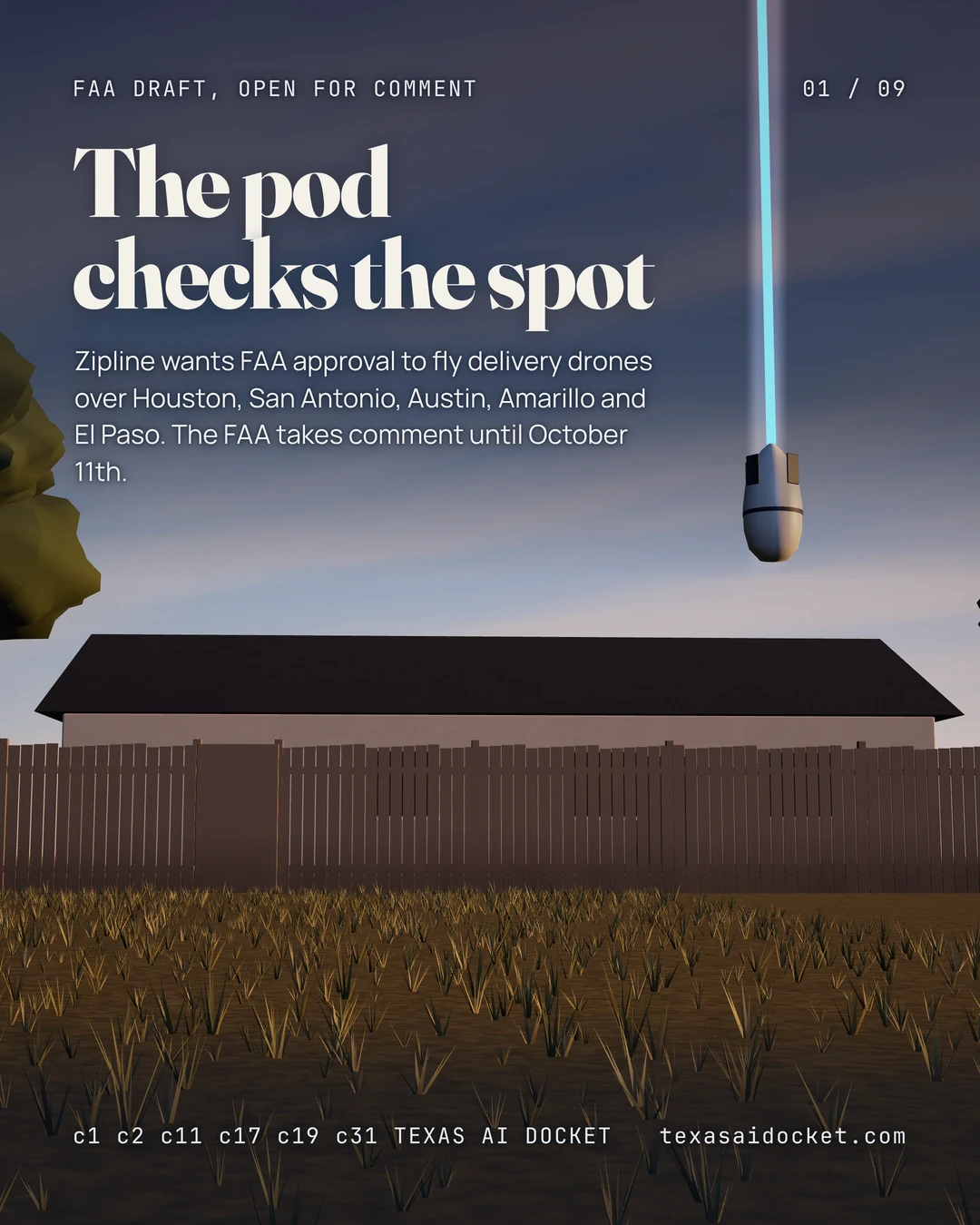
Zipline International is seeking FAA approval to begin commercial package delivery operations in five Texas metropolitan areas. The five are Amarillo, Austin, El Paso, Houston and San Antonio. The Federal Aviation Administration has published a draft environmental assessment of that request and takes comments on it until October 11th, 2026.
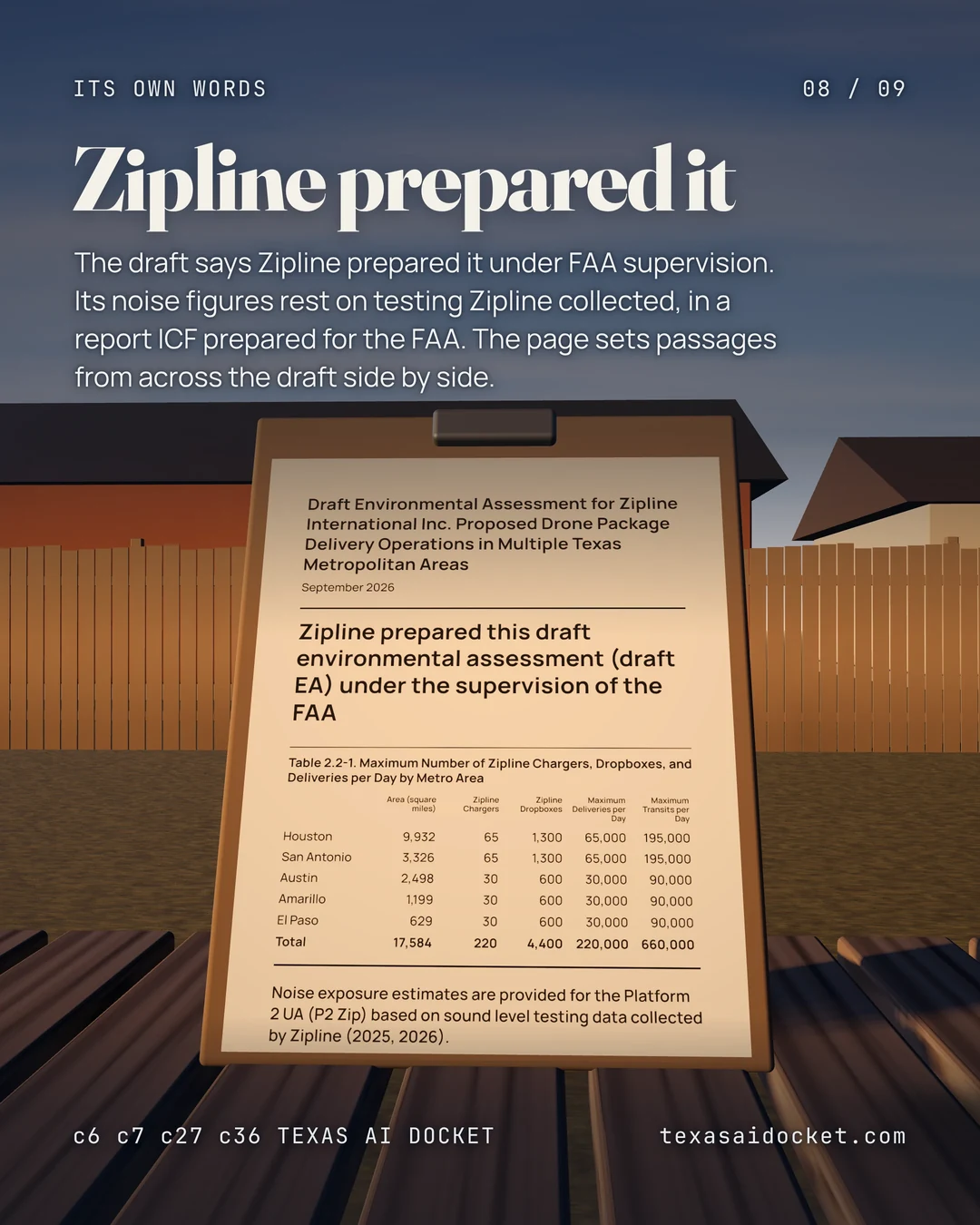
The document is a draft, and it says who prepared it. Zipline prepared this draft environmental assessment (draft EA) under the supervision of the FAA. The agency says all substantive comments received will be responded to in the final EA, so the final assessment and the decision it informs are still to come.
The pod judges the spot
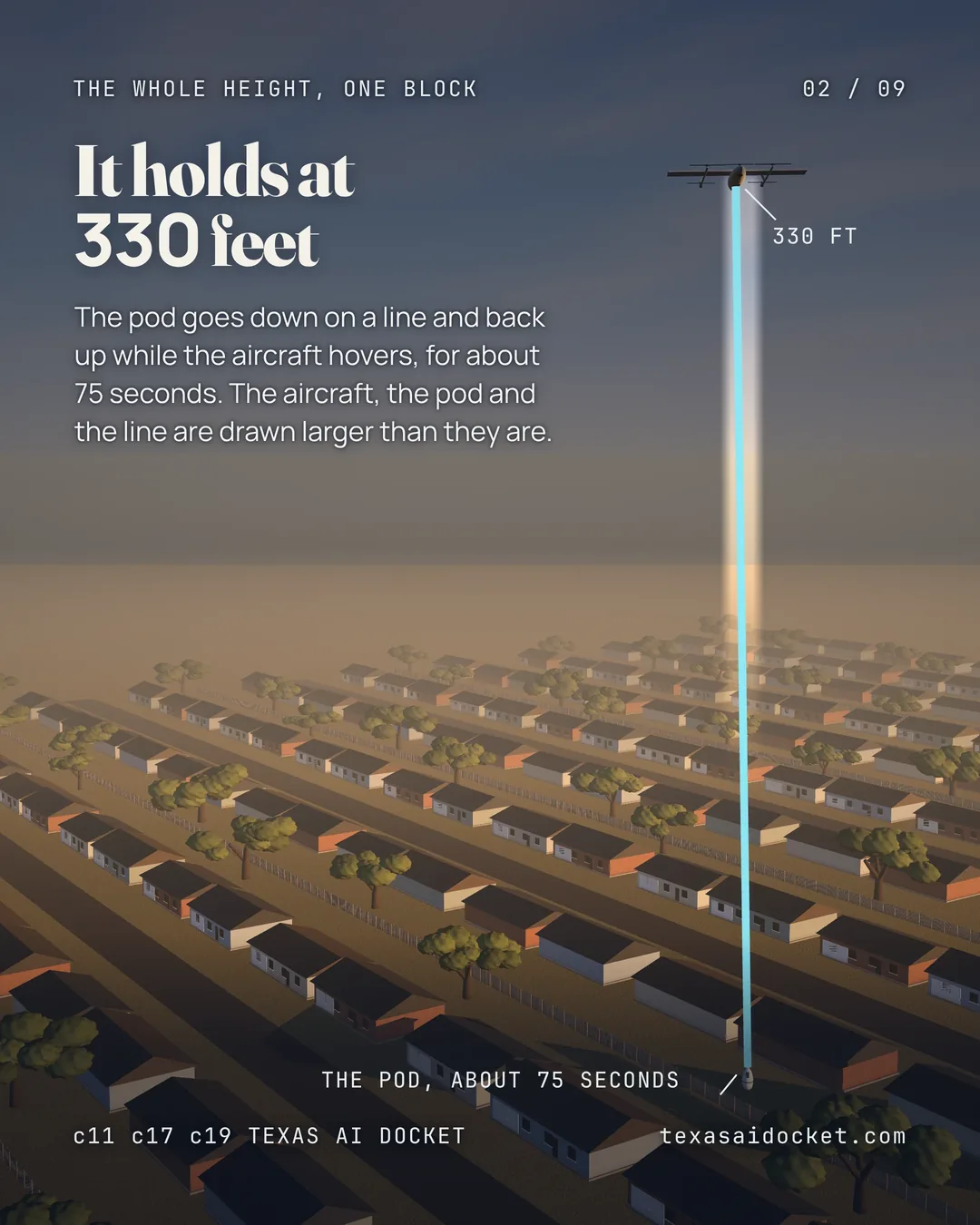
At a delivery the aircraft stays in the air. The draft has it generally operated at an altitude of 330 feet above ground level. In the delivery sequence it holds a hover at 330 feet AGL while the pod goes down to the ground and back. The draft puts that hover at about 75 seconds.
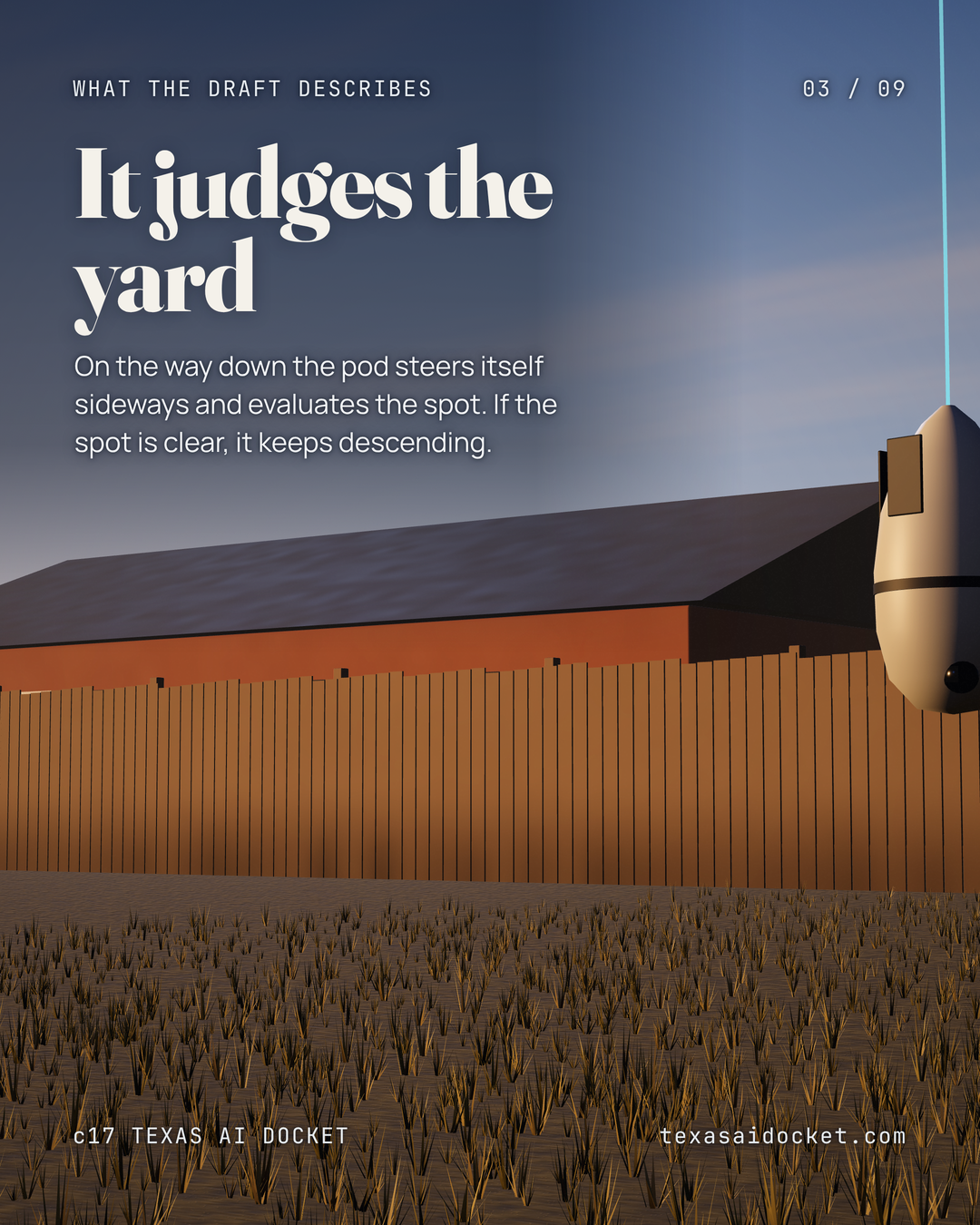
The pod does the deciding. The draft says the pod automatically controls its position laterally and evaluates the delivery location, and that it continues to descend if the location is clear.
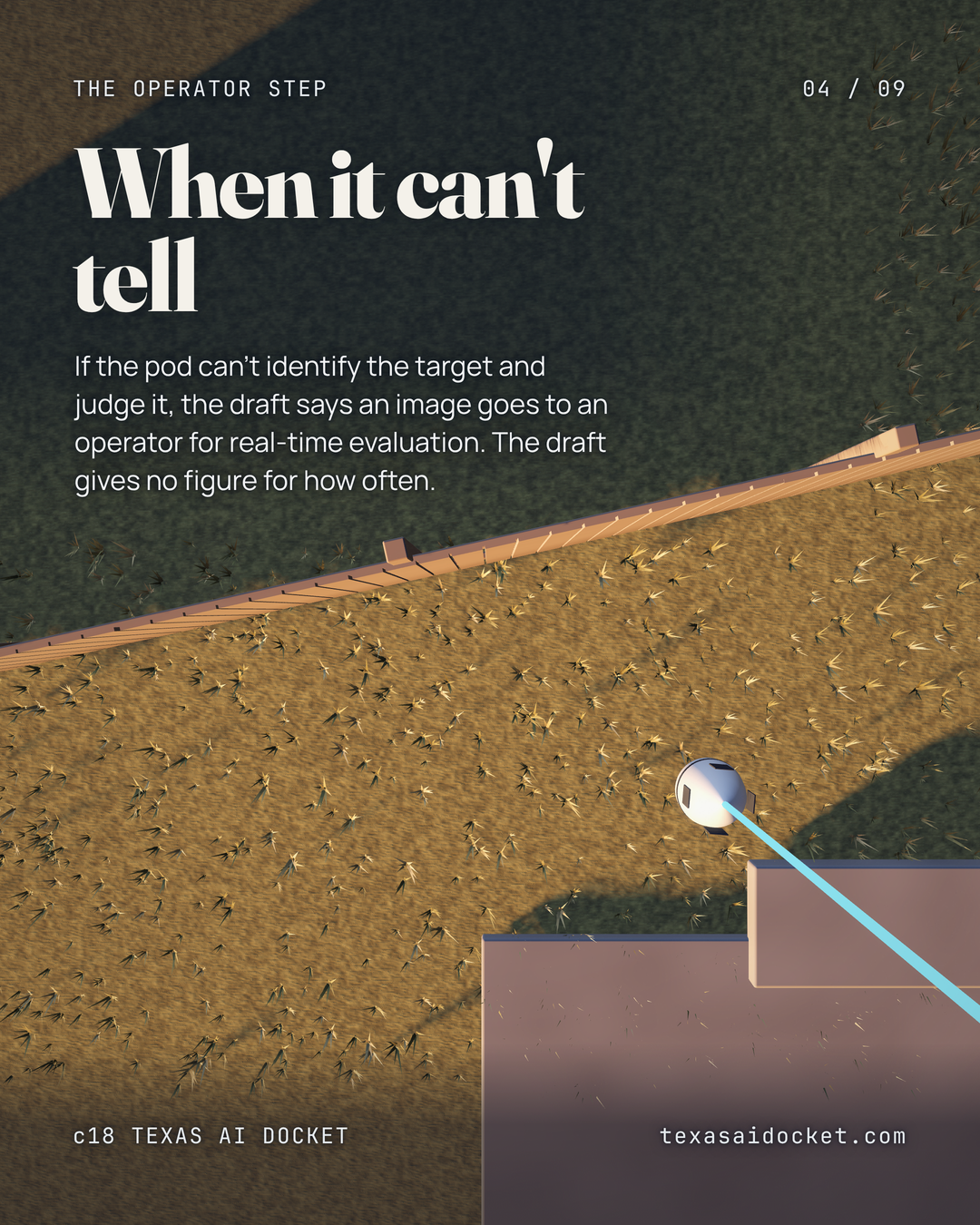
If the pod is unable to automatically identify the delivery target and evaluate its suitability, an image is sent to an operator for real-time evaluation. The draft gives no figure for how often that happens. The sentence sits in its section on visual effects rather than in its description of flight operations. People appear elsewhere in the draft too. It says the Remote Pilot in Command has the ability to command flight termination if an aircraft flies outside its operating area.
Routing is automated too. Routes are generated by software that takes into consideration factors including weather risk, wind direction, and population density, and the aircraft automatically deconflict with each other. The draft describes the aircraft itself as highly automated.
What the draft assesses
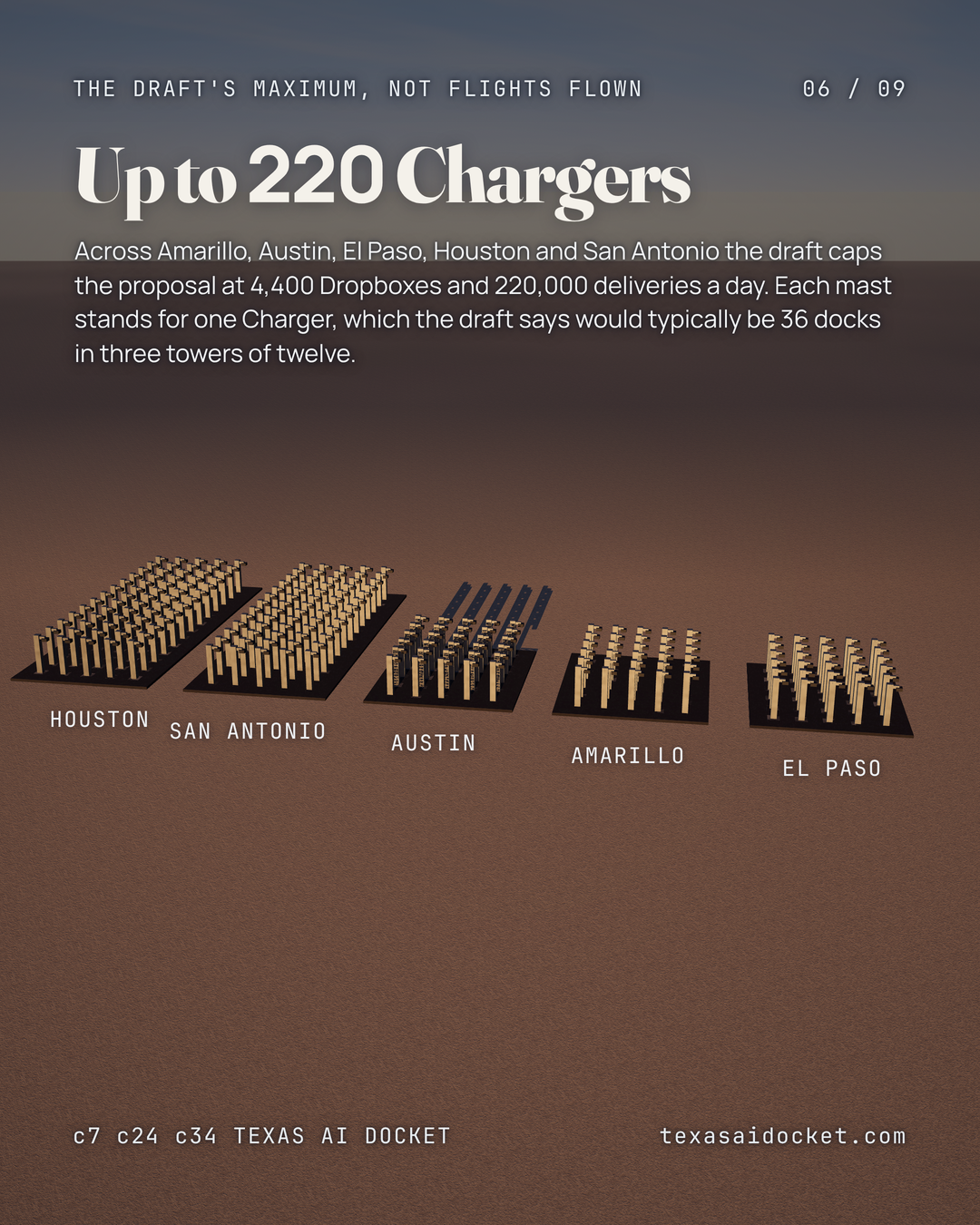
The draft's table sets a ceiling for each metro. Across the five metros the totals are 220 Chargers, 4,400 Dropboxes and 220,000 deliveries a day, and every delivery counts as three transits. A Charger is a site rather than a single mast, since most Chargers would have around 36 docks. Houston and San Antonio carry the largest allotments. Operations would run 24 hours a day, 7 days per week, including holidays, with approximately 95% of flights between 7 am and 10 pm.
Those numbers are maximums the draft assesses, not deliveries anyone has flown. The draft itself says there would be variability in the actual number of flights per day based on customer demand and weather conditions.
Noise, as the draft measures it
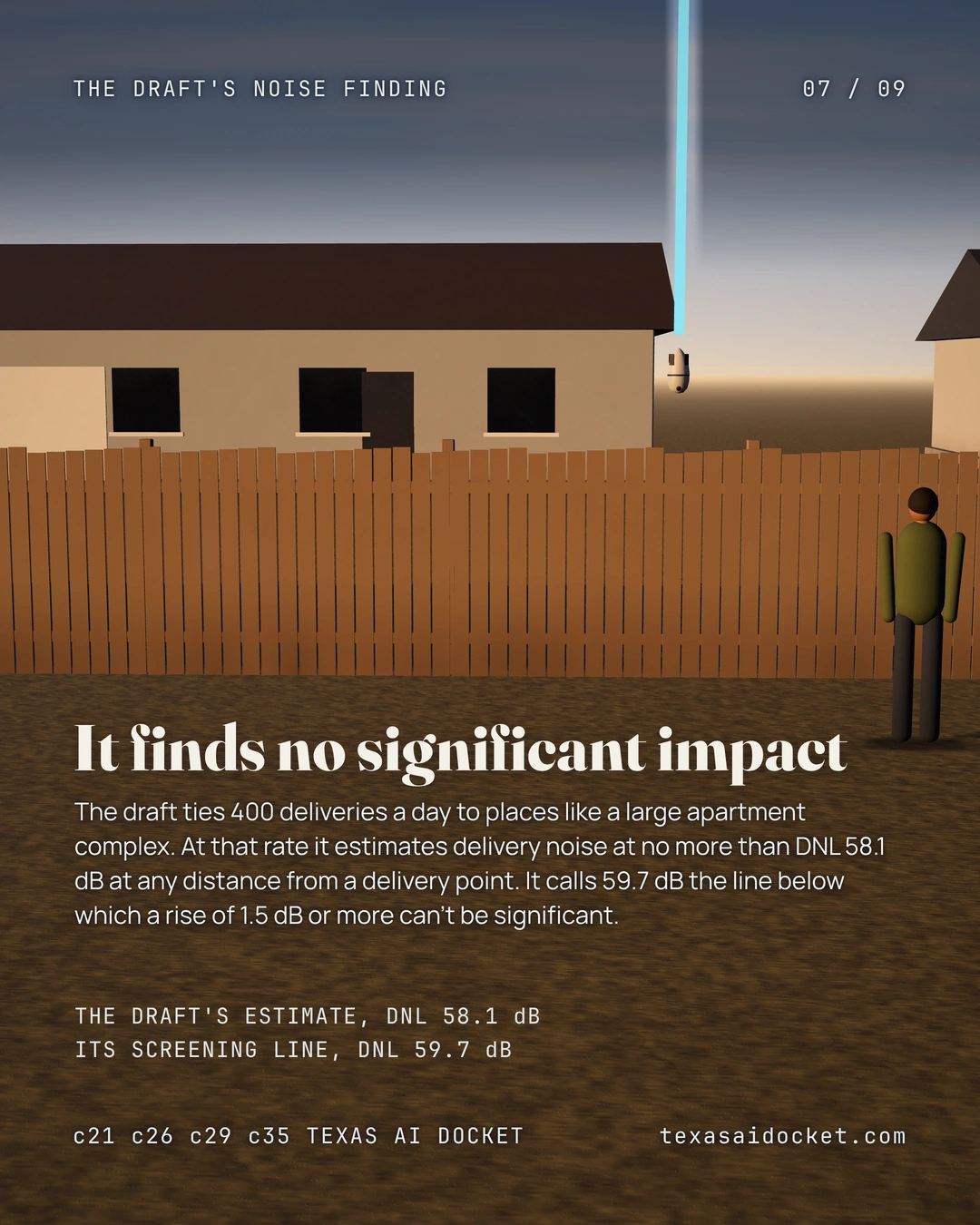
The draft applies the FAA's own test. Under it a noise impact is significant if the action would increase the DNL by 1.5 dB or more where the area already sits at or above DNL 65 dB. The same holds where that increase brings an area to DNL 65 dB or above. At 400 average daily deliveries per day the draft puts delivery noise at no more than DNL 58.1 dB at any distance from a delivery point. It says the noise would not exceed DNL 59.7 dB at any point. The draft treats 59.7 dB as the DNL threshold below which a rise of 1.5 dB or more in aviation noise can't cause a significant impact. Its estimate at any distance from a delivery point, 58.1 dB, sits under that line. The draft adds that deliveries to single family homes would be much lower, so this maximum represents delivery locations such as a large apartment complex.
It concludes that the proposed action would not have a significant noise impact. Its noise estimates rest on sound level testing data collected by Zipline.
What this edition does not establish
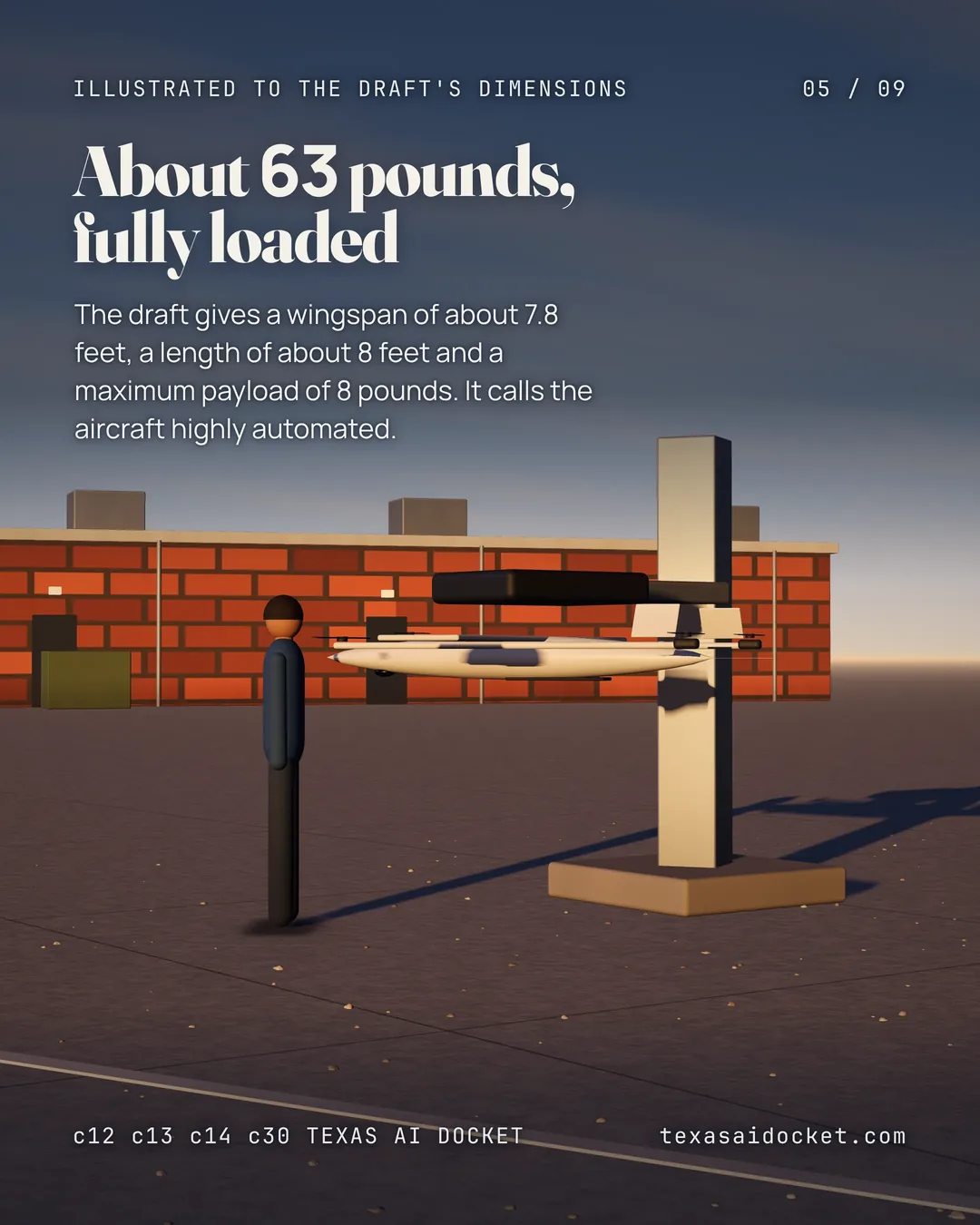
The draft does not say how often a pod sends an image to an operator, or what share of deliveries that would be. This edition publishes no estimate of either. It does not establish that any of the ceilings would be reached. The configuration of the aircraft in the visual edition is illustrative between the dimensions the draft gives.
Sources for this story
- FAA, Public Involvement and Environmental Review for Drone Operations
- Draft Environmental Assessment for Zipline International Inc. Proposed Drone Package Delivery Operations in Multiple Texas Metropolitan Areas, September 2026
Claim-by-claim verification · 38 claims
Zipline International is seeking Federal Aviation Administration approval to begin commercial package delivery operations in five Texas metro areas. They are Amarillo, Austin, El Paso, Houston and San Antonio.
Zipline International Inc. (Zipline) is seeking FAA approval to begin commercial package delivery operations in five Texas metropolitan areas: Amarillo, Austin, El Paso, Houston, and San Antonio.
Comments on the draft environmental assessment are due to the FAA by October 11th.
Please review the Draft EA and submit your comments by October 11, 2026.
The FAA takes comments by email and asks that the subject line name the Zipline Texas Draft EA.
Comments should be submitted to: 9-FAA-Drone-Environmental@faa.gov . Please reference the Zipline Texas Draft EA in the email subject line when sending comments.
The FAA notice says the draft became available for a 30-day public review beginning on Friday, September 11th.
The Draft EA will be available for a 30-day public review beginning on Friday, September 11, 2026.
The FAA notice says every substantive comment received will be responded to in the final environmental assessment.
All substantive comments received will be responded to in the final EA.
The draft states that Zipline, the applicant, prepared it under FAA supervision.
Zipline prepared this draft environmental assessment (draft EA) under the supervision of the FAA
The draft's totals row caps the proposal at 220 Chargers, 4,400 Dropboxes, 220,000 maximum deliveries per day and 660,000 maximum transits per day. Houston and San Antonio are each allotted up to 65 Chargers, 1,300 Dropboxes and 65,000 deliveries per day.
Houston 9,932 65 1,300 65,000 195,000 San Antonio 3,326 65 1,300 65,000 195,000 Austin 2,498 30 600 30,000 90,000 Amarillo 1,199 30 600 30,000 90,000 El Paso 629 30 600 30,000 90,000 Total 17,584 220 4,400 220,000 660,000
The draft counts three transits in every delivery. A drone flies from a Charger to a Dropbox, then from the Dropbox to the delivery location, then from the delivery location to a Charger.
Each delivery includes three transits: 1) flight from Charger to Dropbox, 2) flight from Dropbox to delivery location, and 3) flight from delivery location to ending Charger.
Zipline proposes to fly 24 hours a day, 7 days per week, holidays included.
Zipline is proposing to conduct operations 24 hours a day, 7 days per week, including holidays
The draft says approximately 95% of flights would take place between 7:00 am and 10:00 pm and 5% between 10:00 pm and 7:00 am.
Approximately 95% of flights would take place during 7:00 am to 10:00 pm and 5% of flights would take place during 10:00 pm to 7:00 am.
Zipline drones would generally fly at 330 feet above ground level on the way to and from Chargers, Dropboxes and delivery locations.
Zipline UAs would generally be operated at an altitude of 330 feet above ground level (AGL) while en route to and from Charger, Dropbox, and delivery locations.
The draft describes the Zipline aircraft as highly automated. It is an electrically powered vertical takeoff and landing aircraft that can hover and fly forward.
The Zipline UA is a highly automated, electrically powered vertical takeoff and landing aircraft capable of hover and forward flight
The draft gives the aircraft a multi-rotor design with 5 propellers and a weight of approximately 63 pounds including its maximum payload of 8 pounds.
The Zipline UA features a multi-rotor design with 5 propellers and weighs approximately 63 pounds when combined with its maximum payload weight of 8 pounds.
The aircraft has a wingspan of approximately 7.8 feet, a height of approximately 1.8 feet and a length of approximately 8 feet.
The Zipline UA has a wingspan of approximately 7.8 feet, a height of approximately 1.8 feet, and a length of approximately 8 feet.
According to the draft, routes are generated by software that takes weather risk, wind direction and population density into consideration.
Routes are generated by software that takes into consideration factors including weather risk, wind direction, and population density.
The draft says Zipline drones automatically deconflict with each other through a combination of strategic and tactical avoidance measures.
Zipline UAs automatically deconflict with each other using a combination of strategic and tactical avoidance measures
At a delivery the pod is lowered on a winch line and steers its own lateral position while it evaluates the delivery location. It descends the rest of the way only if the location is clear.
The pod is released from the Zipline UA and lowered to the ground via the winch line. During pod descent, the pod automatically controls its position laterally and evaluates the delivery location. If the delivery location is clear, the pod would continue to descend and deliver the payload at the delivery target.
When the pod can't automatically identify the delivery target and evaluate its suitability, the draft says an image is sent to an operator for real-time evaluation.
If the pod is unable to automatically identify the delivery target and evaluate its suitability, an image is sent to an operator for real-time evaluation.
The noise report's delivery sequence has the aircraft hold a hover at 330 feet AGL while the pod is winched to the ground and stowed again, for approximately 75 seconds.
Maintain hover at 330 feet AGL as Droid is un-stowed from the P2 Zip, Droid is winched down to the ground at the delivery point, and Droid is re-stowed once delivery is complete (approximately 75 seconds).
The draft applies the FAA Order 1050.1G test. Under it a noise impact is significant if the action raises DNL by 1.5 dB or more where an area already sits at or above DNL 65 dB. The same holds where that increase brings an area to 65 dB or above.
FAA Order 1050.1G, Appendix A, states noise impacts would be significant if the action would increase the DNL by 1.5 dB or more for a noise sensitive area that is exposed to noise at or above DNL 65 dB, or that will be exposed to DNL values at or above 65 dB due to an increase of DNL 1.5 dB or greater, when compared to the no action alternative for the same timeframe.
At 400 average daily deliveries, the draft finds delivery noise would be no more than DNL 58.1 dB at any distance from a delivery point. It would not exceed DNL 59.7 dB at any point.
At a rate of 400 average daily deliveries per day, the maximum noise exposure would be no more than DNL 58.1 dB at any distance from a delivery point and would not exceed DNL 59.7 dB at any point.
A Dropbox handling up to 300 deliveries per day would be placed at least 50 feet from noise-sensitive areas.
For example, a Dropbox with up to 300 deliveries per day would be placed at least 50 feet away from noise- sensitive areas.
The draft says a drone in flight would appear as a small object moving at twice the speed of bird flight.
In flight, the UA would appear as a small object moving at twice the speed of bird flight.
Each Charger could launch a maximum of 1,000 deliveries per day, and the draft says actual flights would vary with customer demand and weather.
There could be a maximum of 1,000 deliveries per day from each Charger, but there would be variability in the actual number of flights per day based on customer demand and weather conditions.
The FAA's Section 106 letter to the Texas State Historic Preservation Officer lists the counties the metro areas reach into, among them Bexar, El Paso, Harris, Potter, Randall and Travis.
These metro areas include portions of Armstrong, Atacosta, Austin, Bandera, Bastrop, Bexar, Blanco, Brazoria, Brazos, Burleson, Burnet, Caldwell, Carson, Chambers, Colorado, Comal, El Paso, Fort Bend, Galveston, Grimes, Guadalupe, Harris, Hays, Kendall, Kerr, Liberty, Matagorda, Medina, Montgomery, Potter, Randall, Roberston, San Jacinto, Travis, Waller, Walker, Washington, Wharton, Williamson, and Wilson Counties.
The draft concludes that the proposed operations would not have a significant noise impact.
Based on the noise analysis, and the above project restrictions, the proposed action would not have a significant noise impact.
The noise estimates in the draft's technical noise report are based on sound level testing data collected by Zipline.
Noise exposure estimates are provided for the Platform 2 UA (P2 Zip) based on sound level testing data collected by Zipline (2025, 2026).
Appendix C of the Texas draft, its list of agencies consulted, names the Washington Department of Archaeology and Historic Preservation.
Washington Department of Archaeology and Historic Preservation
The draft says deliveries to single family homes would be much lower than its 400 a day maximum, which represents places such as a large apartment complex.
Zipline anticipates a maximum of 400 daily deliveries to any single location; deliveries to single family homes would be much lower, so this maximum represents delivery locations such as a large apartment complex.
The draft says the aircraft attaches to the dock from below using its docking fin.
The Zipline UA then attaches to the dock from below using its docking fin.
The draft names a residential yard among the delivery points the aircraft hovers over.
The delivery phase consists of deceleration and hovering over a delivery point, such as a residential yard,
The draft says each Charger would hold up to 72 docks, and most around 36.
Each Charger would contain up to a maximum of 72 individual "docks" with charging capability, but most Chargers would have around 36 docks; all docks may not be occupied at any one time.
The draft says a Remote Pilot in Command can command flight termination if an aircraft flies outside its operating area.
Additionally, the Remote Pilot in Command has the ability to command flight termination if a Zipline UA flies outside of this pre-determined operational area.
The draft says a typical Charger would be 36 docks in three towers of twelve.
A typical Charger would consist of 36 docks (arranged in three towers of twelve docks each)
The draft calls DNL 59.7 dB the level below which a rise of 1.5 dB or more in aviation noise can't cause a significant impact.
59.7 dB, because this is the DNL threshold below which increases of 1.5 dB or more in aviation noise cannot result in significant impacts
The draft's technical noise study report says it was prepared for the FAA by ICF.
PREPARED FOR: Federal Aviation Administration Unmanned Aircraft Systems Integration Office (AUS) 950 L'Enfant Plaza SW, Suite 500 Washington, D.C. 20024 PREPARED BY: ICF
The draft says an area at DNL 63.5 dB would need added noise of at least DNL 59.7 dB to rise 1.5 dB.
For an increase of 1.5 dB or more to occur from an existing DNL of 63.5 dB, the added noise on its own must be at least a DNL 59.7 dB
The draft says a rise from DNL 63.5 dB to 65 dB counts as a significant impact.
For example, an increase of the DNL from 65.5 dB to 67 dB is considered a significant impact, as is an increase from 63.5 dB to 65 dB.