Articles · State policy
Nobody at the wheel on Interstate 45
Two companies are moving toward driverless freight between Dallas and Houston. The state permission they need carries no fee, does not expire and can't require crash history.
Read the story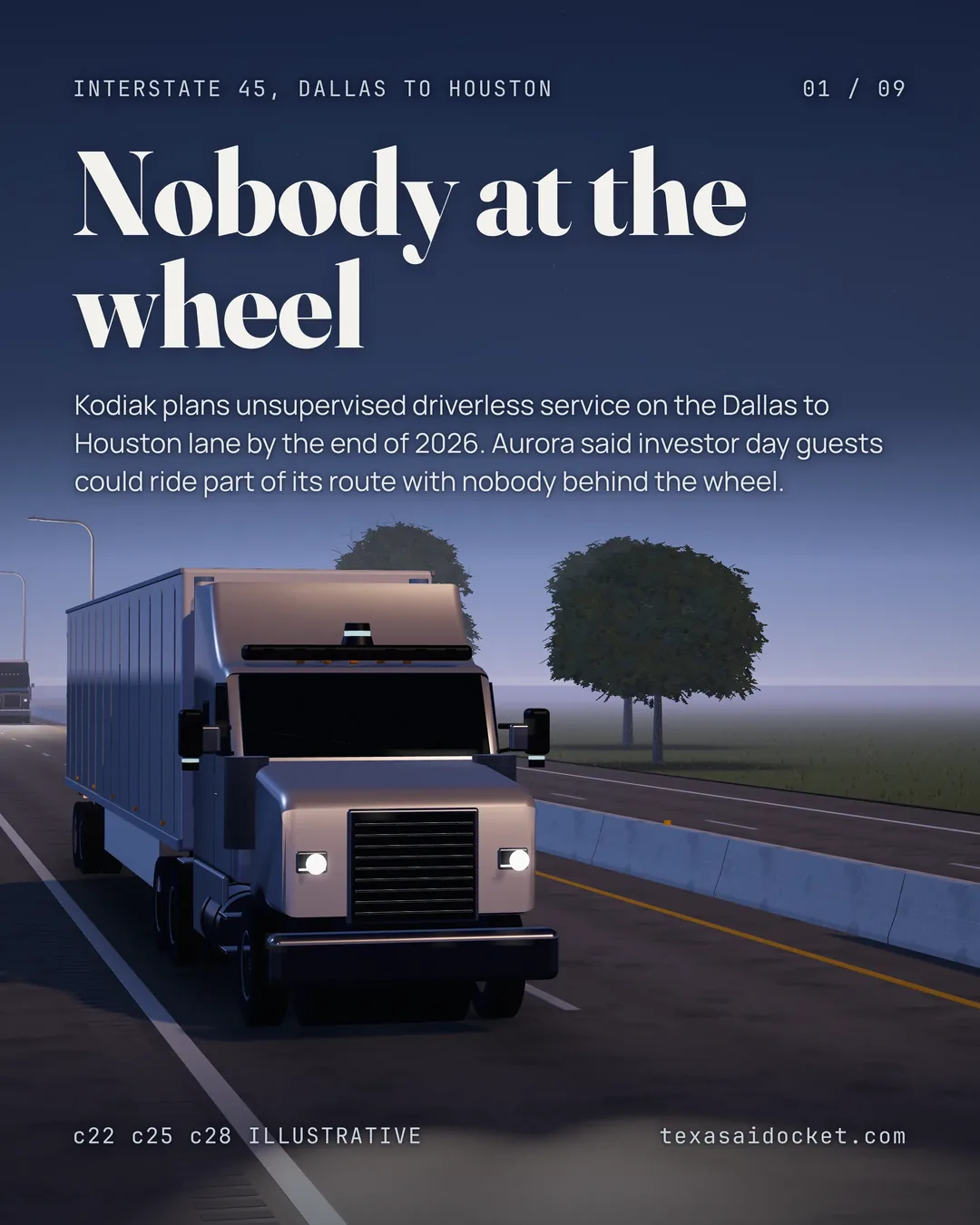
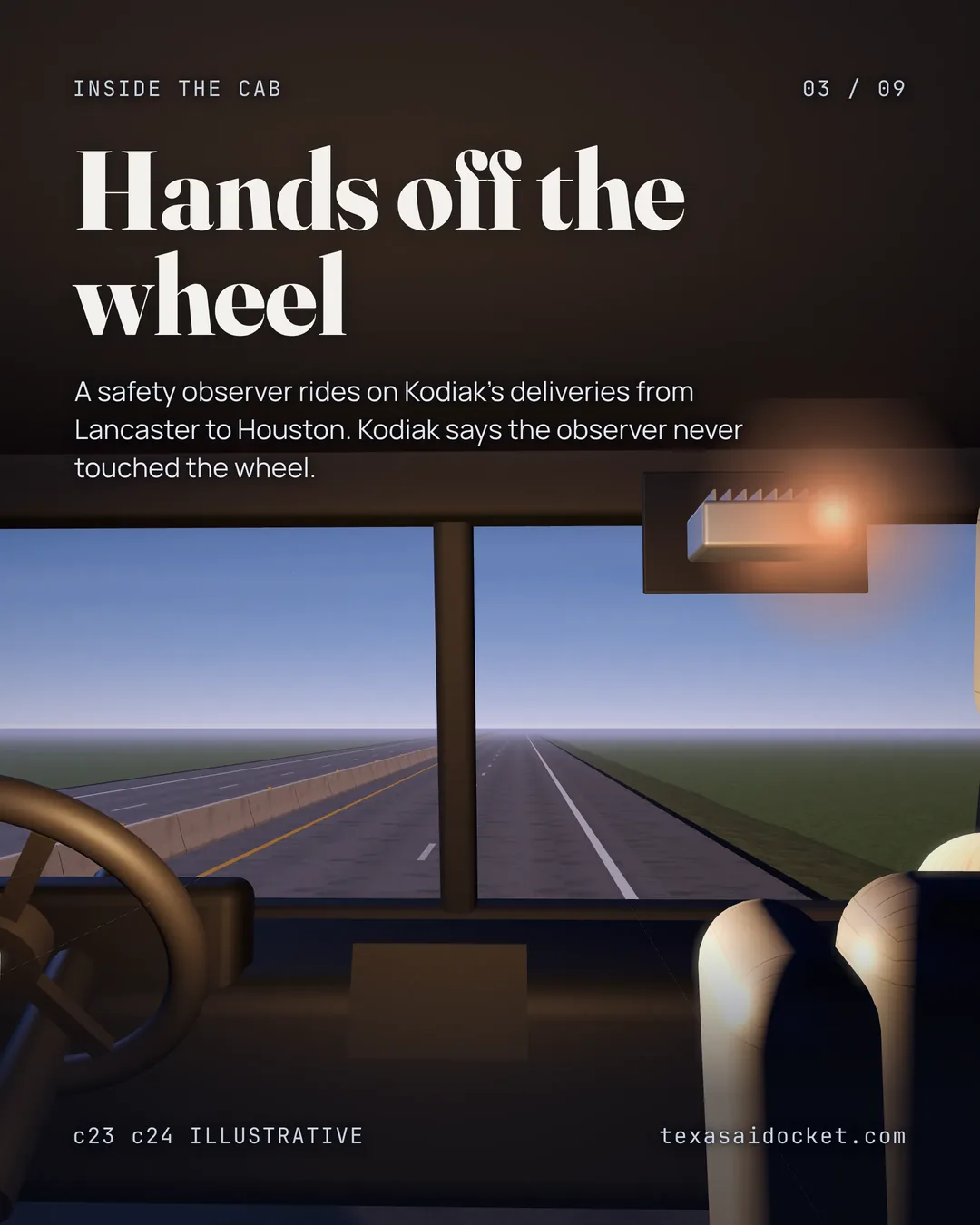
Kodiak AI has announced its plans to launch unsupervised long-haul driverless service on the Dallas-Houston freight lane by the end of 2026. It says it now consistently completes deliveries between its Lancaster, Texas, hub and its launch destination in Houston without human intervention. A safety observer still rides along, and the company says the safety observer never touched the wheel, including on surface streets.
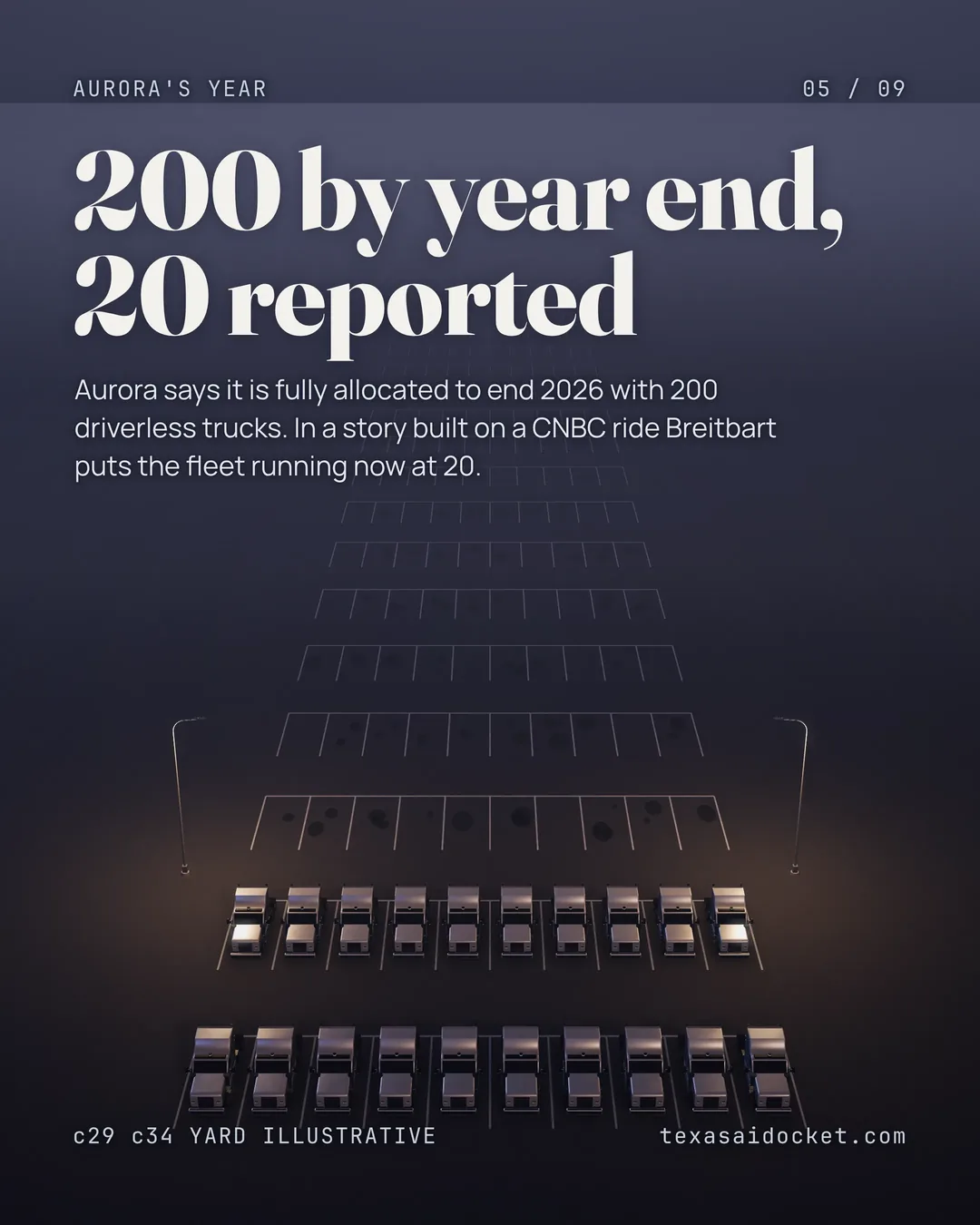
Aurora's release for its investor day in Dallas described rides on part of the same route. Attendees will have the opportunity to ride in Aurora Driver-powered trucks, without a person behind the wheel. Aurora says it is fully allocated to exit the year with 200 driverless trucks in operation. Those figures are the companies' own statements, not an agency's findings.
What the state asks for
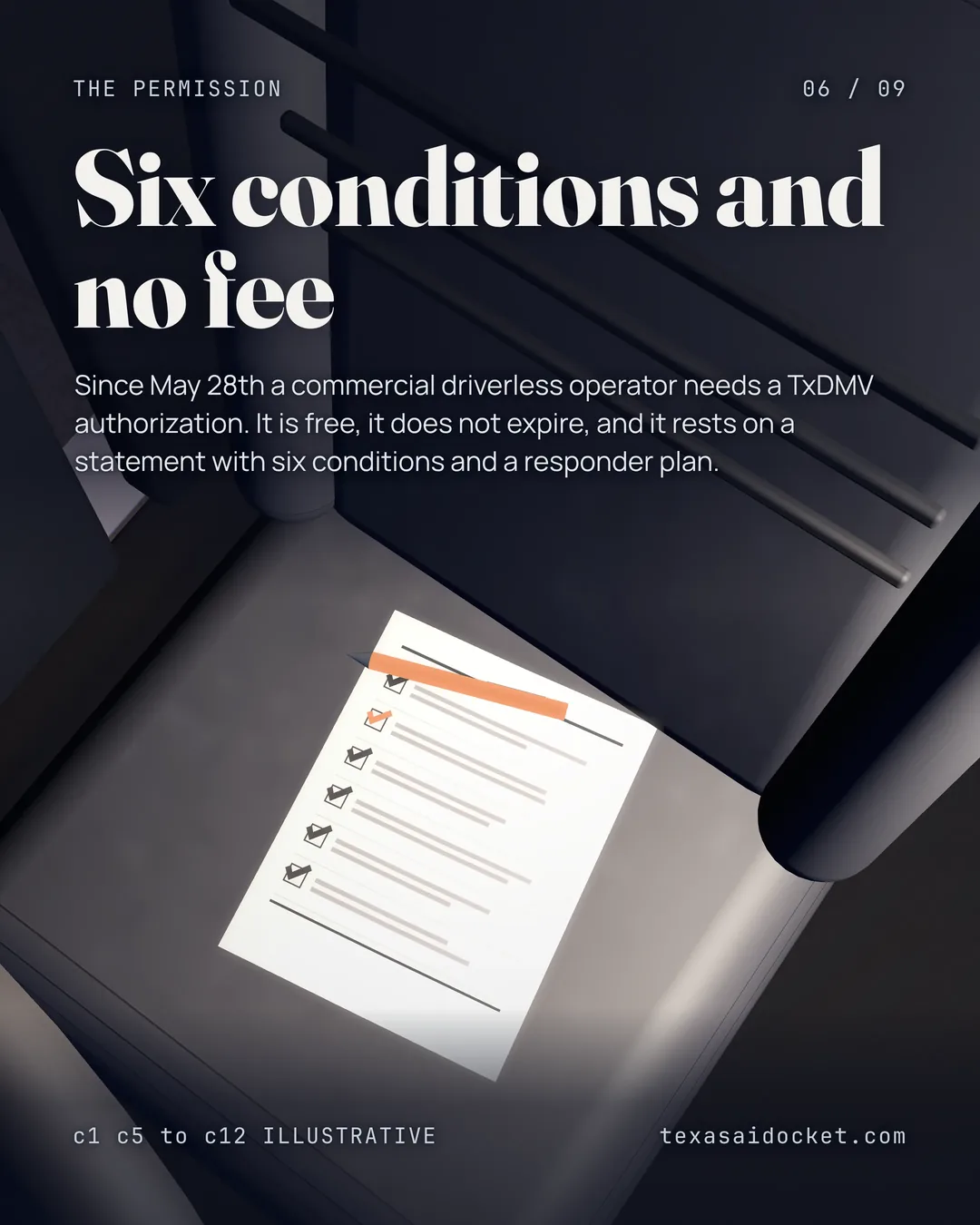
Texas has required a permission for this since May 28th, 2026. The Texas Department of Motor Vehicles says companies operating automated vehicles commercially are required to maintain an active authorization with TxDMV. Commercial activity means moving property or passengers in furtherance of a commercial enterprise on Texas roads without a human driver.
The application is a set of acknowledgements. The first says the truck is Capable of operating in compliance with applicable traffic and motor vehicle laws of this state. The next says it is Equipped with a required recording device, and that its driving system is in compliance with applicable federal law. The company also affirms the truck is Capable of achieving a minimal risk condition if that system fails. It affirms the truck is Registered and titled in accordance with the laws of this state and insured. It also certifies that the Department of Public Safety has a plan for how emergency responders should interact with the automated motor vehicle.
The department states the terms plainly. No fees are required for an authorization to operate automated vehicles. Authorizations do not expire and are valid until revoked by the department.
What the department can't require
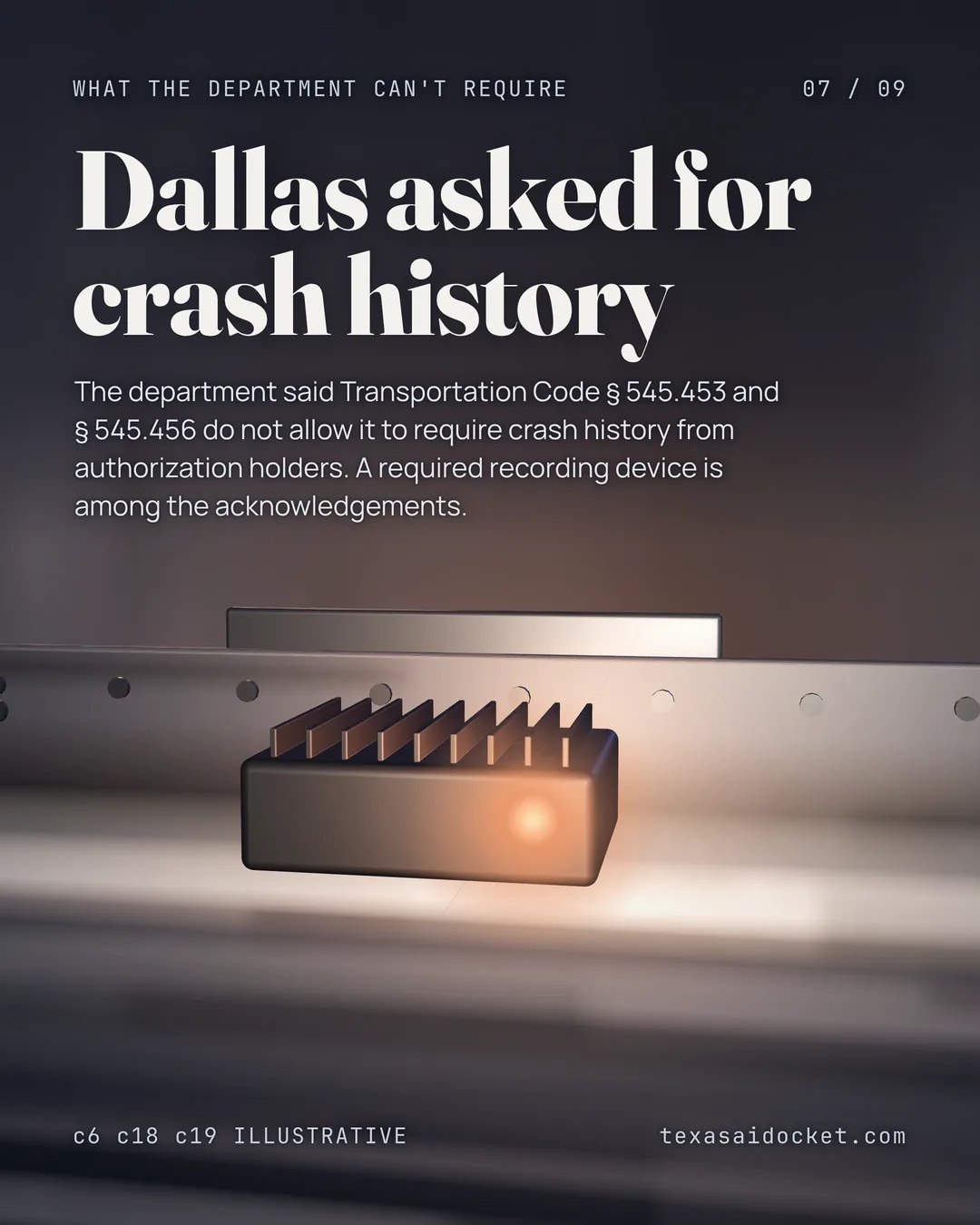
When the department wrote its rules, the City of Dallas asked for more. The City of Dallas encourages the department to require robust safety documentation, including crash history and proof of community stakeholder coordination, and to make information about approved operators publicly accessible.
The department answered that the law gave it no room. It wrote that Transportation Code, § 545.453 and § 545.456 do not allow the department to require authorization holders to submit crash history or proof of community stakeholder coordination. Whether it publishes information about operators, it said, is based on statutory confidentiality requirements in Government Code, Chapter 552. So a truck has to carry a recorder, and the department that authorizes it can't require the operator to hand over its crash history.
When the state steps in
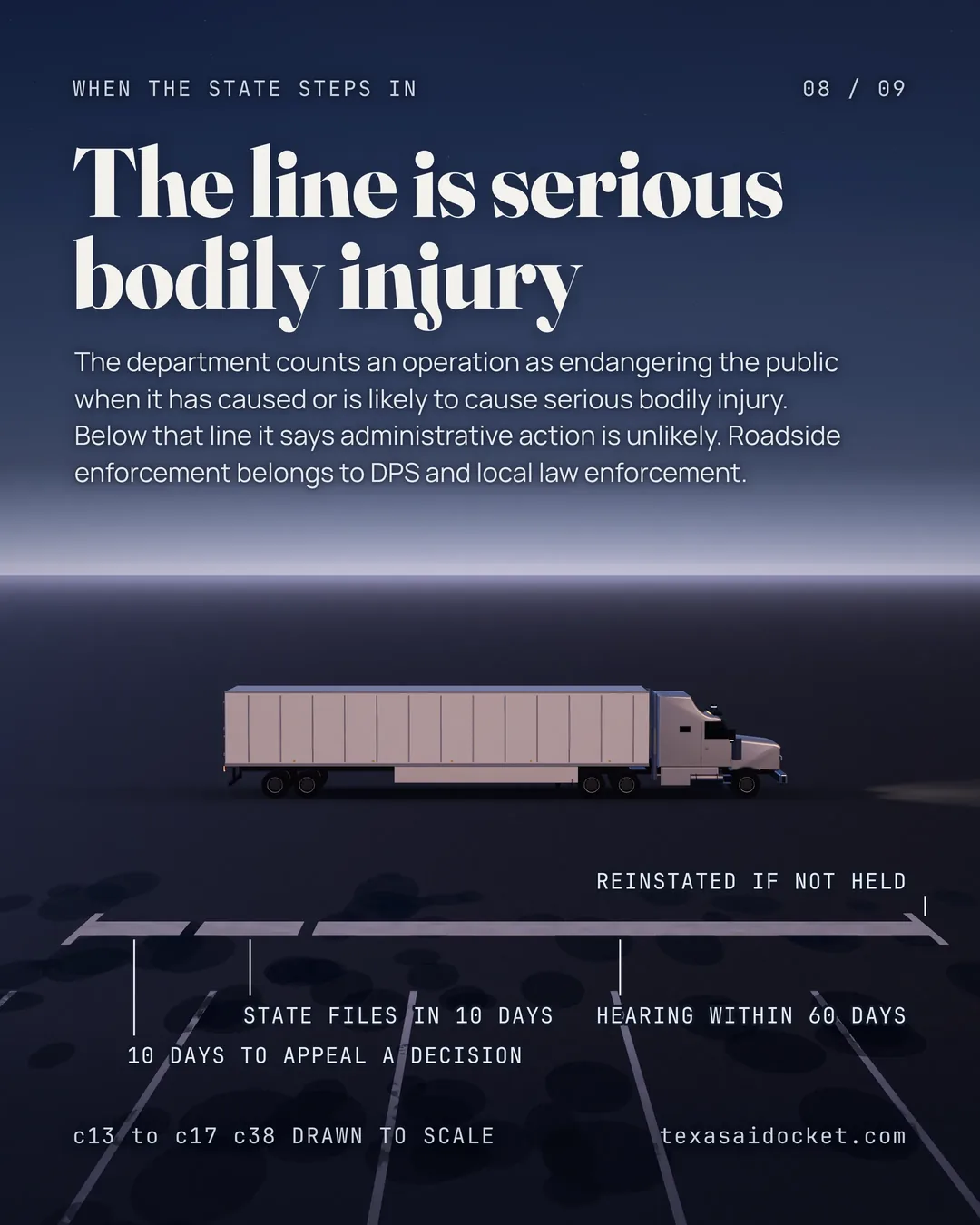
The department sets its line at serious harm. The operation of an automated motor vehicle is considered to endanger the public when it has caused or is likely to cause serious bodily injury. Below that line the department says so directly. The department is unlikely to take administrative enforcement action in those cases.
Once it acts, the operator has a path back. An authorization holder has 10 days to request that a final decision be reviewed by the State Office of Administrative Hearings (SOAH). The department then files within 10 days and the hearing must be held within 60 days of the request filed by the department. If the hearing is not held within the required time, then the authorization is immediately reinstated.
What a Texan can do
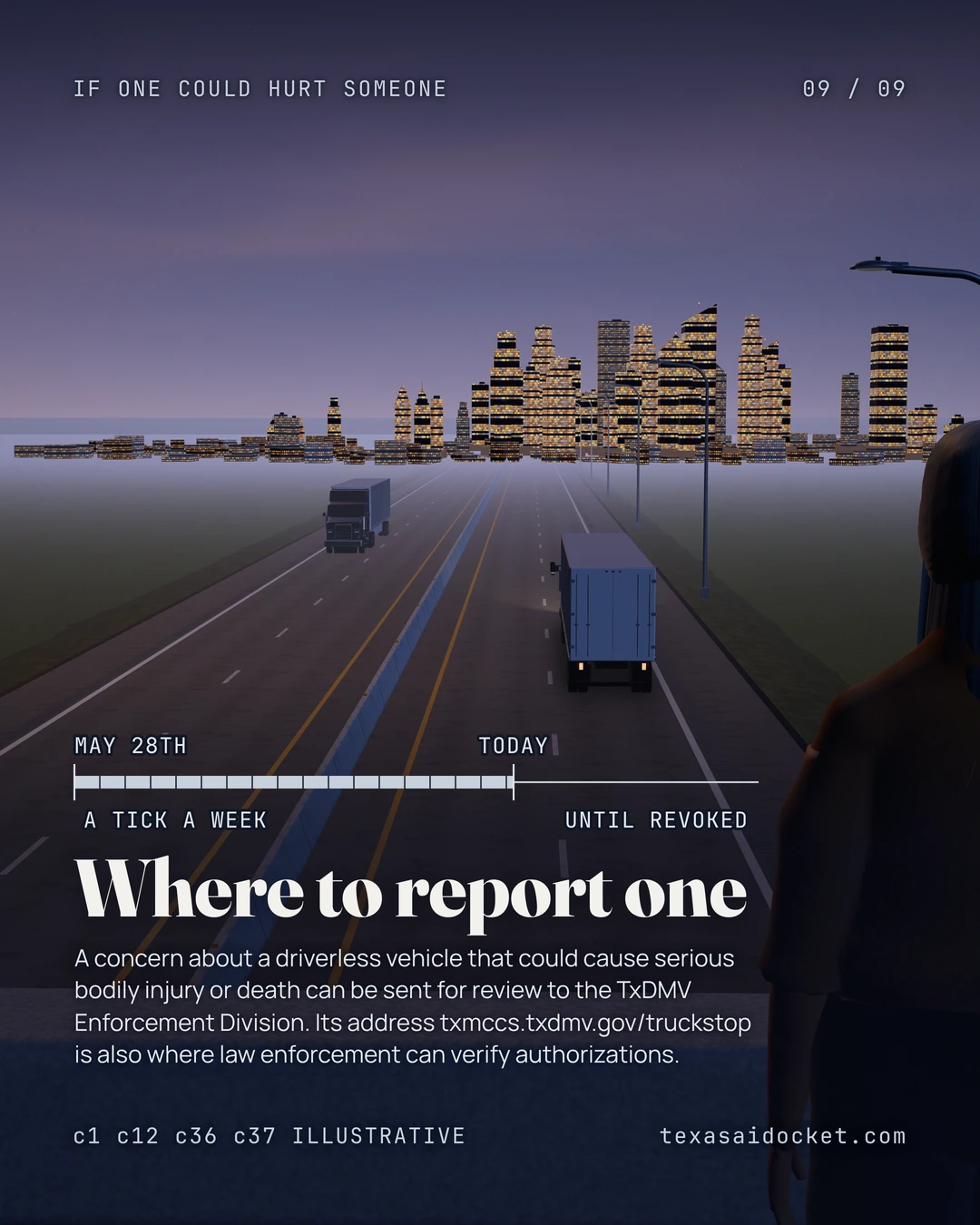
A concern about a driverless truck operating in a way that could cause serious bodily injury or death can be sent for review to the department's Enforcement Division at txmccs.txdmv.gov/truckstop. The same site is where law enforcement can verify whether a vehicle or its operator holds an authorization. Roadside enforcement stays with DPS and local law enforcement, as it does for any vehicle.
What this edition does not establish
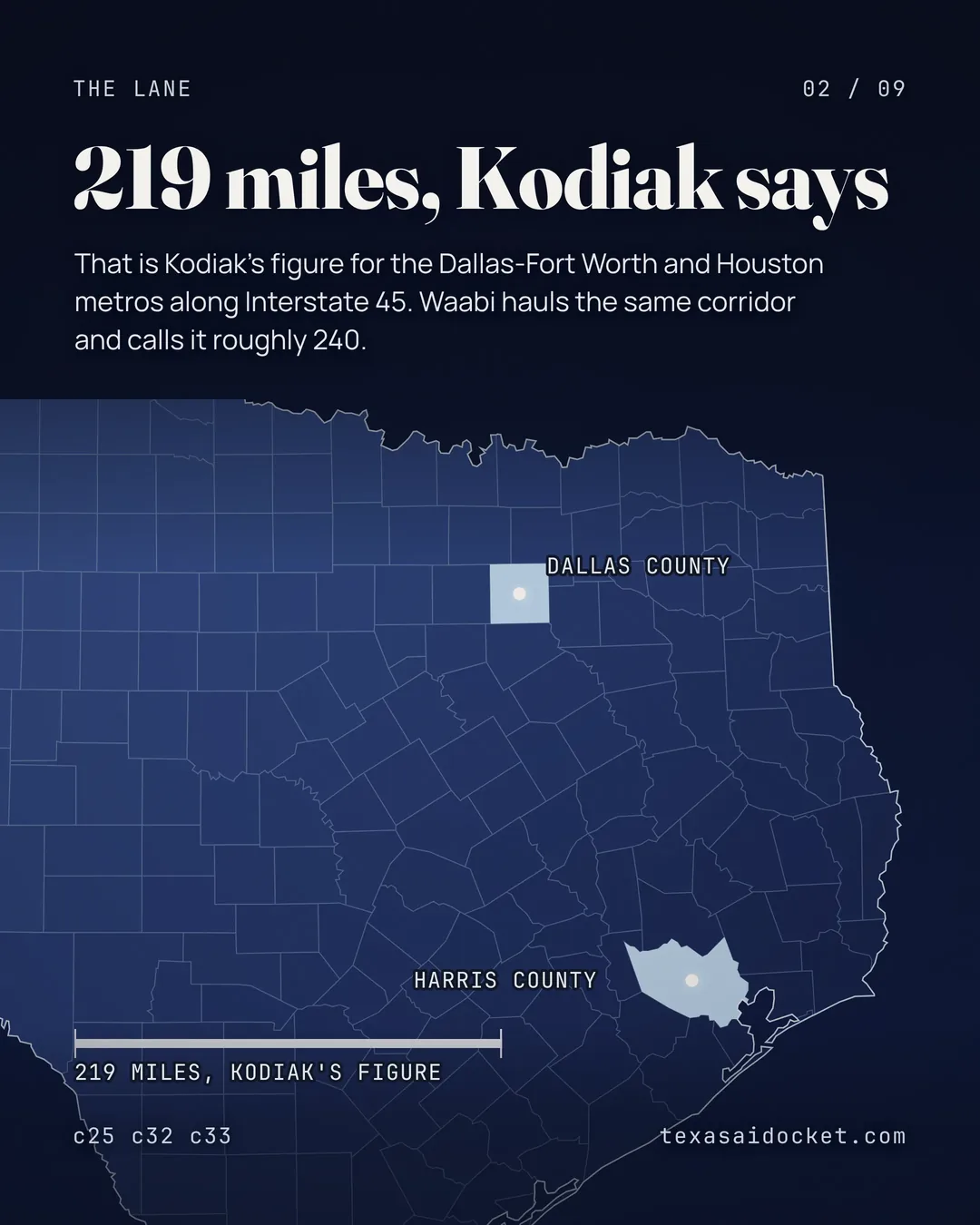
It does not establish which companies hold an authorization today, because the department's lookup was not read. The count of trucks now on the road comes only from Breitbart's account of a CNBC ride, which puts Aurora at 20 driverless trucks now. Kodiak and Waabi give different lengths for the same corridor, 219 miles apart along Interstate 45 and roughly 240 miles, and this edition does not choose between them. The sensor kit and the cab in the visual edition are illustrative and are not any one company's hardware.
Sources for this story
- Texas Department of Motor Vehicles, Automated Vehicles Regulatory Program
- Texas Department of Motor Vehicles, adopted 43 TAC Chapter 220, Automated Motor Vehicles
- Kodiak AI Names Dallas-Houston As Long-Haul Driverless Launch Lane, Consistently Completes Intervention-Free, End-to-End Deliveries (September 25, 2026)
- Aurora Outlines 2030 Vision to Scale to 30,000 Driverless Trucks at Analyst and Investor Day (DALLAS, September 23, 2026)
- Waabi, 80% Growth on Long Haul's Toughest Corridor (September 15, 2026)
- Breitbart, Aurora Tests Autonomous Semi Truck in Texas, Aims to Replace Human Drivers, Lucas Nolan (September 23, 2026)
Claim-by-claim verification · 38 claims
Texas requires every company running automated vehicles commercially to hold an active TxDMV authorization from May 28th, 2026.
All companies operating automated vehicles commercially on or after May 28, 2026, are required to maintain an active authorization with TxDMV.
The last of the TxDMV and DPS implementing rules for the program took effect on February 27th, 2026.
The department and DPS both proposed and adopted administrative rules related to the new programs, the latest of which become effective on February 27, 2026.
The department defines commercial activity as moving property or passengers for a commercial enterprise on Texas roads with no human driver.
Operation of an automated motor vehicle to transport property or passengers in furtherance of a commercial enterprise on Texas roads without a human driver.
Privately owned vehicles used for personal driving need no authorization.
Individually owned vehicles, operated for personal use, do not require an authorization.
An applicant acknowledges in writing that the vehicle can operate in compliance with Texas traffic and motor vehicle laws.
Capable of operating in compliance with applicable traffic and motor vehicle laws of this state
An applicant acknowledges the vehicle carries a required recording device.
Equipped with a required recording device
An applicant acknowledges the automated driving system complies with federal law.
Equipped with an automated driving system in compliance with applicable federal law
An applicant acknowledges the vehicle can reach a minimal risk condition if its driving system fails.
Capable of achieving a minimal risk condition if a failure of the automated driving system occurs that renders the system unable to perform
An applicant acknowledges the vehicle is registered and titled under Texas law.
Registered and titled in accordance with the laws of this state
An applicant acknowledges the vehicle is insured or self-insured at least to the level state or federal law requires.
Covered by motor vehicle liability coverage or self-insurance in an amount equal to or greater than the amount of coverage that is required under the laws of this state or federal law
An applicant also certifies that DPS has received its plan for how emergency responders should deal with the vehicle.
The applicant must also certify that the Texas Department of Public Safety has been provided a copy of the plan specifying how a person who provides firefighting, law enforcement, ambulance, medical, or other emergency services should interact with the automated motor vehicle during the provision of those services
The authorization costs nothing and lasts until the department revokes it.
No fees are required for an authorization to operate automated vehicles. Authorizations do not expire and are valid until revoked by the department.
The department counts an operation as endangering the public when it has caused, or is likely to cause, serious bodily injury.
The operation of an automated motor vehicle is considered to endanger the public when the operation has resulted, or is likely to result, in serious bodily injury as defined by Section 1.07, Texas Penal Code.
The department says it probably won't take administrative action on a complaint that falls below that serious-injury standard.
The department is unlikely to take administrative enforcement action in cases that do not meet this standard as defined by Texas Penal Code, Section 1.07.
A holder hit with an enforcement decision gets 10 days to ask for review at the State Office of Administrative Hearings.
An authorization holder has 10 days to request that a final decision be reviewed by the State Office of Administrative Hearings (SOAH).
The department files for a SOAH hearing within 10 days of the request, and the hearing has to happen within 60 days.
The department will file a request for a SOAH hearing within 10 days of receiving the request, and the hearing must be held within 60 days of the request filed by the department.
If that hearing is not held in time, the authorization is reinstated at once.
If the hearing is not held within the required time, then the authorization is immediately reinstated.
In rulemaking comments, the City of Dallas asked TxDMV to require crash history and to make approved operators public.
The City of Dallas encourages the department to require robust safety documentation, including crash history and proof of community stakeholder coordination, and to make information about approved operators publicly accessible.
TxDMV answered that the statute does not let it require crash history from authorization holders.
Transportation Code, § 545.453 and § 545.456 do not allow the department to require authorization holders to submit crash history or proof of community stakeholder coordination
TxDMV said whether it publishes information about authorization holders turns on state confidentiality law rather than on the rule.
whether the department makes information about authorization holders publicly accessible is based on statutory confidentiality requirements in Government Code, Chapter 552
The adopted rule says Chapter 220 took effect February 27th, 2026. Compliance is due by May 28th, 2026 or 90 days after the Public Safety Commission's rules take effect, whichever is later.
The effective date of Chapter 220 is February 27, 2026; however, a person is not required to comply with Subchapter J of Chapter 545 of the Transportation Code, as amended by SB 2807, and Chapter 220 until the later of May 28, 2026, or the 90th day after the effective date of the rules adopted by the Public Safety Commission
Kodiak says it plans unsupervised driverless long-haul service on the Dallas-Houston lane by the end of 2026.
today announced its plans to launch unsupervised long-haul driverless service on the Dallas-Houston freight lane by the end of 2026.
Kodiak says it now regularly completes deliveries from its hub in Lancaster, Texas, to Houston without human intervention.
now consistently completes deliveries between its Lancaster, Texas, hub and its launch destination in Houston without human intervention
A Kodiak safety observer is still aboard these deliveries, and the company says the observer never touched the wheel.
During these end-to-end deliveries, the safety observer never touched the wheel, including on surface streets.
Kodiak puts the Dallas-Fort Worth and Houston metros 219 miles apart on Interstate 45.
first driverless long-haul lane will connect the Dallas–Fort Worth and Houston metropolitan areas, 219 miles apart along Interstate 45
Kodiak says it has hauled freight between Dallas and Houston since 2019 with safety drivers in the cab.
Kodiak has delivered freight on the Dallas to Houston route since 2019 with safety drivers in the cab.
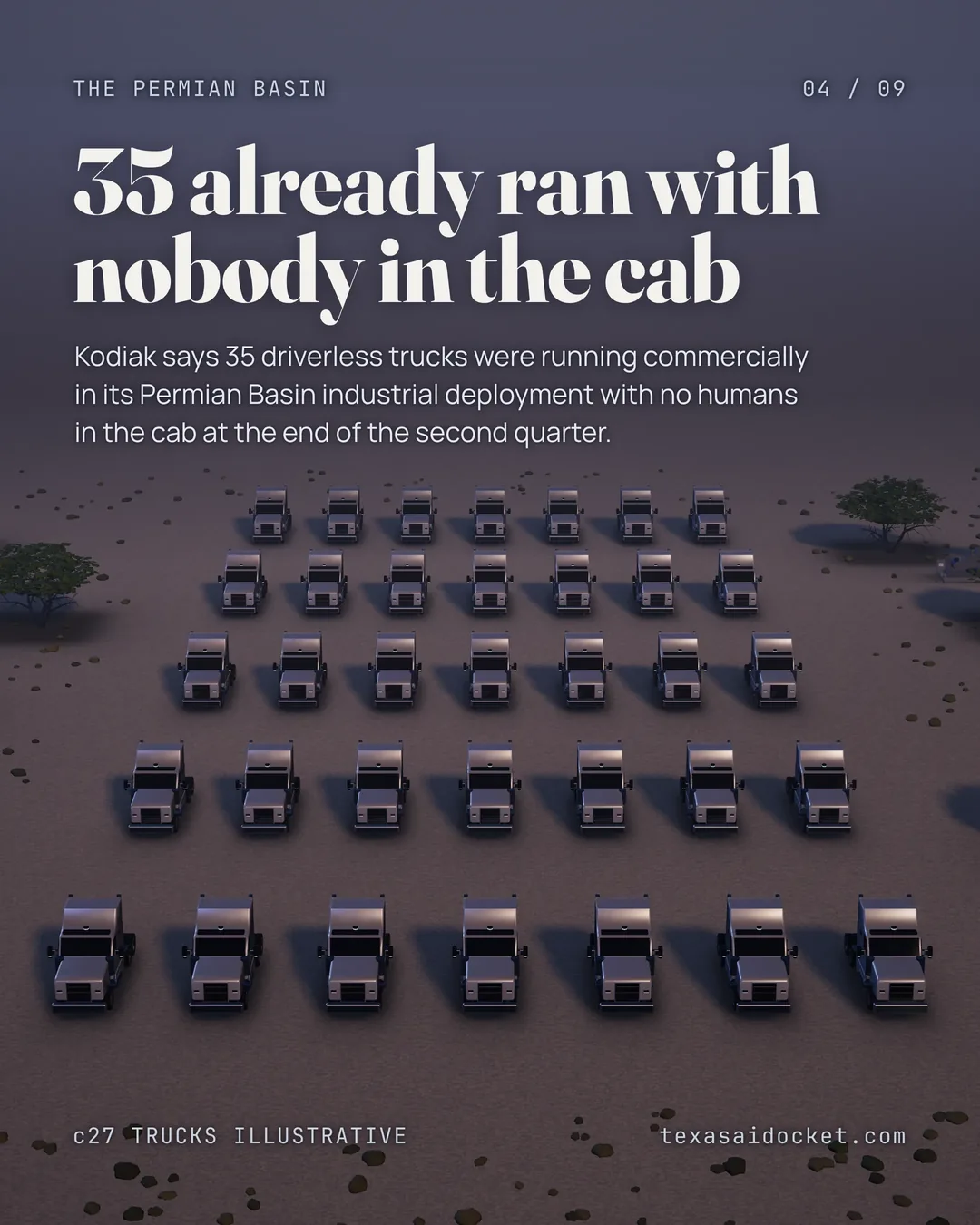
Kodiak says 35 driverless trucks were running commercially with nobody in the cab in its Permian Basin industrial deployment at the end of the second quarter.
the safety case the company completed for its industrial deployment in the Permian Basin, where 35 driverless trucks were operating commercially with no humans in the cab as of the end of the second quarter
Aurora says investor day attendees would ride its trucks with no one behind the wheel on part of its Dallas-to-Houston route.
Attendees will have the opportunity to ride in Aurora Driver-powered trucks, without a person behind the wheel, on a segment of Aurora’s Dallas-to-Houston commercial route.
Aurora says it is fully allocated to end 2026 with 200 driverless trucks in operation.
The company is fully allocated to exit the year with 200 driverless trucks in operation through Transport as a Service (TaaS) agreements.
Aurora says its driver has completed over 500,000 driverless miles since commercial launch.
having safely completed over 500,000 driverless miles since commercial launch
Aurora's 2030 target is more than 30,000 driverless trucks in operation.
Aurora will outline its 2030 vision, targeting more than 30,000 driverless trucks in operation
Waabi says its own Dallas-Houston load volumes have grown more than 80% in 2026.
commercial freight operations between Dallas and Houston are scaling rapidly, with load volumes growing more than 80% in 2026 alone
Waabi describes Interstate 45 as the backbone of the Texas Triangle, running roughly 240 miles between two major hubs.
Interstate 45 (I-45) is the backbone of the Texas Triangle, connecting two of the country’s largest economic and logistics hubs across roughly 240 miles.
Breitbart, reporting on a CNBC ride, says Aurora runs 20 driverless trucks now and wants 200 by year end.
Aurora runs 20 driverless trucks now and wants that fleet at 200 by the end of the year.
Per Breitbart's account of the CNBC ride, the Aurora truck pulled off the highway once for under a minute to reset hazard lights that had come on unexplained.
The truck pulled off the highway once, for less than a minute, to reset hazard lights that had switched on for unclear reasons.
A concern about an automated vehicle that could result in serious bodily injury or death can be submitted to the TxDMV Enforcement Division.
Beginning May 28, 2026, concerns about automated vehicles operating in ways that could result in serious bodily injury or death can be submitted to the TxDMV Enforcement Division for review at https://txmccs.txdmv.gov/truckstop
Law enforcement can verify a vehicle's or an operator's authorization at the same address.
Law enforcement officials can verify the TxDMV AV authorization status of individual vehicles or operators at https://txmccs.txdmv.gov/truckstop
Roadside enforcement of driverless vehicles belongs to DPS and local law enforcement, as it does for human-driven vehicles.
Roadside enforcement is the authority of the Texas Department of Public Safety and local law enforcement agencies