Articles · Federal action
Pinnacle, RealPage and a rent recommended overnight
A proposed federal judgment would bar a Frisco apartment manager from rent software fed by rivals' data. It binds one landlord, and the public can comment first.
Read the story





The Justice Department has asked a federal court to enter a judgment against Pinnacle Property Management Services. The proposed judgment was filed on September 4th, 2026. It bars Pinnacle from licensing or using a revenue management software that relies on competitively sensitive data. The Competitive Impact Statement describes the company plainly. Pinnacle, headquartered in Frisco, Texas, is one of the largest apartment managers in the United States.
The judgment comes out of a larger case. The United States first sued RealPage on August 23rd, 2024 with co-plaintiff states. On January 7th, 2025 it amended the complaint to add Pinnacle and five other property management companies. RealPage itself is headquartered in Richardson, Texas.
What the complaint says the software does
The government's account of the software is an allegation, not a finding. The amended complaint describes a nightly run. Every night, for each participating property, AIRM applies the model's learned parameters to that property's internal transactional data. It says a new floor plan price recommendation is generated daily. It says the model's learned parameters come from landlords' nonpublic data and are then used for all AIRM clients across the country.
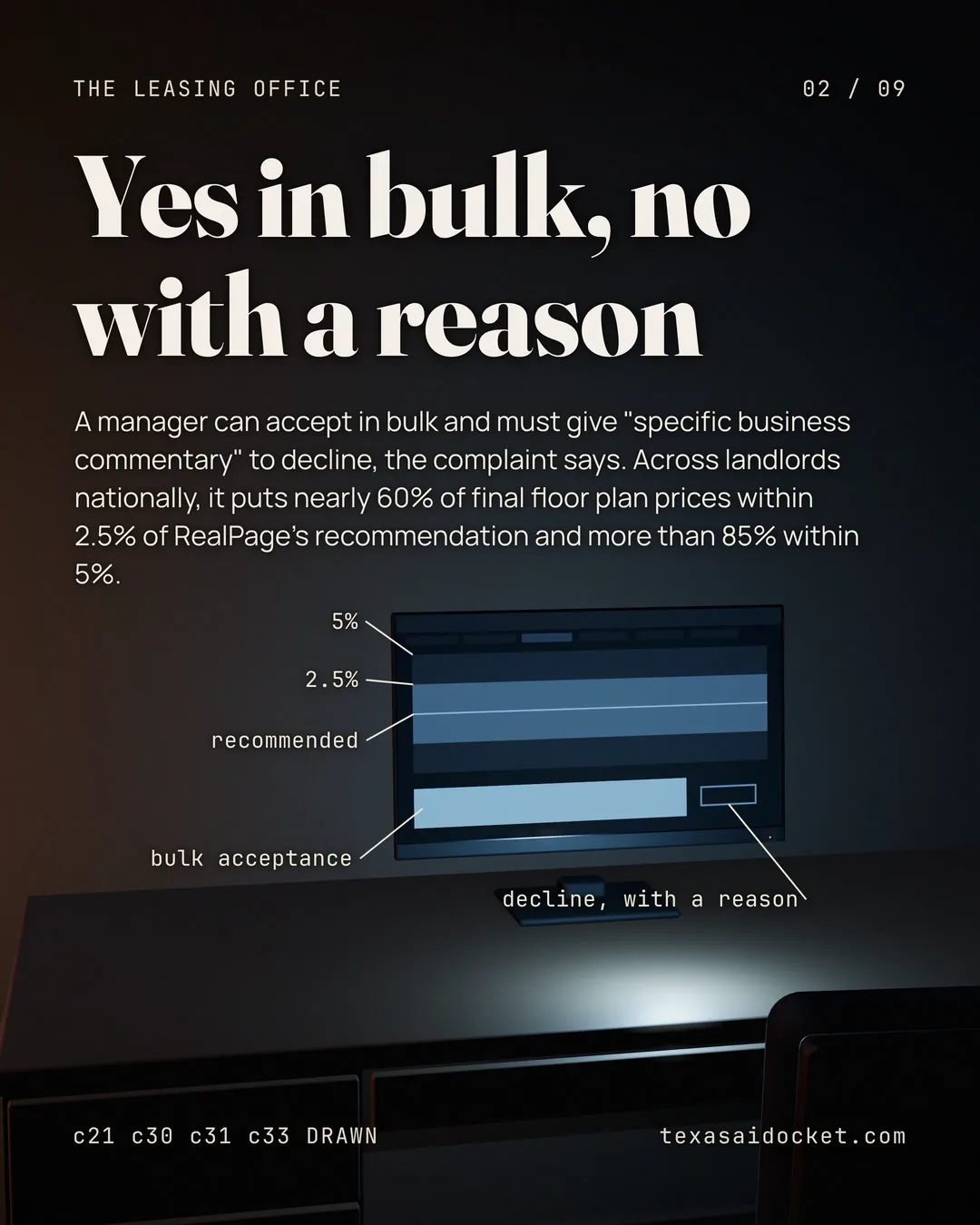
The complaint describes how easily a recommendation becomes a rent. Auto-accept is a switch the landlord can turn on or off. The complaint says by default, AIRM and YieldStar set auto-accept parameters of a 3% daily change and an 8% weekly change. Once it is on, it says, a landlord functionally delegates pricing authority to RealPage within those limits. A manager can choose to do a bulk acceptance, while one who declines must provide "specific business commentary". By the complaint's count, nearly 60% of final floor plan prices are within 2.5% of RealPage's recommendation.
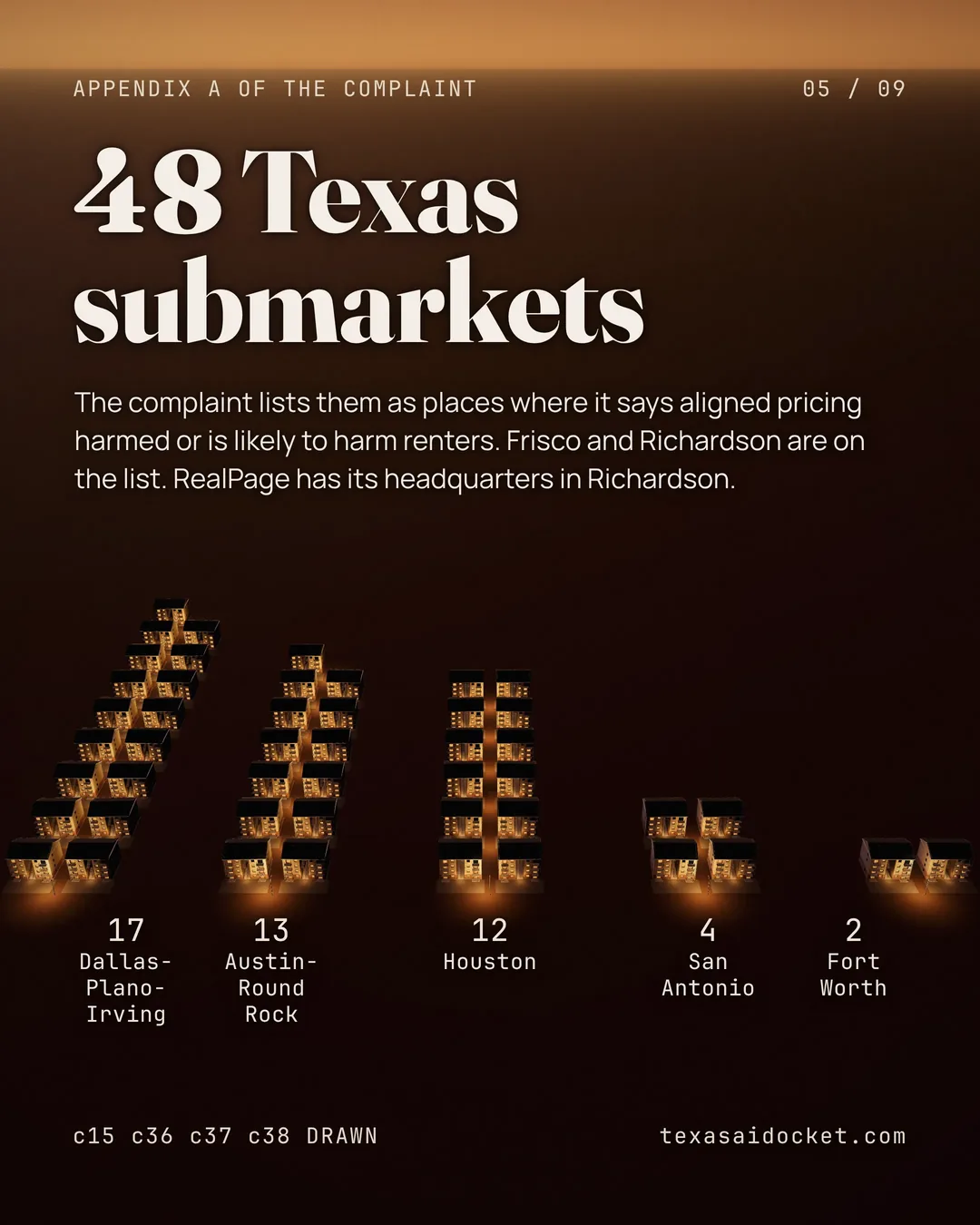
Texas is all over the complaint's market list. Appendix A names RealPage-defined submarkets where the government says aligned pricing has harmed or is likely to harm renters, and Frisco and Richardson are both on it. The complaint says the penetration rate for AIRM and YieldStar in each of those markets runs from at least around 26%% to 69%%.
What the judgment would require
The core limits are about data. Pinnacle can't use outside pricing software that relies on third-party nonpublic data to recommend or set prices. Nor can it use one that pools information across Pinnacle properties with different owners. It also can't use a product that requires Defendant to accept, or provides any financial rewards for Defendant to accept, any recommended rental prices. Those software limits begin 180 days after entry of the Stipulation and Order.
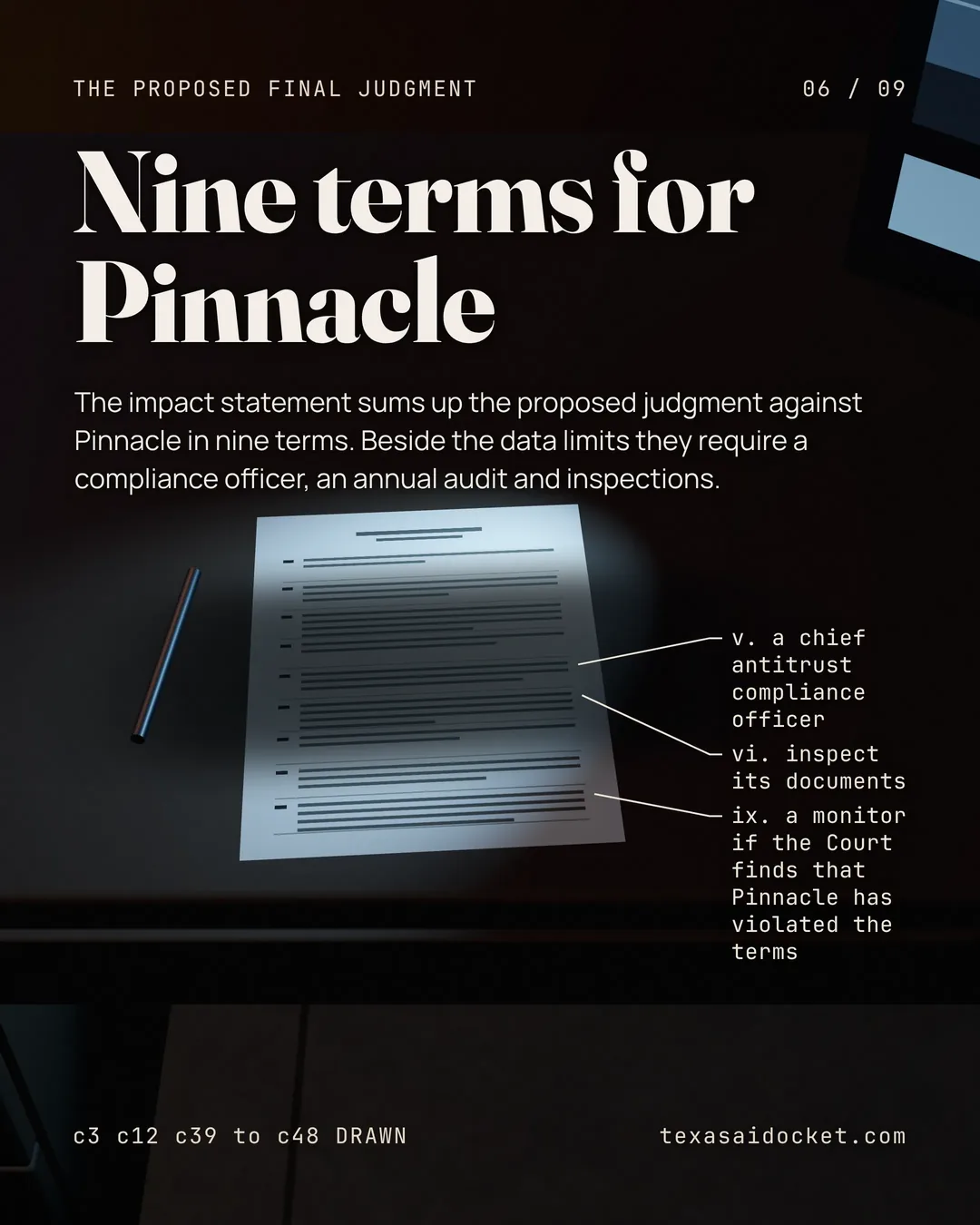
The rest is oversight. Pinnacle must designate a chief antitrust compliance officer, who will conduct an annual antitrust compliance audit. The United States may inspect its documents and interview its employees and may review the relevant code and pseudocode of Pinnacle's own pricing product. A court may appoint a monitor if the Court finds that Pinnacle has violated the terms.
What it doesn't do
It isn't a ban on RealPage. After entry by the Court of a RealPage Final Judgment, Defendant may license or use a RealPage Revenue Management Product without a separate certification. It binds Defendant, as defined above, and all other Persons in active concert or participation with Defendant who receive actual notice, not every landlord in Texas. Pinnacle consented without this Final Judgment constituting any evidence against or admission by any party, and the government's claims against the remaining defendants go on.
The record doesn't say whether the judgment will change any rent Pinnacle charges in Frisco or elsewhere. The filings describe what software Pinnacle may use, not what its rents will be.
How to comment
The notice ran in the Federal Register on September 18th, 2026, and public comment is invited within 60 days of the date of this notice. The Competitive Impact Statement words the window as 60 days from the later of its Federal Register publication or its newspaper summary. Comments go in English to the Technology and Digital Platforms Section of the Antitrust Division, or by email to ATR.Public-Comments-Tunney-Act-MB@usdoj.gov. The court may enter the judgment only after the Court's determination that the proposed Final Judgment is in the public interest.
Sources for this story
Claim-by-claim verification · 64 claims
The notice was published in the Federal Register on September 18th, 2026, in Volume 91 beginning at page 59304.
59304 Federal Register / Vol. 91, No. 180 / Friday, September 18, 2026 / Notices
A proposed Final Judgment, a Stipulation and a Competitive Impact Statement were filed in the federal district court for the Middle District of North Carolina in United States et al. v. RealPage et al.
a proposed Final Judgment, Stipulation, and Competitive Impact Statement have been filed with the United States District Court for the Middle District of North Carolina
The proposed Final Judgment was filed September 4th, 2026. It bars Pinnacle from licensing or using revenue management software that relies on competitively sensitive data, and from sharing such information with other landlords.
The proposed Final Judgment, filed on September 4, 2026, bars Pinnacle from licensing or using a revenue management software that relies on competitively sensitive data and prohibits Pinnacle from sharing competitively sensitive information with other landlords.
The United States filed the proposed Final Judgment and a Stipulation and Order on September 4th, 2026.
On September 4, 2026, the United States filed a proposed Final Judgment and a Stipulation and Order
The United States first sued RealPage on August 23rd, 2024, together with co-plaintiff states.
On August 23, 2024, the United States, along with co-plaintiff States, filed a civil antitrust Complaint
On January 7th, 2025, the United States and the co-plaintiff states amended the complaint to add Pinnacle and five other property management companies as defendants.
On January 7, 2025, the United States and its co-plaintiff States amended the Complaint to add Pinnacle Property Management Services, LLC (‘‘Pinnacle’’) and five other property management companies
The United States and Pinnacle agreed that the court may enter the proposed judgment after the Tunney Act procedures are complied with.
The United States and Pinnacle have stipulated that the proposed Final Judgment may be entered by the Court after compliance with the APPA.
The notice invites public comment within 60 days of the date of the notice.
Public comment is invited within 60 days of the date of this notice.
The Competitive Impact Statement sets the comment window at 60 days from its Federal Register publication or 60 days from the first newspaper publication of its summary, whichever is later.
within 60 days of the date of publication of this Competitive Impact Statement in the Federal Register, or within 60 days of the first date of publication in a newspaper of the summary of this Competitive Impact Statement, whichever is later
Comments go in English to Danielle Hauck, Acting Chief of the Technology and Digital Platforms Section of the Justice Department's Antitrust Division in Washington.
Comments should be submitted in English and directed to Danielle Hauck, Acting Chief, Technology and Digital Platforms Section, Antitrust Division, Department of Justice, 450 Fifth Street NW, Suite 7100, Washington, DC 20530
Comments may also be sent by email to ATR.Public-Comments-Tunney-Act-MB@usdoj.gov.
email address: ATR.Public-Comments-Tunney-Act-MB@usdoj.gov
The Justice Department's Competitive Impact Statement describes Pinnacle as headquartered in Frisco, Texas, and as one of the largest apartment managers in the United States.
Pinnacle, headquartered in Frisco, Texas, is one of the largest apartment managers in the United States.
The amended complaint lists Pinnacle's address as 2401 Internet Boulevard, Suite 110, in Frisco, Texas.
Pinnacle Property Management Services, LLC, 2401 Internet Blvd., Ste. 110, Frisco, TX 75034
The amended complaint says Pinnacle is the subsidiary through which Cushman and Wakefield runs its multifamily rental property business, and that Cushman and Wakefield acquired Pinnacle in March 2020.
Wakefield’s multifamily rental property business is operated through its subsidiary Pinnacle, and also under the Cushman & Wakefield name since acquiring Pinnacle in March 2020.
The amended complaint says RealPage is a Delaware company headquartered in Richardson, Texas.
RealPage is a privately-owned company organized and existing under the laws of the State of Delaware and is headquartered in Richardson, Texas.
The amended complaint lists RealPage's address as 2201 Lakeside Boulevard in Richardson, Texas.
REALPAGE, Inc., 2201 Lakeside Blvd., Richardson, TX 75082
The amended complaint says Camden Property Trust, a co-defendant, is headquartered in Houston, Texas.
Camden is a publicly-traded multifamily company organized under the laws of the State of Delaware and is headquartered in Houston, Texas.
The amended complaint lists co-defendant Willow Bridge Property Company at 2000 McKinney Avenue, Suite 1100, in Dallas, Texas.
Willow Bridge Property Company, LLC, 2000 McKinney Ave., Ste. 1100, Dallas, TX 75201
The amended complaint says Willow Bridge is organized under Texas law and headquartered in Dallas.
organized under the laws of the State of Texas and is headquartered in Dallas, Texas
According to the Competitive Impact Statement, Pinnacle licensed RealPage's AIRM and YieldStar products when the complaint was filed.
As of the date of the Complaint, Pinnacle licensed AIRM and YieldStar from RealPage.
The Competitive Impact Statement says Pinnacle reviews AIRM and YieldStar floor plan price recommendations every day. It says Pinnacle uses the products to set floor plan rents and even the prices of individual units.
It reviews AIRM and YieldStar floor plan price recommendations daily and uses these revenue management products to set scheduled floor plan rents and even unit-level prices.
The amended complaint says RealPage offered landlords three revenue management systems, YieldStar, AI Revenue Management (AIRM) and Lease Rent Options (LRO).
RealPage currently offers three revenue management systems to landlords: YieldStar, AI Revenue Management (AIRM), and Lease Rent Options (LRO).
The amended complaint says RealPage runs landlords' nonpublic leasing data through a machine learning model, and the learned parameters it produces are used for every AIRM client in the country.
This data is run through a machine learning model to generate learned parameters for supply and demand models that are then used for all AIRM clients across the country.
The amended complaint says RealPage generally retrains the AIRM models three to four times a year on updated nonpublic data.
RealPage generally retrains the models three to four times per year using updated nonpublic data.
The amended complaint says that every night AIRM applies the model's learned parameters to each participating property's own transaction data to forecast expected vacancies and lease applications.
Every night, for each participating property, AIRM applies the model’s learned parameters to that property’s internal transactional data to forecast the number of expected vacancies and expected lease applications for a certain period into the future.
The amended complaint says the pricing process repeats for every floor plan every night, producing a new floor plan price recommendation each day.
This process repeats for every floor plan in the client’s property, every night. A new floor plan price recommendation is generated daily.
The amended complaint says AIRM and YieldStar include auto-accept functions. Their default parameters are a 3% daily change and an 8% weekly change, and the landlord can change the parameters or disable or enable auto-accept.
By default, AIRM and YieldStar set auto-accept parameters of a 3% daily change and an 8% weekly change. The landlord can change these parameters, disable or enable auto-accept
The amended complaint says that by enabling auto-accept a landlord in effect hands pricing authority to RealPage within the daily and weekly limits.
a landlord functionally delegates pricing authority to RealPage (within the bounds of the daily and weekly limits)
The amended complaint quotes internal RealPage onboarding guidance saying auto accept should be confirmed as switched on.
AUTO ACCEPT should be confirmed as ‘on’ with parameters in place.
The amended complaint says a property manager accepting RealPage recommendations can choose to do a bulk acceptance.
When accepting recommendations, the manager can choose to do a bulk acceptance
The amended complaint says a property manager who declines a recommendation must give specific business commentary for going against it.
the property manager must provide ‘‘specific business commentary’’ for diverging from the recommendation
The amended complaint quotes a client who complained to RealPage that the design seemed to push clients to take the recommendations, almost as though anything else had been made hard.
trying to persuade [clients] to take the recommendations (almost like we made it hard to do anything but)
The amended complaint says nearly 60% of final floor plan prices were within 2.5% of RealPage's recommendation and more than 85% within 5%.
nearly 60% of final floor plan prices are within 2.5% of RealPage’s recommendation, and more than 85% are within 5% of RealPage’s recommendation
The plaintiffs allege that RealPage's data agreements give it access to confidential information from over 16 million units across the country.
These agreements grant RealPage access to confidential information from over 16 million units across the country
The amended complaint quotes a RealPage sales representative telling a prospective client that RealPage had over 16 million units of data flowing into its benchmarking platform.
we have over 16 million units of data coming from various source operating systems (PMS)
The amended complaint alleges that in each RealPage defined submarket listed in Appendix A, AIRM and YieldStar penetration ranges from at least around 26% to 69%.
The RealPage-defined submarkets identified in Appendix A are relevant markets in which the agreements between RealPage and AIRM and YieldStar users to align pricing has harmed, or is likely to harm, competition and thus renters. In each of these markets, the penetration rate for AIRM and YieldStar ranges from at least around 26% to 69%
Appendix A of the amended complaint lists Frisco as a RealPage defined submarket in the Dallas-Plano-Irving area. Its Texas rows, counted row by row in compute.py, number 48. That is 17 under Dallas-Plano-Irving, 13 under Austin-Round Rock, 12 under Houston-The Woodlands-Sugar Land, 4 under San Antonio-New Braunfels and 2 under Fort Worth-Arlington.
Dallas-Plano-Irving, TX ............................................ Frisco
Appendix A of the amended complaint also lists Richardson, where RealPage has its headquarters, as a RealPage defined submarket in the Dallas-Plano-Irving area.
Dallas-Plano-Irving, TX ............................................ Richardson
Under the proposed judgment, Pinnacle can't license or use any third party revenue management product that uses third party nonpublic data to recommend or set prices.
i. Pinnacle cannot license or use any third-party revenue management product that uses third-party nonpublic data to recommend or set prices;
Pinnacle can't use any third party revenue management product that pools information across Pinnacle properties with different owners.
ii. Pinnacle cannot license or use any third-party revenue management product that pools information across Pinnacle properties with different owners;
Pinnacle can't disclose, solicit or use competitors' competitively sensitive information that could be used to set rental prices.
iii. Pinnacle cannot disclose, solicit, or use competitively sensitive information from competitors that can be used to set rental prices or generate pricing;
Pinnacle must cooperate in the case against the other defendants.
iv. Pinnacle must cooperate in this civil antitrust proceeding (United States et al. v. RealPage et al.) with respect to the claims against other defendants;
Pinnacle must adopt a written antitrust compliance policy and name a chief antitrust compliance officer to train employees on it.
v. Pinnacle must adopt a written antitrust compliance policy and designate a chief antitrust compliance officer who will train Pinnacle employees on the policy
The chief antitrust compliance officer must run an annual antitrust compliance audit.
The chief antitrust compliance officer will conduct an annual antitrust compliance audit.
Pinnacle must let the United States inspect its documents and interview its employees to check compliance.
vi. Pinnacle must allow the United States to inspect its documents and to interview its employees to ensure compliance with the Final Judgment;
Pinnacle must let the United States inspect documents about its own proprietary revenue management product and review the product's code and pseudocode.
vii. Pinnacle must allow the United States to inspect documents regarding its proprietary revenue management product and review the relevant code and pseudocode;
If Pinnacle uses a third party revenue management product, it faces a court appointed monitor. The exception is a certification that the product meets the limits on using competitors' data, including in runtime operation and model training.
viii. If Pinnacle uses a third-party revenue management product, Pinnacle will be subject to the appointment of a monitor unless Pinnacle obtains a certification that meets certain requirements, including affirming, among other things, that the product complies with all required limitations regarding use of competitors’ competitively sensitive data in its runtime operation or model training;
Pinnacle will also face a monitor if the court finds it has violated the judgment.
ix. Pinnacle will also be subject to the appointment of a monitor if the Court finds that Pinnacle has violated the terms of the proposed Final Judgment.
The software restrictions take effect 180 days after the court enters the Stipulation and Order.
Beginning 180 days after entry of the Stipulation and Order Defendant must not, within the United States and its territories
The proposed judgment bars Pinnacle from using any revenue management product that requires it to accept recommended rents or pays it rewards for accepting them.
requires Defendant to accept, or provides any financial rewards for Defendant to accept, any recommended rental prices
The proposed judgment bars Pinnacle from using a product with a built in rent floor or a limit on recommended rent cuts. A floor chosen by hand is allowed if it isn't based on other landlords' nonpublic data.
incorporates a rental price floor or a limit on rental price recommendation decreases
Pinnacle may not attend or take part in RealPage meetings such as user groups and steering committees.
Defendant will not attend or participate in any RealPage Meetings.
Once the court enters a RealPage Final Judgment, Pinnacle may use a RealPage revenue management product without a vendor certification.
After entry by the Court of a RealPage Final Judgment, Defendant may license or use a RealPage Revenue Management Product at any Defendant Property without the need to obtain certification
The judgment would expire five years after entry, and the United States could end it after three years by notice if it is no longer needed.
this Final Judgment will expire five years from the date of its entry, except that after three years from the date of its entry, this Final Judgment may be terminated upon notice by the United States to the Court and Defendant
The judgment binds Pinnacle and people acting in concert with it who receive actual notice. It is not a rule for every landlord.
This Final Judgment applies to Defendant, as defined above, and all other Persons in active concert or participation with Defendant who receive actual notice of this Final Judgment.
Under the Stipulation and Order, Pinnacle must follow the proposed judgment's terms before the court enters it.
Pinnacle must abide by and comply with the provisions of the proposed Final Judgment until it is entered by the Court
Entry of the judgment would end the case only between the United States and Pinnacle.
Entry of the proposed Final Judgment will terminate this action with respect to the United States and Pinnacle
The United States' claims against the remaining defendants continue, and Pinnacle's duty to cooperate with them depends on reaching settlement with certain states.
Under the terms of the proposed Final Judgment, and subject to reaching settlement with certain States, Pinnacle must cooperate with the United States relating to the United States’ claims against the remaining defendants included in the Complaint.
Pinnacle consented without admitting anything, and the judgment is not evidence against any party.
without this Final Judgment constituting any evidence against or admission by any party relating to any issue of fact or law
The judgment does not stop any non-settling state attorney general from suing Pinnacle.
The entry of the Final Judgment does not limit the ability of any non-settling attorney general of any State to bring or maintain any action under federal or state law against Defendant.
The judgment neither helps nor hurts private antitrust damage suits.
Entry of the proposed Final Judgment neither impairs nor assists the bringing of any private antitrust damage action.
The court may enter the judgment only after it determines that the judgment is in the public interest under the Tunney Act.
The APPA conditions entry upon the Court’s determination that the proposed Final Judgment is in the public interest.
The Justice Department may withdraw its consent to the judgment at any time before the court enters it.
remains free to withdraw its consent to the proposed Final Judgment at any time before the Court’s entry of the Final Judgment
The amended complaint says that by RealPage's own account it controls at least 80 percent of the commercial revenue management software market.
By its own account, RealPage controls at least 80 percent of that market.