Articles · Utility regulation
Agreed to count AI fire detections, SPS counted cameras
Xcel Energy's Texas utility agreed to report AI camera fire detections under its approved plan. Its annual report answered that line with a count of cameras.
Read the story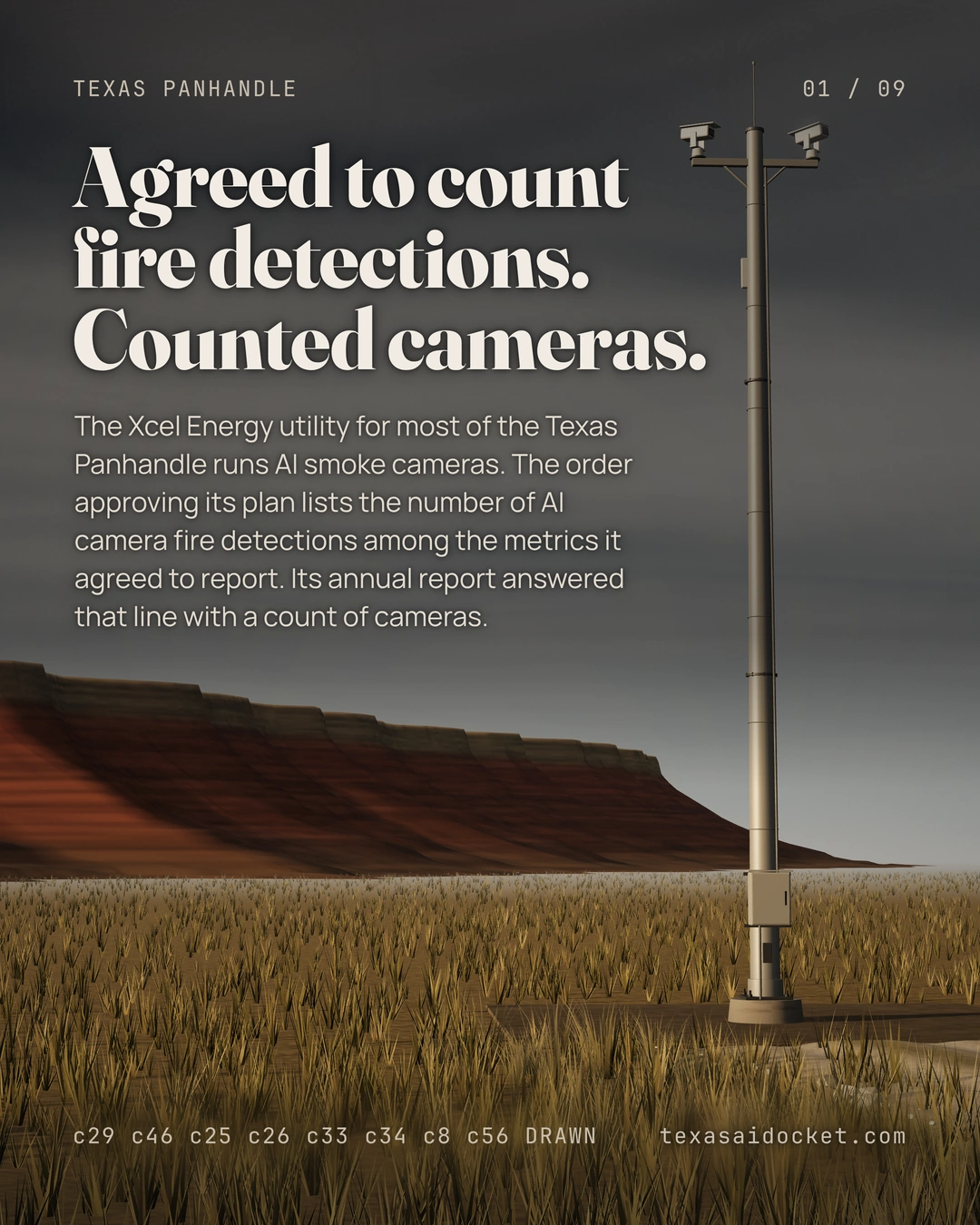
Southwestern Public Service Company operates as Xcel Energy, the Tribune reports. Its service area covers most of the Texas Panhandle, about 33,000 square miles by the utility's own study. Its resiliency plan called for AI cameras in its Tier 2 and Tier 3 wildfire risk areas.
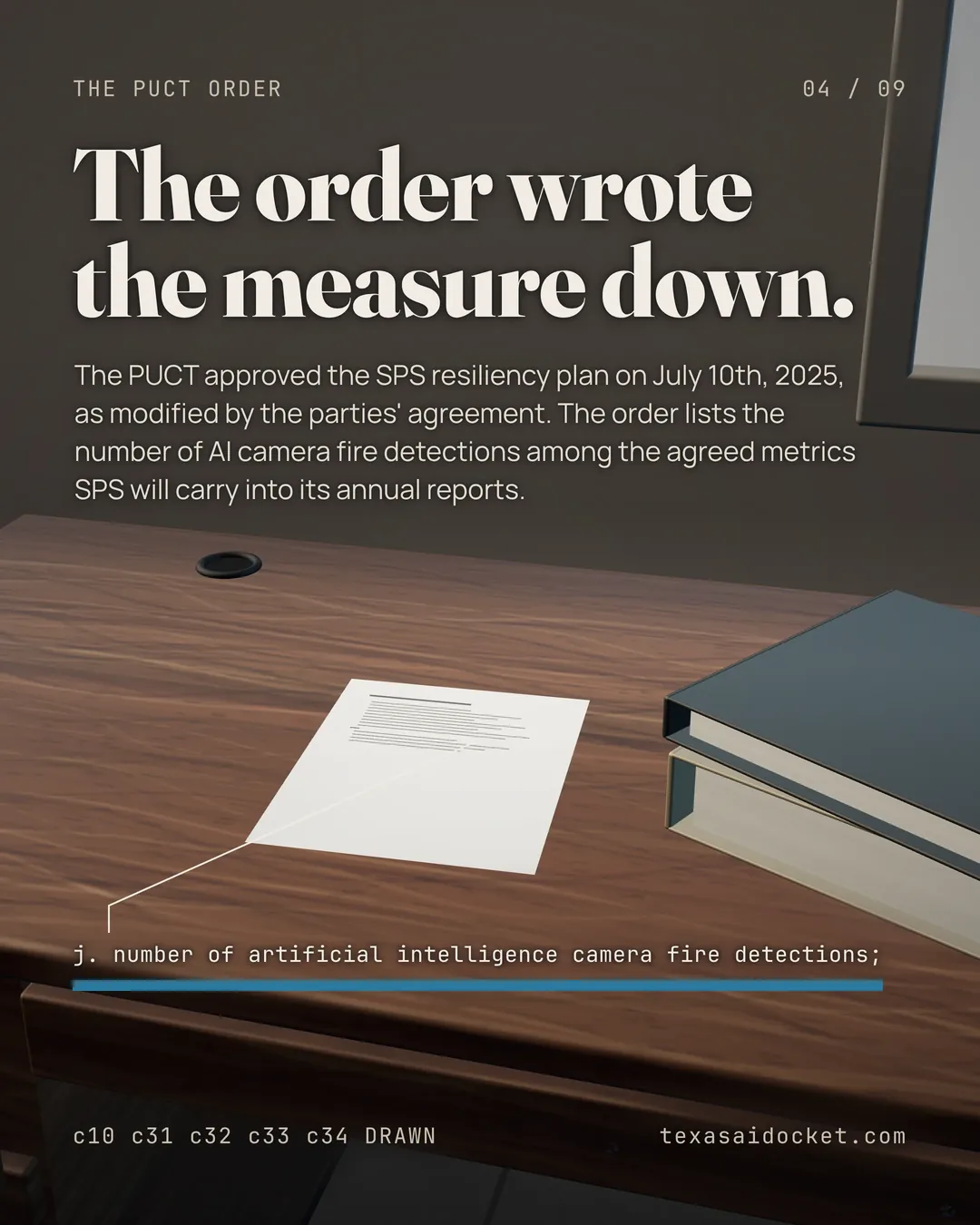
The Public Utility Commission approved the utility's resiliency plan on July 10th, 2025. The order lists the number of artificial intelligence camera fire detections among the evaluation metrics for that plan. SPS will include the agreed evaluation metrics in its annual resiliency plan reports under the same order.
What the report put on that line
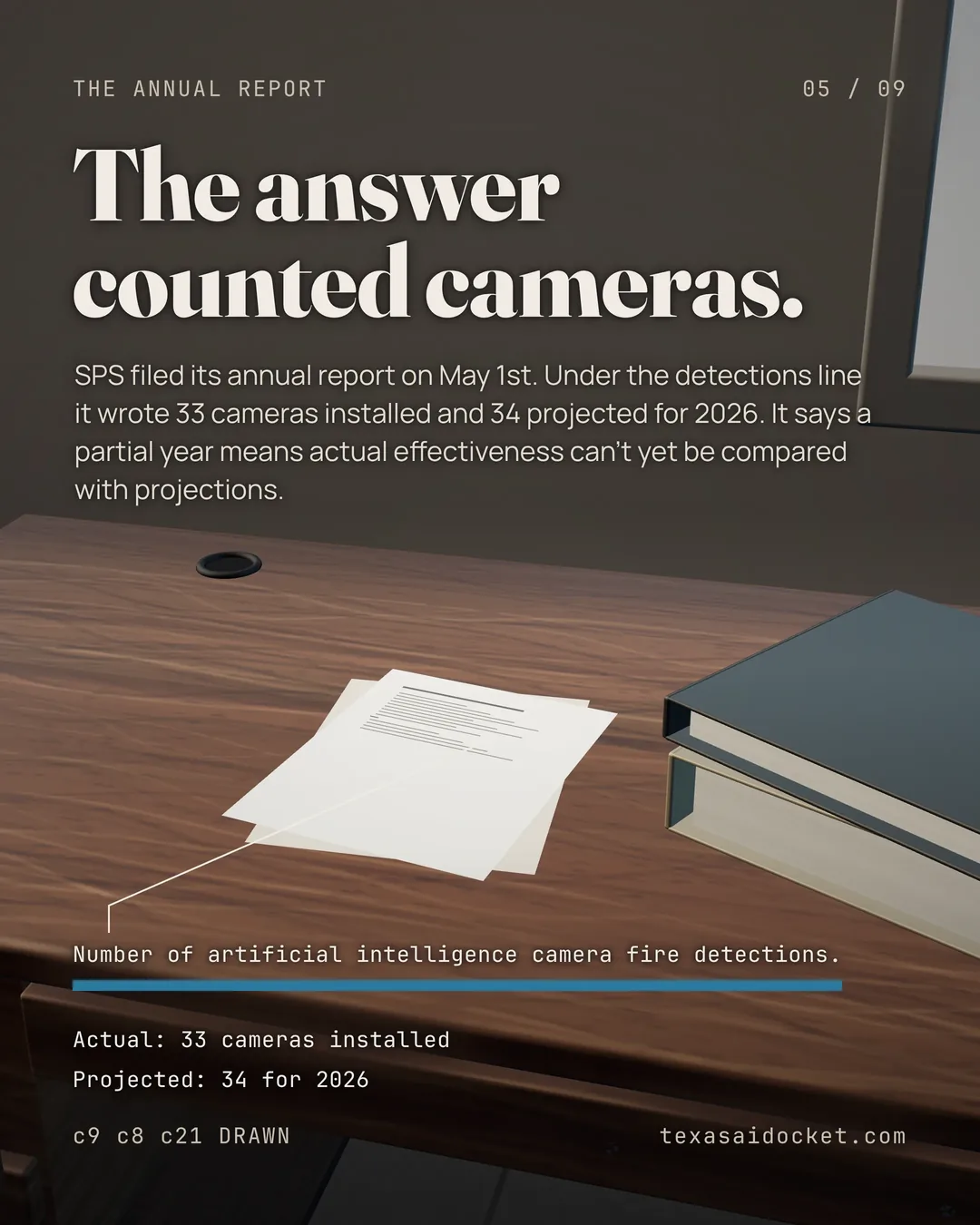
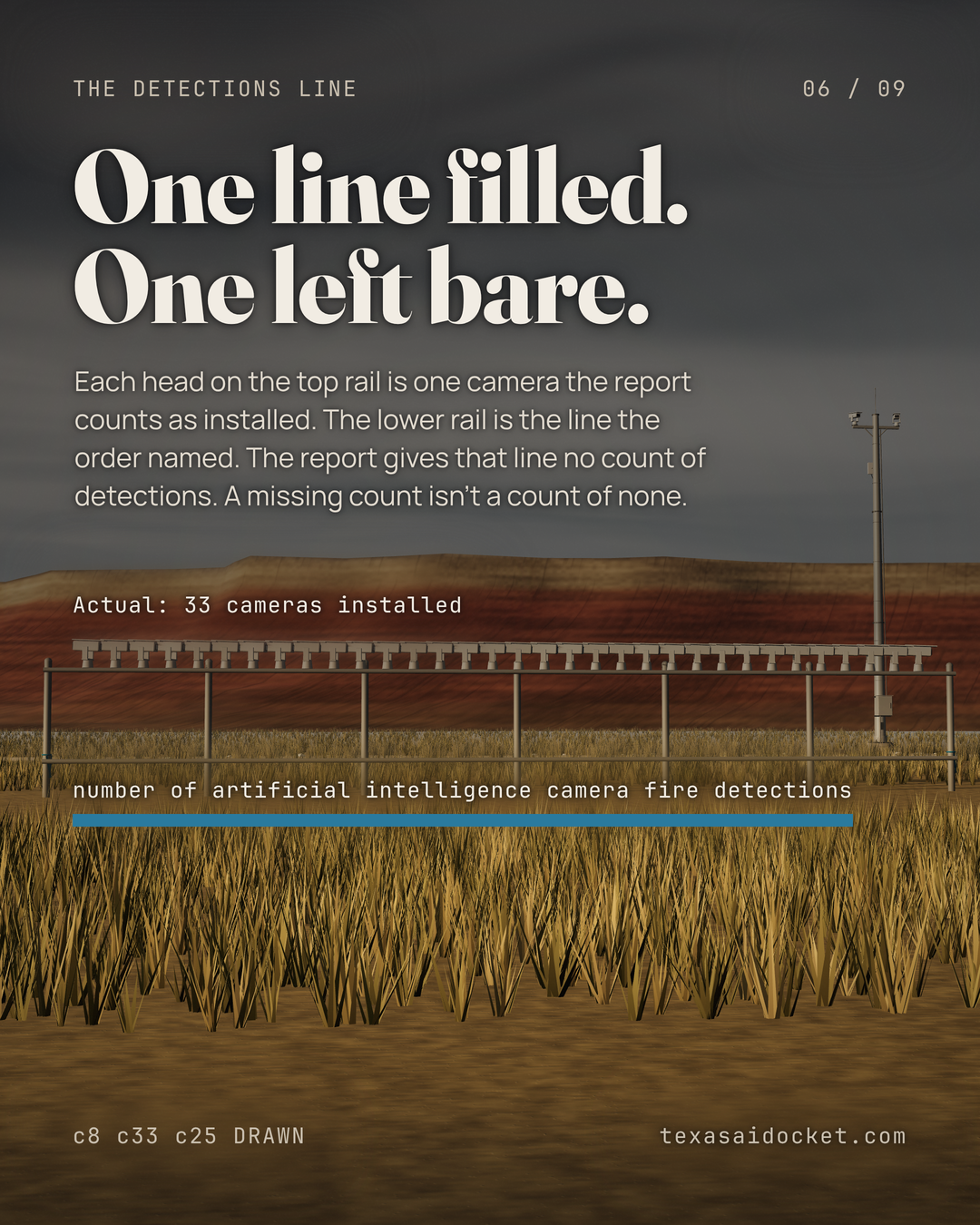
SPS filed its annual resiliency plan report on May 1st, 2026. Under the detections metric the report gives 33 cameras installed as the actual figure and 34 for 2026 as the projection. The line reports a count of cameras. It gives no count of detections.
The report states its own limits. SPS says the partial reporting year means it can't yet compare each measure's actual effectiveness with its projected effectiveness. Other lines on the same page do carry counts. For wildfire ignitions associated with overhead power lines the report gives a single actual figure of 24. It gives 26 as the actual total of wildfires reported by the National Interagency Fire Center in counties SPS serves.
What the cameras do
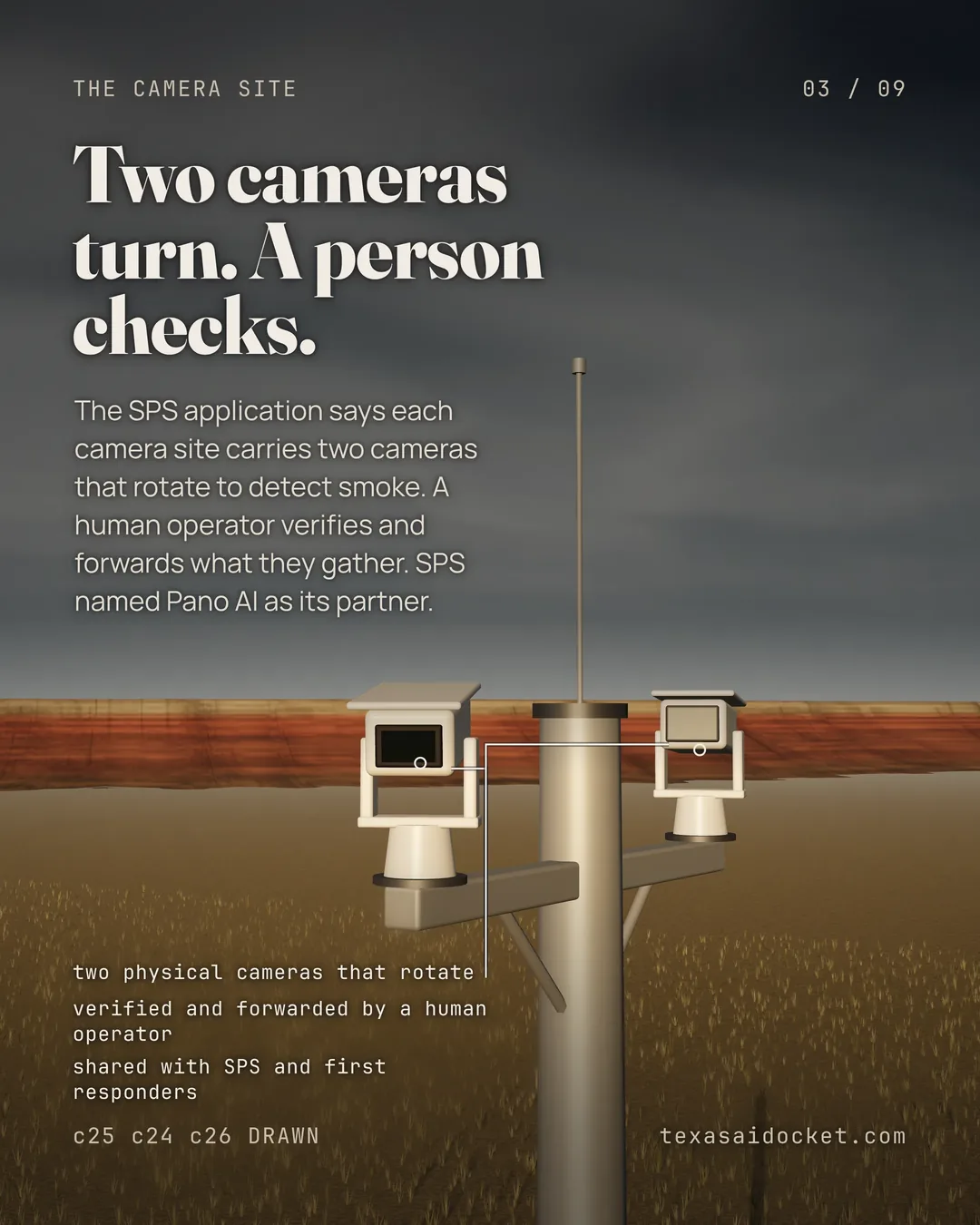
The plan application describes the system in plain terms. Each AI camera location carries two physical cameras that rotate to detect smoke. Data from the cameras is verified and forwarded by a human operator. SPS named Pano AI as its partner and said the system's fire detections are shared with SPS and first responders. SPS said it planned to install a total of 68 AI cameras in Tier 2 and Tier 3 wildfire risk areas.
What it costs
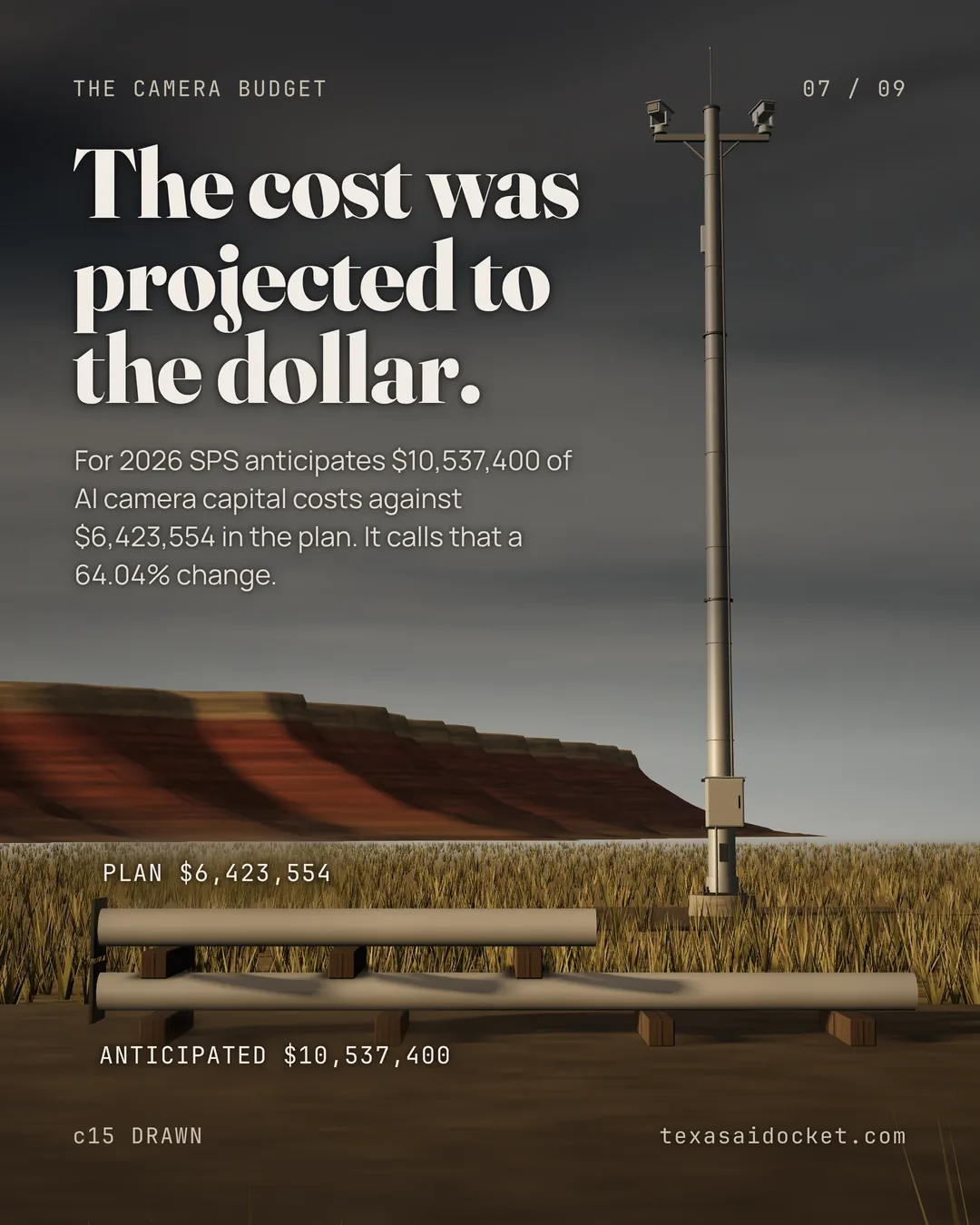
SPS budgeted $0 in 2025 capital for the AI camera project because the project was scheduled to start in 2026. It reports approximately $2M of actual capital spending on it in 2025 once the order was approved. For the current year SPS anticipates $10,537,400 of AI camera capital costs against $6,423,554 in the plan, which it calls a 64.04% change. It points in part to added system capabilities and expanded camera coverage in high-risk areas.
What the state asks of every utility
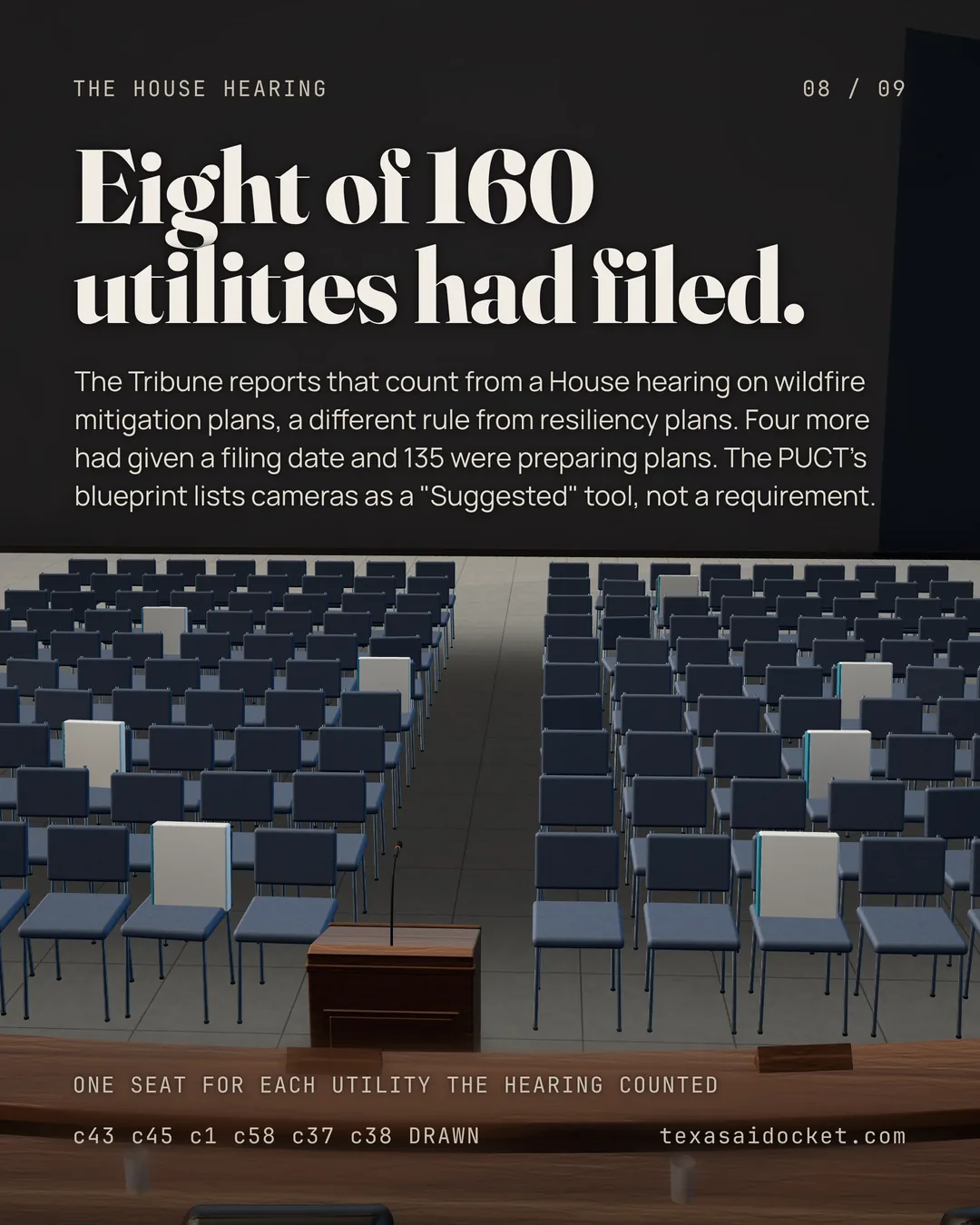
The rule behind these plans reaches far past one company. It applies to every electric utility, municipally owned utility and electric cooperative that owns a transmission or distribution facility in Texas. The staff blueprint for writing a plan treats cameras as optional. Its Situational Awareness section is marked Suggested and lists cameras or other monitoring technology as a tool. The PUCT said utilities are not required to use the blueprint. Pano AI had asked the commission to add a minimum requirement that plans describe their use of situational awareness solutions.
Few plans had arrived when lawmakers asked. Only eight of 160 utilities operating in fire-prone areas of Texas had complied with the wildfire mitigation plan law, the Tribune reports from a House State Affairs hearing.
What the record can't show
The report doesn't say whether the cameras detected a fire. It doesn't say they detected none either. A missing count isn't a count of zero. SPS says its 2027 annual report will carry a full year of data, and under the order that report carries the same line. The Tribune reports the company's interim president told lawmakers the company has deployed 97 wildfire detection cameras across its service territory. That count covers more than Texas.
Both documents are public on the PUCT Interchange. The order sits in Docket 57463 and the report in Project 57941. Under the state rule the deadline to intervene in a wildfire mitigation plan case is 30 calendar days from the date service of notice is complete.
Sources for this story
- PUCT substantive rule §25.60, Project 56789, rule text PDF
- PUCT Project 57941, Item 7, SPS annual resiliency plan report
- PUCT Docket 57463, Item 108, Order, Finding of Fact 5
- PUCT Docket 57463, Item 2, application, plan section 2.1.d Description of Artificial Intelligence Cameras Activity
- PUCT Project 59053, Item 20, staff memorandum (filing receipt dated 2026-04-10)
- PUCT news release dated April 17th
- PUCT Project 59053, Item 14, Pano AI comments (filing receipt dated 2025-12-29)
- The Texas Tribune, Jayme Lozano Carver, September 21, 2026
Claim-by-claim verification · 58 claims
The Texas wildfire mitigation plan rule, 16 TAC §25.60, carries the header marking effective 12/04/25 and project number P-56789.
§25.60-1 effective 12/04/25 (P-56789)
The wildfire mitigation plan rule applies to every electric utility, municipally owned utility and electric cooperative that owns a transmission or distribution facility in Texas.
This section applies to each electric utility, municipally owned utility, and electric cooperative that owns a transmission or distribution facility in this state.
The rule asks each plan to describe inspections, including any use of geospatial or remote sensing technologies such as LiDAR or satellite, or risk-modeling tools.
description of the entity’s use of geospatial or remote sensing technologies (such as Light Detection and Ranging (LiDAR), satellite, etc.) or risk-modeling tools
The rule requires a detailed operations plan for reducing wildfire ignition and responding to wildfire, including any use of automated fault detection devices or programs.
A detailed operations plan for reducing the likelihood of wildfire ignition from the entity’s transmission and distribution facilities and responding to a wildfire in the entity’s wildfire risk area(s), including, if applicable, a description of the entity’s use of automated fault detection devices or programs
Under the rule, the deadline to intervene in a wildfire mitigation plan case is 30 calendar days from the date service of notice is complete.
the intervention deadline is 30 calendar days from the date service of notice is complete.
An entity with an approved wildfire mitigation plan must file an annual report on it by May 1st of each year, starting the year after approval.
An entity with an approved wildfire mitigation plan must file an annual report on its plan by May 1 of each year, beginning the year after the plan is approved.
The rule lets commission staff develop one or more pro forma wildfire mitigation plans.
Commission staff may develop one or more pro forma wildfire mitigation plans.
The SPS annual report has a metric for the number of artificial intelligence camera fire detections. Under it, the report gives 33 cameras installed as the actual figure and 34 for 2026 as the projection. The line reports a count of cameras, not a count of detections.
Number of artificial intelligence camera fire detections. • Actual: 33 cameras installed • Projected: 34 for 2026
SPS filed its annual resiliency plan report in Project 57941 as Item 7 on May 1st, 2026.
Filed Date - 2026-05-01 03:15:44 PM Control Number - 57941 Item Number - 7
The SPS annual report states that the PUCT approved the SPS resiliency plan in Docket 57463 on July 10th, 2025.
current SRP was approved by the Public Utility Commission of Texas ("PUCT") in Docket No. 57463 on July 10, 2025
SPS says its AI cameras enhance its ability to detect smoke, identify fires and notify its Wildfire Command Center.
AI Cameras enhance SPS's ability to detect smoke, identify fires, notify the Wildfire Command Center
SPS budgeted $0 in 2025 capital for the AI camera project because the project was scheduled to start in 2026.
In 2025, SPS's budgeted $0 in capital expenditures for this project because it was scheduled to commence in 2026.
SPS reports that it started the AI camera work once the order was approved and incurred approximately $2M of actual capital spending on it in 2025.
However, once the Order was approved, SPS initiated work on this project, incurring approximately $2M of actual capital spend in 2025.
SPS reports $82,764 of operating and maintenance spending on AI cameras in 2025, against $0 estimated in the approved plan.
SPS' s O&M spend for AI Cameras in 2025 was $82,764 as compared to $0 estimated in the approved SRP.
For 2026 SPS anticipates $10,537,400 of AI camera capital costs against $6,423,554 in the plan, which it calls a 64.04% change.
In 2026, SPS anticipates $10,537,400 of capital costs as compared to $6,423,554 estimated costs included in the plan, resulting in a 64.04% change.
SPS attributes the higher AI camera costs partly to added system capabilities and expanded camera coverage in high-risk areas.
As implementation progressed, SPS incorporated additional system capabilities, expanded camera coverage in high-risk areas
SPS projects $463,646 of AI camera operating and maintenance costs for 2026, which it calls a 44.36% change from the plan.
current projections for that period are $463,646, resulting in a 44.36% change.
The report has a metric for wildfire ignitions associated with overhead power lines within each risk tier. It gives a single actual figure of 24 and a projection of 18 for 2026, with no breakdown by tier.
Number of wildfire ignitions associated with electric overhead power lines within each wildfire risk tier. • Actual: 24 • Projected: 18 for 2026
The report counts downed transmission and distribution wires by wildfire risk tier, with 83 in Tier 1, 22 in Tier 2 and 29 in Tier 3.
Wildfire Risk Tier 1: 83 Distribution and Transmission downed wires • Wildfire Risk Tier 2: 22 Distribution and Transmission downed wires • Wildfire Risk Tier 3: 29 Distribution and Transmission downed wires
The report gives 26 as the actual total of wildfires reported by the National Interagency Fire Center in counties SPS serves.
Total number of wildfires reported by the national interagency fire center in counties in SPS provides electric service. • Actual: 26
SPS says the partial reporting year means it can't yet compare each measure's actual effectiveness with its projected effectiveness.
Given the partial reporting year, a comparison of each measure's actual effectiveness with its projected effectiveness is not available at this time.
In its December 31st, 2024 application, SPS sought approval of a resiliency plan that included $538.3 million of investments.
On December 31, 2024, SPS filed the application at issue in this proceeding seeking approval of a system resiliency plan, including $538.3 million of investments
In its resiliency plan application, SPS said it planned to install a total of 68 AI cameras in Tier 2 and Tier 3 wildfire risk areas.
SPS plans to install a total of 68 cameras in Tier 2 and Tier 3 wildfire risk areas.
The SPS application says data from its high-resolution AI cameras is verified and forwarded by a human operator.
These high-resolution cameras gather data that is verified and forwarded by a human operator.
Each AI camera location in the SPS plan carries two physical cameras that rotate to detect smoke.
Each identified location is equipped with two physical cameras that rotate to detect smoke.
SPS named Pano AI as its partner for implementing the AI cameras, and said the system's fire detections are shared with SPS and first responders.
This system delivers real- time information and fire detections, which are shared with SPS and first responders.
In testimony filed with the application, SPS said approximately 64 percent of its system lies in Tier 2 or Tier 3 wildfire risk areas.
approximately 64 percent of SPS’ s system is located in either Tiers 2 or 3 wildfire risk areas
In the same testimony, SPS said its equipment appeared to be involved in two ignitions of the Smokehouse Creek Fire.
our equipment appeared to be involved in two ignitions of the Smokehouse Creek
The SPS service area covers most of the Texas Panhandle, approximately 33,000 square miles and 37 counties, according to the resiliency study in the application.
SPS’s service area covers most of the Texas Panhandle, covering approximately 33,000 square miles and 37 counties.
SPS testimony says the AI camera algorithm was trained on thousands of images.
The AI algorithm has been trained on thousands of images
The PUCT order in Docket 57463 was filed as Item 108 on July 10th, 2025.
Filed Date - 2025-07-10 11:54:00 AM Control Number - 57463 Item Number - 108
The commission approved the SPS system resiliency plan as modified by the parties' agreement and the order.
The Commission approves SPS's proposed system resiliency plan, as modified by the agreement and to the extent provided in this Order.
The order lists the number of artificial intelligence camera fire detections among the evaluation metrics for the SPS plan.
j. number of artificial intelligence camera fire detections;
Under the order, SPS will include the agreed evaluation metrics in its annual resiliency plan reports.
SPS will use the agreed-upon evaluation metrics and criteria and will include those evaluation metrics and criteria in the annual reports filed under 16 TAC § 25.62(g)
The wildfire mitigation measure was one of four resiliency measures the parties agreed to approve as SPS applied for them.
should be approved as applied for in the application: distribution overhead hardening, distribution system protection modernization, communication modernization, and wildfire mitigation.
The PUCT staff memo filed April 10th, 2026 says a utility may use the pro forma wildfire mitigation plan but is not required to.
An entity required to file an application for approval of a wildfire mitigation plan may, but is not required to, use a pro forma plan.
In the staff pro forma, the Situational Awareness section is marked Suggested rather than tied to a rule requirement, and it lists cameras or other monitoring technology as a tool.
Suggested - to support operational decision-making during elevated risk conditions
The PUCT said on April 17th, 2026 that utilities are not required to use its pro forma blueprint when preparing a wildfire mitigation plan.
These tools do not replace utility-specific planning, and utilities are not required to use the pro-forma blueprint when preparing a WMP.
In comments filed December 29th, 2025 on the draft pro forma, Pano AI asked the commission to add a minimum requirement that plans describe their use of situational awareness solutions.
Pano recommends inclusion of an additional minimum requirement to provide a description of the use of situational awareness solutions.
Pano AI told the commission its product is deployed with more than 20 electric utilities, naming CenterPoint Energy, American Electric Power, Xcel Energy and Austin Energy.
Our solution is deployed with more than 20 electric utility companies across the United States, including CenterPoint Energy, American Electric Power, Xcel Energy, and Austin Energy in Texas.
The Texas Tribune reports that Brad Baldridge, interim president of Southwestern Public Service Company, told lawmakers the company has deployed 97 wildfire detection cameras across its service territory. That is a service territory count, not a Texas count.
The company was heavily criticized in the wake of the fires and has since deployed 97 wildfire detection cameras across its service territory.
According to the Tribune, the SPS cameras use AI to detect smoke and send that information in real time to utility personnel, local fire responders and emergency managers.
The cameras use AI to detect smoke and provide that information in real-time to utility personnel, local fire responders and emergency managers.
The Tribune reports that only eight of 160 utilities operating in fire-prone areas of Texas had complied with the wildfire mitigation plan law. Lawmakers learned it at a House State Affairs committee hearing.
Only eight of 160 utility companies that operate in fire-prone areas of Texas have complied with a law that helps mitigate wildfires, lawmakers recently learned.
Rep. Ken King warned utilities that had not filed that January is coming, as reported by the Tribune.
I think it’s imperative for anybody that has not filed that report to realize January is coming.
PUC director Connie Corona told lawmakers that beyond the eight filed, four more utilities had given a filing date, the Tribune reports. Corona said 135 were preparing plans and 13 had not communicated.
four more have given the PUC a date for when they intend to file their plans. Corona said another 135 have indicated to the PUC they are in the process of preparing their plan. This leaves 13 who have not communicated their plans to the PUC.
The Xcel Energy president whose title covers New Mexico and Texas announced the Texas resiliency plan. It proposed approximately $539 million in investments and included placing panoramic cameras among its wildfire measures.
Adrian J. Rodriguez, president, Xcel Energy – New Mexico, Texas
In Colorado, Xcel Energy says it is more than tripling its deployment of Pano AI camera stations. This is a Colorado statement, not a Texas one.
more than tripling our deployment of Pano AI camera stations, which can identify smoke plumes and potential fire starts within minutes
In Colorado, Xcel Energy described Pano cameras that spot wildfire activity within a 15-mile radius and notify Xcel Energy and first responders when an incident is detected. This describes the Colorado system.
As soon as an incident is detected, a notification is sent to Xcel Energy and first responders, providing detailed visuals and location triangulation.
The TDEM wildfire risk area determination counts a county whose TxWRAP Wildfire Exposure Score reached 3.0 or higher on any day in the preceding 12 months.
within a county that in the immediately preceding 12 months has, on any day for which data is available, had a Wildfire Exposure Score ≥ 3.0 (Moderate Exposure)
AiDash, a satellite vegetation analytics vendor, told the commission that these systems operate within a human-in-the-loop decision framework.
Importantly, these systems operate within a human-in-the-loop decision framework.
Corona told lawmakers that pole and maintenance plans are also due in January and will inventory the assets utilities own, the Tribune reports.
Corona, with the PUC, said there are also pole and maintenance plans due in January that will detail a complete inventory of those assets owned by utilities.
Baldridge told lawmakers SPS submitted its wildfire mitigation plan the month before the hearing, and that the company has shut off power five times since 2024, according to the Tribune.
When King asked if the company had submitted its wildfire mitigation plans, Baldridge said it was submitted last month.
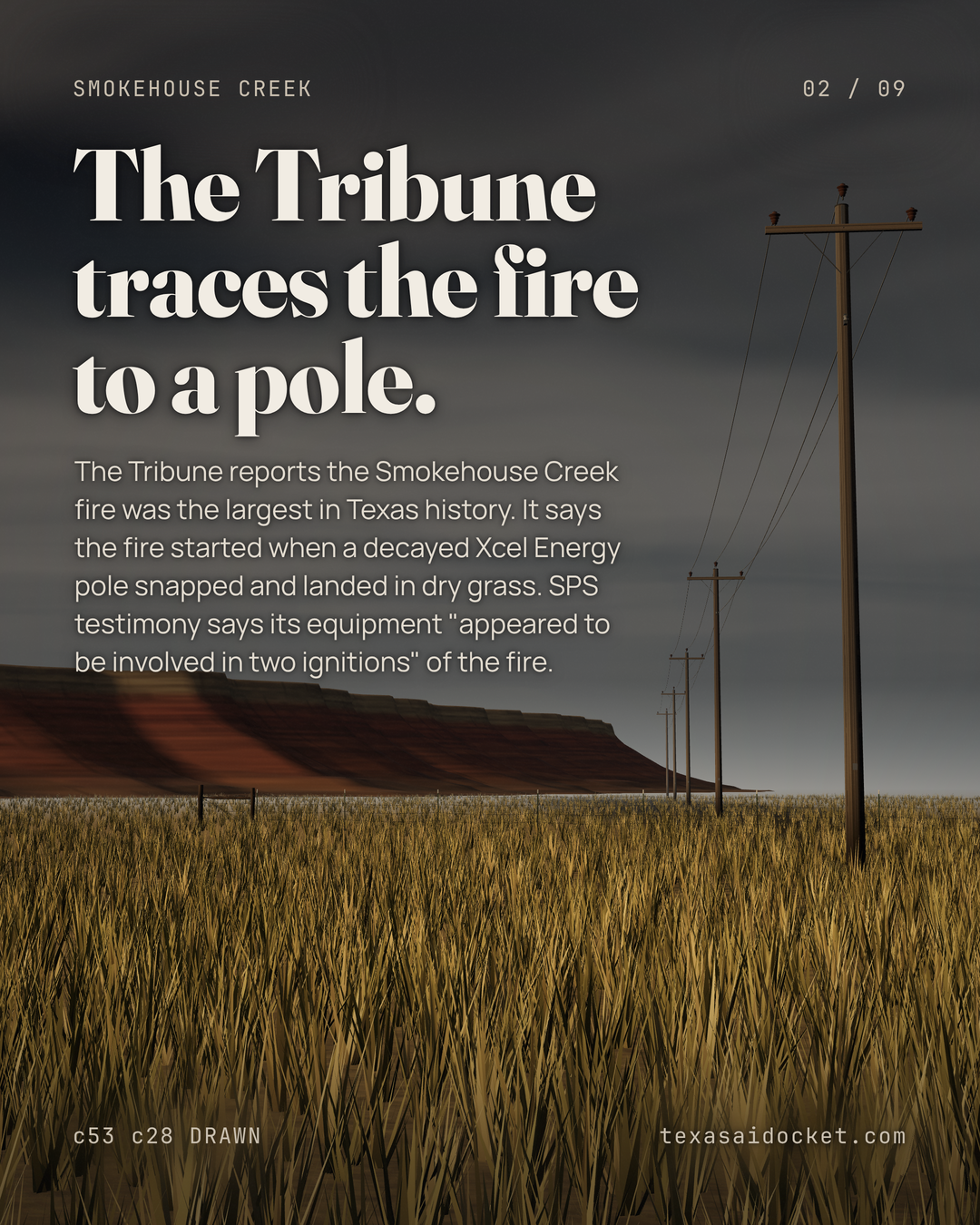
The Tribune reports that the Smokehouse Creek fire was the largest in Texas history and started when a decayed Xcel Energy power pole snapped.
It was the largest wildfire in Texas history, started when a decayed power pole owned by Xcel Energy snapped and landed in dry grass.
The SPS annual report says Moore County issued a local disaster declaration after the one resiliency event in its reporting period, an August 3rd, 2025 storm across the Texas Panhandle.
Storm damage was of sufficient severity that Moore County issued a local disaster declaration in response to the event.
In testimony with its plan application, SPS gave a Hutchinson County circuit as an example of a project in its highest wildfire risk area.
BURN1398 in Hutchinson County. This lateral circuit lies in SPS’s highest wildfire
The Tribune reports that Southwestern Public Service Company operates as Xcel Energy.
Brad Baldridge, interim president of Southwestern Public Service Company, which operates as Xcel Energy, told lawmakers what his company is doing to mitigate wildfires.
SPS says its 2027 annual report will carry a fuller assessment of the plan's impact on its efficiency measures, with a full year of data.
in the 2027 Annual Report which will include a full year' s worth of data
The SPS report says the resiliency plan rule requires a utility with an approved plan to file an annual report no later than May 1st of the year following approval.
file an annual report with the PUCT no later than May 1 of the year