Articles · Cities, policing and public services
Same pole. Two councils. Texas cities decide on Flock cameras
The state built a network of Flock plate reader cameras with a fee on auto insurance, then paused the money. Texas towns are now deciding whether to pay for the cameras themselves.
Read the story
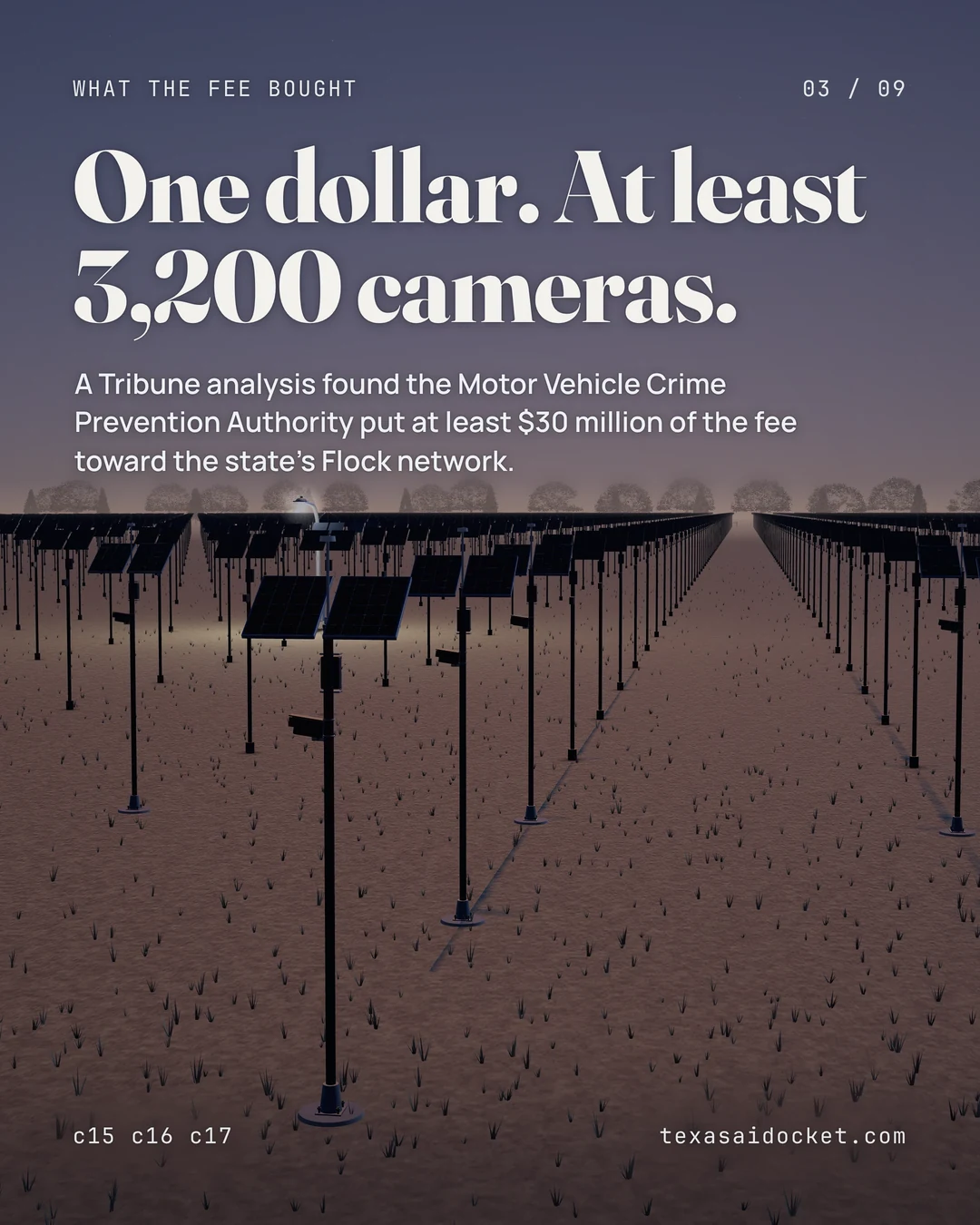




In 2023, the Legislature unanimously added $1 to Texans' auto insurance to fight catalytic converter theft. The Motor Vehicle Crime Prevention Authority turned that fee into at least 3,200 Flock cameras. A Tribune analysis found the authority put at least $30 million of the fee toward the network.
Then the Governor ordered every state agency to pause funding for Flock cameras, which the Tribune called AI-powered surveillance devices. His spokesman confirmed the order in an article dated August 28th, 2026. Any state agency providing money is making clear its funds can't be used for the cameras. The camera on the pole is now a line in each town's own budget, and the towns are not answering alike.
Towns that switched them off
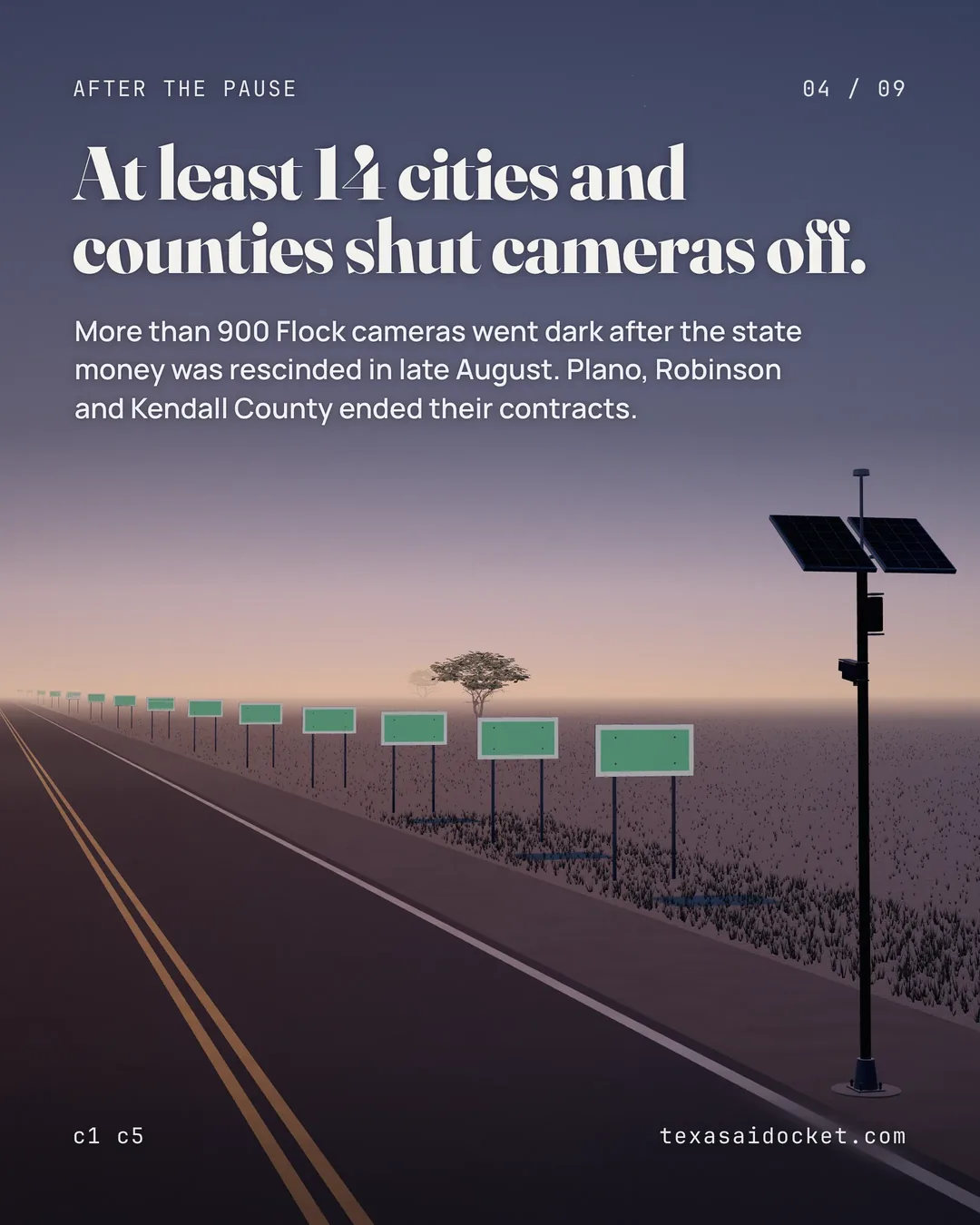
At least 14 cities and counties have shut off more than 900 Flock cameras since the state money was rescinded in late August, the Tribune reported. Plano, Robinson and Kendall County ended their contracts entirely. Houston and Dallas shut their grant funded cameras and kept much of their networks running. The two counts come from different articles and different populations, so neither is a share of the other.
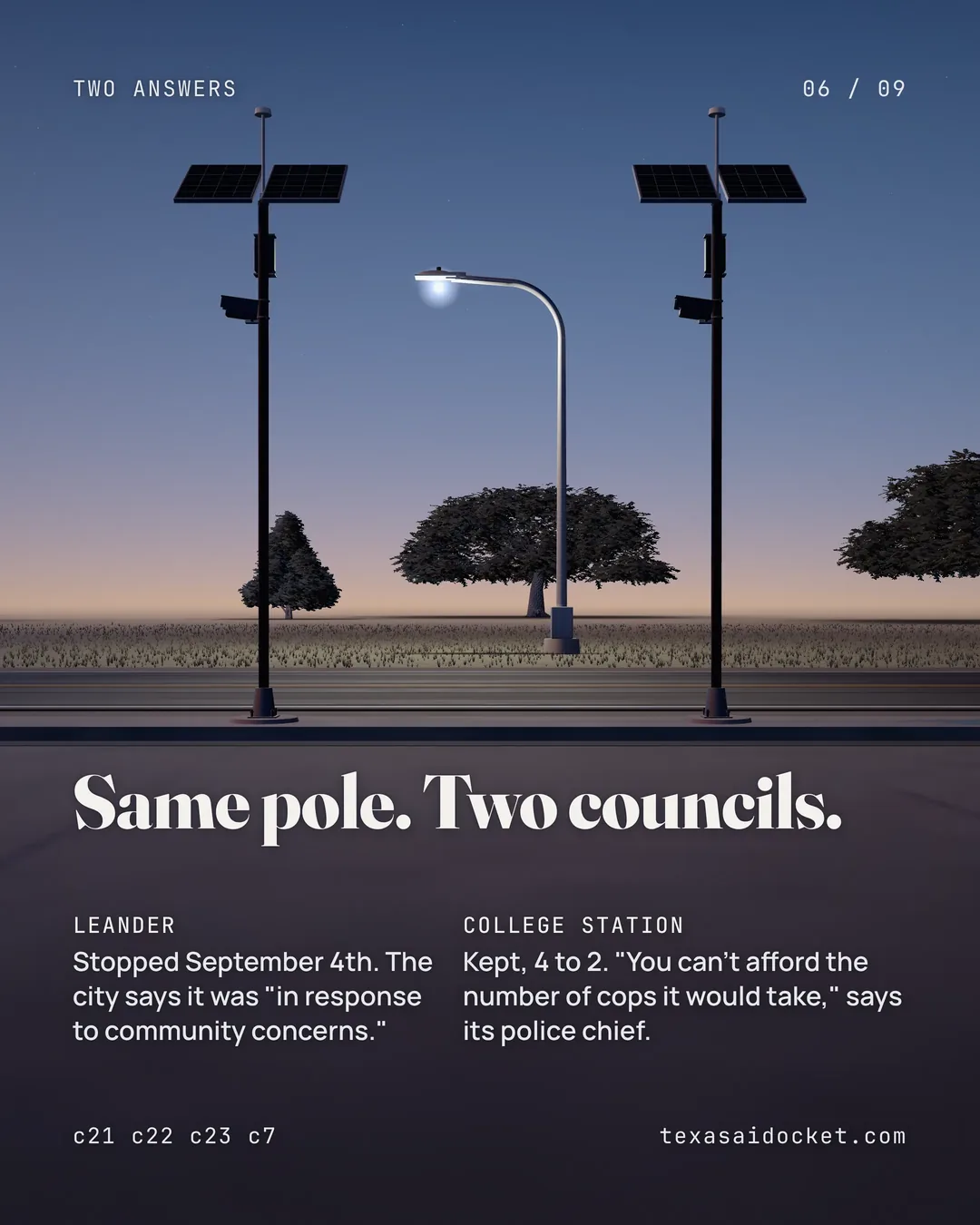
On September 15th, 2026 the El Paso City Council passed an item as revised. As filed it called for removing every Flock fixed camera on city property and right of way within 60 days. A second item also passed as revised. As filed it barred the city manager from entering or renewing any contract with Flock or any other provider of fixed plate reader cameras. This record does not carry the text of either revision. Leander's council directed the city to stop funding its Flock contract. Its police stopped using Flock cameras and Flock data as of September 4th, 2026, in the city's words "in response to community concerns".
Towns that kept paying
Kyle's 2026 grant had not arrived when the Tribune reported on the city, and part of it would help pay for 32 Flock cameras. Its council voted 6 to 1 to keep the contract anyway.
The College Station City Council voted 4 to 2 on September 24th, 2026 to keep two Flock agreements. One covers cameras on state highway roads and the other cameras on other roads. Its police chief put the case plainly. "You can't afford the number of cops it would take to do what this system is doing". The city says no search of the system can be made without reasonable suspicion, and that it keeps every search with no end date. It reports property crime fell over the same months and says the drop correlates with the cameras. Correlation is the city's word, and it is not a finding that the cameras caused the drop.
Towns that will ask voters
Laredo's council voted 7 to 2 to put the question to a nonbinding referendum in May. Voters will be asked whether to spend $1 million a year to keep 165 cameras running in city limits. The mayor said the city's residents should have a chance to say whether local taxpayers fund the whole system.
League City's council called its own vote before the pause, on August 11th, 2026. Its ballot asks, as a nonbinding statement of voter preference, whether police should keep using fixed plate reader cameras on public roadways. That election is on November 3rd, 2026.
What the record can't yet say
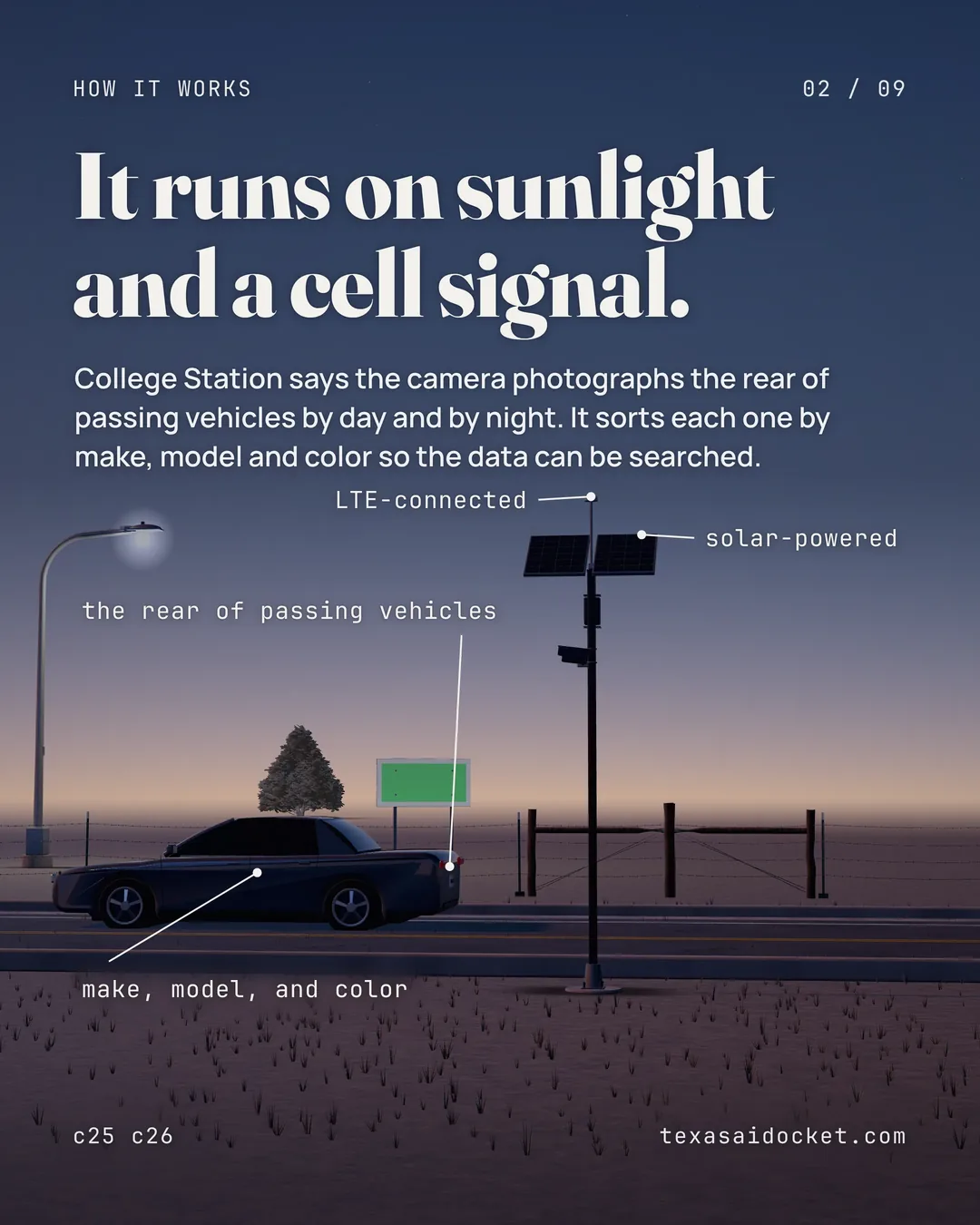
The articles print no calendar date for the Governor's order, only that it came on a Thursday night, and none for Laredo's vote, only a Monday night. College Station describes the cameras as solar powered and LTE connected, photographing the rear of passing vehicles by day and by night. It says they sort each vehicle's make, model and color from the image. This record carries no retention period for the camera images and no list of the cities and counties in the Tribune's count.
Sources for this story
- The Texas Tribune, At least 900 Flock cameras have been unplugged in Texas since state funding was cut, September 24th, 2026
- The Texas Tribune, Gov. Abbott blocks state agencies from spending money on Flock cameras, August 28th, 2026
- The Texas Tribune, Lawmakers added $1 to Texans' car insurance policies, August 28th, 2026
- City of Leander news flash, Leander discontinues funding Flock contract, September 4th, 2026
- City of College Station blog, Live from City Hall, council meeting of September 24th, 2026
- City of El Paso Legistar, City Council meeting of September 15th, 2026
- City of League City news flash, Proposition on November Ballot Regarding City's Use of Flock Cameras
- League City Legistar, matter 26-0320, Election Order
Claim-by-claim verification · 38 claims
At least 14 Texas cities and counties had shut off more than 900 Flock cameras since state funding was rescinded in late August, the Tribune reported on September 24th, 2026. The population is cameras shut off, not cameras the state funded.
At least 14 cities and counties have shut off more than 900 Flock cameras since state funding was rescinded in late August
The Laredo City Council voted 7 to 2 on a Monday night to set a nonbinding referendum for May on its Flock cameras. The Tribune reported it on September 24th, 2026.
The Laredo City Council voted 7-2 Monday night to set a nonbinding referendum for May
Laredo, cut off from state funding for its Flock cameras, will ask voters whether to spend $1 million a year to keep 165 of the cameras operating in city limits.
will ask voters for advice on whether to devote $1 million a year to keep 165 of the surveillance devices operating in city limits
Laredo Mayor Victor Treviño said that if keeping the Flock systems means local taxpayers fund the whole system, the city's 272,000 residents should get a chance to express their opinion.
If continuing these Flock systems will require the local taxpayer to fund their entire system, I believe that 272,000 residents should have an opportunity to express their opinion.
Plano, Robinson and Kendall County were among the Texas governments that ended their Flock contracts entirely after state funding was cut.
while Plano, Robinson and Kendall County were among those that ended their Flock contracts entirely
Houston and Dallas shut down their grant-funded Flock cameras and left much of their camera networks running.
Larger cities like Houston and Dallas shuttered grant-funded cameras while leaving much of their networks in operation
College Station police chief Billy Couch said the city can't afford the number of officers it would take to do the work the Flock system does.
You can't afford the number of cops it would take to do what this system is doing
Kyle, a small city south of Austin, has not received its 2026 grant for $205,000. Of that grant, $80,000 would help pay for 32 Flock cameras.
Kyle, a small city south of Austin, has not received its 2026 grant for $205,000, $80,000 of which would help pay for 32 Flock cameras.
The Kyle City Council voted 6 to 1 at a September 5th meeting to keep the city's Flock contract even though the grant had not arrived.
Even so, the City Council voted 6-1 at a Sept. 5 meeting to continue Kyle's Flock contract.
Kyle, College Station, Conroe and Carrollton all rejected calls to end their partnerships with Flock.
Like Kyle, College Station, Conroe and Carrollton have rejected calls to end their partnerships with Flock.
DeFlock, an anti-surveillance watchdog that maps Flock cameras through verified crowdsourcing, estimated 13,000 Flock cameras across Texas as of late August. It is a watchdog's estimate of every Flock camera in the state.
As of late August, there were an estimated 13,000 Flock cameras across Texas, according to DeFlock
Governor Greg Abbott ordered all Texas state agencies to pause funding for Flock cameras, the Tribune reported in an article dated August 28th, 2026.
Gov. Greg Abbott has ordered all state agencies to pause funding for Flock cameras as scrutiny over the AI-powered surveillance devices has mounted.
Abbott gave the order on a Thursday night and his spokesman confirmed it on Friday, according to the Tribune article dated August 28th, 2026.
Abbott gave the order Thursday night to halt state funding for Flock cameras, his spokesman confirmed Friday.
Abbott's spokesperson Andrew Mahaleris said any state agency providing money is making clear that its funds can't be used for Flock cameras.
To the extent any funding comes from Texas agencies, those agencies are clarifying that those funds cannot be used for Flock cameras
In 2023 the Texas Legislature unanimously passed a law that added $1 to Texans' auto insurance costs to fight catalytic converter theft.
In 2023, the Texas Legislature unanimously passed a law raising auto insurance costs for Texans by $1 to combat rampant catalytic converter theft.
A Tribune analysis found that a state agency put at least $30 million of the $1 fee toward building up the state's Flock surveillance network.
a little-known state agency has devoted at least $30 million of that fee toward supercharging the state's Flock surveillance network
The Motor Vehicle Crime Prevention Authority, whose board is mostly appointed by Abbott, turned the $1 fee into at least 3,200 Flock cameras. That counts cameras the authority funded, not cameras later shut off.
The Motor Vehicle Crime Prevention Authority, led by a board mostly appointed by Gov. Greg Abbott, has turned the $1 fee hike into at least 3,200 Flock cameras.
A report from the authority said its license plate reader data was searched 62,000 times in 2025 and led to about 1,660 cleared catalytic converter theft cases.
was searched 62,000 times in 2025, leading to about 1,660 cleared catalytic converter theft cases, a report from the authority said.
In early August the authority approved another $3 million to help DPS install 583 more cameras along Texas tollways over the next year.
In early August, the agency approved another $3 million to help DPS install 583 more cameras along Texas tollways over the next year.
Leander will stop funding its Flock contract, following a directive the Leander City Council gave at its September 3rd, 2026 meeting.
The City of Leander will discontinue funding its contract with Flock, following the directive by the Leander City Council during its September 3, 2026 meeting.
The Leander Police Department stopped using Flock cameras and Flock data as of September 4th, 2026.
As of September 4, 2026, the Leander Police Department is no longer using Flock cameras or Flock data.
Leander says its council ended Flock services because of community concerns.
In response to community concerns, the City Council decided to discontinue Flock services.
On September 24th, 2026 the College Station City Council voted 4 to 2 to approve a Flock Group agreement not to exceed $158,000 for license plate readers on TxDOT roads. It also approved a separate $141,062 agreement for cameras on other roads.
The Council voted 4-2 to approve an agreement not to exceed $158,000 with Flock Group for automatic license plate readers on Texas Department of Transportation roads and a $141,062 agreement for cameras on non-TxDOT roads.
College Station Councilmen Mark Smith and Bob Yancy cast the two votes against the Flock agreements.
Councilmen Mark Smith and Bob Yancy voted against the motion.
College Station describes its Flock cameras as solar powered and LTE connected. The city says they photograph the rear of passing vehicles by day and by night.
The solar-powered, LTE-connected cameras capture photos of the rear of passing vehicles during the day and night.
According to College Station, the system sorts each vehicle's make, model and color from the plate image so the data can be searched for criminal justice purposes.
The license plate image categorizes the vehicle's make, model, and color, making the data searchable for criminal justice purposes.
College Station says no one may search its Flock system without reasonable suspicion, the same standard an officer needs to start a traffic stop.
No search of the Flock system can be conducted without reasonable suspicion, the same level required for an officer to initiate a traffic stop.
College Station police decide which agencies may search the city's Flock network, and the city keeps every search with no end date.
CSPD controls the agencies that can search its network, and all searches are retained indefinitely.
The Flock Audit Assistant tool went live in College Station on April 14th. The city says it catches most of the misuse cases highlighted in recent months.
The Flock Audit Assistant tool went live April 14 and detects most of the misuse cases highlighted in recent months
College Station reports figures comparing March to September activity in 2025 and 2026. Home burglaries fell 54% (63 to 29), car burglaries fell 84% (113 to 18) and firearm thefts fell 22% (23 to 18).
Comparing March-September activity from 2025 to 2026, home burglaries are down 54% (63 to 29), car burglaries are down 84% (113 to 18), and firearm thefts are down 22% (23 to 18).
The city's post says the drop in property crime correlates with the arrival of Flock cameras. That is the city's own claim of correlation and not a finding that the cameras caused the drop.
This reduction in property crime offenses correlates with the introduction of Flock cameras.
On September 15th, 2026 the El Paso City Council passed an item as revised. As filed it directed the City Manager to remove all Flock Safety fixed license plate reader cameras and related hardware within 60 days. That covered city property, city right of way and anywhere else under the city's control.
Discussion and action directing the City Manager to ensure the removal, within 60 days, of all Flock Safety fixed automated license plate reader (ALPR) cameras and related hardware
At the same September 15th, 2026 meeting, El Paso's council passed a second item as revised. As filed it directed the City Manager not to enter into, execute, renew or extend any such contract. That covered Flock Safety and any other provider of fixed, networked license plate reader cameras.
directing the City Manager to refrain from entering into, executing, renewing, or extending any contract, agreement, or other arrangement with Flock Safety or any other provider
On Tuesday, August 11th, 2026 the League City Council voted to call a referendum on its use of Flock license plate reader cameras. The proposition is on the November 3rd, 2026 ballot. That vote came before the funding pause.
At their meeting on Tuesday, August 11, the League City Council voted to call for a referendum to place a proposition on the November 3, 2026, ballot regarding the City's use of Flock Safety license plate reader (LPR) cameras.
The League City proposition is a nonbinding statement of voter preference. It asks whether the police department should keep using fixed license plate reader cameras on public roadways for law enforcement.
As a nonbinding statement of voter preference, should the League City Police Department continue using automated license plate reader cameras at fixed locations on public roadways for law enforcement purposes?
League City's ordinance orders a special election on Tuesday, November 3rd, 2026 on the police department's continued use of fixed license plate reader cameras on public roadways.
ordering a Special Election for the City of League City, Texas, on Tuesday, November 3, 2026, to submit a proposition regarding the League City Police Department's continued use of automated license plate reader cameras at fixed locations on public roadways
Harris County Commissioners Court approved a renewal option with Flock Group for license plate reader and sound detection systems on May 28th, 2026, before the funding pause.
Request for approval of a renewal option with Flock Group, Inc. for license plate reader and sound detection system for Harris County
On July 9th, 2026 Harris County Commissioners Court passed an amendment making its Flock Group agreement available for use across the whole county.
execute an amendment to an agreement with Flock Group, Inc. to supplement certain terms and clarify that the agreement is available for use County-wide