Articles · Health care
Asked inside the chart. UTMB's OpenEvidence account beside Texas law
UTMB says more than half of its clinicians use OpenEvidence inside its health record. A Texas statute sets a disclosure rule for AI used to diagnose. UTMB's release never uses that word.
Read the story

UTMB and OpenEvidence announced a collaboration that brings evidence-based AI into clinicians' everyday workflows. UTMB published the announcement September 22nd, 2026. It says OpenEvidence is embedded within its electronic health record environment, and that the integration went live at UTMB in March.
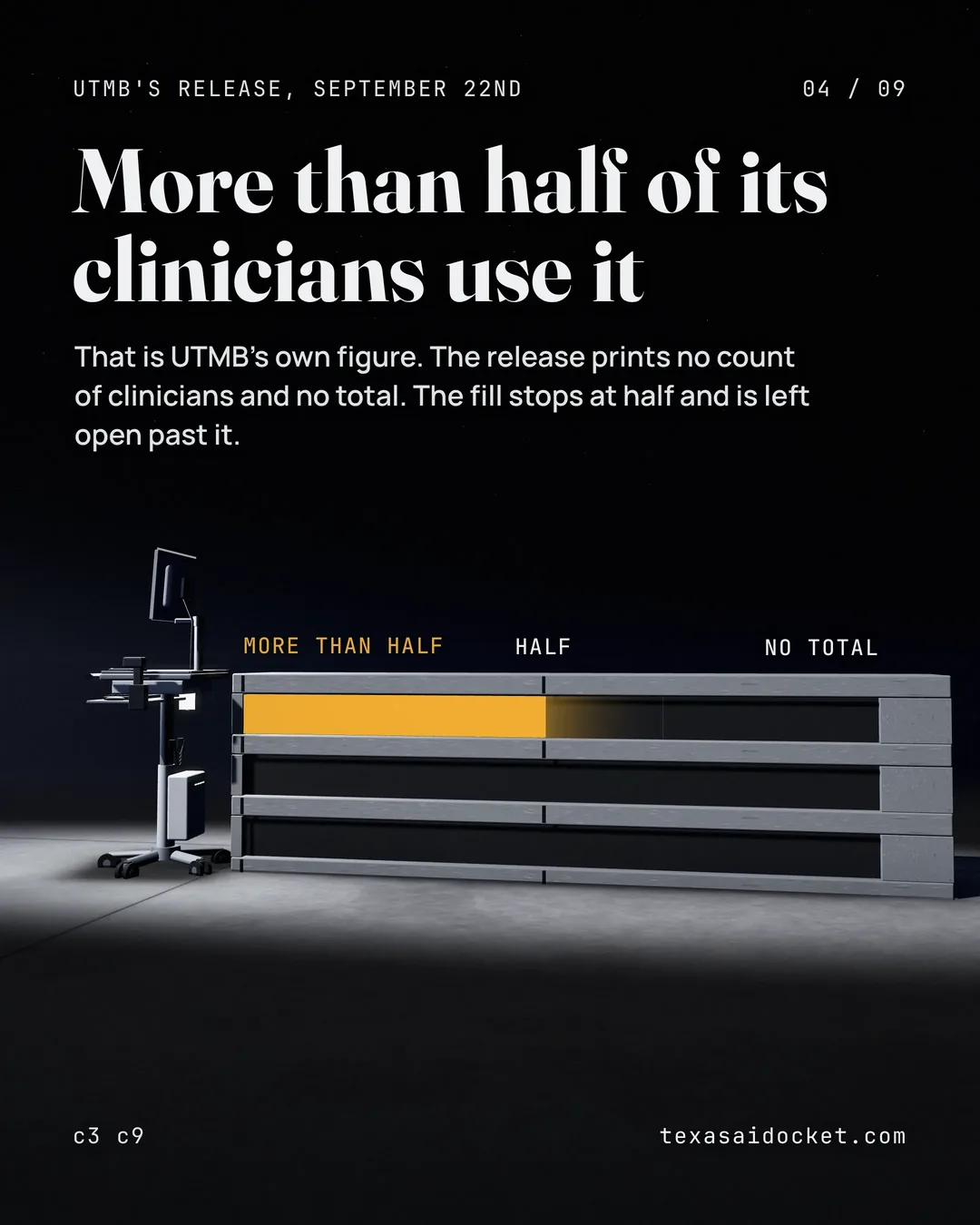
UTMB says more than half of its clinicians actively use OpenEvidence for clinical decision support. Its release gives no count of clinicians, no count of queries and no accuracy figure. Texas law already says that a practitioner who uses AI for diagnostic purposes must disclose that use to patients. UTMB's release never uses the word diagnostic, and says nothing about telling patients.
What UTMB says the tool does
Clinicians reach OpenEvidence with their standard UTMB enterprise credentials. They can ask clinical questions in natural language and get answers that cite medical literature and clinical guidelines. UTMB says the collaboration gives its physicians and other clinical users access to cited medical evidence from within the electronic health record.
UTMB has hospitals on four campuses and runs more than 100 clinics across Southeast Texas. It reports strong growth since March in the number of clinicians using the tool and in the volume of queries. It says many clinicians have made it part of their daily work. The release puts no number on that growth.
OpenEvidence describes its product as an AI copilot for doctors that helps them make high-stakes decisions at the point of care. It says it has supported over 200 million AI-powered clinical consultations. Those figures are the company's own.
What the release does not measure
UTMB says it will keep evaluating utilization and clinician experience. It says it wants validated AI tools governed and evaluated on their real-world use and impact. The release reports no evaluation result and no error rate.
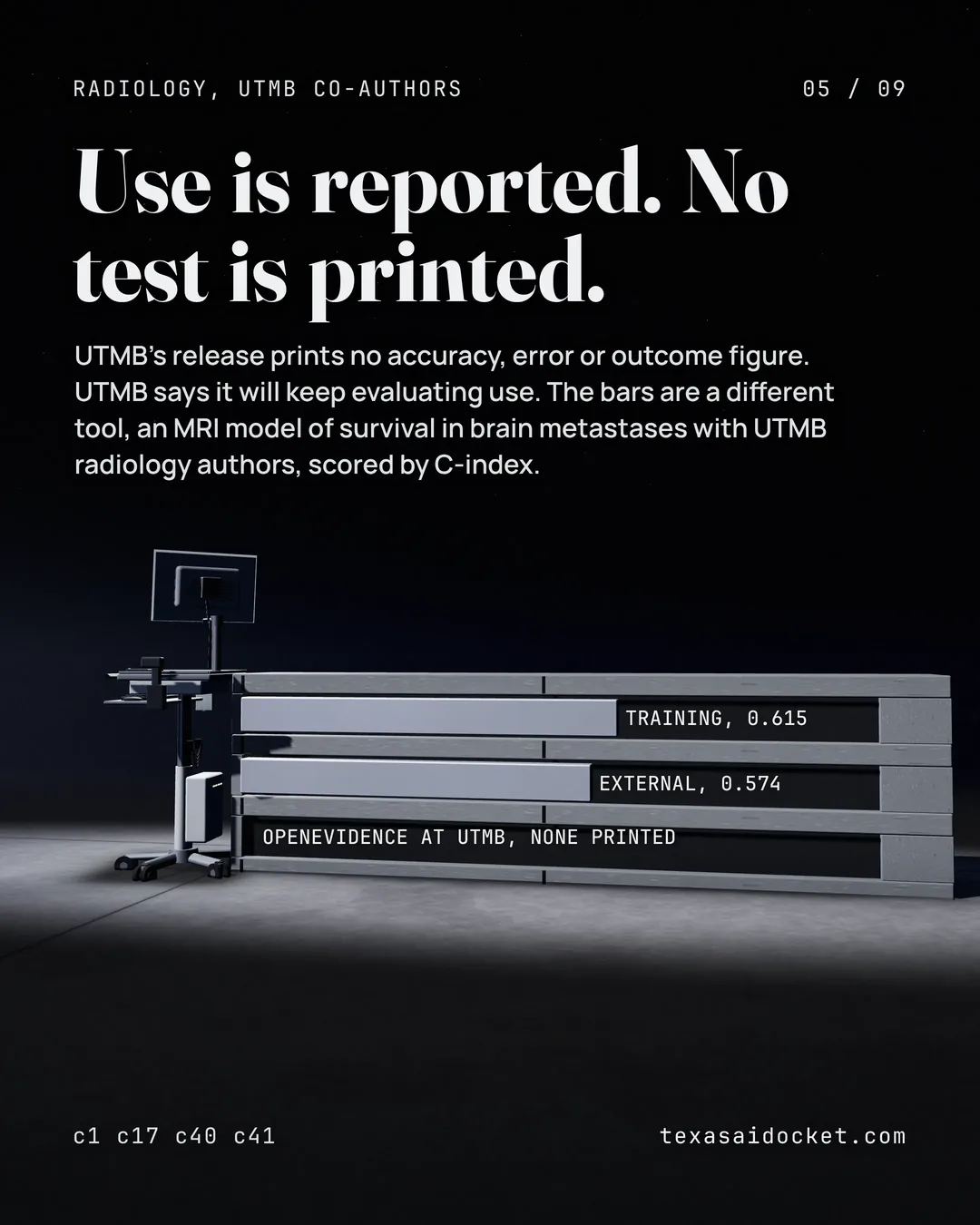
A published test of a different tool shows what such a figure looks like. An MRI survival model with authors in UTMB's Department of Radiology scored a C-index of 0.615 in its training cohort and 0.574 in external validation. That model is not OpenEvidence, and its numbers say nothing about it.
What Texas law says
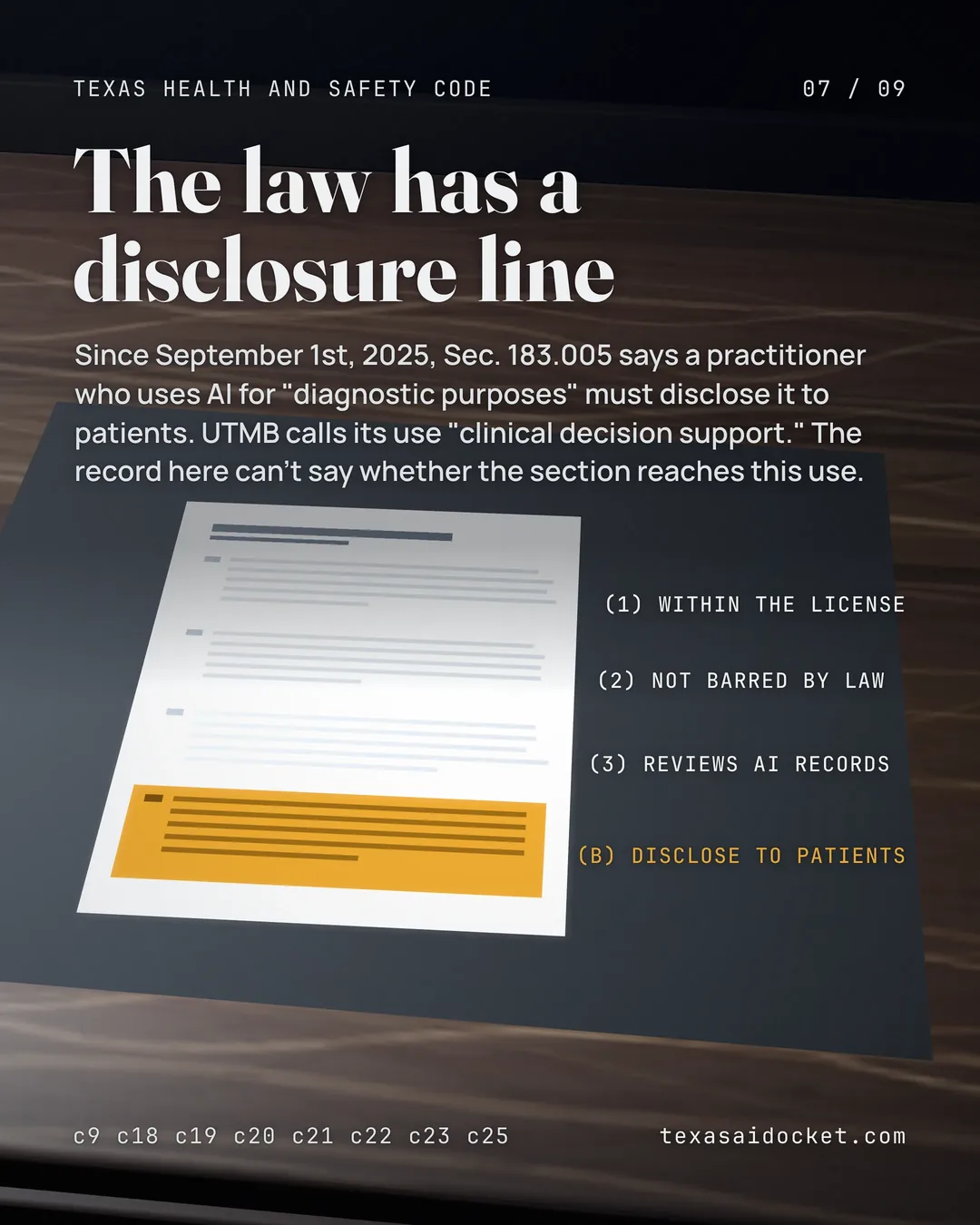
Section 183.005 of the Health and Safety Code is headed Artificial Intelligence in Electronic Health Record. It lets a health care practitioner use AI for diagnostic purposes if listed conditions are met. The practitioner must act within the scope of the practitioner's license. The use must not be otherwise restricted by state or federal law. The practitioner must review all records created with AI under Texas Medical Board standards.
A practitioner who uses AI for diagnostic purposes as the section describes must disclose that use to patients. The section took effect September 1st, 2025. The duty falls on a practitioner and turns on diagnostic use. UTMB describes its use as clinical decision support. Its release never uses the word diagnostic, so the record here can't say whether the section reaches this use.
UTMB's other AI platform
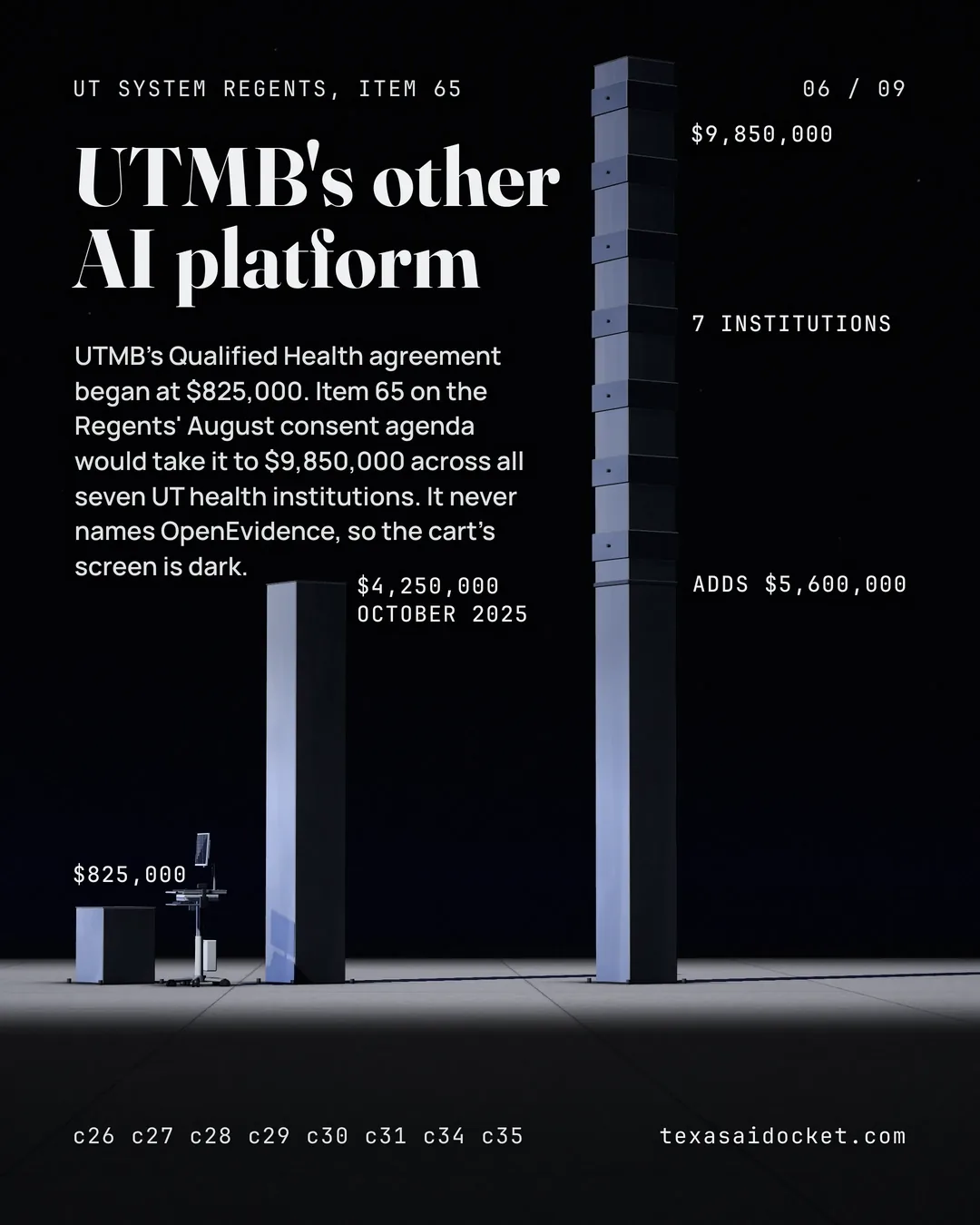
UTMB also holds an agreement with Qualified Health for an AI platform. UTMB entered it in December 2024. It began at $825,000, within UTMB's own authority. A first amendment in October 2025 raised it to $4,250,000. A third amendment on the Regents' August consent agenda adds $5,600,000, for a total of $9,850,000. It extends the platform to all seven UT System health-related institutions. Item 65 does not name OpenEvidence, and no vote record was read.
Where a reader can ask
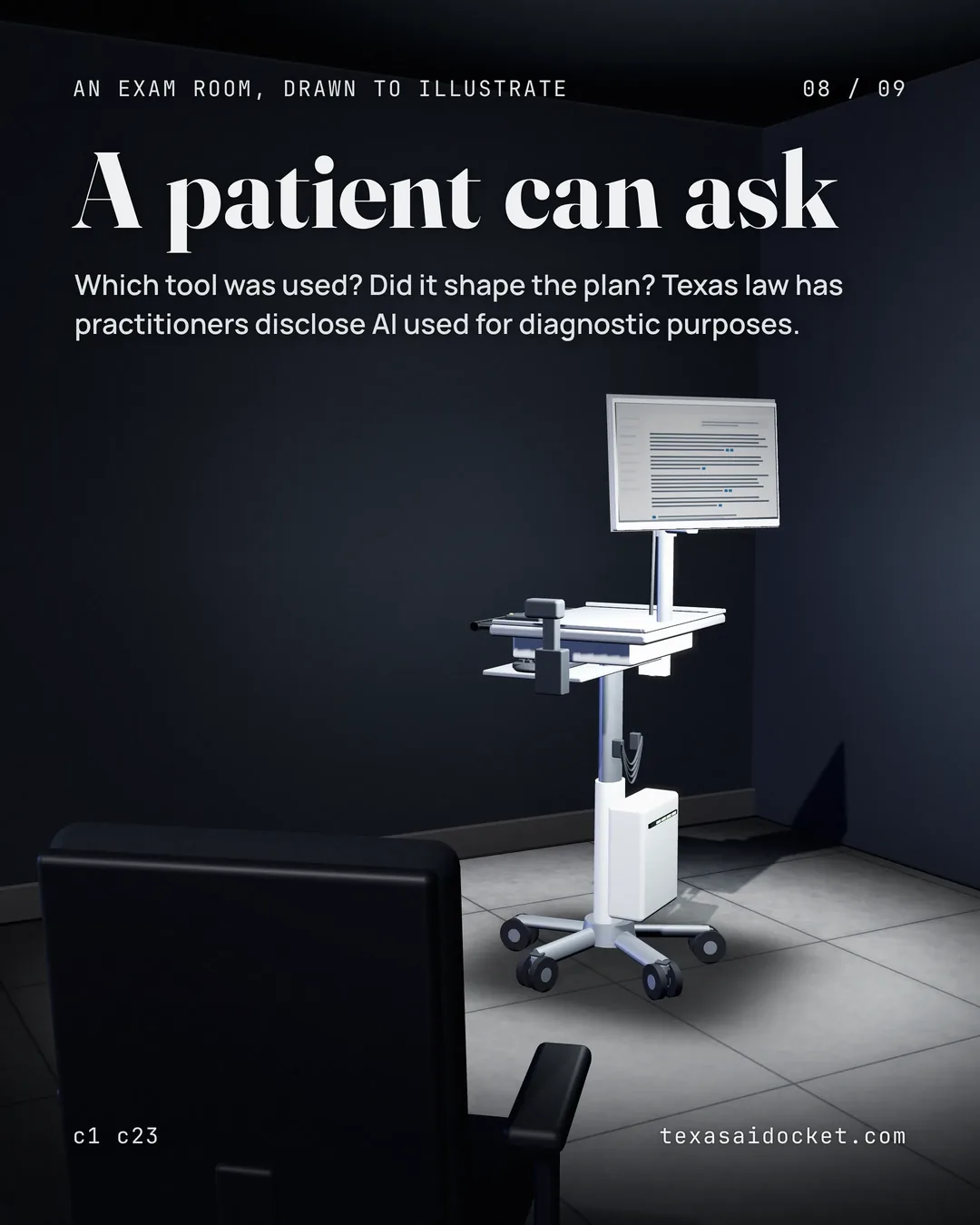
A patient can ask in the exam room which tool was used and whether it shaped the plan. The UT System Board of Regents lists its next regular meeting for November 18th to 19th in Austin. Members of the public may testify on any topic a committee or board agenda lists. A speaker gives the board's General Counsel a name and agenda topic at least 24 hours before the meeting. Topics not listed on the agenda can't be raised.
Sources for this story
- UTMB news release, UTMB collaborates with OpenEvidence to integrate AI platform directly into clinical workflows
- Texas Health and Safety Code Chapter 183, Electronic Health Records
- UT System Board of Regents agenda book, August 2026 meeting, page 227
- OpenEvidence About page
- PubMed abstract 42716711, MRI radiomics for survival prediction in brain metastases
- UT System Board of Regents, Regents' Meetings page
- Regents' Rule 10403, Board Meeting Accessibility and Public Participation
Claim-by-claim verification · 45 claims
UTMB and OpenEvidence announced a collaboration that brings evidence-based AI into clinicians' everyday workflows.
The University of Texas Medical Branch (UTMB) and OpenEvidence today announced a collaboration that brings evidence-based artificial intelligence directly into clinicians’ everyday workflows
UTMB says the collaboration gives its physicians and other clinical users access to cited medical evidence from within the electronic health record.
giving UTMB physicians and other clinical users secure access to cited medical evidence from within the electronic health record
UTMB published the announcement on September 22nd, 2026, under Stephen Hadley's byline.
September 22, 2026 • 9:10 a.m. by Stephen Hadley
UTMB says the integration went live at UTMB in March.
The integration, which went live at UTMB in March, was developed to give clinicians access to AI-enabled information resources within existing clinical workflows.
UTMB says OpenEvidence is embedded within its electronic health record environment.
OpenEvidence is embedded within the UTMB electronic health record environment.
Clinicians reach OpenEvidence with their standard UTMB enterprise credentials, according to UTMB.
Clinicians access the platform using their standard UTMB enterprise credentials.
UTMB says clinicians can ask clinical questions in natural language and get answers that cite medical literature and clinical guidelines.
Once authenticated, clinicians can ask clinical questions in natural language and receive responses that include citations to medical literature, clinical guidelines, and other authoritative sources.
UTMB reports strong growth since the March launch in both the number of clinicians using OpenEvidence and the volume of clinical queries.
Since the March launch, UTMB has seen strong growth in both the number of clinicians using OpenEvidence and the volume of clinical queries submitted through the platform.
UTMB says more than half of its clinicians actively use OpenEvidence for clinical decision support.
Today, more than half of UTMB clinicians actively use OpenEvidence for clinical decision support.
UTMB says its adoption data indicate that many clinicians have made the tool part of their daily workflows.
Adoption data indicate that many clinicians have incorporated the tool into their daily workflows.
UTMB has hospitals on four campuses.
With hospitals located on four campuses
UTMB also runs more than 100 clinics across Southeast Texas.
in addition to more than 100 clinics across Southeast Texas
UTMB chief digital and AI officer Peter McCaffrey said the harder challenge is making AI tools usable in clinical practice while keeping security, governance and trust.
The harder challenge is making those tools genuinely usable in clinical practice while maintaining the security, governance, and trust that healthcare requires,” said Peter McCaffrey, MD, MS, FCAP , vice president and chief digital and AI officer at UTMB
McCaffrey said the growth in use since launch suggests clinicians use AI when it is placed where they already work.
The growth in utilization since launch suggests that when you remove friction and put useful AI where clinicians actually work, they use it.
OpenEvidence chief medical officer Travis Zack said successful clinical technology has to fit the way clinicians already work.
UTMB has approached AI deployment with a clear understanding that successful clinical technology has to fit naturally into the way clinicians already work,” said Travis Zack, MD, PhD, chief medical officer at OpenEvidence
UTMB says it is working toward an environment where validated AI tools are governed and evaluated on their real-world use and impact.
UTMB is working to establish an enterprise environment where validated AI capabilities can be securely incorporated into clinical and operational workflows, appropriately governed, and evaluated based on their real-world use and impact.
UTMB says it will keep evaluating utilization, clinician experience and ways to improve how evidence reaches the point of care.
As adoption grows, UTMB will continue evaluating utilization, clinician experience, and opportunities to improve how evidence and clinical intelligence are delivered at the point of care.
Texas Health and Safety Code Section 183.005 is headed Artificial Intelligence in Electronic Health Record.
Sec. 183.005. ARTIFICIAL INTELLIGENCE IN ELECTRONIC HEALTH RECORD.
The section lets a health care practitioner use AI for diagnostic purposes if listed conditions are met. Those purposes include recommendations on a diagnosis or course of treatment based on a patient's medical record.
(a) A health care practitioner may use artificial intelligence for diagnostic purposes, including the use of artificial intelligence for recommendations on a diagnosis or course of treatment based on a patient's medical record, if:
One condition is that the practitioner acts within the scope of the practitioner's license, certification or other authorization in Texas, whether or not AI is used.
(1) the practitioner is acting within the scope of the practitioner's license, certification, or other authorization to provide health care services in this state, regardless of the use of artificial intelligence
Another is that the particular use of AI is not otherwise restricted or prohibited by state or federal law.
(2) the particular use of artificial intelligence is not otherwise restricted or prohibited by state or federal law
The practitioner must also review all records created with AI in a manner consistent with medical records standards developed by the Texas Medical Board.
(3) the practitioner reviews all records created with artificial intelligence in a manner that is consistent with medical records standards developed by the Texas Medical Board.
A practitioner who uses AI for diagnostic purposes as the section describes must disclose that use to the practitioner's patients.
(b) A health care practitioner who uses artificial intelligence for diagnostic purposes as described by Subsection (a) must disclose the practitioner's use of that technology to the practitioner's patients.
The section was added by Senate Bill 1188 of the 89th Legislature in 2025.
Added by Acts 2025, 89th Leg., R.S., Ch. 1002 (S.B. 1188
The section took effect September 1st, 2025.
Sec. 1, eff. September 1, 2025.
Consent agenda item 65 for the UT System Board of Regents covers a UTMB amendment to its agreement with Qualified Health for an AI technology platform.
65. Contract (funds going out) - U.T. Medical Branch - Galveston: Amendment to Agreement with Qualified Health, PBC, to provide AI technology platform
The item sits in the consent agenda for the Regents' meeting of August 12th to 13th, 2026.
August 12-13, 2026 Meeting of the U.T. System Board of Regents - Consent Agenda
In December 2024 UTMB entered a Master Subscription Agreement with Qualified Health for the qOS platform and Qualified GPT. The agenda describes Qualified GPT as a secure interface to generative AI models and applications.
In December 2024, U.T. Medical Branch - Galveston (UTMB) entered into a Master Subscription Agreement (MSA) with Qualified Health for the Qualified Operating System (qOS) platform and Qualified GPT, which is a secure interface to interact with Generative Artificial Intelligence (Gen AI) models and applications.
The initial agreement was valued at $825,000. That was within UTMB's delegated authority, so it needed no Board approval.
The initial Agreement had a contract value set at $825,000, which was within the institution's delegated authority threshold and did not require Board approval
A first amendment in October 2025 moved UTMB to the Qualified Health Enterprise AI Platform and raised the value to $4,250,000.
In October 2025, UTMB entered into the First Amendment of the MSA, which transitioned to Qualified Health Enterprise AI Platform and increased the value to $4,250,000
The third amendment extends the Qualified Health platform to all seven UT System health-related institutions.
This Third Amendment extends the Qualified Health Technology Platform to all seven U.T. System Health-Related Institutions (HRIs)
UT System is to fund the third amendment under the UT-REAL-Health AI initiative appropriated by the 89th Texas Legislature.
will be funded by U.T. System under the UT-REAL-Health AI initiative appropriated by the 89th Texas Legislature
The third amendment runs from October 31st, 2025 to October 30th, 2027.
The term of the Third Amendment is October 31, 2025 through October 30, 2027
The third amendment adds $5,600,000 in value.
the additional value is $5,600,000 bringing the total value
That brings the total value of UTMB's agreement with Qualified Health to $9,850,000.
bringing the total value of the Agreement with Qualified Health to $9,850,000
The agenda item says the agreement was competitively procured.
This Agreement was competitively procured.
OpenEvidence describes its product as an AI copilot for doctors that helps them make high-stakes decisions at the point of care.
As a product, OpenEvidence is an AI copilot for doctors that helps them make high-stakes decisions at the point of care.
OpenEvidence claims to be the most widely used medical AI among verified U.S. clinicians.
OpenEvidence is the most widely used medical AI among verified U.S. clinicians.
OpenEvidence says it has supported over 200 million AI-powered clinical consultations from U.S. doctors and other frontline clinicians.
To date, we have supported over 200 million AI-powered clinical consultations from U.S. doctors and other frontline clinicians.
The radiomics survival model scored a C-index of 0.615 in its training cohort and 0.574 in external validation.
The radiomics score had a C-index of 0.615 (95% CI, 0.543-0.687) in the training cohort and 0.574 (95% CI, 0.491-0.658) in external validation.
The study lists authors in the Department of Radiology at The University of Texas Medical Branch in Galveston.
Department of Radiology (H.A.S., A.N., M.W.), The University of Texas Medical Branch, Galveston, TX, USA
The UT System Board of Regents lists its next regular meeting for November 18th to 19th, 2026, in Austin.
November 18-19, 2026 , Austin, TX
Members of the public may give written and oral testimony on any topic listed on a Regents committee or board agenda.
Members of the public are allowed to present written and oral testimony, for a reasonable amount of time as determined by the Chairman of the Board, on any topic listed on the agenda for a Committee or Board meeting.
A person who wants to testify gives the board's General Counsel a name and agenda topic at least 24 hours before the meeting.
Members of the public seeking to present testimony shall provide their name and agenda topic they seek to address to the General Counsel to the Board of Regents at least 24 hours in advance of the meeting.
Testimony on topics not listed on the agenda is not allowed.
Testimony on topics not listed on the agenda will not be allowed.