Articles · Agriculture
West Texas A&M's research feedlot and its one AI sentence
West Texas A&M won a USDA grant for a research feedlot near Canyon. The release says new methods can be tested with AI and names no tool, vendor or result.
Read the story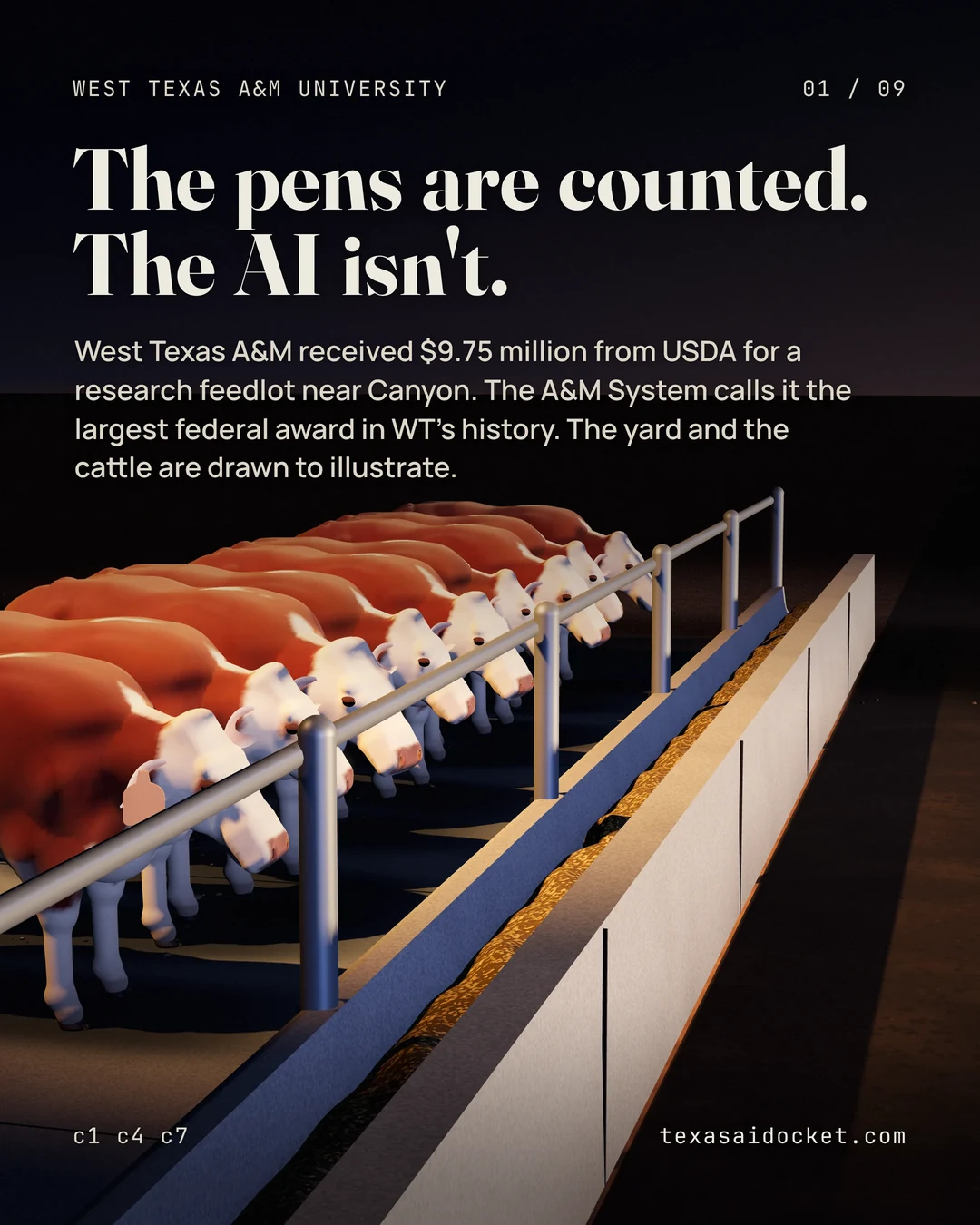

West Texas A&M University has received a $9.75 million grant from the U.S. Department of Agriculture, which the A&M System's release calls the largest federal award in the university's history. The grant comes through USDA's Research Facilities Act Program for a center for beef cattle research and innovation.
The release says new feeding, health and handling techniques can be evaluated with traditional and artificial intelligence-powered approaches. That sentence is the release's only mention of AI. It names no AI tool, vendor, camera, model or result.
What the money builds
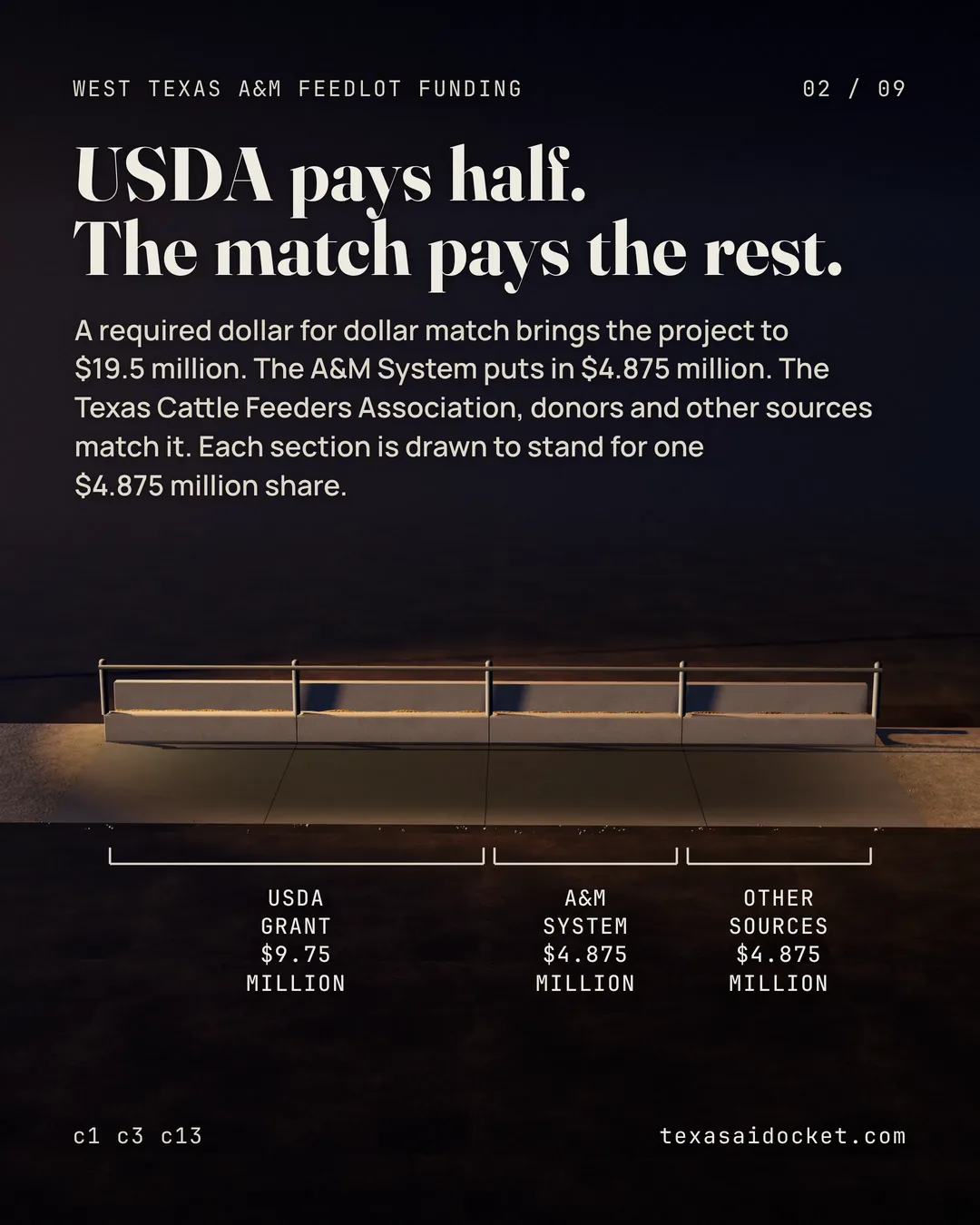
A required dollar for dollar match, $4.875 million from the A&M System and another $4.875 million from other sources, brings the project total to $19.5 million. The release says the Texas Cattle Feeders Association, its members, university donors and other sources will match the System's share.
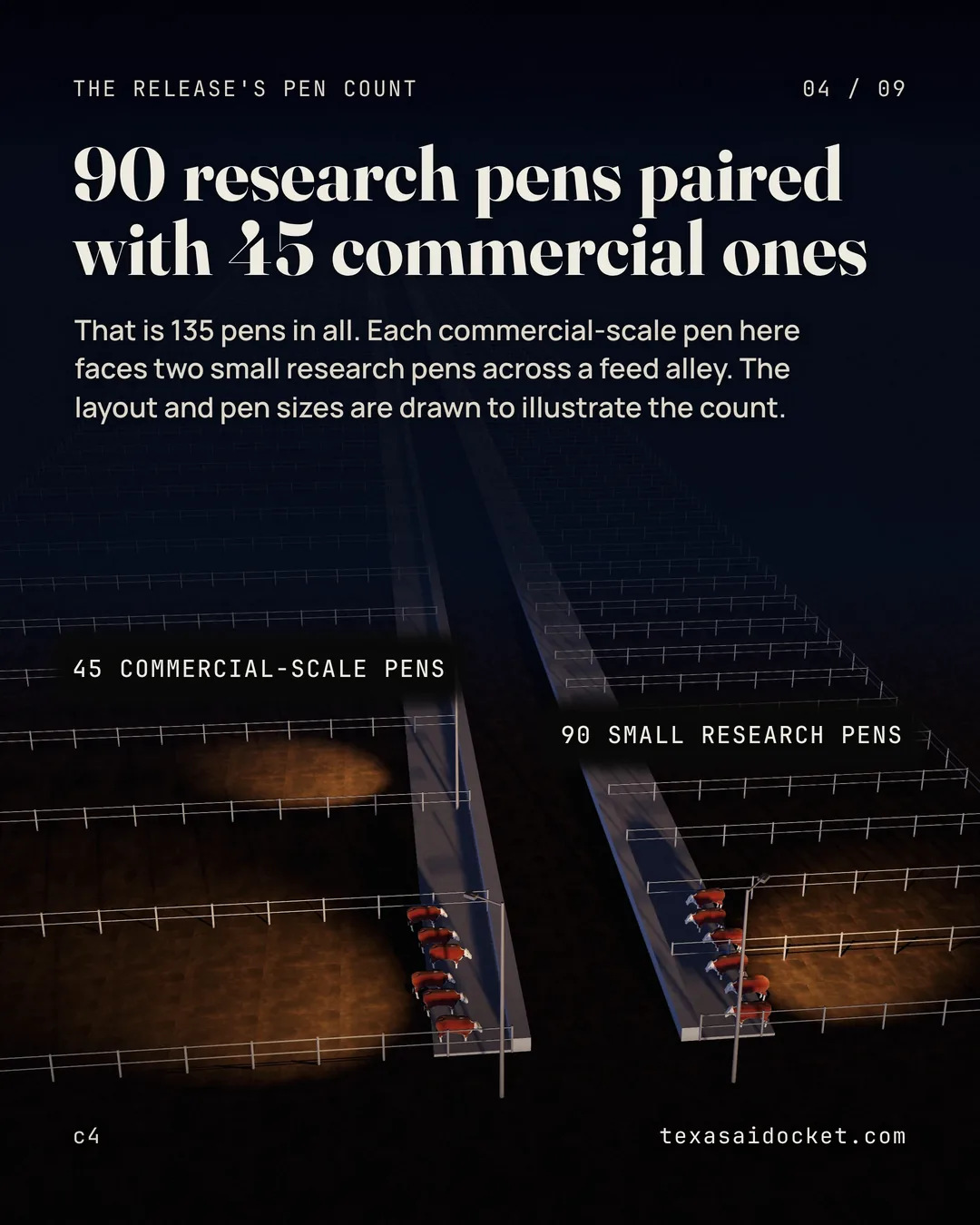
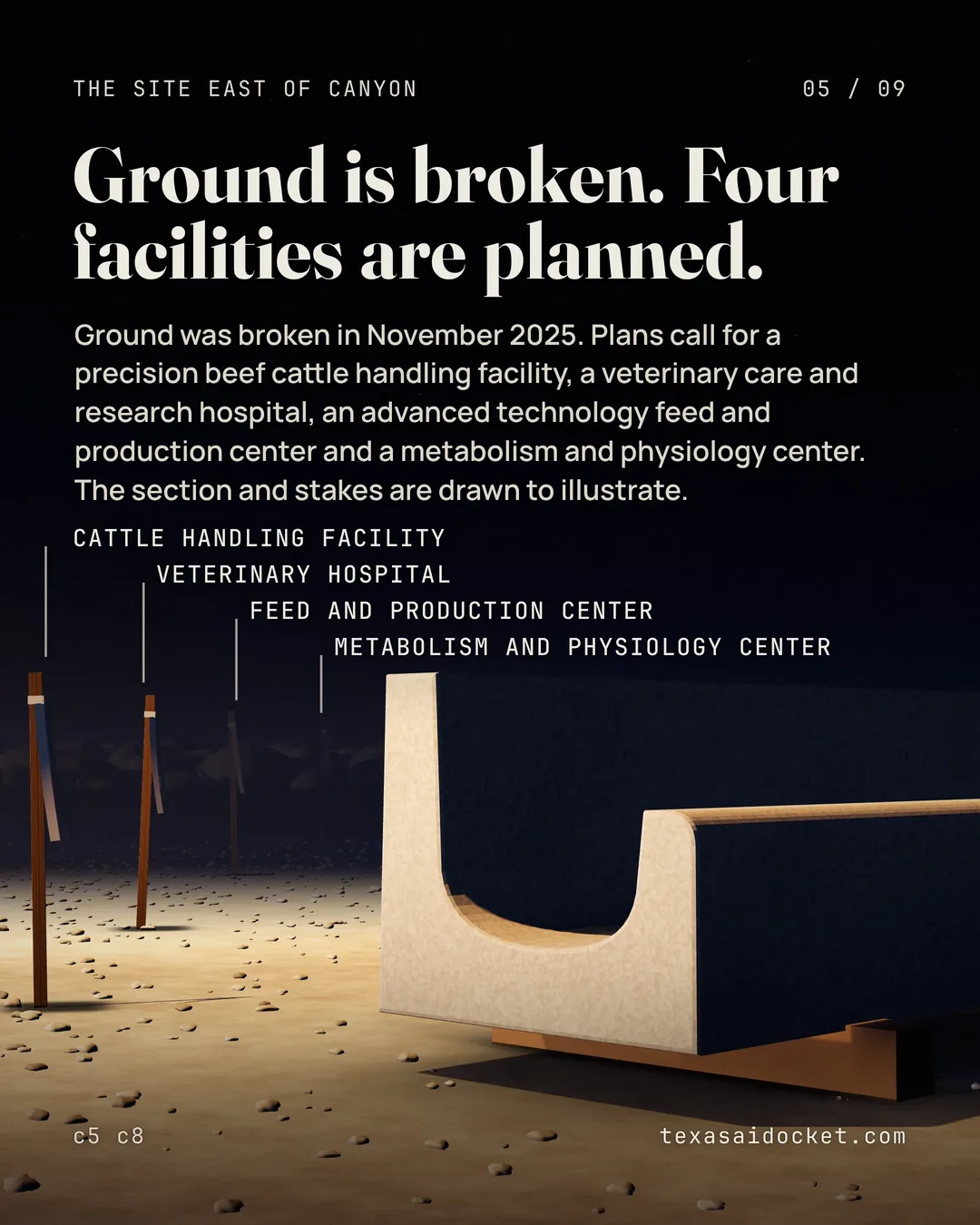
The research feedlot pairs 90 small research pens for scientific studies with 45 commercial-scale pens. Plans call for a precision beef cattle handling facility, a veterinary care and research hospital, an advanced technology feed and production center and a metabolism and physiology center. The release describes these as planned components. None is described as built.
Where it goes
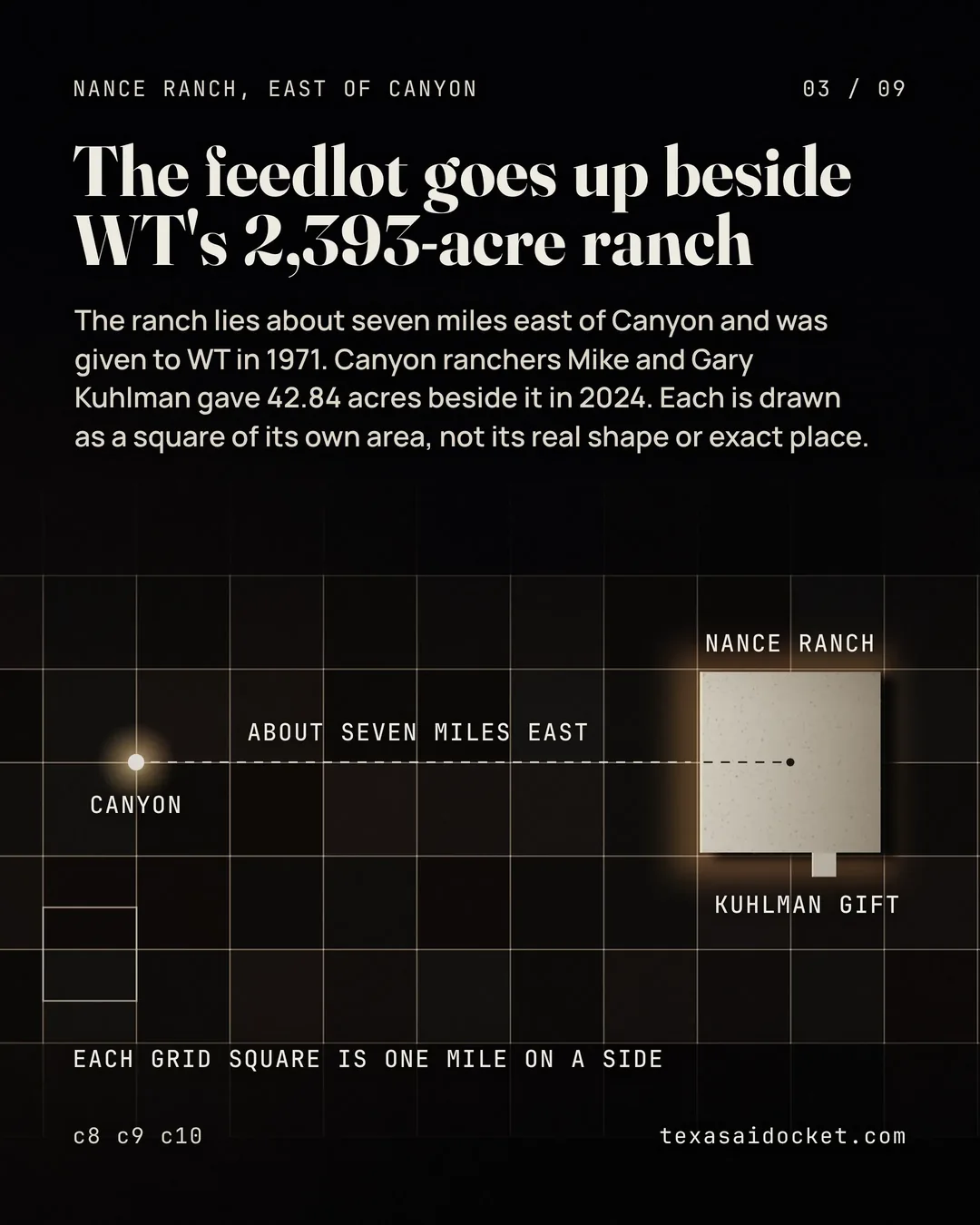
Ground was broken in November 2025 next to WT's Nance Ranch. The ranch lies about seven miles east of Canyon, covers 2,393 acres including its headquarters and was given to WT in 1971. Brothers and Canyon ranchers Mike and Gary Kuhlman gave 42.84 acres beside the ranch in 2024.
Why the Panhandle
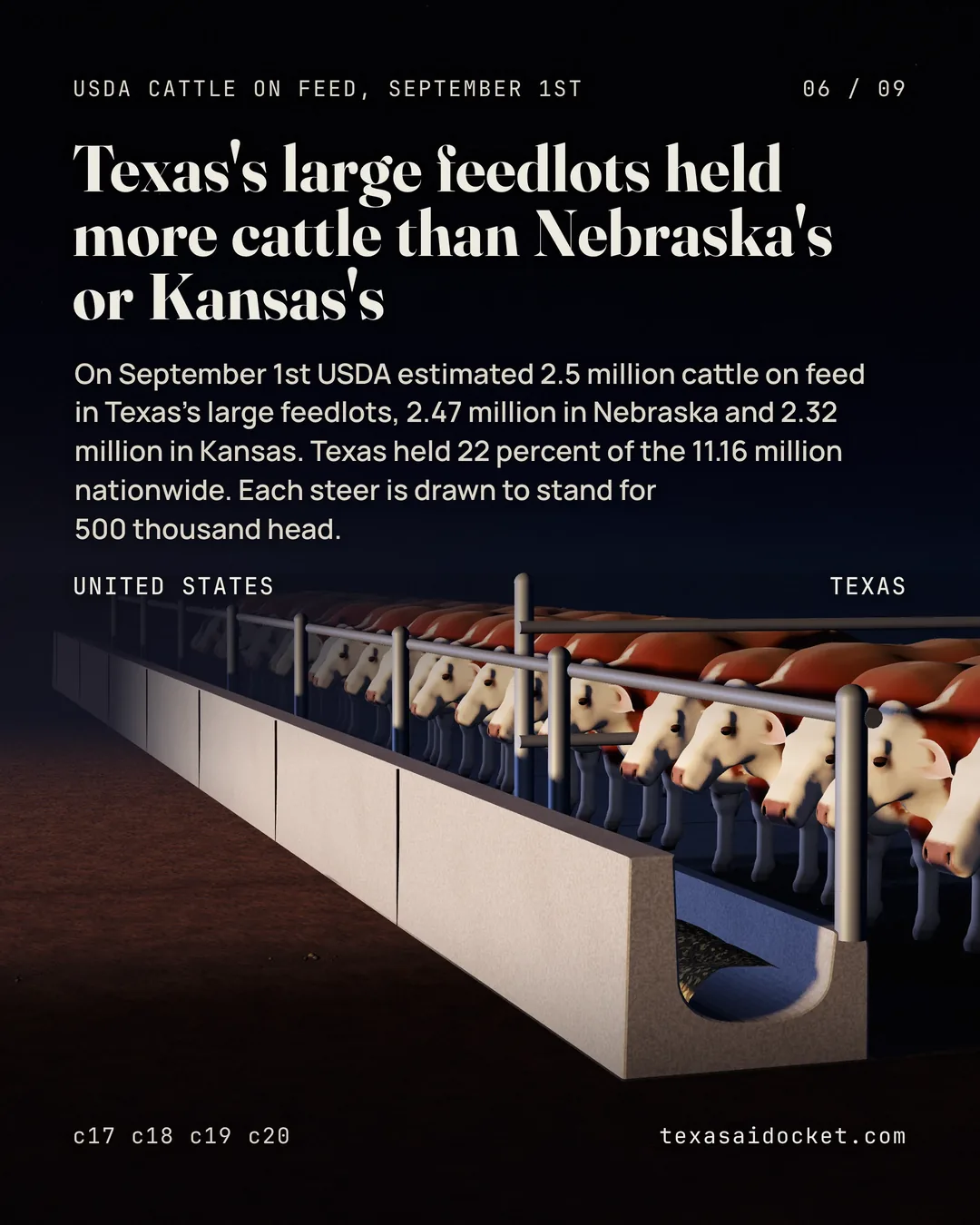
USDA's Cattle on Feed report estimated 2,500 thousand head on feed in Texas's large feedlots on September 1st. Nebraska had 2,470 thousand and Kansas 2,320 thousand. The national total was 11,163 thousand.
What the release leaves open
The release says AI-powered approaches are designed to increase beef production efficiency and advance feedlot management practices. It does not say which tools the feedlot will test, who will supply them, what they will measure or when any result will be published. A reader can't tell from the release whether AI work has begun or remains a plan for the finished pens.
Sources for this story
- Texas A&M University System press release, October 7th, 2026
- USDA NASS, Cattle on Feed, released September 18th, 2026
Claim-by-claim verification · 24 claims
West Texas A&M University received a $9.75 million grant from the U.S. Department of Agriculture, which the A&M System release calls the largest federal award in University history.
West Texas A&M University has received a $9.75 million grant from the U.S. Department of Agriculture—the largest federal award in University history
The release says the USDA awarded the grant through its Research Facilities Act Program for a center for beef cattle research and innovation.
awarded the grant for a center for beef cattle research and innovation through its Research Facilities Act Program
A required dollar-for-dollar match of $4.875 million from the Texas A&M University System and $4.875 million from other sources brings the project total to $19.5 million, according to the release.
A required dollar-for-dollar match—with $4.875 million from The Texas A&M University System and another $4.875 million from other sources—brings the project total to $19.5 million.
The research feedlot will pair 90 small research pens for scientific studies with 45 commercial-scale pens.
by pairing 90 small research pens for scientific studies with 45 commercial-scale pens
Plans for the research feedlot include a precision beef cattle handling facility and a veterinary care and research hospital. They also include an advanced technology feed and production center and a metabolism and physiology center.
Plans call for the research feedlot to include a precision beef cattle handling facility, a veterinary care and research hospital, an advanced technology feed and production center, and a metabolism and physiology center.
The release says new feeding, health and handling techniques can be evaluated with traditional and artificial intelligence-powered approaches.
New feeding, health and handling techniques can be evaluated with traditional and artificial intelligence-powered approaches that are designed to increase beef production efficiency and advance feedlot management practices.
The A&M System release of October 7th, 2026 names no AI tool, vendor, camera, model or result. Its only mention of artificial intelligence is a planned way of evaluating techniques.
artificial intelligence-powered approaches that are designed to increase beef production efficiency and advance feedlot management practices
Ground was broken in November 2025 next to WT's Nance Ranch, according to the release.
Ground was broken in November 2025 adjacent to WT’s Nance Ranch.
WT's Nance Ranch lies about seven miles east of Canyon, covers 2,393 acres including the headquarters and was given to WT in 1971.
located about seven miles east of Canyon, consists of 2,393 acres including the headquarters. Given to WT in 1971
Canyon ranchers Mike and Gary Kuhlman made a 2024 land legacy gift of 42.84 acres next to WT's Nance Ranch.
a 2024 land legacy gift of 42.84 acres adjacent to WT’s Nance Ranch by brothers and Canyon ranchers Mike and Gary Kuhlman
The research feedlot and the education facility are being built southwest of the existing WT feedlot near Nance Ranch.
which are being constructed southwest of the existing WT feedlot near Nance Ranch
The Paul F. and Virginia J. Engler Foundation Feedlot Education Facility is being built in part with federal community project funding secured by U.S. Rep. Ronny Jackson. That funding included $2.1 million in fiscal year 2024 and $1 million in fiscal year 2026.
under construction in part through federal community project funding secured by U.S. Rep. Ronny Jackson, which included $2.1 million in fiscal year 2024 and $1 million in fiscal year 2026
The Texas Cattle Feeders Association, its members, University donors and other sources will match the $4.875 million the A&M System is investing, according to the release.
Texas Cattle Feeders Association, its members, University donors and other sources will match the A&M System’s $4.875 million investment in the facility.
Dr. Neil Terry, interim president of WT, said the grant, the A&M System funding and donor support underscore the role of the Texas Panhandle in the beef cattle industry.
underscore the critical role the Texas Panhandle plays in the beef cattle industry
Ben Weinheimer, president and CEO of the Texas Cattle Feeders Association, said cattle feeding plays a significant role in the economy and communities of Texas, Oklahoma and New Mexico.
Cattle feeding plays a significant role in the economy and communities across Texas, Oklahoma and New Mexico.
The release ties the planned feedlot to the Center for Advancing Food Animal Production in the Panhandle and the Feedlot Research Group at WT.
through the Center for Advancing Food Animal Production in the Panhandle and through the Feedlot Research Group
USDA NASS estimated 2,500 thousand cattle on feed in Texas feedlots with capacity of 1,000 or more head on September 1st, 2026.
Texas ............: 2,500 2,510 2,500 100 100
Kansas feedlots with capacity of 1,000 or more head had 2,320 thousand cattle on feed on September 1st, 2026, according to NASS.
Kansas ...........: 2,350 2,260 2,320 99 103
Nebraska feedlots with capacity of 1,000 or more head had 2,470 thousand cattle on feed on September 1st, 2026, according to NASS.
Nebraska .........: 2,430 2,470 2,470 102 100
NASS put the United States total of cattle on feed in feedlots with capacity of 1,000 or more head at 11,163 thousand on September 1st, 2026.
United States ....: 11,080 11,117 11,163 101 100
The Texas Cattle Feeders Association says the region of Texas, Oklahoma and New Mexico is known as Cattle Feeding Country. It calls it the largest cattle feeding region in the U.S.
This area, known as Cattle Feeding Country, is the largest cattle feeding region in the U.S.
The Texas Cattle Feeders Association says its members market approximately 25 percent of the fed cattle produced in the United States.
approximately 25 percent of the fed cattle produced in the United States
AgriLife Today reported on February 27th, 2019 that drones carrying thermal imaging cameras were flying over a research feedlot near Amarillo to find feverish animals.
drones equipped with thermal imaging cameras have been buzzing over a research feedlot near Amarillo
The same 2019 AgriLife Today report said scientists in College Station and the Panhandle were experimenting with video cameras and artificial intelligence to identify ailing animals by their behavior.
Scientists in College Station and the Panhandle also are experimenting with video cameras and artificial intelligence