Articles · Courts
A trial court struck an AI transcript. Texas's top court weighs it
A Montgomery County court struck a deposition transcript made with AI because no certified reporter prepared it. The Supreme Court of Texas heard the dispute on October 6th.
Read the story
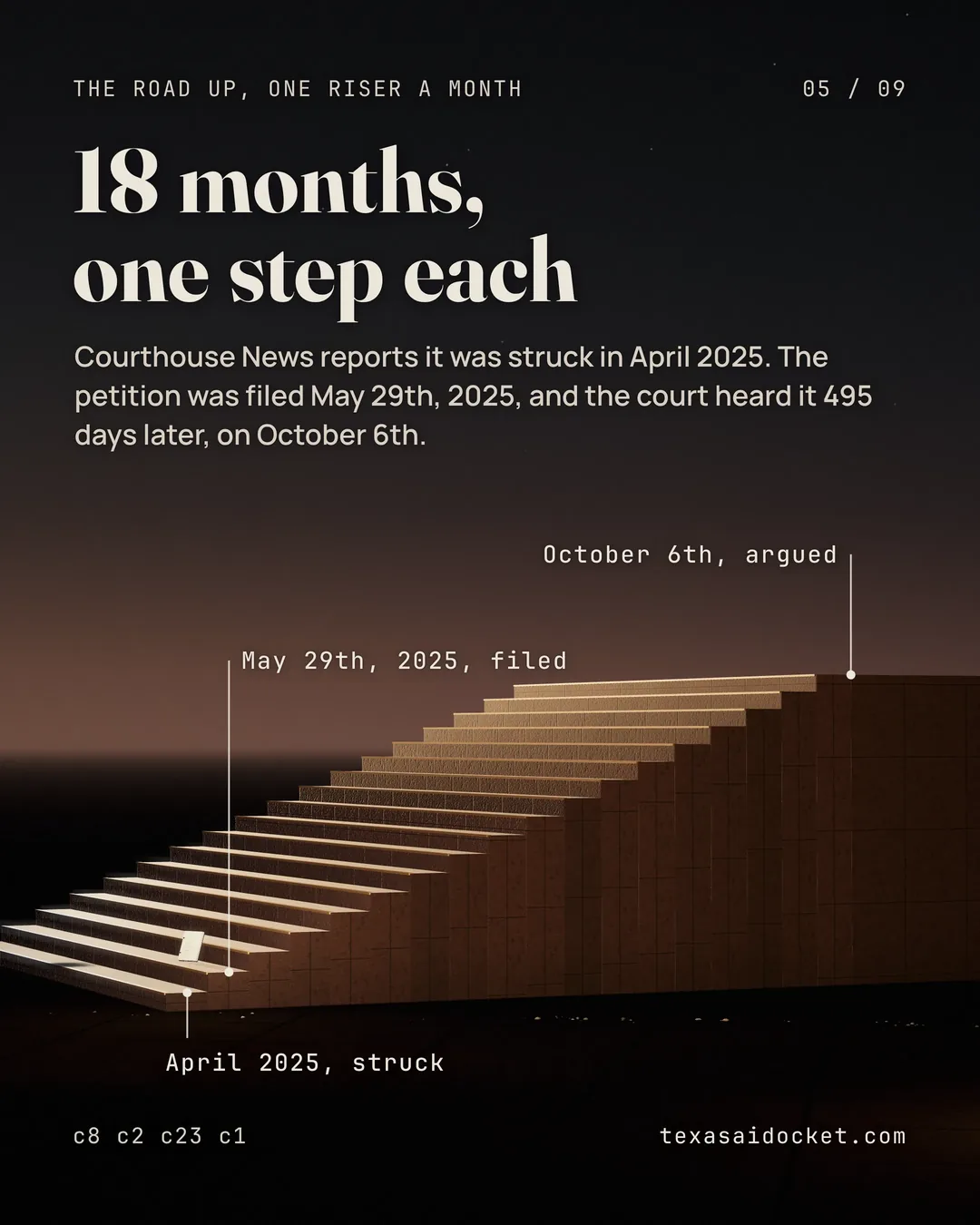
The Supreme Court of Texas heard argument over whether a party should be allowed to submit a deposition transcript generated with AI as evidence, Courthouse News reports. The court listed the case, In re Patrick Hughey, on its submission schedule for October 6th, 2026. It came as a petition for writ of mandamus from Montgomery County and the Ninth District.
The case began as a Montgomery County man's wrongful termination claim against his former employer. The fight in front of the court is narrower. It is about who has to stand behind the written record of what a witness said.
How the transcript was struck
The employer did not object to the transcription software at the deposition. It asked the trial court to strike the transcript several weeks later. The trial court struck it from the record because no certified shorthand reporter prepared it.
What the rules already say
The Texas Rules of Civil Procedure let any party have an oral deposition recorded by other than stenographic means, including on video. The party asking for that kind of recording must obtain a person authorized to administer the oath and assure the recording will be intelligible, accurate and trustworthy.
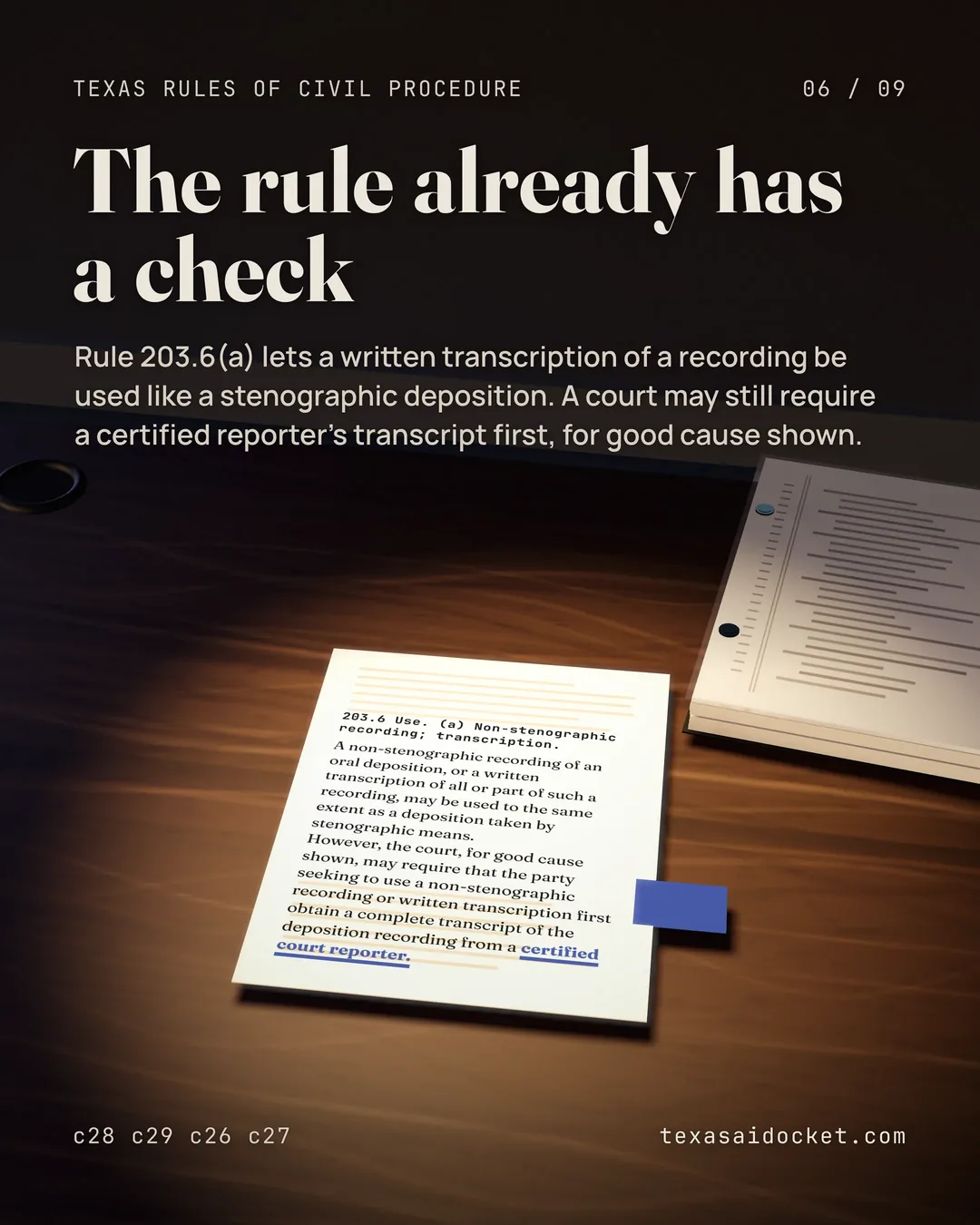
A written transcription of such a recording may be used to the same extent as a deposition taken by stenographic means. A court may still require a complete transcript from a certified court reporter first, on good cause shown. Whether the transcript in this case falls inside that allowance is the question the court has taken up.
The two sides
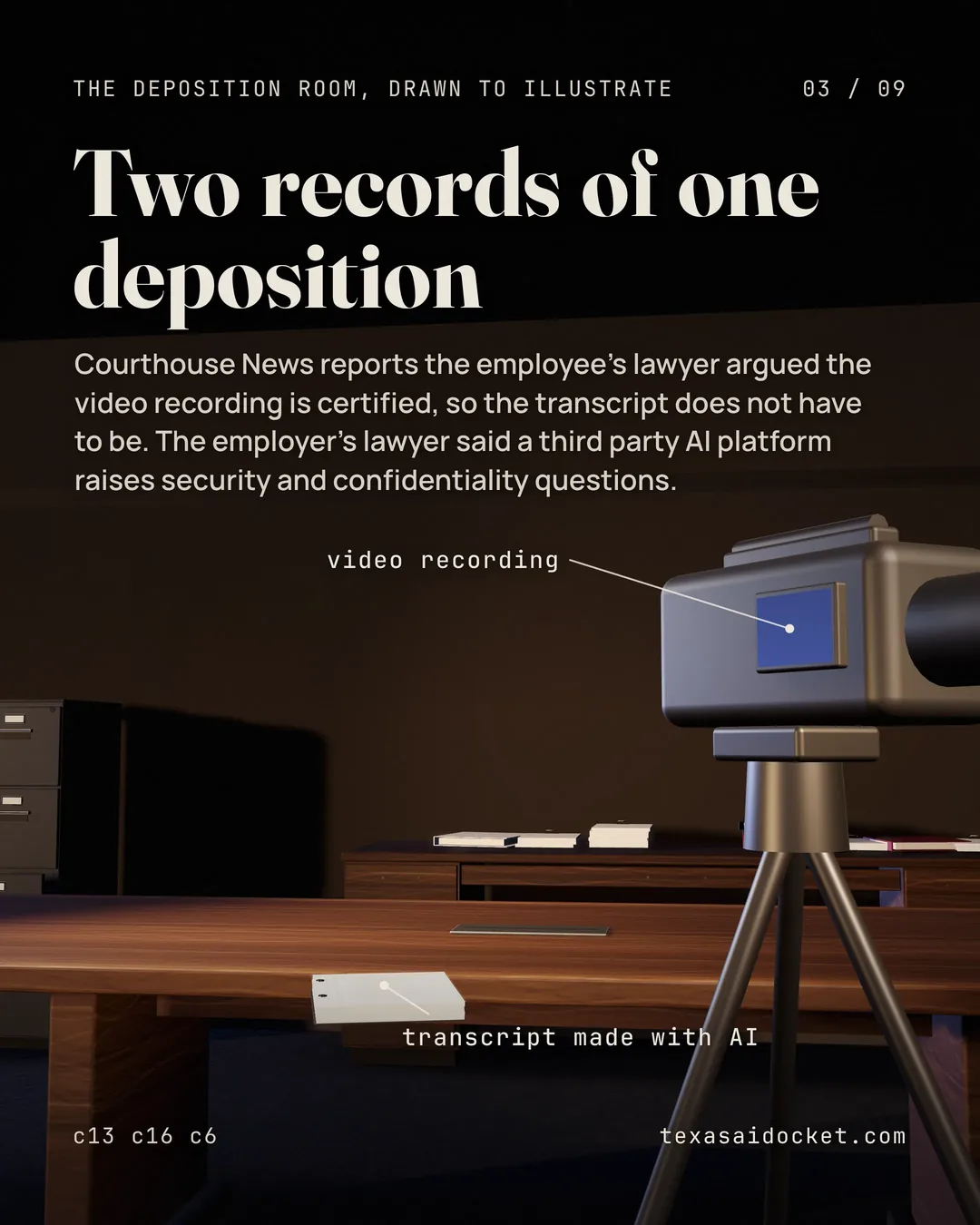
Bradley Snead argued for the employee that the deposition's video recording is certified, so the transcript does not have to be. He told the court it can write more rules if it wants and said the current rules allow what his client did.
Stephanie L. Bryant argued for the employer that depositions transcribed this cheaply by AI programs would multiply discovery costs. She said she had no issue with lawyers using their own in-house AI software. She argued that a third-party platform like the one the employee used raises security and confidentiality questions. The Texas Deposition Reporters Association shared her side's time as amicus curiae, and the court reporters' trade association filed its own amicus brief.
What the bench asked
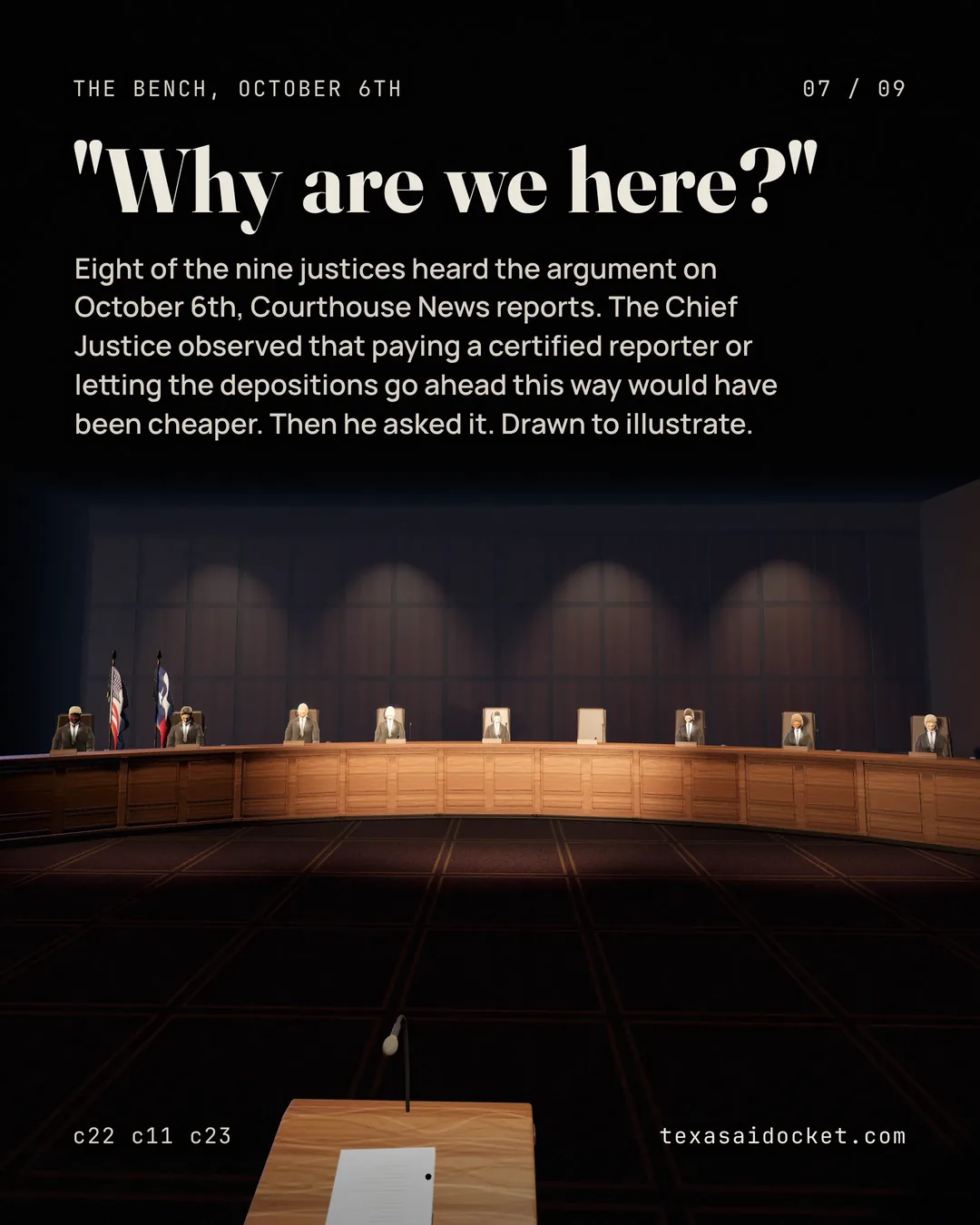
Chief Justice Jimmy Blacklock observed that paying a certified reporter or letting the depositions go ahead this way would have been cheaper. Then he asked why the case was before the court at all. Justice Kyle Hawkins said the other side can point out an error and watch the video. He asked why the court should set aside what he called an efficient, cost-effective tool.
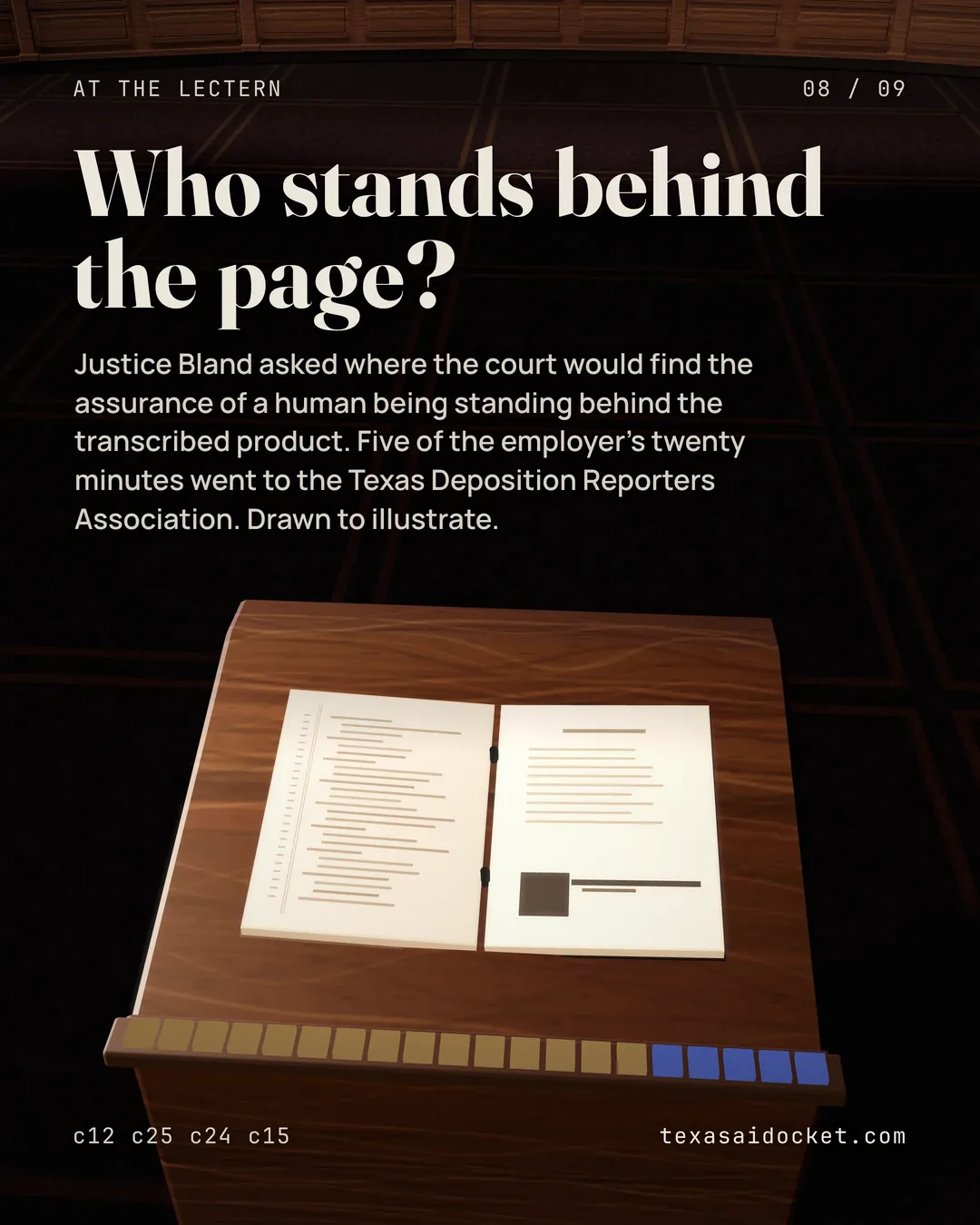
Justice Jane Bland asked where the court would find the assurance of a human being standing behind the transcribed product. Justice J. Brett Busby asked whether the court's proportionality rules would answer the concern about cost. Justice Evan Young said the court has escape hatches, naming the recording itself and a judge's power to order a certified shorthand reporter.
What is still open
Courthouse News read the argument as showing the justices inclined to allow AI transcripts where verified video recordings serve as the check. That is the outlet's reading, not a ruling. The orders the court pronounced on October 9th list no order in the case. The court's orders page listed no later orders date when read on October 15th. Justice John Devine was absent from the argument.
A ruling would say whether a video recording can stand behind a transcript no certified reporter prepared. It would also say what a trial judge should treat as good cause to demand one. Until the court decides, the trial court's order striking the transcript stands.
Sources for this story
- Supreme Court of Texas, Case 25-0463 case information
- Submission Schedule, In the Supreme Court of Texas, Tuesday, October 6, 2026
- Texas high court toys with AI transcripts for witness depositions
- Texas Rules of Civil Procedure
- The Supreme Court of Texas, Orders Pronounced October 9, 2026
- Supreme Court of Texas, Orders and Opinions, 2026
Claim-by-claim verification · 31 claims
The court's own case record sets the argument date and hour.
This case has been set for oral argument at 9:00 a.m., October 6, 2026.
The case record gives the docket number, the filing date, the case type and the style.
Case: 25-0463 Date Filed: 05/29/2025 Case Type: Mandamus/Cause Style: IN RE PATRICK HUGHEY
The court reporters' trade association filed an amicus brief.
Amicus Curiae Brief received on behalf of Texas Court Reporters Association, Inc., submitted by Jason Ray of Riggs & Ray P.C. of Austin, Texas.
The opposing party in the underlying suit filed its own brief on the merits.
Real Party in Interest's Brief on the Merits filed on behalf of Reddico Construction Co., Inc.
The court's submission schedule for its October 6th sitting names the relator's counsel.
Relator will be represented by Bradley W. Snead (Wright Close
Courthouse News reports the Supreme Court of Texas heard argument over whether a party should be allowed to submit a deposition transcript generated with AI as evidence.
The Texas Supreme Court heard arguments Tuesday over whether an individual should be allowed to submit an AI-generated transcript of a deposition as evidence.
Courthouse News reports the case began as a Montgomery County man's wrongful termination claim against his former employer.
The case concerns a Montgomery County man’s wrongful termination claim against his former employer.
Courthouse News reports the trial court in Montgomery County struck the transcript from the record in April 2025 because no certified shorthand reporter prepared it.
The trial court in Montgomery County struck the AI-generated transcript the employee submitted from the record back in April 2025 because the transcript was not prepared by a certified shorthand reporter.
Courthouse News reports the Texas Court of Appeals for the Ninth District denied the employee in an unsigned ruling. It says that court found the issue was the uncertified written transcript generated with AI, not the content of the deposition or its use as evidence.
In their unsigned denial of his appeal, the Texas Court of Appeals for the Ninth District reaffirmed that the issue was not with the content of the deposition or the use of the deposition as evidence, but merely with the use of an uncertified, AI-generated written transcript.
Courthouse News reports the company did not object to the transcription software at the deposition and asked the trial court to strike the transcript several weeks later.
However, the company did not object to the use of the transcription software at the time of the deposition, only asking the trial court to strike it several weeks later.
Courthouse News reports Chief Justice Jimmy Blacklock observed at argument that paying a certified reporter, or letting the depositions go ahead this way, would have been cheaper. He then asked why the case was before the court at all, Courthouse News reports.
Chief Justice Jimmy Blacklock noted it would have just been cheaper for the employee’s counsel to pay for the certified reporter, or it would have been cheaper for the company’s counsel to just let the depositions happen this way. “Why are we here?” he asked.
Justice Jane Bland asked at argument where the court would find the assurance of a human being standing behind the transcribed product, Courthouse News reports.
Where are we going to get that peace, of a human being standing behind the transcribed product?
Bradley Snead argued for the employee that the deposition's video recording is certified and so the transcript does not have to be, Courthouse News reports.
Snead argued that because the deposition’s video recording is certified, the transcript does not have to be.
Snead told the court it can create more rules if it wants. He said that under the current rules a party is allowed to do this, Courthouse News reports.
“If the court wants to create more rules, they can. But under the current rules, you are allowed to do this.”
The employer's lawyer Stephanie L. Bryant argued that using AI programs to produce written transcripts and take depositions this cheaply would exponentially increase discovery costs, Courthouse News reports.
the use of these AI programs to generate written transcripts and do these depositions this cheaply is going to affect litigation. It’s going to exponentially increase discovery costs.
Bryant said she had no issue with lawyers using their own in-house AI software. She argued that a third-party AI transcription platform like the one the employee used raises substantial security and confidentiality questions, Courthouse News reports. She said it would not be allowed under current Texas rules.
Bryant insisted she had no issue with litigants or attorneys using their own in-house AI software, but that using a third-party AI transcription platform like the employee did in this case raises substantial security and confidentiality questions, and that as such, it would not be allowed under current Texas rules of procedure.
Justice J. Brett Busby asked Bryant at argument whether the court's proportionality rules would take care of her concern about costs, Courthouse News reports.
Justice J. Brett Busby pressed Bryant on her assertion of increased costs for defendants and reduced costs for plaintiffs. “Wouldn’t our proportionality rules take care of that?”
Justice Kyle Hawkins said at argument that the other side can point out an error and watch the video, Courthouse News reports. He said he didn't see what the issue is.
If they submit the AI transcript, you have the chance to say, ‘That’s wrong, there’s an error in the transcript, and we’ve got the video and we can just watch that.’ I don’t see what the issue is.
Hawkins asked at argument why the court should set aside what he called an efficient, cost-effective tool, Courthouse News reports.
He also questioned why they should set aside the use of “this efficient, cost-effective tool,” as he described the AI transcription platform.
Justice Evan Young said at argument that the court has escape hatches. He named the actual recording and a judge's power to order a certified shorthand reporter, Courthouse News reports.
“We have all of these escape hatches,” Young continued. “We have the actual recording. We have the ability of the judge to say ‘Okay, there’s just too much about this. I want a certified shorthand reporter to do this.’
Courthouse News read the argument as showing the justices seemed inclined to allow AI transcripts where verified video recordings act as escape hatches. That is the outlet's reading, not a ruling.
Texas Supreme Court justices seemed inclined to allow AI-generated transcripts for witness depositions where verified video recordings can act as "escape hatches" to ensure accuracy.
Eight of the nine justices heard the argument and Justice John Devine was absent, Courthouse News reports.
Eight of the nine justices heard the arguments Tuesday, with Justice John Devine absent.
The Supreme Court of Texas listed case 25-0463, In re Patrick Hughey, on its submission schedule for Tuesday, October 6th, 2026. It is a petition for writ of mandamus from Montgomery County and the Ninth District.
Tuesday, October 6, 2026
The schedule names Stephanie L. Bryant of The Bays Firm, from Conroe, to argue for the real party in interest.
Real Party in Interest will be represented by Stephanie L. Bryant
The schedule gives each side 20 minutes. On the real party's side Bryant presents the first 15 minutes. Shelby O'Brien of Butler Snow LLP presents the remaining 5 minutes for the Texas Deposition Reporters Association as amicus curiae.
Curiae, Tex. Dep. Reporters Ass’n, Shelby O’Brien will present the remaining 5 minutes.
Rule 199.1(c) of the Texas Rules of Civil Procedure lets any party have an oral deposition recorded by other than stenographic means, including videotape recording.
to be recorded by other than stenographic means, including videotape recording.
Under Rule 199.1(c) the party requesting a non-stenographic recording must obtain a person authorized by law to administer the oath. That party must also assure that the recording will be intelligible, accurate and trustworthy.
requesting the non -stenographic recording will be responsible for obtaining a person
Rule 203.6(a) lets a non-stenographic recording of an oral deposition, or a written transcription of it, be used to the same extent as a deposition taken by stenographic means.
A non- stenographic recording of an oral deposition, or a written transcription of all or part of such a recording, may be used to the same extent as a deposition taken by stenographic means.
Rule 203.6(a) also lets a court require a complete transcript from a certified court reporter before a non-stenographic recording or written transcription is used, on good cause shown.
However, the court, for good cause shown, may require that the party seeking to use a non- stenographic recording or written transcription first obtain a complete transcript of the deposition recording from a certified court reporter.
The orders the Supreme Court of Texas pronounced on October 9th, 2026 list no order in case 25-0463, In re Patrick Hughey.
Orders Pronounced October 9, 2026
The Supreme Court of Texas's orders and opinions page for 2026 lists October 9th as its latest orders date when read on October 15th, 2026.
September 28, 2026 October October 2, 2026 October 9, 2026