Articles · Agriculture
How USDA uses AI to pick screwworm surveillance and sterile fly release sites in Texas
USDA uses AI models to pick where Texas surveils, traps and releases sterile flies against New World screwworm. Its own scientists say the models miss one thing.
Read the story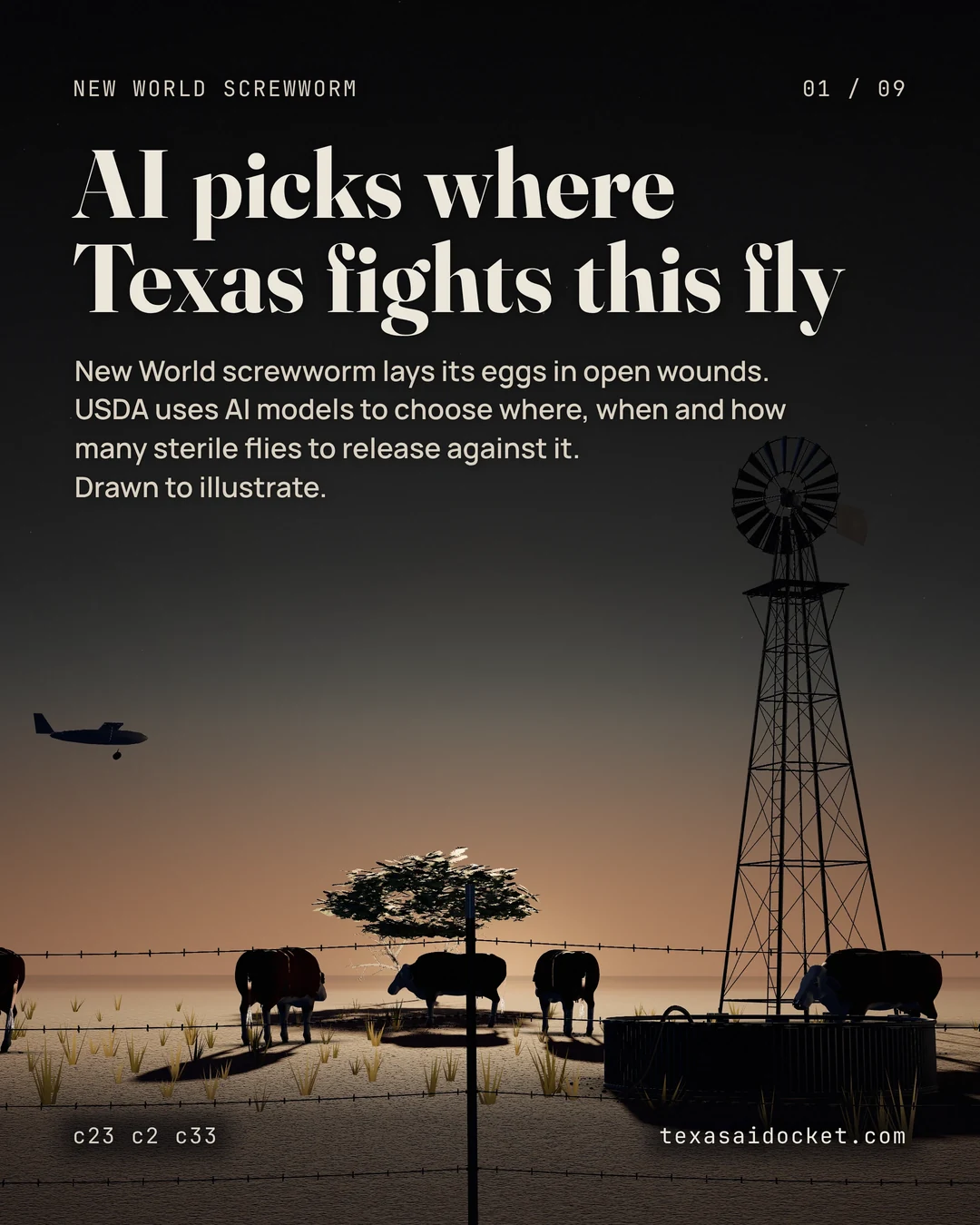
The U.S. Department of Agriculture uses predictive models built with artificial intelligence to choose where, when and how many sterile flies to release against New World screwworm. The fly lays its eggs in open wounds and body openings. Those eggs hatch into maggots that feed on living tissue.
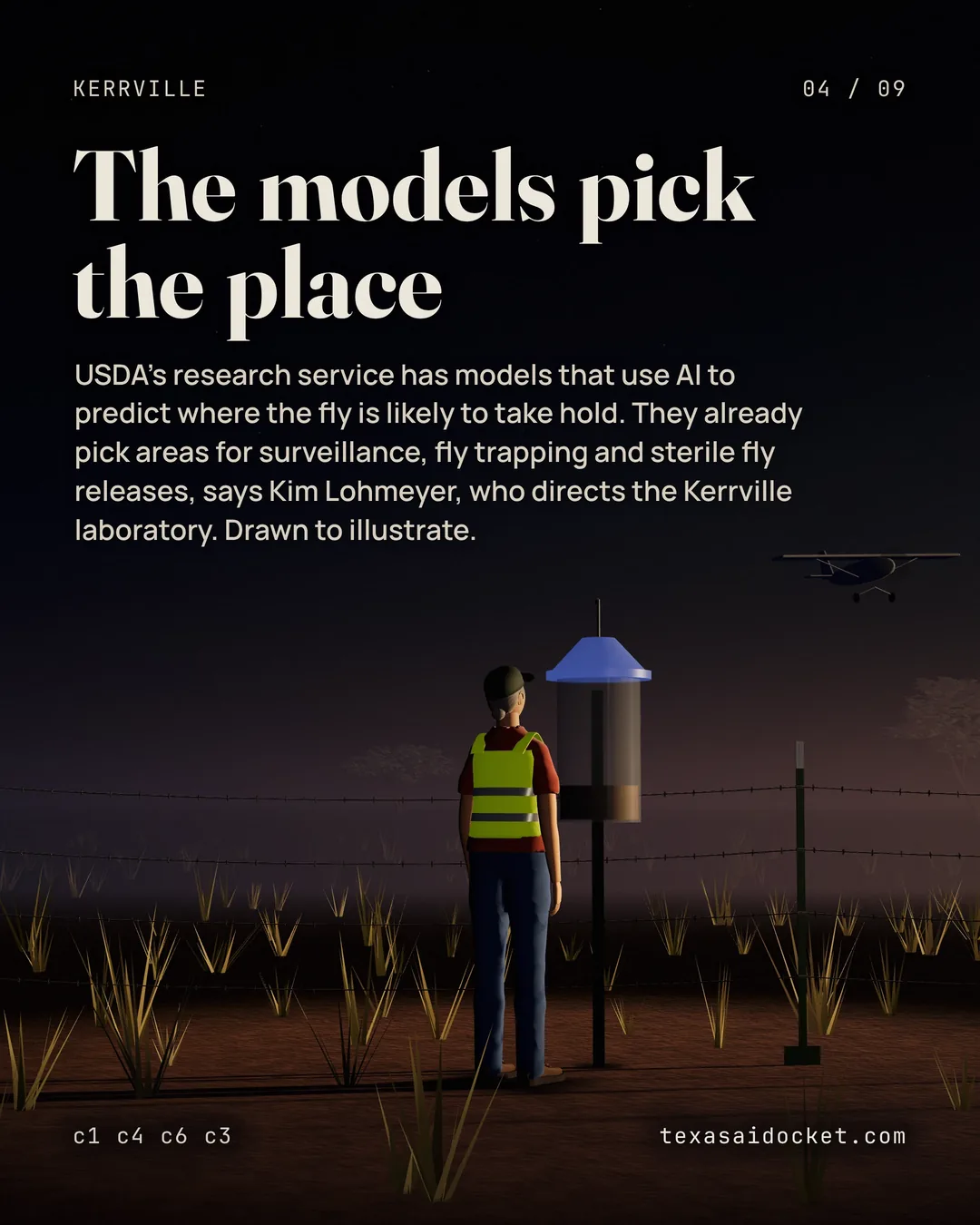
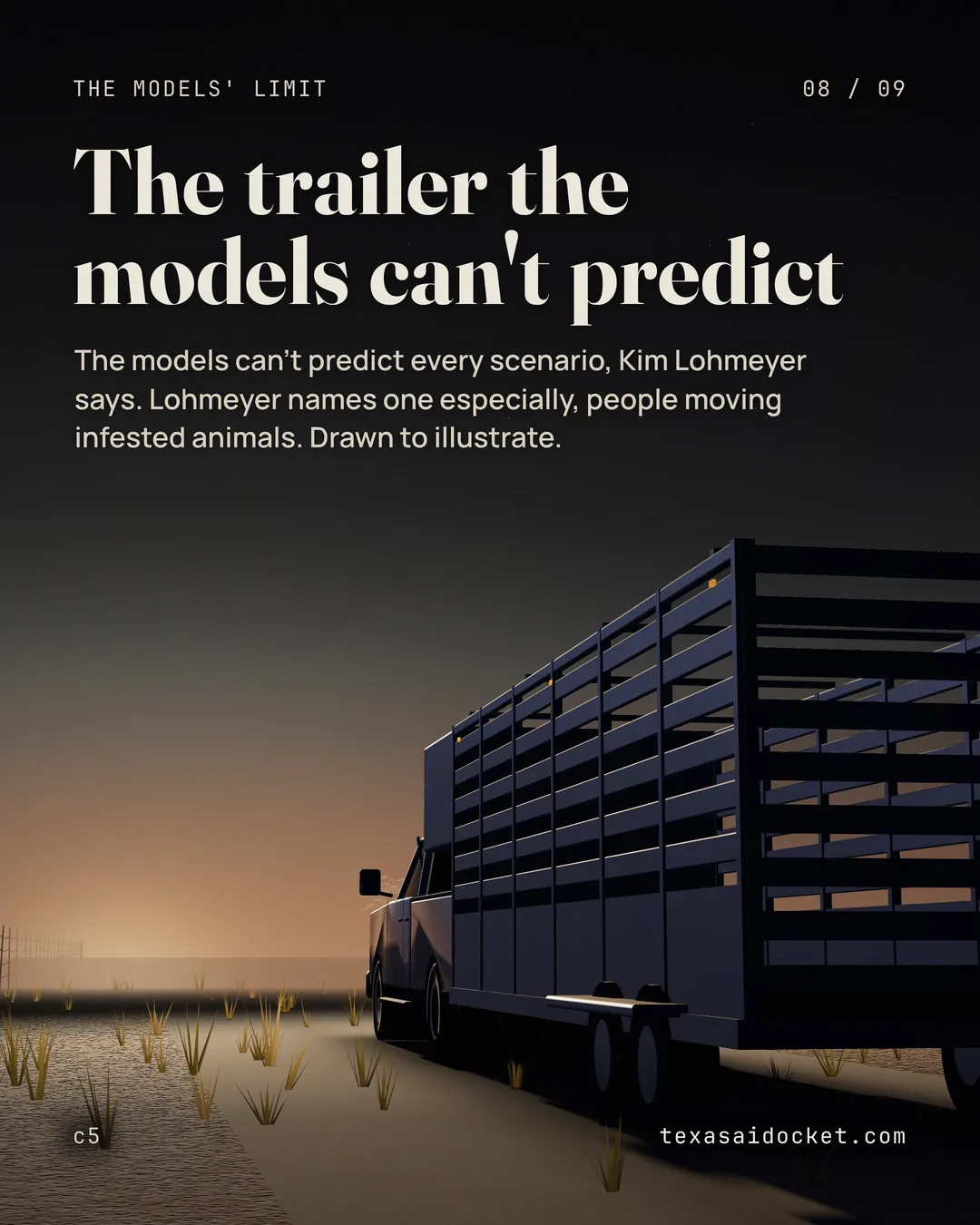
Kim Lohmeyer directs the research service's livestock insects laboratory in Kerrville. Lohmeyer says the models already pick areas for surveillance, adult fly trapping and sterile fly releases. Lohmeyer also says they can't predict every scenario, especially people transporting infested animals.
Where the outbreak stands
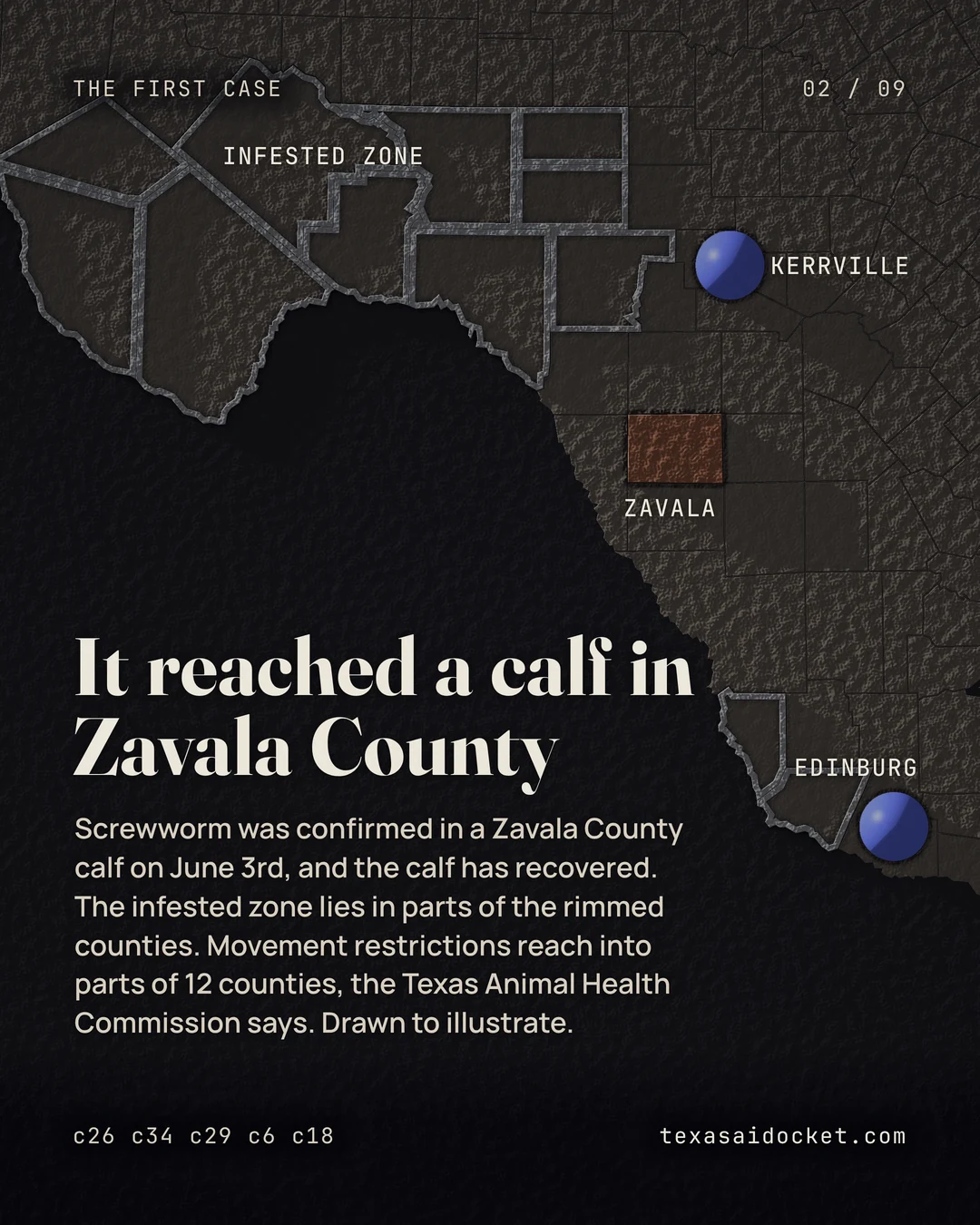
The Texas Animal Health Commission says the fly was first confirmed in Texas on June 3rd, 2026 in a calf in Zavala County. That calf has recovered and its case is considered inactive.
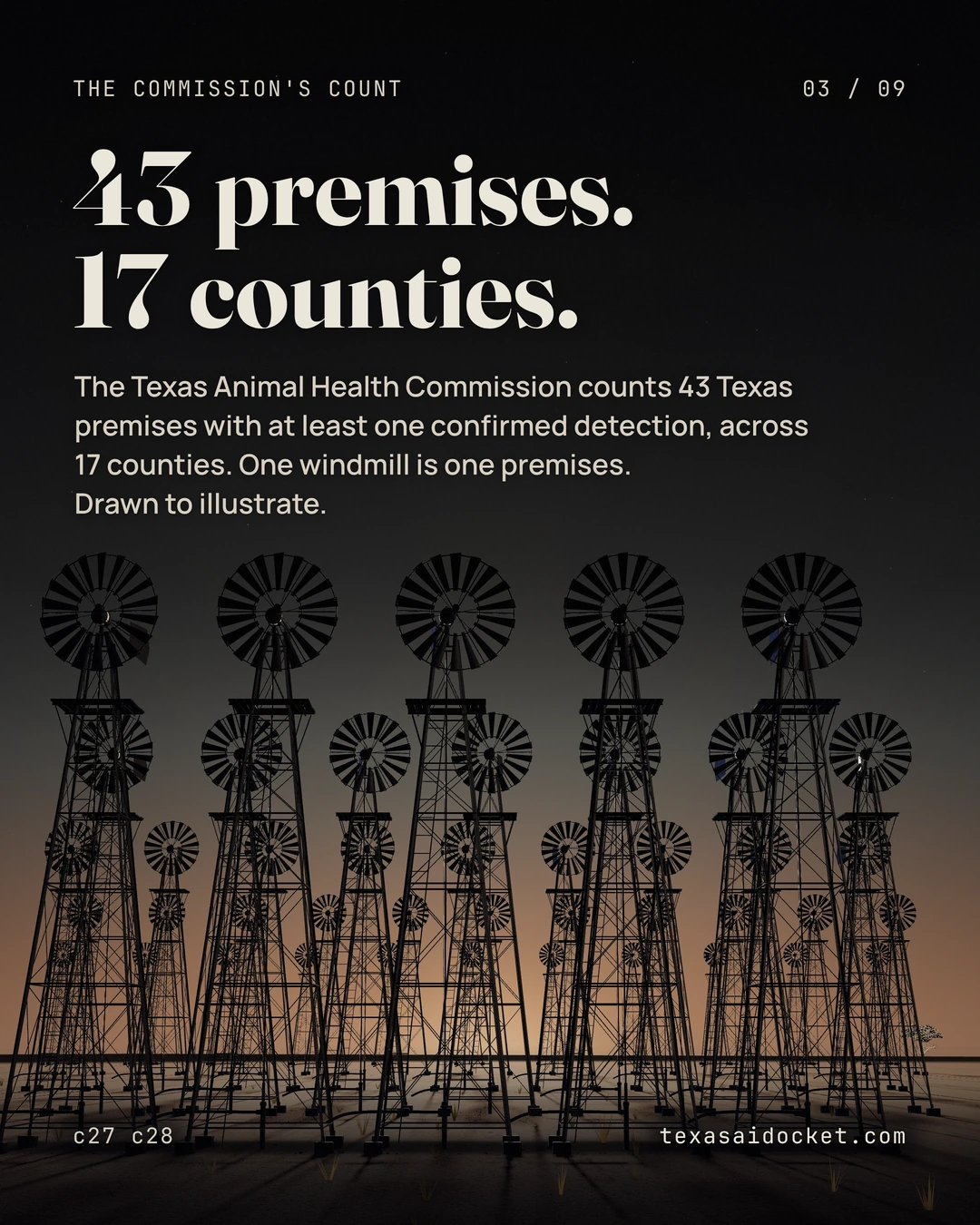
The commission now counts 43 Texas premises with at least one confirmed detection. Those premises sit in 17 counties. Movement restrictions cover an established infested zone in parts of counties that run from Brewster and Presidio to Starr and Zapata.
What the models steer
The research service says its models read ecological and environmental records to predict where the pest is likely to become established and how it may spread. The system is meant to send aircraft, personnel, fly traps and sterile insects where they protect the most.
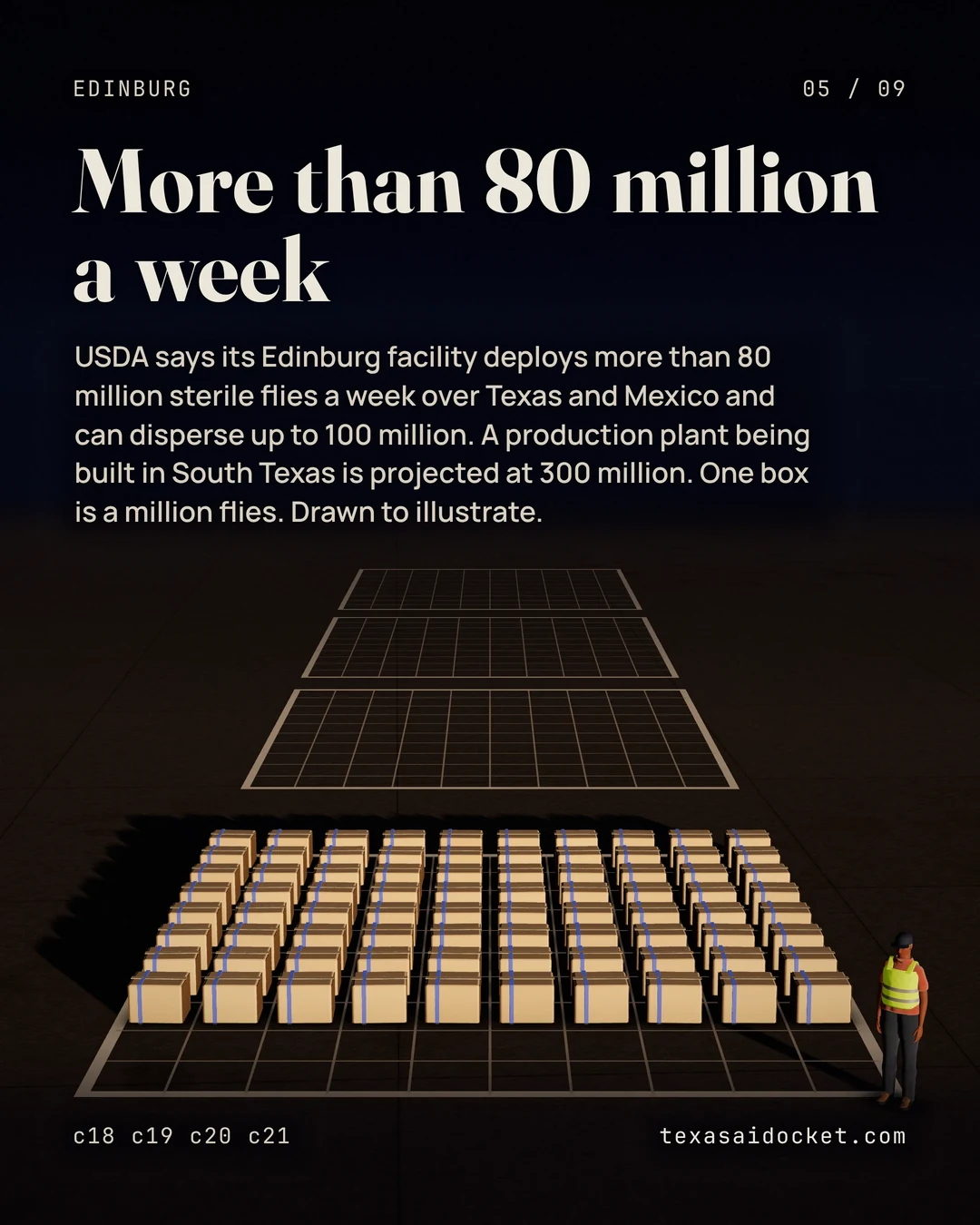
USDA says its Edinburg facility deploys more than 80 million sterile flies a week. An agency page says the facility can disperse up to 100 million a week. A production plant planned for South Texas is projected at 300 million a week.
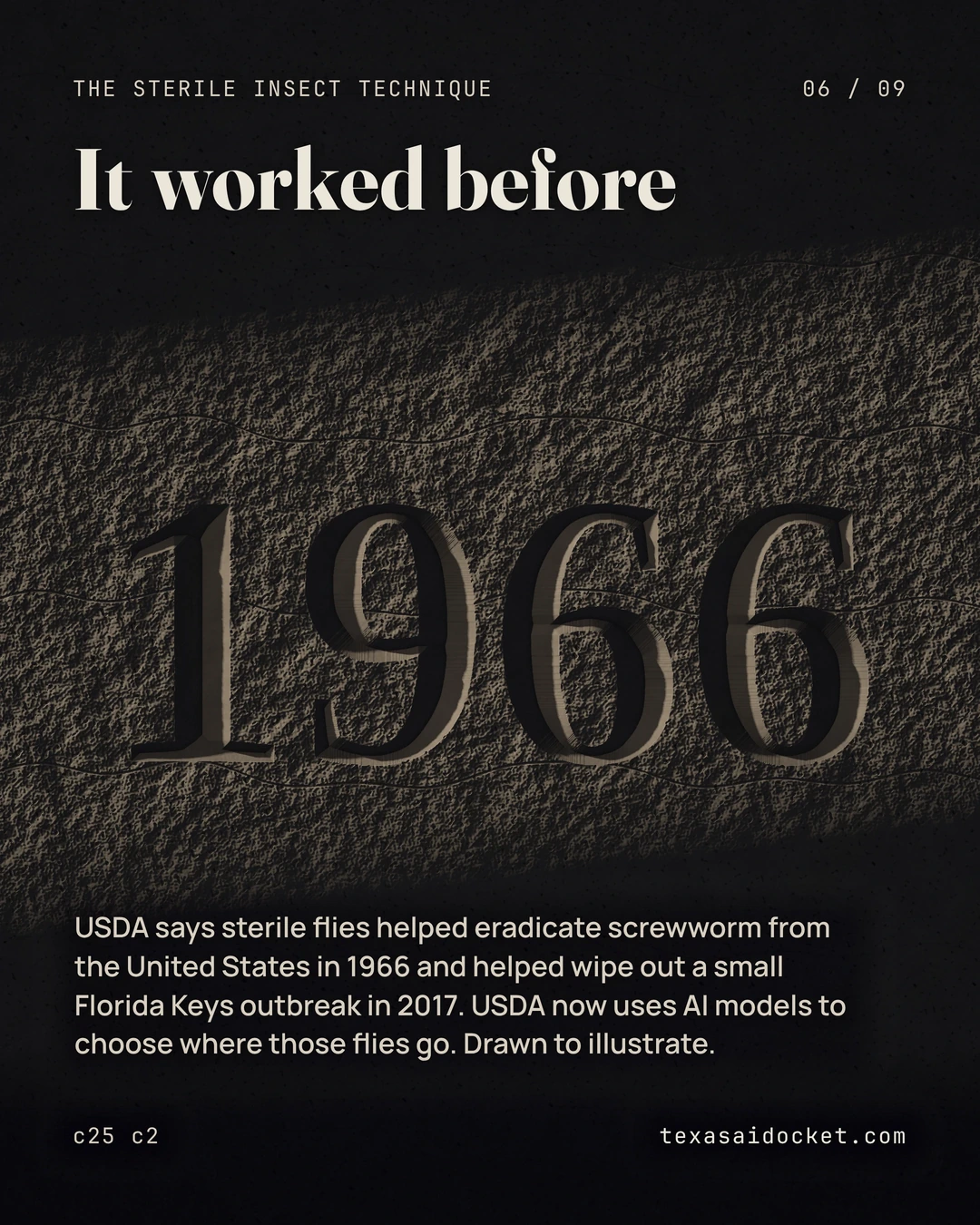
The sterile insect technique helped eradicate the fly from the United States in 1966. It also ended a small Florida Keys outbreak in 2017.
What the drones found
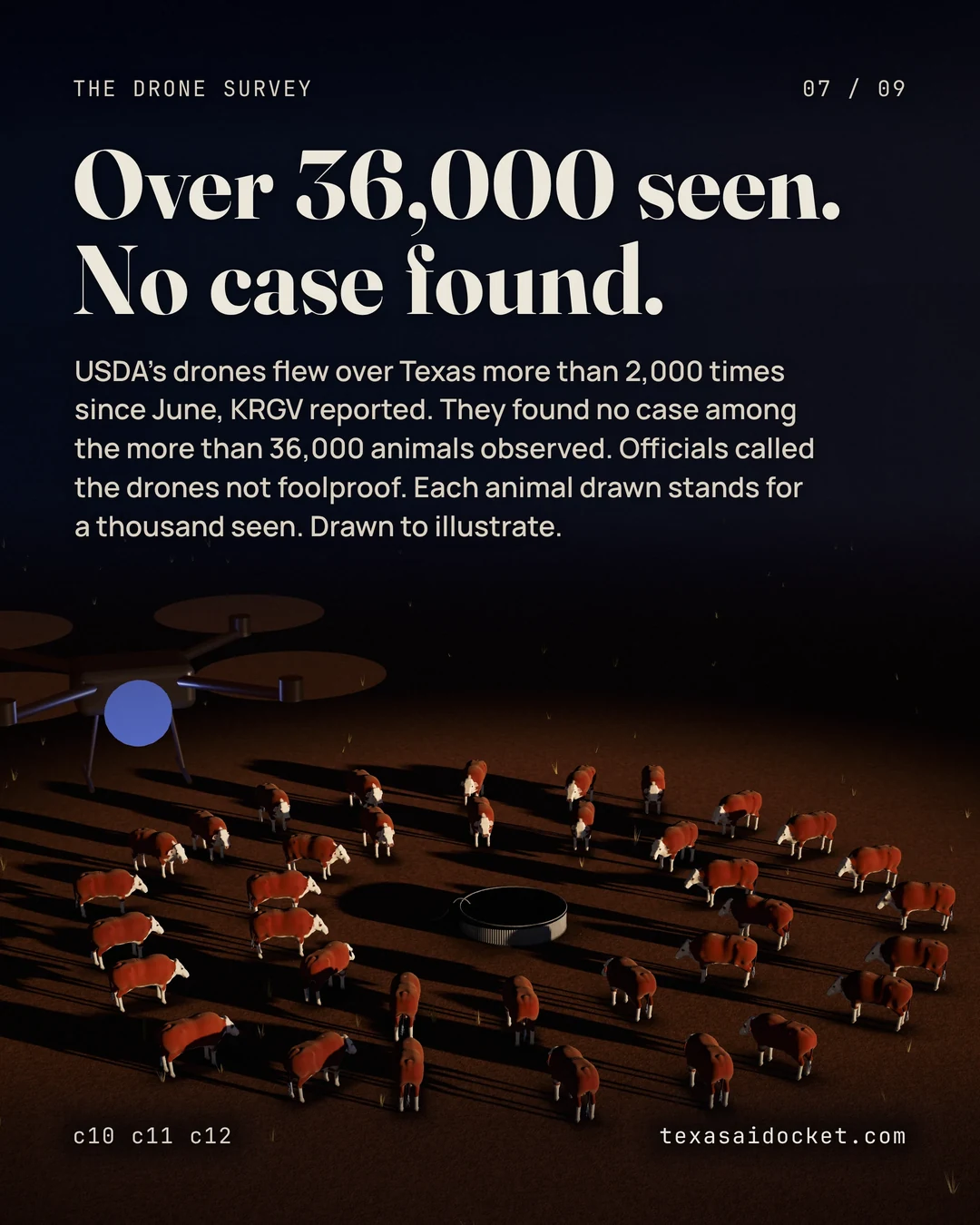
KRGV reported that USDA has flown drones across Texas more than 2,000 times since June. The agency said it observed more than 36,000 animals and found no screwworm case among them. That result covers the animals the drones saw and says nothing about the premises the commission has confirmed.
USDA officials also told KRGV the drones are not foolproof for detecting screwworm.
What the models can't see
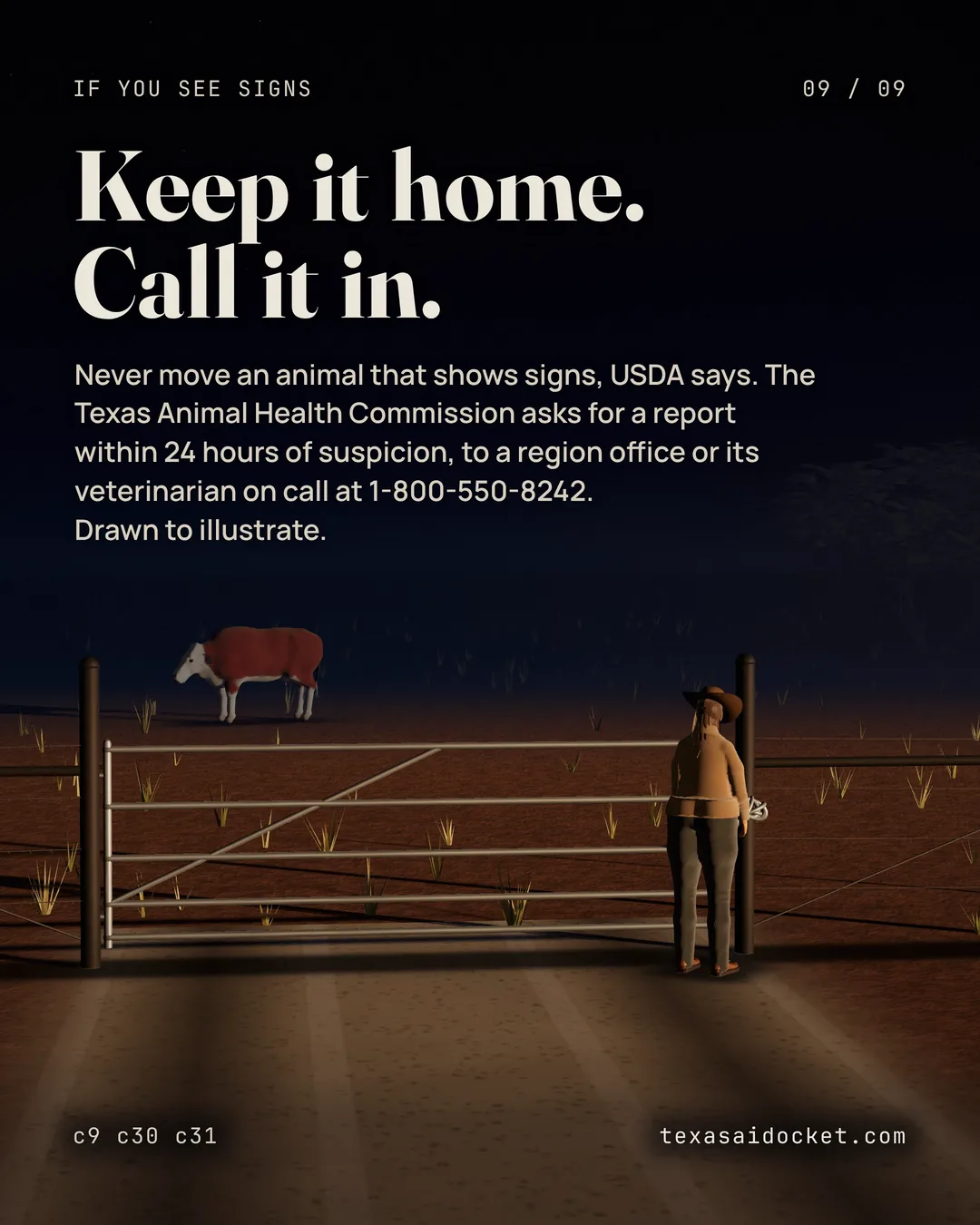
Lohmeyer names one blind spot above the rest, people moving infested animals. The research service tells livestock owners never to move an animal that shows signs of infestation or is suspected of it.
The commission says a suspected case should be reported within 24 hours of suspicion. Reports go to a regional office or to its veterinarian on call. Whether the models will ever account for animals moved by hand is a question the published material does not answer.
Sources for this story
- USDA Agricultural Research Service, Tracking the Path of New World Screwworm
- KRGV, No screwworm cases found after USDA conducts 2,000 drone flights over Texas, by Santiago Caicedo
- APHIS, New World Screwworm Response
- APHIS, Sterile Fly Production and Dispersal
- CDC, About New World Screwworm
- APHIS, Sterile Insect Technique
- Texas Animal Health Commission, New World Screwworm
Claim-by-claim verification · 34 claims
USDA's research service says its New World screwworm models use advanced analytic tools and artificial intelligence. They predict where the pest is likely to become established and how it may spread.
Predictive models use advanced analytic tools and artificial intelligence (AI) to interpret ecological, environmental, and historical information to predict where New World screwworm is likely to become established and the potential pathways it may follow to spread.
USDA says it uses the models to choose the locations, timing and number of sterile flies to release.
USDA uses insights from the models to identify optimal locations, timing, and the number of sterile flies to release for the most effective application, to interrupt their reproductive cycle and spread.
The research service says the modeling system will help send aircraft, personnel, fly traps and sterile insects to the places and times where they protect the most.
directing resources such as aircraft, personnel, fly traps, and sterile insects to the areas where they offer the greatest protection and at precise times to cause the greatest impact
Kim Lohmeyer says the models are already being used to select areas for livestock and wildlife surveillance, adult fly trapping and sterile fly releases.
are already being utilized to select areas for increased livestock and wildlife surveillance, adult fly trapping, and for implementing SIT
Lohmeyer says the models can't predict every scenario, especially ones driven by people transporting infested animals.
However, these models cannot predict every scenario, especially those impacted by unpredictable variables like people transporting infested animals.
Lohmeyer directs the research service's Knipling-Bushland Livestock Insects Research Laboratory in Kerrville.
said Kim Lohmeyer, Director of the ARS Knipling-Bushland Livestock Insects Research Laboratory in Kerrville, TX
Lohmeyer says advanced AI and predictive modeling tools can help forecast where New World screwworm infestations are likely to appear.
advanced AI and predictive modeling tools that can be employed to help us forecast where New World screwworm infestations are likely to pop up
USDA asks anyone who sees signs of screwworm infestation in an animal to report it through its New World screwworm reporting page.
If you spot signs of New World screwworm infestation in animals, report it to the appropriate responding official by visiting the USDA New World screwworm reporting page
The research service tells livestock owners never to move an animal that shows signs of infestation or is suspected of being infested.
Livestock owners should remain vigilant and never move an animal that exhibits signs of infestation or that is suspected of being infested.
KRGV reported on October 12th that USDA says its drones have flown across Texas more than 2,000 times since June looking for New World screwworm.
The U.S. Department of Agriculture says it has flown drones across Texas more than 2,000 times since June to look for the New World screwworm.
KRGV reported USDA saying it observed more than 36,000 animals and found no screwworm cases.
The USDA said it observed more than 36,000 animals and found no screwworm cases.
USDA officials told KRGV the drones are not foolproof for detecting screwworm and use artificial intelligence to inspect animal wounds.
USDA officials said drones are not foolproof for detecting screwworms, but they use artificial intelligence to inspect animal wounds more effectively.
KRGV reported that federal officials announced a partnership with U.S. Customs and Border Protection in August to use CBP drones to find infected animals.
In August, federal officials announced a partnership with U.S. Customs and Border Protection to use CBP drones to find infected animals.
KRGV reported on August 10th that USDA and U.S. Customs and Border Protection signed an agreement letting USDA use CBP drones to find infected animals.
signed an agreement allowing the USDA to use CBP drones to find infected animals.
KRGV reported that the CBP drones use AI technology to identify which animals may be infected.
The drones use AI technology to identify which animals may be infected.
Agriculture Secretary Brooke Rollins and CBP Commissioner Rodney Scott announced the drone initiative at a press conference in Edinburg, KRGV reported.
U.S. Secretary of Agriculture Brooke Rollins and U.S. Customs and Border Protection Commissioner Rodney Scott held a Monday press conference
An APHIS response page last modified July 31st says USDA had conducted over 1,000 drone surveillance flights in Texas since June 3rd and observed over 20,000 animals.
Since June 3, 2026, USDA has conducted over 1,000 drone surveillance flights in Texas, observing over 20,000 animals
USDA says it has completed a sterile fly dispersal facility at Moore Air Force Base in Edinburg.
USDA has completed construction of a domestic sterile fly dispersal facility at Moore Air Force Base in Edinburg, Texas.
An APHIS page last modified July 31st says the $8.5 million Edinburg dispersal facility deploys more than 80 million sterile flies per week over Texas and Mexico.
This $8.5 million facility is now used to deploy more than 80 million sterile flies per week over Texas and Mexico.
An APHIS page last modified October 6th says the Edinburg dispersal facility is capable of dispersing up to 100 million sterile flies per week.
This facility is capable of dispersing up to 100 million sterile flies per week
USDA says it is partnering with the Army Corps of Engineers to build a sterile fly production facility in Southern Texas. Its projected capacity is 300 million sterile flies per week.
in Southern Texas, with a projected capacity of 300 million sterile flies per week.
APHIS says it examines wildlife captured in high-risk Texas counties and has examined more than 6,600 wild animals across 28 species with no evidence of screwworm found.
To date, more than 6,600 wild animals across 28 species have been examined, with no evidence of NWS found.
CDC says the New World screwworm fly lays its eggs in open wounds and body openings.
New World screwworm (NWS) is a fly that lays its eggs in open wounds and body openings
CDC says the eggs hatch into maggots that burrow into and feed on living tissue.
NWS eggs hatch into parasitic maggots (larvae) that burrow into and feed on living tissue or flesh.
USDA says the sterile insect technique helped eradicate New World screwworm from the United States in 1966 and eliminate a small Florida Keys outbreak in 2017.
It helped eradicate NWS from the United States in 1966 and eliminate a small outbreak in the Florida Keys in 2017.
The Texas Animal Health Commission says New World screwworm was first confirmed in Texas on June 3rd in a calf in Zavala County.
On June 3, 2026, New World screwworm (NWS) was confirmed in a calf in Zavala County, Texas.
The Texas Animal Health Commission counts 17 Texas counties with a confirmed New World screwworm detection in the 2026 outbreak.
Total Texas counties with a confirmed NWS detection: 17
The Texas Animal Health Commission counts 43 Texas premises confirmed with at least one New World screwworm detection.
Total Texas premises confirmed with at least one NWS detection: 43
The Texas Animal Health Commission says movement restrictions are in place in an established infested zone in parts of 12 counties. They are Brewster, Crockett, Edwards, Jeff Davis, Pecos, Presidio, Schleicher, Starr, Sutton, Terrell, Val Verde and Zapata.
There are currently movement restrictions in place due to an established New World Screwworm Infested Zone in parts of the following Texas counties: Brewster, Crockett, Edwards, Jeff Davis, Pecos, Presidio, Schleicher, Starr, Sutton, Terrell, Val Verde, Zapata.
The commission says screwworm is reportable to it and should be reported within 24 hours of suspicion.
NWS is reportable to the TAHC and should be reported within 24 hours of suspicion.
The commission says suspected cases in livestock and pets go to a regional office or its veterinarian on call at 1-800-550-8242.
Report suspected cases in livestock and companion animals: TAHC — Region Office or the Veterinarian on Call 1-800-550-8242.
The commission says screwworm was detected in a cow at an inspection checkpoint in Chiapas, Mexico in November 2024, and has spread north in Mexico since.
In November 2024, NWS was detected in a cow at an inspection checkpoint in Chiapas, Mexico. Progressive Northern spread of NWS has been confirmed in Mexico since the original detection.
The commission says sterile fly dispersal by ground release and from the air is underway in affected areas.
Currently, sterile fly dispersal efforts, including ground release and aerial dispersals, to eradicate NWS are underway in affected areas.
The commission says the Zavala County calf has recovered and its case is now considered inactive.
The calf has since recovered from the infestation and this individual animal case is now considered inactive.