Articles · Health
Houston Methodist's operating room AI and a study tying it to about 25 more cases a month
Houston Methodist put four AI cameras in each room of a 15 room cardiothoracic suite. A study ties them to more cases a month and names its own limits.
Read the story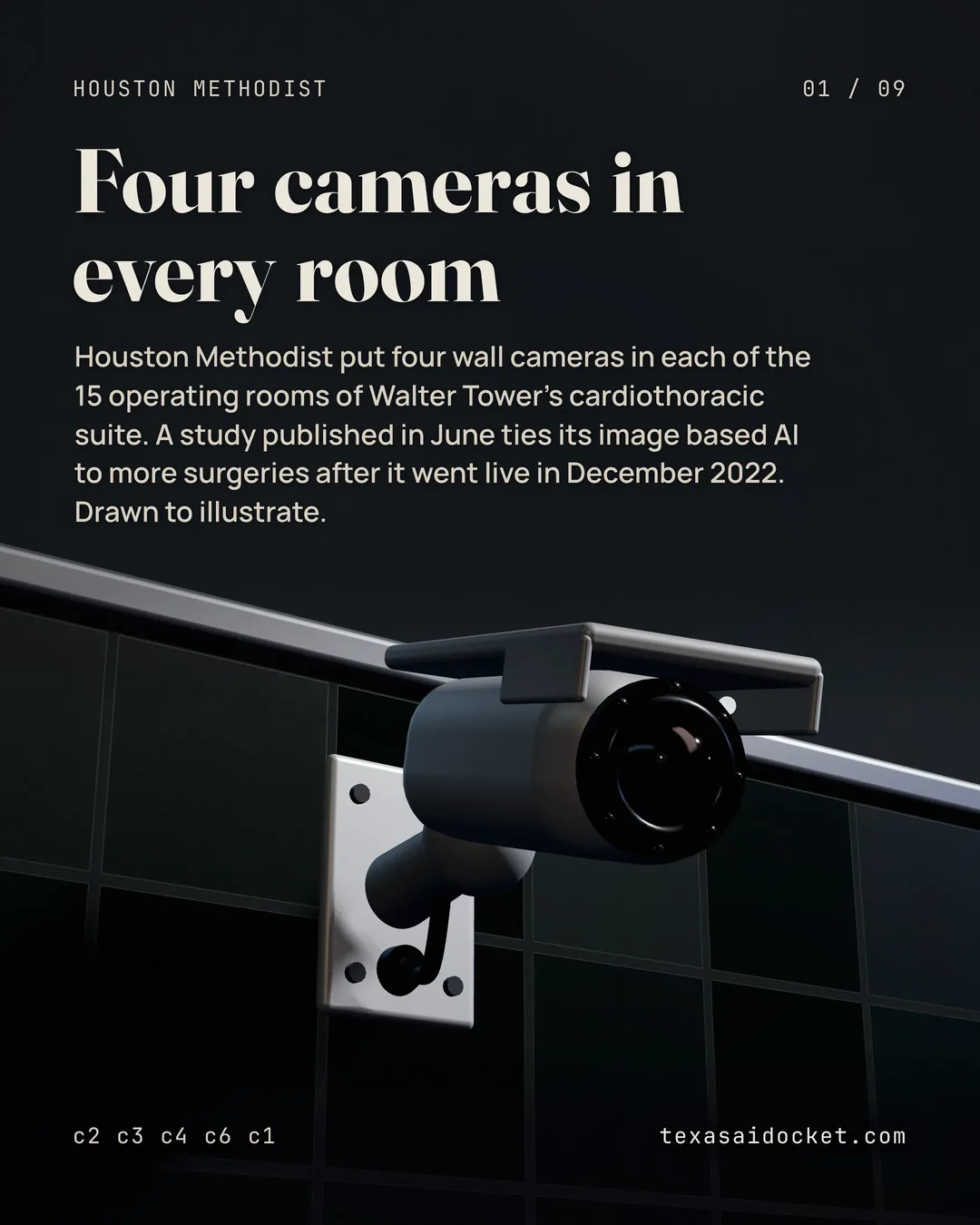
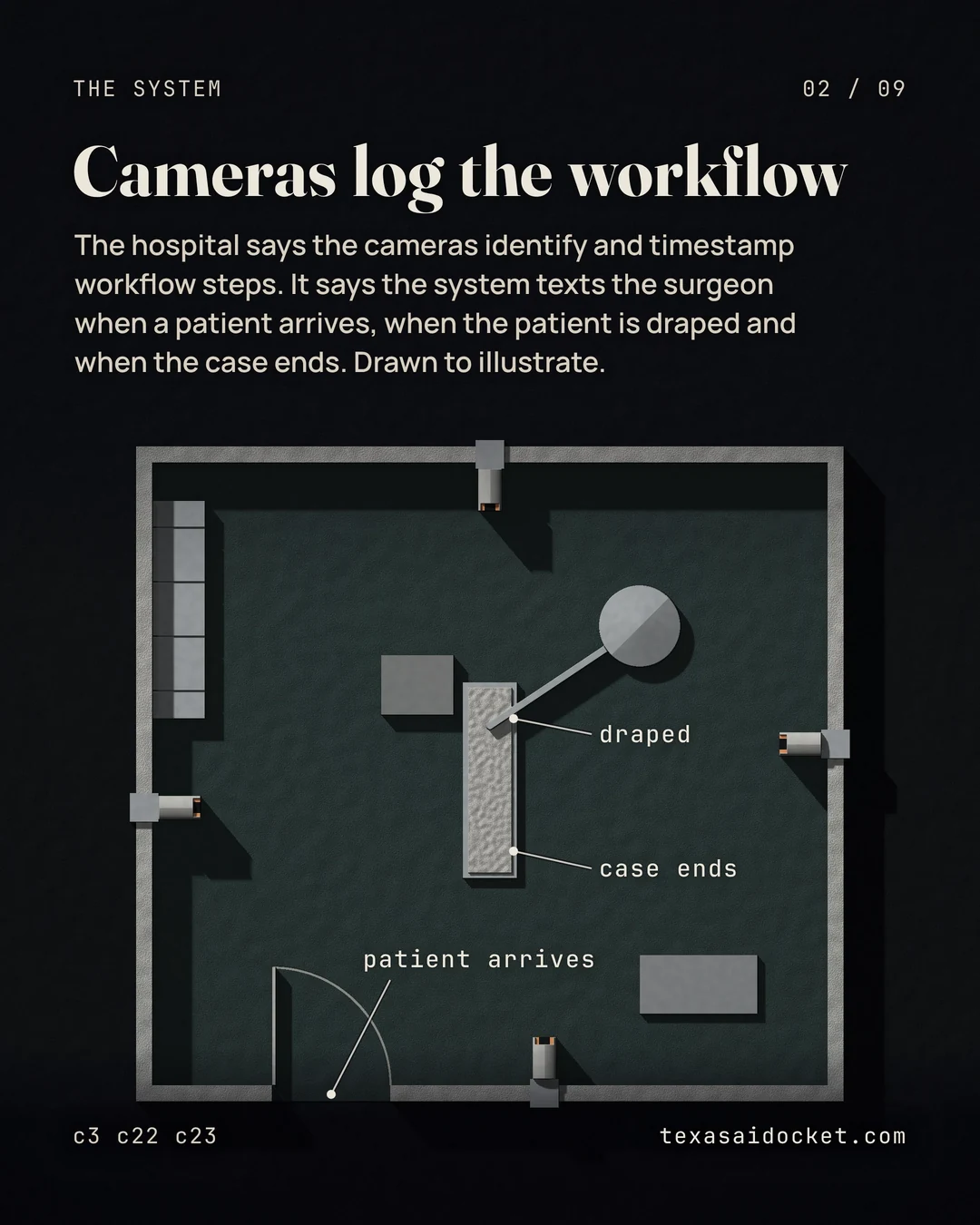
The study covers a 15 room cardiothoracic operating suite at Houston Methodist Hospital. Each operating room there was fitted with four high resolution wall mounted cameras. The hospital says the cameras identify and timestamp workflow steps. The system texts surgeons when a patient arrives, when the patient is draped and when the case ends.
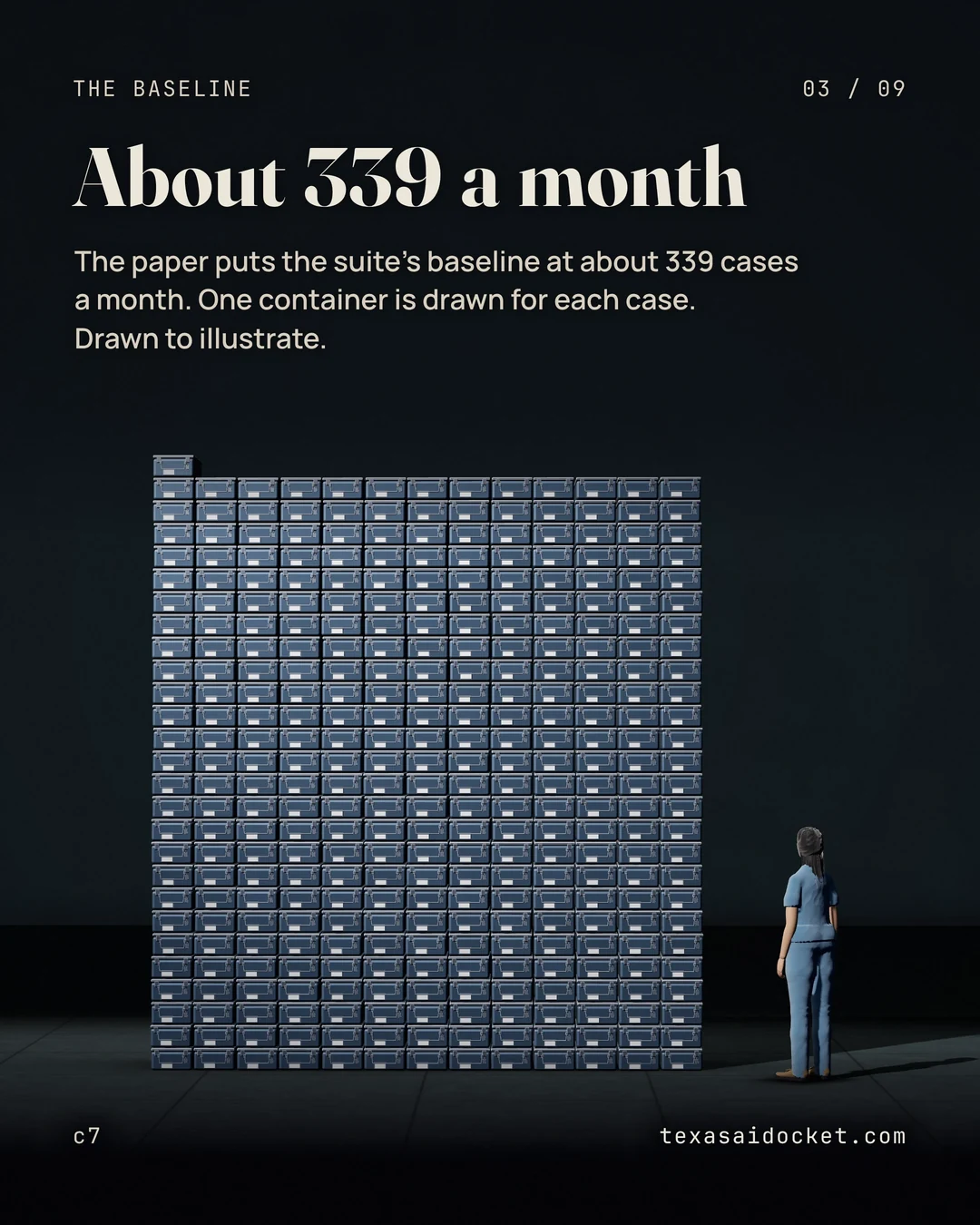
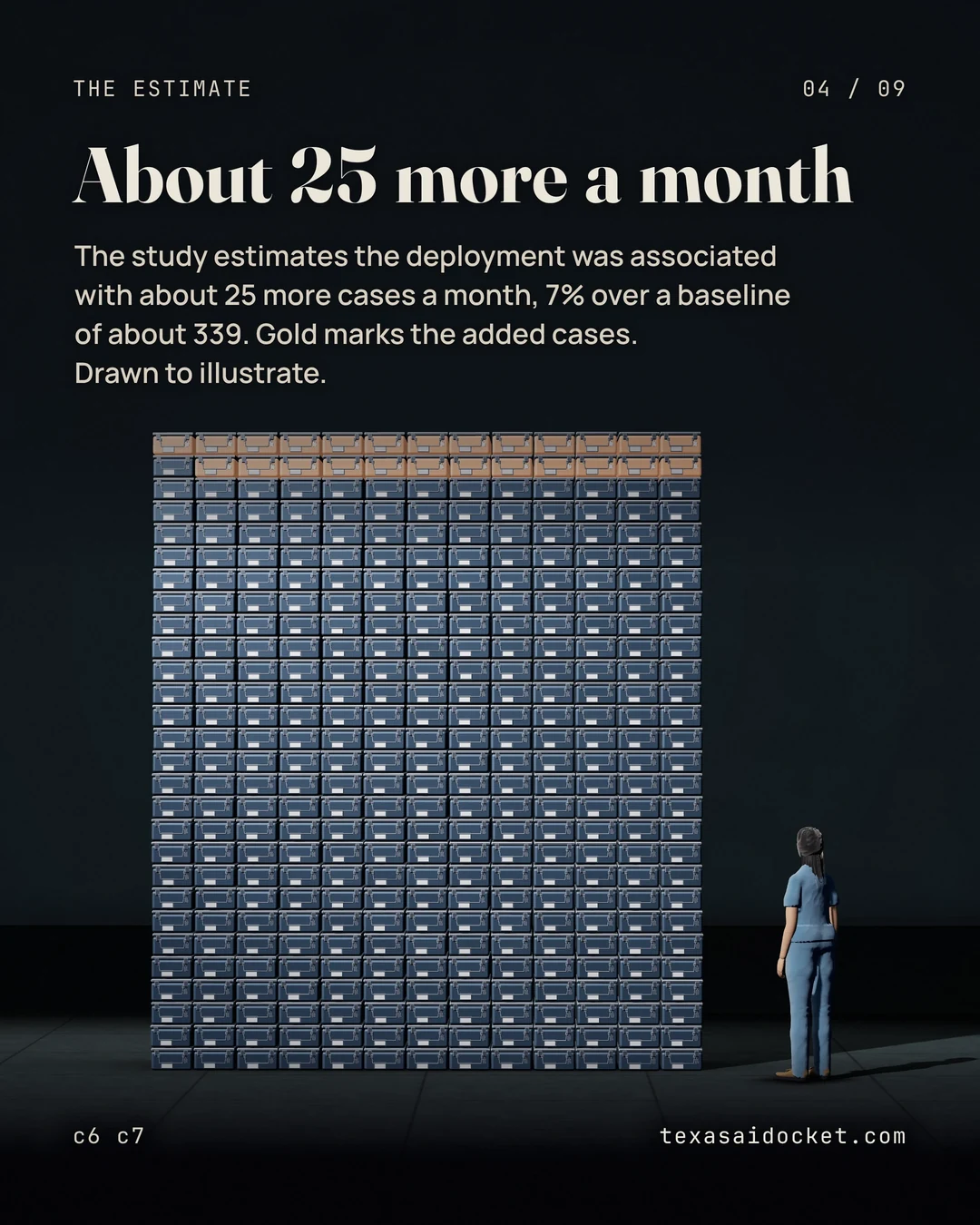
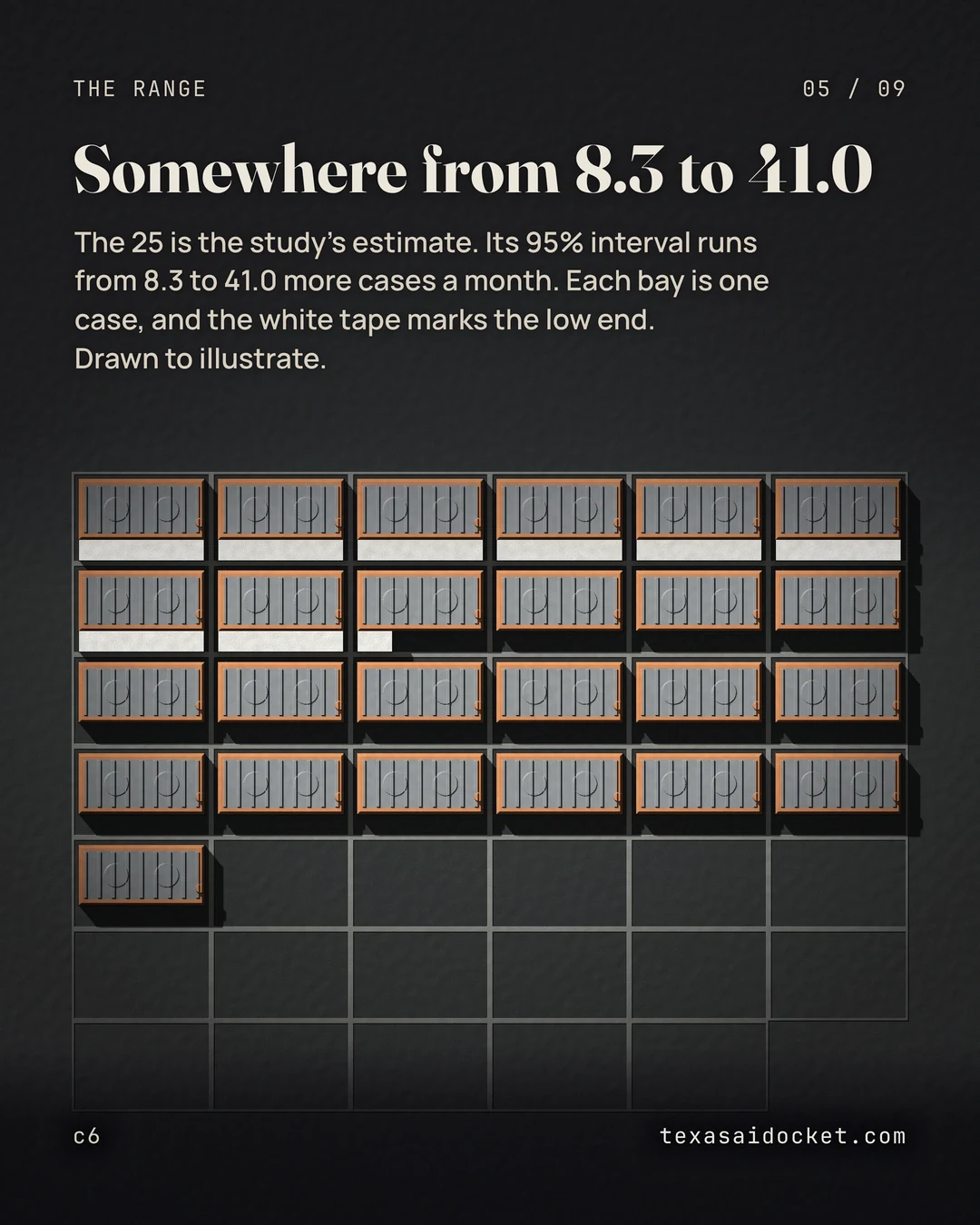
The study was published in the Journal of Imaging on June 27th, 2026. It estimates the deployment was associated with about 25 more cases a month. That is roughly 7% over a baseline of about 339 cases a month.
What the study measured
The software went live at Walter Tower in December 2022. The study window ran 16 months with 6 before deployment and 10 after. It covered 5417 surgical cases at the suite.
The estimate's 95% confidence interval runs from 8.3 to 41.0 more cases a month.
The detection system was trained on 137,517 surgical cases from 315 operating rooms. During a learning period a human led quality control team confirmed the locations and actions it identified.
What the study can't establish
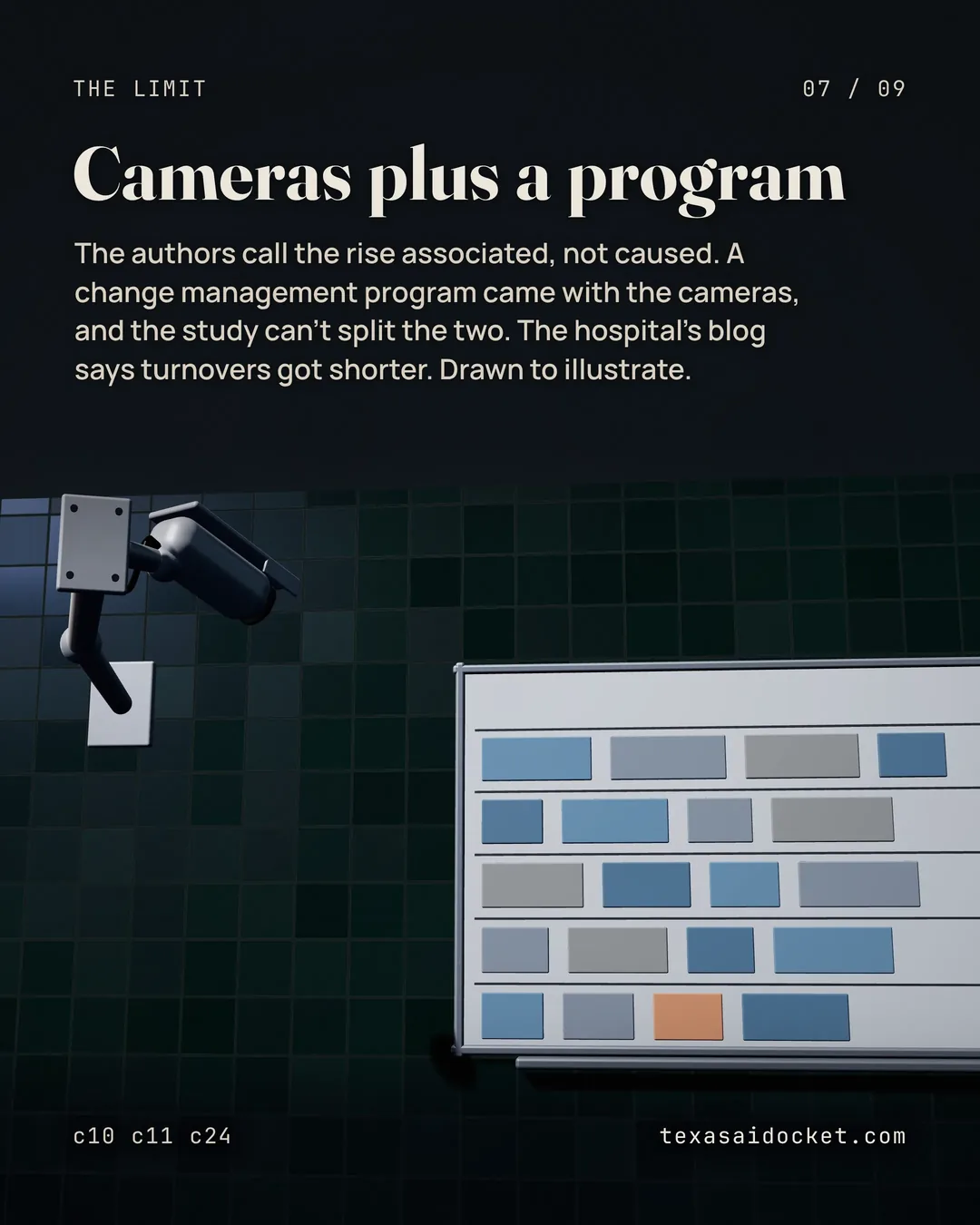
The authors call the rise associated with the deployment rather than caused by it. A change management program came with the cameras, and the study can't attribute the gains to either one alone.
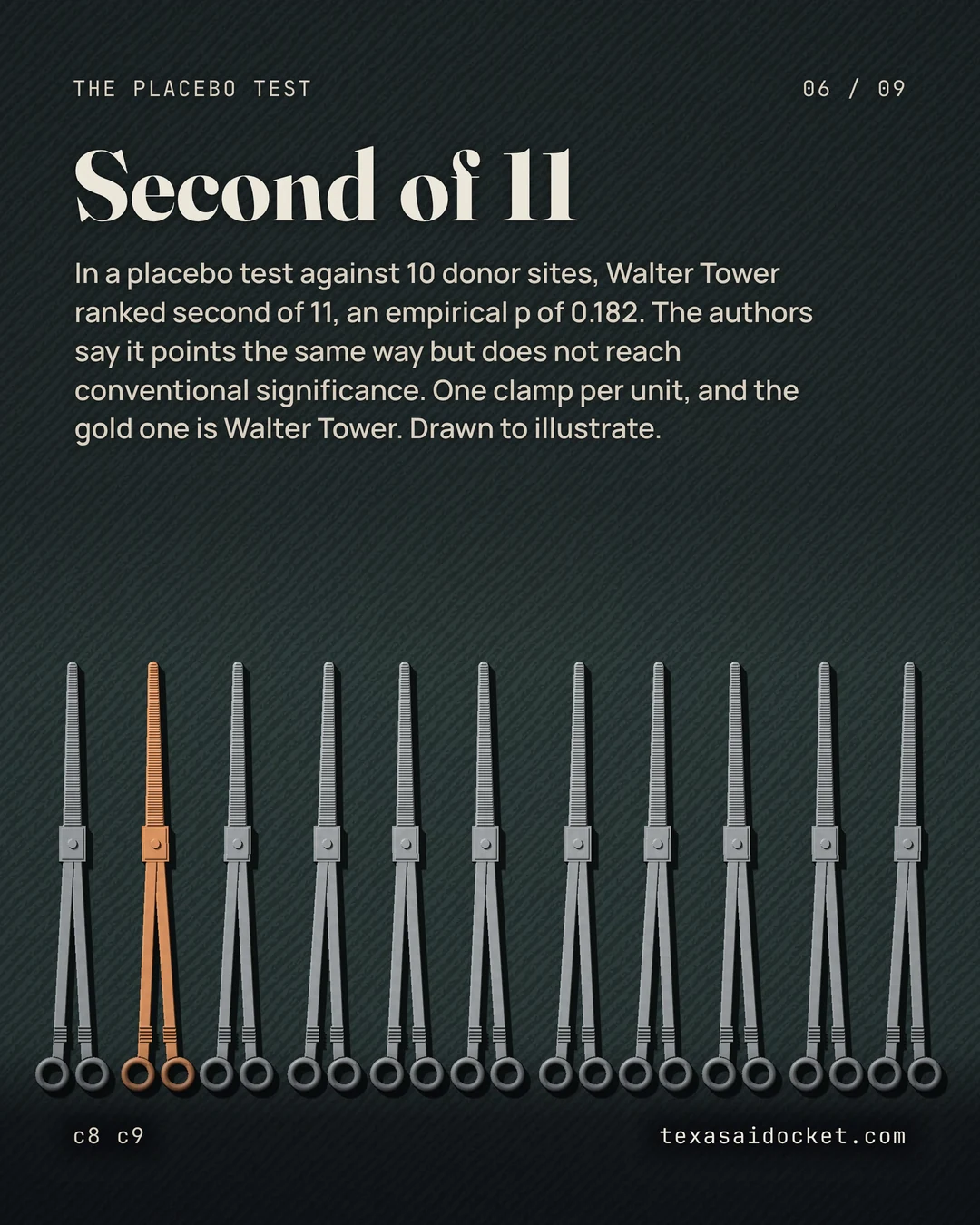
In a placebo test Walter Tower ranked second of 11 units. The authors write that this result points the same way as the main estimate and does not reach conventional statistical significance. A sensitivity analysis found no significant change in total operative minutes a month. The hospital's blog says turnover times fell while operative minutes did not.
Who ran the numbers
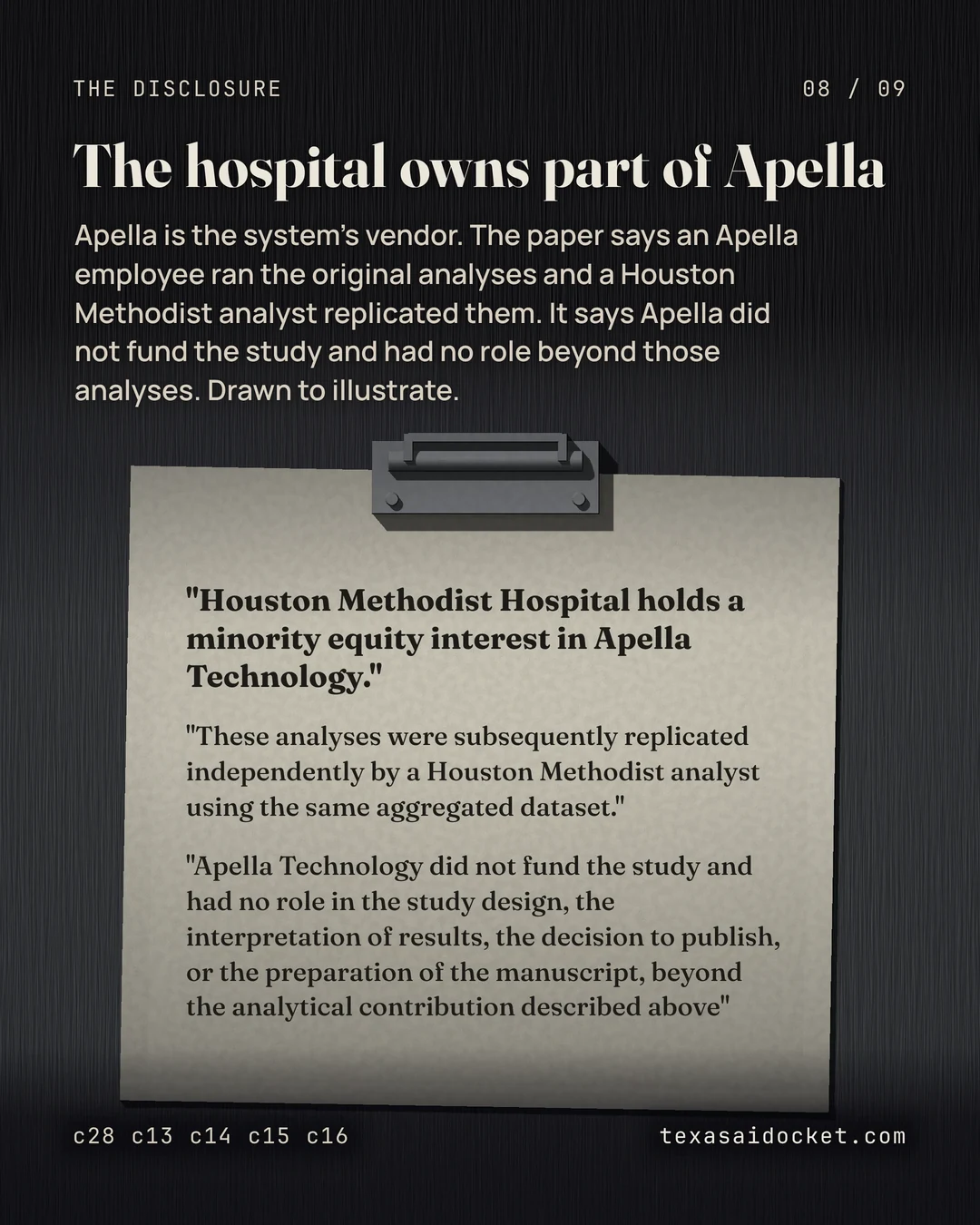
The paper names Apella Technology as the vendor of the system it evaluates. Houston Methodist holds a minority equity interest in Apella. An Apella employee ran the original analyses. A Houston Methodist analyst then replicated them on the same aggregated dataset. The paper says Apella did not fund the study and had no role beyond those analyses.
What happens to the footage
The paper says video is kept for at most 30 days and audio for at most 7. Recordings from incision to skin closure are open to three designated roles. The surgeon is told whenever one of them is reviewed.
The hospital's blog says staff raised concerns about surveillance, data security and privacy. It says signs are posted in operating rooms and patient consent is folded into universal consent for care. Neither the paper nor the blog says whether a patient can ask not to be recorded.
Sources for this story
- Journal of Imaging, Implementation of Image-Based Artificial Intelligence Is Associated with Increased Case Volume in a High-Acuity, 15-Room Cardiothoracic Operating Suite at a Tertiary Academic Hospital
- Houston Methodist, Image-Based AI Improves OR Efficiency at Houston Methodist
Claim-by-claim verification · 28 claims
The study was published in the Journal of Imaging on June 27th, 2026.
2026 Jun 27;12(7):283. doi: 10.3390/jimaging12070283
The study covers a 15 room cardiothoracic operating suite at Houston Methodist Hospital.
in a 15-room cardiothoracic suite at Houston Methodist Hospital (HMH)
Each operating room in the suite was fitted with four high resolution wall mounted cameras.
Each operating room was outfitted with four high-resolution wall-mounted cameras
The image based AI software was deployed at Walter Tower in December 2022.
The IBAI software was deployed at Walter Tower (WT) in December 2022.
The study window ran 16 months, 6 before deployment and 10 after, and covered 5417 surgical cases at the suite.
Over a 16-month period spanning 6 months pre-deployment and 10 months post-deployment, the system monitored 5417 surgical cases
The study estimates the deployment was associated with about 25 more cases a month, with a 95% confidence interval of 8.3 to 41.0, about 7% above baseline.
showed a statistically significant increase of approximately 25 cases per month (95% CI 8.3 to 41.0; p < 0.01; Bonferroni-adjusted p < 0.05), corresponding to a 7% increase in monthly case volume relative to baseline
The paper puts the suite's baseline at approximately 339 cases a month.
roughly 7% against a baseline of approximately 339 cases per month
In the placebo permutation test Walter Tower ranked second of 11 units, an empirical p of 0.182.
Walter Tower had the second-largest ratio of post-deployment to pre-deployment prediction error among the 11 units (Walter Tower and 10 donor sites; empirical p = 0.182)
The authors write that the permutation result points the same way as the main estimate but does not reach conventional statistical significance.
the permutation result is directionally consistent with the difference-in-differences estimate but does not reach conventional statistical significance
The authors interpret the rise in case volume as associated with the deployment rather than caused by it.
we interpret the case-volume effect as associated with, rather than caused by, IBAI deployment
The estimate covers the technology platform and its change management program together, and the study can't attribute the gains to either one alone.
The current effect estimate therefore reflects the combined contribution of the technology platform and the change-management program, and cannot separately attribute the observed gains to one or the other component.
A sensitivity analysis found no statistically significant change in total operative minutes a month.
In a sensitivity analysis using total operative minutes per month as a case-mix-insensitive outcome, the difference-in-differences estimate was not statistically significant
The hospital holds a minority equity interest in Apella Technology, the paper discloses.
Houston Methodist Hospital holds a minority equity interest in Apella Technology.
The original synthetic control and difference in differences analyses were run by an Apella Technology employee.
Nate Hilger, acknowledged above for conducting the original synthetic control and difference-in-differences analyses, is employed by Apella Technology.
A Houston Methodist analyst then replicated those analyses independently on the same aggregated dataset.
These analyses were subsequently replicated independently by a Houston Methodist analyst using the same aggregated dataset.
The paper states Apella did not fund the study and had no role in its design, interpretation or publication beyond the analyses its employee ran.
Apella Technology did not fund the study and had no role in the study design, the interpretation of results, the decision to publish, or the preparation of the manuscript, beyond the analytical contribution described above
The paper says video is kept for at most 30 days and audio for at most 7 days.
Video footage is retained for a maximum of 30 days and audio for a maximum of 7 days
Access to recordings from incision to skin closure is restricted to three designated roles.
Access to intraoperative recordings, defined as the period from incision to skin closure, is restricted to three designated roles
The surgeon is told whenever one of those recordings is reviewed.
The surgeon is informed whenever an intraoperative recording is reviewed.
The detection system was trained on a global dataset of 137,517 surgical cases from 315 operating rooms.
The system was trained on a global dataset comprising 137,517 surgical cases performed across 315 operating rooms by 1853 surgeons.
During a learning period a human led quality control team confirmed the locations and actions the system identified.
Locations and actions were confirmed by a human-led quality control team.
The hospital's blog says wall mounted cameras in each operating room automatically identify and timestamp workflow steps.
The new system uses wall-mounted cameras in each OR to automatically identify and timestamp these moments.
The hospital's blog says the system texts surgeons when a patient arrives, when the patient is draped and when the case ends.
It also sends text alerts to surgeons when a patient arrives, when the patient is draped and when the case ends.
The hospital's blog says operative minutes did not decrease and that turnover times did, letting more cases fit in the same operating room hours.
Operative minutes did not decrease, indicating surgeons were not operating faster. However, turnover times decreased, enabling more cases to be completed within the same OR hours.
The hospital's blog says staff raised concerns about surveillance, data security and privacy, which led to discussions with legal, ethics and operations teams.
Staff expressed concerns about surveillance, data security and privacy, prompting extensive discussions with legal, ethics and operations teams.
The hospital's blog says signs are posted in operating rooms and patient consent is folded into universal consent for care.
For patients, clear signage is posted in ORs and consent is incorporated into universal consent for care.
The 10 month post deployment period ran from December 2022 through September 2023.
the 10-month post-deployment period (December 2022 through September 2023)
The paper names Apella Technology as the vendor of the image based AI system it evaluates, and says the hospital bought the operating room camera hardware from it.
Houston Methodist has a commercial relationship with Apella Technology (San Francisco, CA, USA), the vendor of the image-based AI system evaluated in this study, comprising the purchase of operating room camera hardware.