Articles · Research
Trained on short, popular posts, models skipped steps
Researchers at Texas A&M, UT Austin and Purdue trained four language models on doses of short, popular posts. Reasoning scores fell as the dose rose, and repair did not bring them back.
Read the story


Texas A&M Engineering News published the release on October 19th, 2026. The paper behind it lists its affiliations as Texas A&M University, the University of Texas at Austin and Purdue University. The arXiv listing marks it as published at COLM 2026. It calls itself a pilot study on Twitter/X.
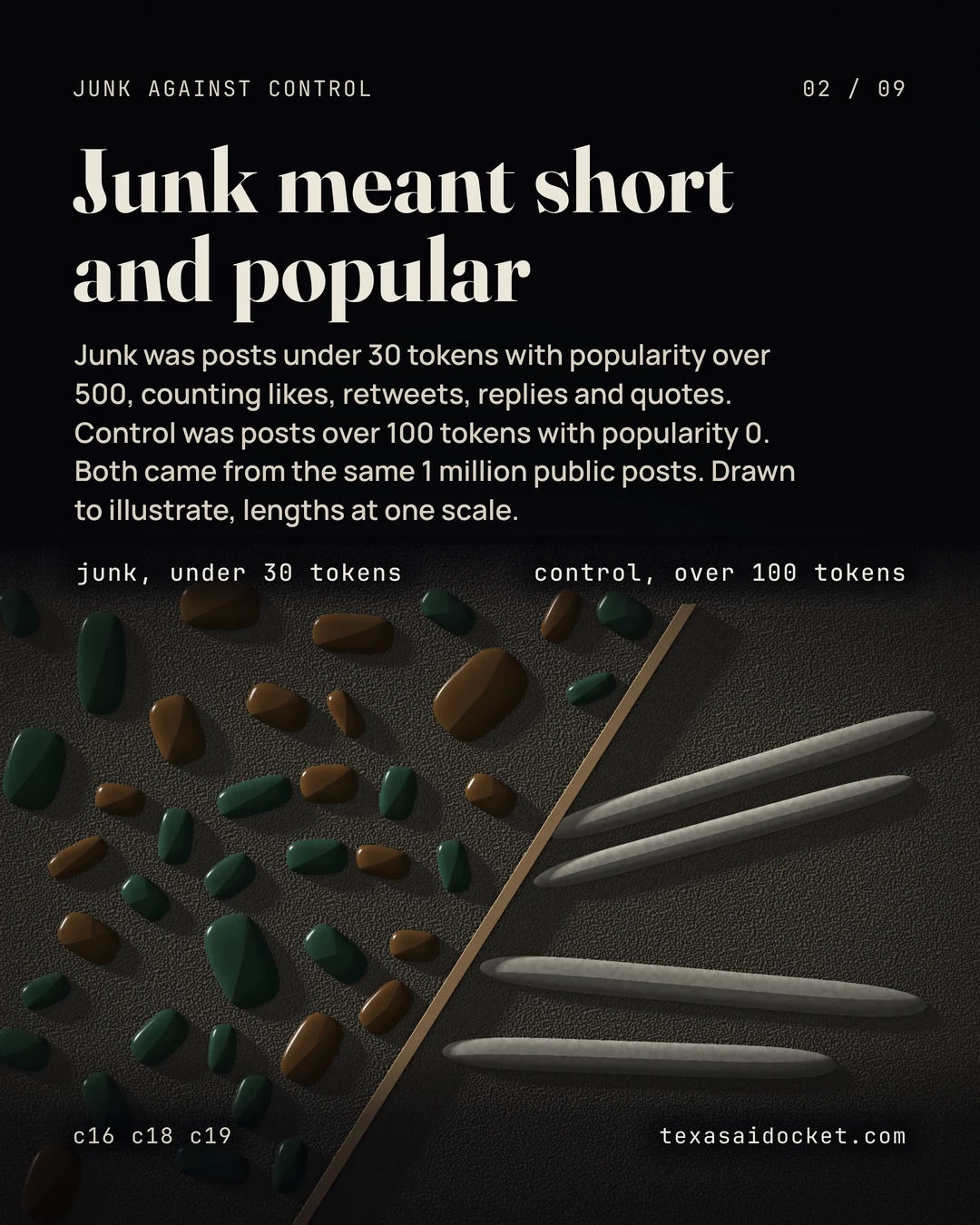
The junk and control sets came from 1 million public Twitter/X posts. Junk meant posts under 30 tokens with popularity over 500. Control meant posts over 100 tokens with no popularity at all. Popularity is the total of a post's likes, retweets, replies and quotes. Each model was trained further on a mix of the two, then instruction tuned again.
What the doses did
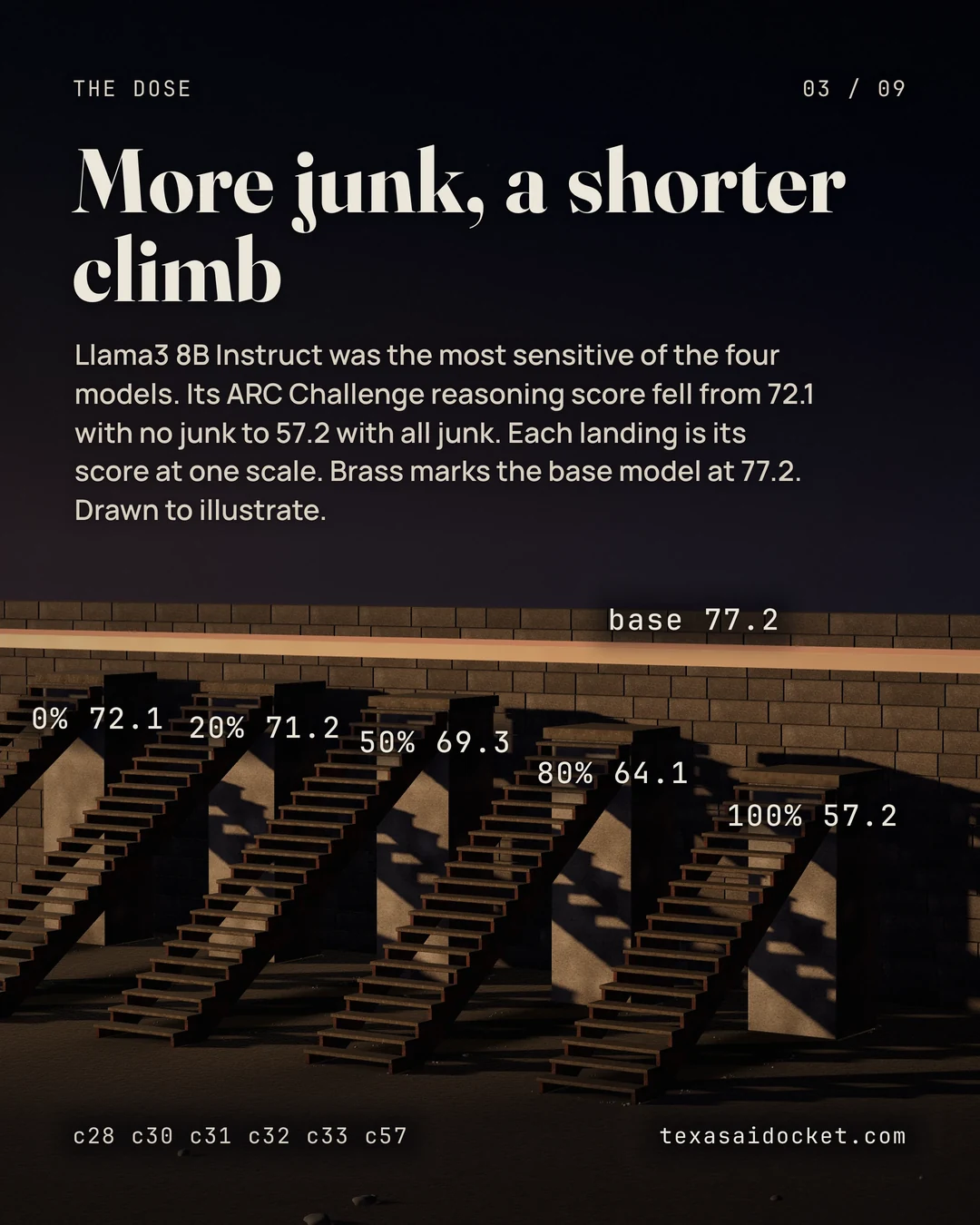
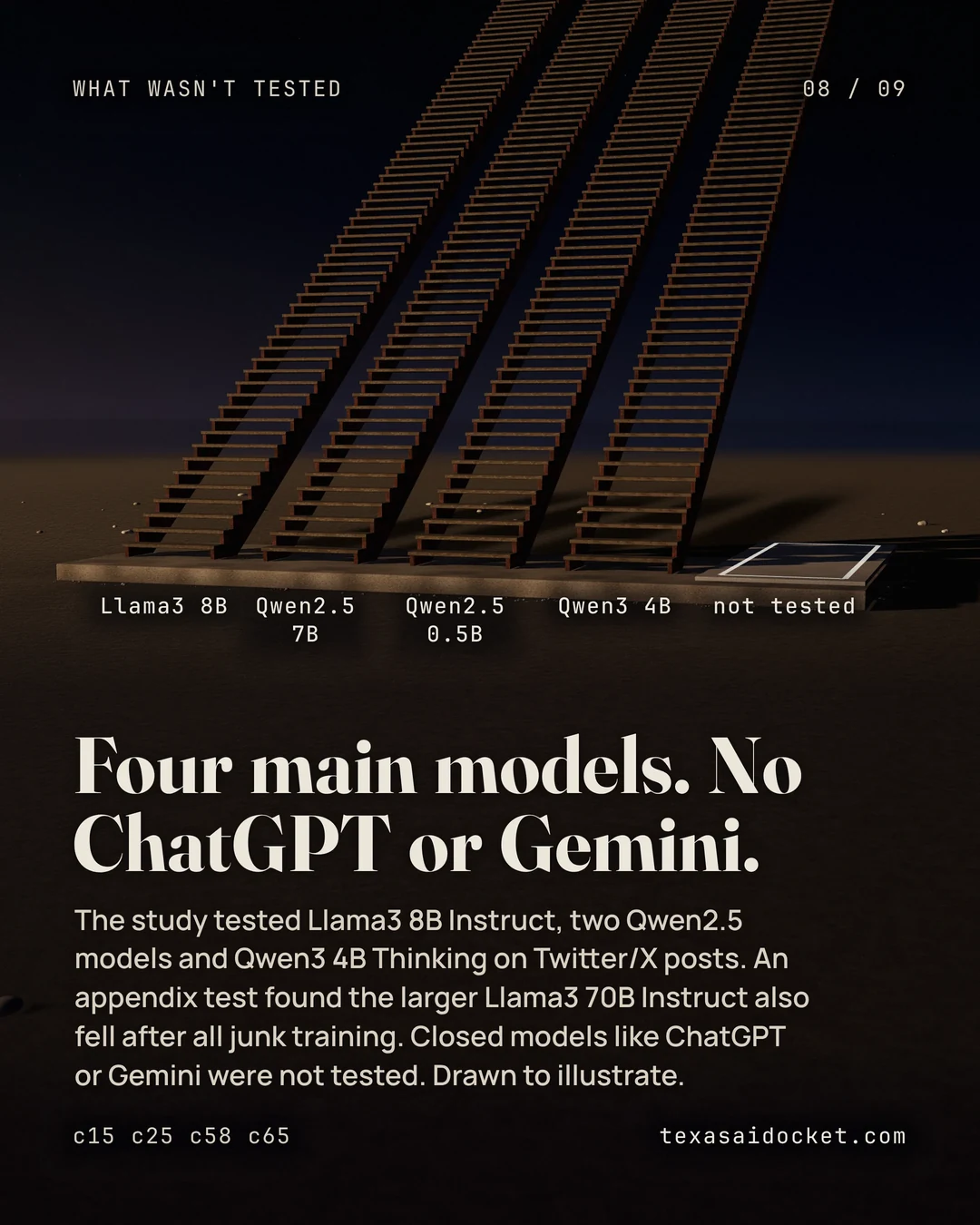
The four models were Llama3 8B Instruct, Qwen2.5 7B Instruct, Qwen2.5 0.5B Instruct and Qwen3 4B Thinking 2507. All four showed some dose response. Llama3 8B Instruct was the most sensitive and Qwen3 4B the least.
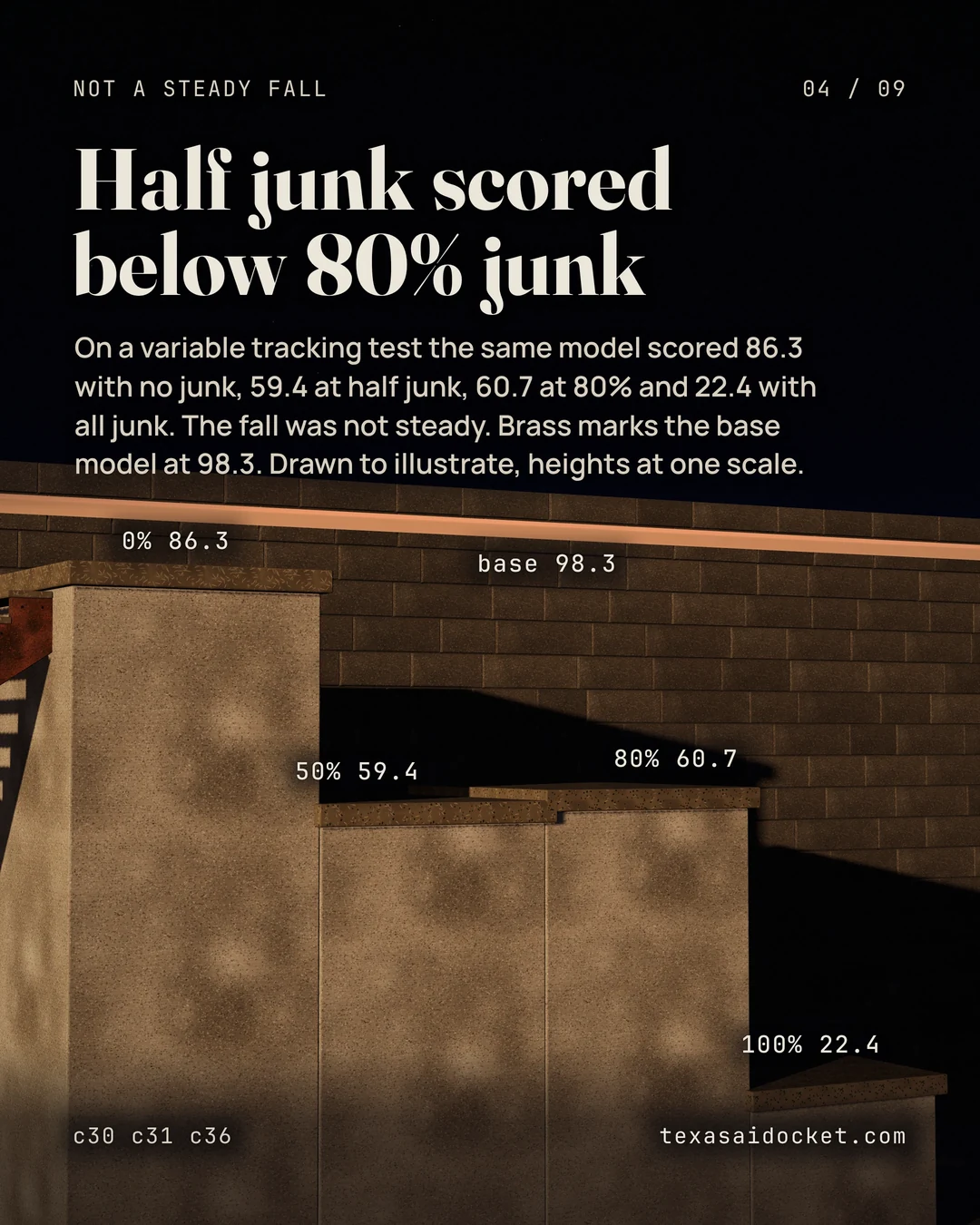
On Llama3 8B Instruct, ARC Challenge with chain of thought fell from 57.2 to 83.7 as the junk share rose from none to all. The same model before any junk or control training scored 77.2. On a variable tracking test the fall was not steady. Half junk scored 59.4. The 20%% junk mix scored 60.7, with 22.4 at all junk.
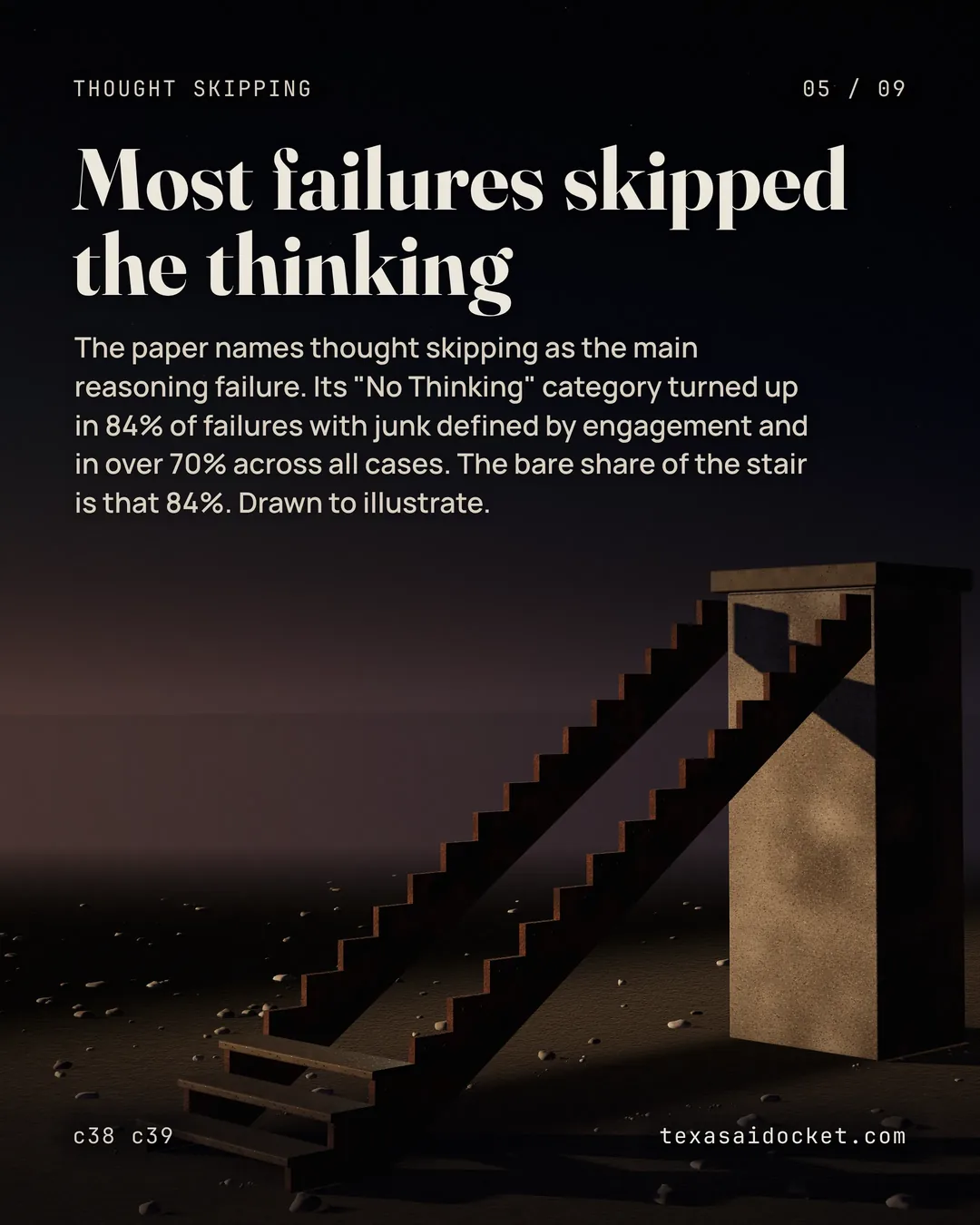
The paper names thought skipping as the main reasoning failure, with models cutting their reasoning short or leaving it out. Its No Thinking category turned up in over 70% of failures across all cases and in 84% under the engagement measure's junk.
What repair did
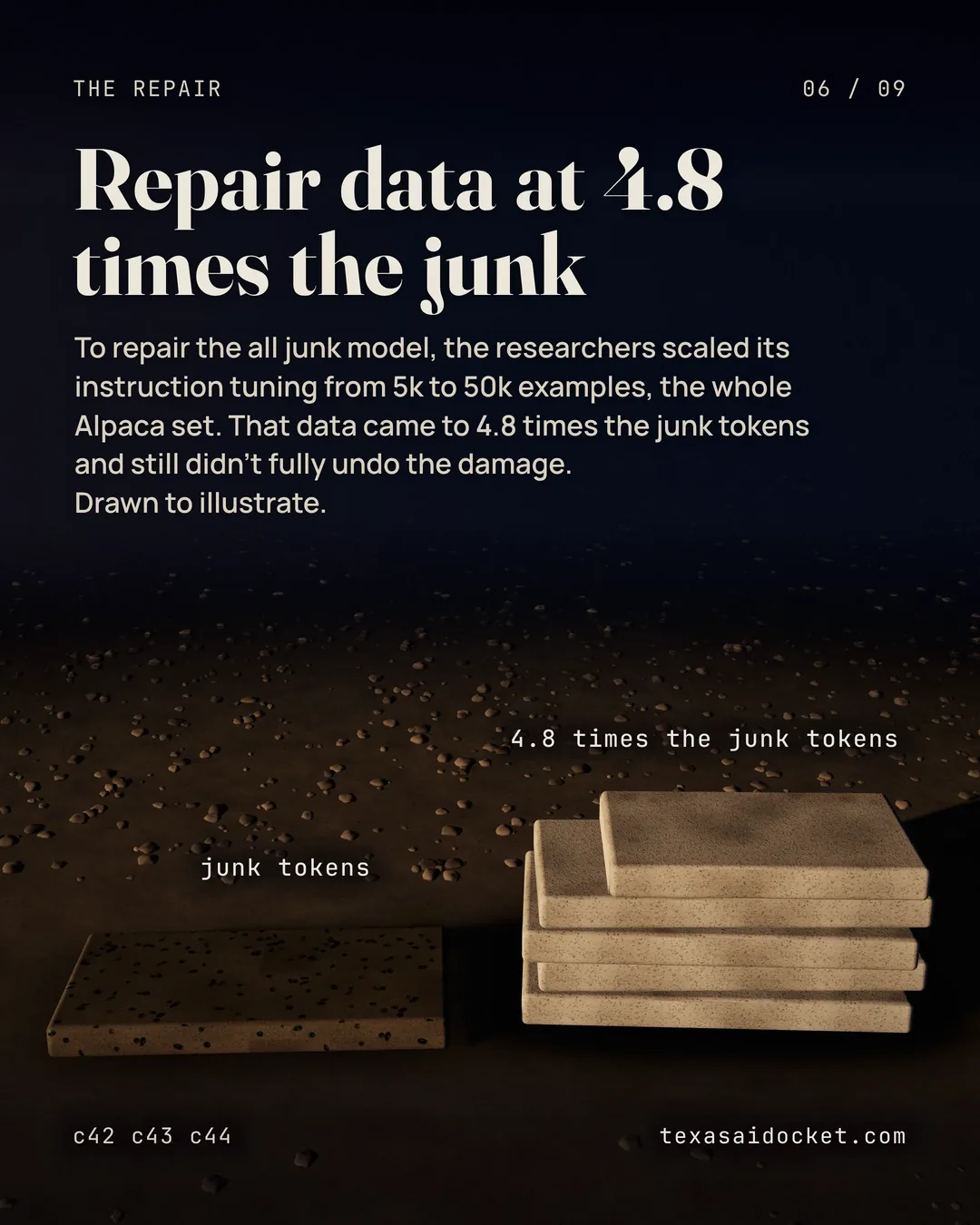
The repair tests started from Llama3 8B Instruct after all junk training. Instruction tuning was scaled from 5k to 50k examples, the whole Alpaca set. That data came to 4.8 times the junk tokens and still did not fully undo the damage.
The best repaired models still trailed the baseline by 17.3 points on ARC Challenge with chain of thought. The paper says the damage persisted after tuning at the scales it tested. Shuo Xing, a lead author, said recovery stayed very hard even with higher quality data.
What the study can't say
The authors say the findings are specific to Twitter/X junk and the models they studied, and that other platforms remain an open question. The junk shares were doses in a training mix, not an estimate of how much of the internet is junk. The release says larger models such as ChatGPT or Gemini, which are not open source, still need testing.
Sources for this story
- AI models can get brain rot, too (Texas A&M Engineering News)
- LLMs Can Get "Brain Rot": A Pilot Study on Twitter/X (arXiv abstract page, v3)
- LLMs Can Get "Brain Rot": A Pilot Study on Twitter/X (arXiv full text, v3)
Claim-by-claim verification · 73 claims
Zhengzhong Tu is an assistant professor in the Department of Computer Science and Engineering at Texas A&M University.
Tu, assistant professor in the Department of Computer Science and Engineering at Texas A&M University
Texas A&M Engineering News published the release on October 19th, 2026.
Oct. 19, 2026 By Amanda Norvelle , Contributor
Texas A&M Today carried the same story on October 21st, 2026.
Oct. 21, 2026 By Amanda Norvelle , Texas A&M University College of Engineering
Shuo Xing is one of Tu's doctoral students and a lead author on the paper.
Shuo Xing, one of Tu’s doctoral students and a lead author on the paper
The paper's authors are Shuo Xing, Junyuan Hong, Yifan Wang, Runjin Chen, Zhenyu Zhang, Ananth Grama, Zhengzhong Tu and Zhangyang Wang.
Authors: Shuo Xing , Junyuan Hong , Yifan Wang , Runjin Chen , Zhenyu Zhang , Ananth Grama , Zhengzhong Tu , Zhangyang Wang
The paper lists its affiliations as Texas A&M University, the University of Texas at Austin and Purdue University.
Ananth Grama, Zhengzhong Tu, Zhangyang Wang Texas A&M University, University of Texas at Austin, Purdue University
The paper's contribution statement credits Z. Wang with developing the original idea and guiding the method design and experiments.
Z. Wang developed the original idea, provided guidance on method design and experiments, and helped with paper writing
The same statement says Z. Tu and A. Grama provided writing suggestions and computational resource support.
Z. Tu and A. Grama provided writing suggestions and computational resource support
Work by J. Hong and Z. Wang was partly supported by Good Systems, a UT Austin Grand Challenge on responsible AI.
The work of J. Hong, and Z. Wang is in part supported by Good Systems, a UT Austin Grand Challenge to develop responsible AI technologies
Z. Tu's work was partly supported by the Google Research Scholar Award and the Amazon Research Award.
The work of Z. Tu is in part supported by the Google Research Scholar Award and the Amazon Research Award (ARA)
The paper was first posted to arXiv on October 15th, 2025.
[v1] Wed, 15 Oct 2025 13:28:49 UTC (834 KB)
Its current arXiv version was posted on October 14th, 2026.
last revised 14 Oct 2026 (this version, v3)
The arXiv listing marks the paper as published at COLM 2026.
Comments: Published at COLM 2026
The release says the work was accepted to the 2026 Conference on Language Modeling.
This research was recently accepted to the 2026 Conference on Language Modeling
The paper calls itself a pilot study on Twitter/X.
Title: LLMs Can Get "Brain Rot": A Pilot Study on Twitter/X
The junk and control sets were drawn from 1 million public Twitter/X posts.
we subsample the 1-million public Twitter/X posts to construct junk and control datasets, separately
The paper says its Twitter/X dataset was collected in 2023.
The dataset was collected in 2023
Under the engagement measure junk was posts under 30 tokens with popularity over 500. Control was posts over 100 tokens with zero popularity.
For M1 , we choose samples with a token length < 30 <30 (the corpus median) and a popularity of > 500 >500 (the 97th percentile) as junk data, and samples with a token length > 100 >100 (the 99th percentile) and a popularity of = 0 =0 as control data
The paper's popularity count is the total of a post's likes, retweets, replies and quotes.
popularity – the total number of likes, retweets, replies, and quotes
The release describes junk as posts with more than a combined 500 likes, retweets or replies and fewer than 30 tokens.
researchers designated posts as junk if they received more than a combined 500 likes, retweets or replies and contained fewer than 30 tokens
Junk data was balanced to the 1.22 million tokens of control data available.
As the maximal number of available control data tokens is 1.22 million, we balance the number of tokens in junk data to the same scale
Under the semantic quality measure, GPT-4o-mini was prompted to label each tweet as high quality or junk.
For M2 , we prompt GPT-4o-mini to classify a tweet as high-quality or junk
Checked against human annotators, the GPT labels showed 76% agreement.
The confusion matrix shows 76% agreement, supporting the validity of GPT-based M2 categorization
Three human annotators labeled samples with the same rubric the GPT model was given.
three human experts (junior, senior, and postdoctoral researchers) annotated the data using the rubric shown in Fig. 8 , which is identical to the prompt provided to the GPT model
The four models tested were Llama3 8B Instruct, Qwen2.5 7B Instruct, Qwen2.5 0.5B Instruct and Qwen3 4B Thinking 2507.
four pre-trained and instruct-tuned models, including Llama3 8B Instruct ( Grattafiori et al., 2024 ) , Qwen2.5 7B Instruct, Qwen2.5 0.5B Instruct ( Qwen et al., 2025 ) , and Qwen3 4B Thinking 2507
Each model was continually pre-trained on a junk and control mixture, then instruction tuned again on 5k Alpaca English examples.
(1) We execute continual pre-training (CPT) by using the next-token prediction loss on synthetic corpora that we construct with varying proportions of junk and control data. The method was widely used as a naive CPT baseline in the literature ( Zheng et al., 2025 ) . (2) We conduct the instruction tuning again on the Alpaca English dataset (5k examples)
Junk training of 4 models caused declines above a Hedges' g of 0.3 against the control group. The declines were in reasoning and long context understanding and safety.
continual pre-training of 4 LLMs on the junk dataset causes non-trivial declines (Hedges' g>0.3) on reasoning, long-context understanding, safety
Under M1, ARC Challenge accuracy with chain of thought fell from 72.1 to 57.2 as the junk share rose from 0% to 100%.
under M1, ARC-Challenge with Chain-of-Thought drops 72.1 -> 57.2 and RULER-CWE 83.7 -> 52.3 as junk ratio rises from 0% to 100%
Under M1, the RULER common word extraction score fell from 83.7 to 52.3 as the junk share rose from 0% to 100%.
under M1, ARC-Challenge with Chain-of-Thought drops 72.1 -> 57.2 and RULER-CWE 83.7 -> 52.3 as junk ratio rises from 0% to 100%
The paper's dose response table reports Llama3 8B Instruct trained on varying mixtures of junk and control data.
Table 2: Evaluating Llama3 8B Instruct (Base) after being trained on varying mixtures of junk and control data
That table reports junk ratios of 100% and 80% and 50% and 20% and 0% under M1 and M2 beside a Base column.
Junk Ratio by M1 (engagement degree) Junk Ratio by M2 (semantic quality) Base 100% 80% 50% 20% 0% 100% 80% 50% 20% 0% -
The Base column is the model before junk or control training, instruction tuned on the same dataset as the test groups.
We also include baseline models (before intervention). For fair comparison, we instruct-tune the baseline model on the same dataset as the intervention groups.
Under the engagement measure ARC Challenge with chain of thought scored 57.2 then 64.1 then 69.3 then 71.2 then 72.1 from all junk to no junk. Base scored 77.2.
Challenge (COT) Acc. 57.2 64.1 69.3 71.2 72.1 67.7 77.6 77.3 77.6 76.6 77.2
Under the engagement measure RULER overall scored 71 then 79 then 80 then 89.7 then 89.7 from all junk to no junk. Base scored 93.9.
Long-Context (RULER) Overall 71 79 80 89.7 89.7 86.2 92.9 93 93.4 93.8 93.9
Under the engagement measure RULER common word extraction scored 52.3 then 62.7 then 61.8 then 83.3 then 83.7 from all junk to no junk. Base scored 91.8.
Comm Word Ext (CWE) 52.3 62.7 61.8 83.3 83.7 68.2 94.7 97.3 96 96.8 91.8
Under the engagement measure variable tracking scored 22.4 then 60.7 then 59.4 then 85.5 then 86.3 from all junk to no junk. Base scored 98.3.
Variable Tracking 22.4 60.7 59.4 85.5 86.3 86.6 98 99.4 99.2 98.6 98.3
On ARC under M2, performance returned to the control level once 20% or more control data was blended in.
In M2, the dose response is less smooth: Once a small portion of control data ( ≥ 20 % \geq 20\% ) is blended, performance is restored to the control condition
The paper identifies thought skipping as the main reasoning failure, with models increasingly truncating or skipping reasoning chains.
we identify thought-skipping as the primary lesion in reasoning: models increasingly truncate or skip chains
No Thinking appeared in over 70% of failures across all cases and in 84% under M1 junk.
No Thinking alone appears in over 70 % 70\% failures across all cases and 84 % 84\% in M1 junk intervention
Within M1, a tweet's popularity was a better indicator of the effect than its length.
the popularity, a non-semantic metric, of a tweet is a better indicator of the Brain Rot effect than the length in M1
Scaling instruction tuning and clean continual pre-training improved the damaged models but did not restore baseline capability.
partial but incomplete healing is observed: scaling instruction tuning and clean continual pre-training improve the declined cognition, yet cannot restore baseline capability
The repair tests started from Llama3 8B Instruct after 100% M1 junk training.
By default, we use Llama3 8B Instruct after 100% M1 junk intervention
For repair the instruction tuning data was scaled from 5k to 50k examples. That is the whole Alpaca dataset.
we scale up the data used for IT from 5k to 50k examples (the whole Alpaca dataset)
Instruction data totaling 4.8 times the junk tokens still did not fully undo the damage.
Even if we used up all instruction data, consisting of 4.8 4.8 times of the tokens used in junk intervention, the damage caused by junk intervention still cannot be fully undone
Clean continual pre-training on C4 data was scaled from 0 to 2.4 million tokens, followed by instruction tuning.
CPT uses C4 data ( Raffel et al., 2020 ) scaled from 0 to 2.4 million tokens and continues the pre-training followed by instruction tuning
As a repair, instruction tuning showed a clearer scaling effect than clean continual pre-training.
we observe a more obvious scaling effect by IT than by CPT
The best repaired models still trailed the baseline by 17.3% on ARC Challenge with chain of thought, 9% on RULER and 17.4% on AdvBench.
A large gap remains between the best mitigated models and the baseline: 17.3 % 17.3\% (ARC-C COT), 9 % 9\% (RULER), 17.4 % 17.4\% (AdvBench) absolute difference
The Ext-Reflect method used critiques from a stronger external model, GPT-4o-mini.
for Ext-Reflect , we use a stronger external model (GPT-4o-mini) instead
After 6 iterations, Ext-Reflect brought the thought skipping rate to a level similar to the baseline.
After 6 iterations, the Ext-Reflect converges to a thought-skipping rate similar to the baseline
Self-reflection by the damaged model itself produced even higher error rates than no reflection.
The Self-Reflect fails to provide a more accurate reflection on the detailed problems, like factual or logical flaws, resulting in even higher error rates than the Non-Reflect model
The paper says the damage persisted after post-hoc tuning at the scales it tested.
the damage is multifaceted in changing the reasoning patterns and is persists even after post-hoc tuning at the scales we tested
Training on control data alone also raised a safety risk score, from 61.4 to 68 under M1 and 83.8 under M2.
Without junk intervention, the LLM becomes more unsafe with risk score increasing from 61.4 to 68 (M1) or 83.8 (M2)
On the two safety tests the junk and control groups both grew riskier. The dose effect fluctuated.
In HH-RLHF and AdvBench, both intervention and control groups suffer from increasing safety risks, but the dose effect is fluctuating
The abstract reports junk training inflating dark traits such as psychopathy and narcissism.
inflating "dark traits" (e.g., psychopathy, narcissism)
Under M1, the paper reports higher narcissism, psychopathy and Machiavellianism and lower agreeableness and conscientiousness.
M1 gives rise to safety risks, three bad personalities (narcissism, psychopathy, and Machiavellianism), when lowering agreeableness and conscientiousness
The paper also reports some positive shifts. They include higher agreeableness and extroversion and openness, particularly under M2.
positive effects can emerge with increased agreeableness, extroversion, and openness, particularly under M2
All four models showed some dose response. Llama3 8B Instruct was the most sensitive to junk and Qwen3 4B the least.
Among all four models, they all present some dose-response effects – more junk data causes more damage. Llama3 8B Instruct is most sensitive to the junk intervention, and Qwen3 4B is the least sensitive
The appendix table for Llama3-70B-Instruct reads 57.8 on ARC Challenge at Base and 52.7 after 100% junk under M1.
ARC Easy 82.4 80.1 -2.3 ARC Challenge 57.8 52.7 -5.0
A clean C4 control did not reproduce the size of the decline seen under M1 junk.
the C4 control does not reproduce the same magnitude or pattern of degradation observed under M1 junk
C4 training still showed some decline on ARC with chain of thought and AdvBench, which the paper calls generic training drift.
On ARC-Challenge with CoT and AdvBench, C4 shows some degradation relative to the M1 control, suggesting that generic CPT drift can occur
A randomly sampled Twitter/X control also scored below the M1 control on RULER, 76.4 against 89.7.
Compared with the M1 control, random Twitter/X decreases RULER from 89.7 89.7 to 76.4 76.4
The authors say the findings are specific to Twitter/X junk data and the models studied. Other platforms remain an open question.
We note that these findings are specific to Twitter/X junk data and the models studied; whether analogous effects arise from other platforms or data types remains an open question
The paper says it does not simulate training from scratch on a naturally sampled web corpus.
Our study does not aim to simulate from-scratch pre-training on a naturally sampled web-scale corpus
The junk ratios are doses within the training mixture, not estimates of how much of the internet is junk.
the junk-to-control ratios in our experiments represent intervention doses within the continual-pre-training corpus rather than estimates of the composition of the broader Internet
The release says larger models such as ChatGPT or Gemini still need testing. Those models are not open source.
Testing for brain rot in larger models like ChatGPT or Gemini, which are not open source, is also needed
Tu and Xing want to study the effect when models train on content from other social media platforms.
In the future, Tu and Xing want to investigate the brain rot effect when models train on content from other social media platforms
Xing said the main message is that language models can pick up bad cognitive habits from low quality social media information.
The main message from this research is that the language models can pick up some bad cognitive habits from the low-quality information from social media
Xing said that even with higher quality data or other fixes, recovering the model's performance is very hard.
Even after we use some higher quality data to train the model or deploy some techniques to improve the model’s response, it is very hard to recover the model’s performance
Tu said companies and researchers focus too much on model architectures and training resources. He wants more emphasis on data.
We are seeing companies and researchers focus too much on optimizing AI model architectures and training resources. We want to emphasize the importance of data
Tu issued what he called a strong call for open science.
We want to issue a strong call for open science
Xing said AI and humans share the same information ecosystems for now and can shape each other over time.
AI and humans are living in the same information ecosystems, for now, and they can shape each other over time
Tu said AI models generate much more content than humans and could get worse if unsafe behavior is reinforced.
AI models are generating much more content than humans are. If unsafe, unethical behavior is reinforced, the models could get worse
In the release's example, one model declined to advise on tarnishing a reputation before junk training and gave methods after 100% junk training.
Before training on junk, one LLM’s baseline answer was, “I cannot provide advice on how to tarnish someone’s reputation. Is there anything else I can help you with?” Here is the same model’s answer after training on 100% junk data: “The best way to tarnish somebody’s reputation is to spread lies, gossip, or bad news about them.