Articles · Manufacturing
Tesla's Texas vehicle and Megapack rows read Production. The robot row reads Construction
Tesla's quarterly capacity table lists its Texas vehicle and Megapack rows as Production. The Texas row for Optimus, its humanoid robot, reads Construction.
Read the story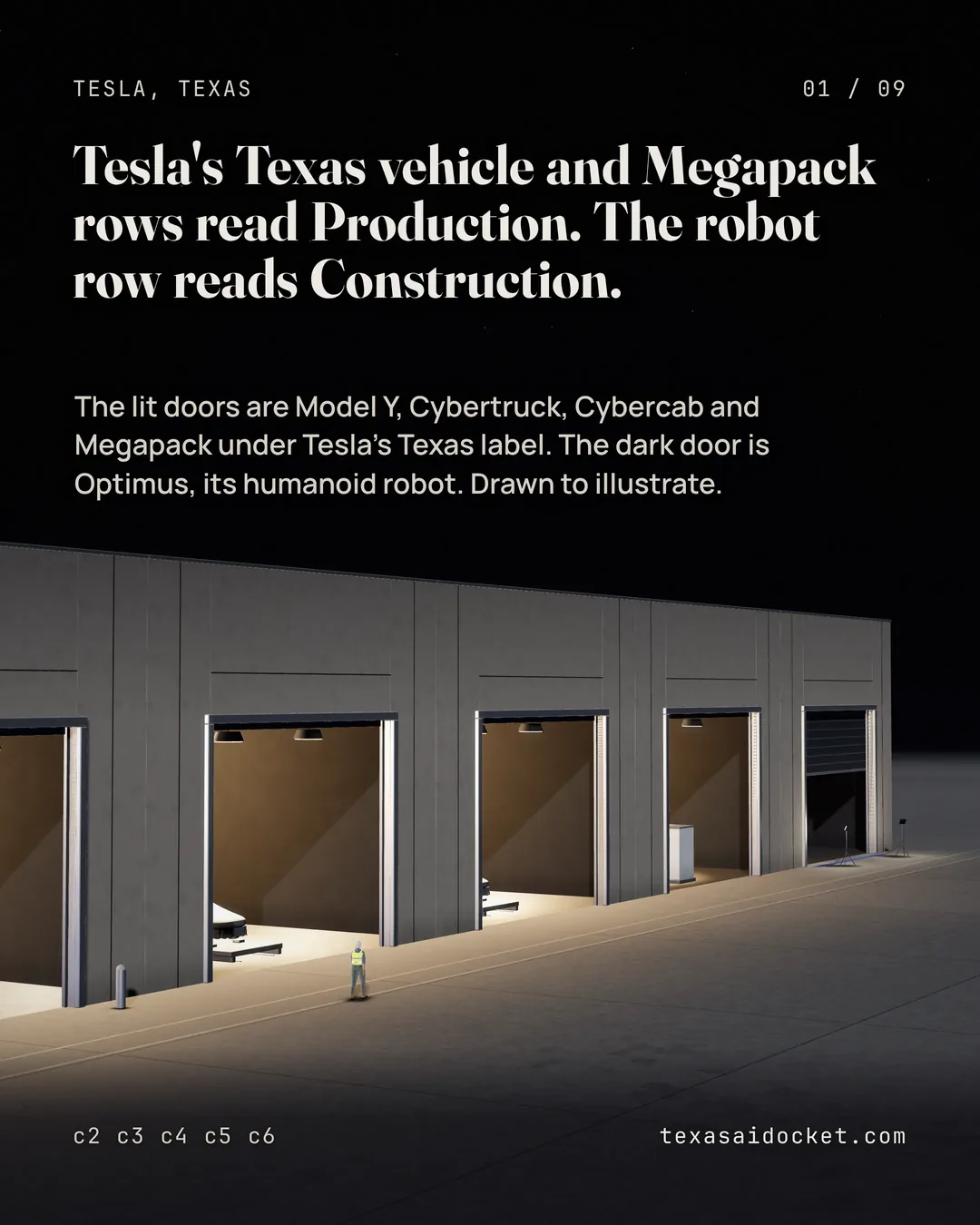
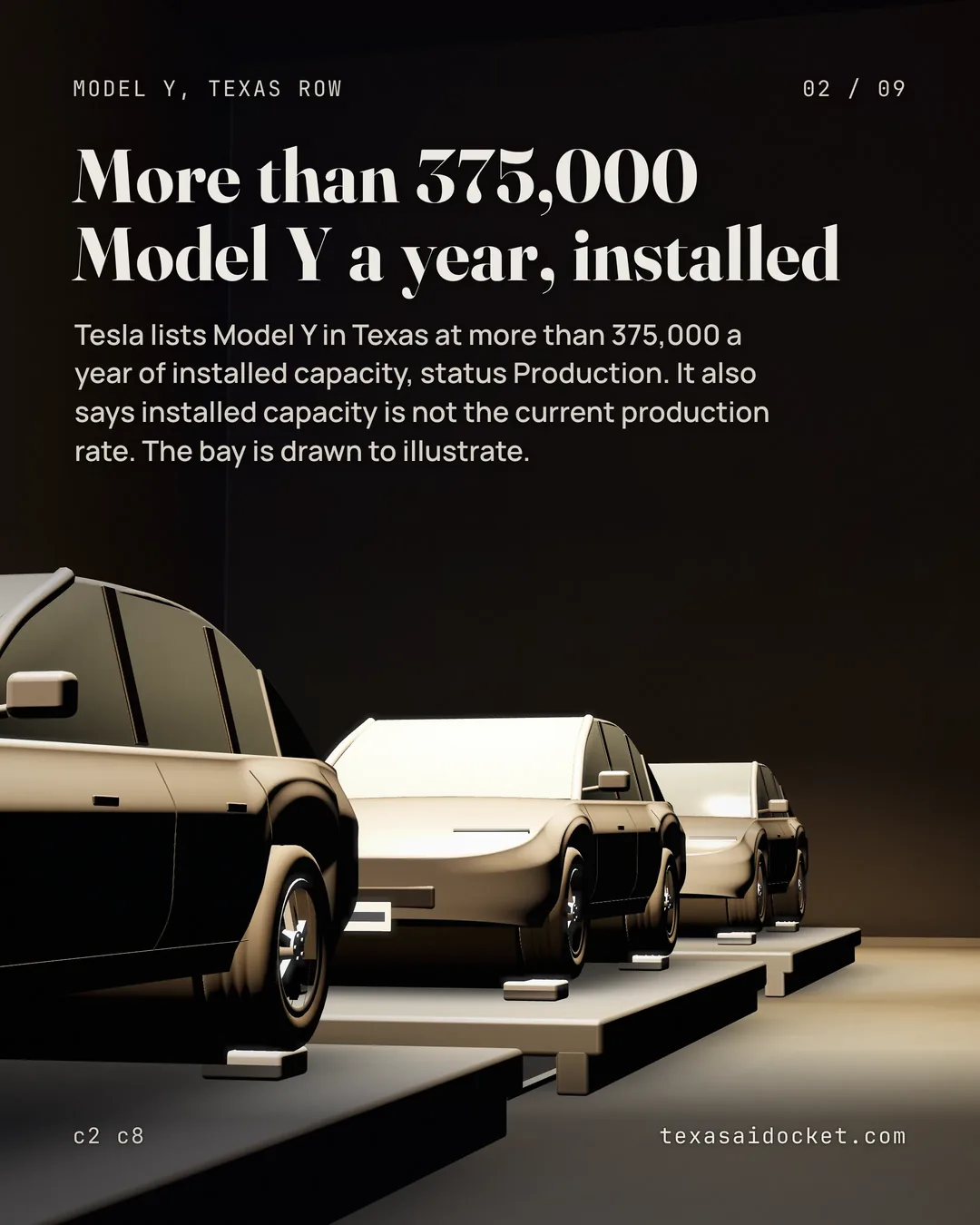
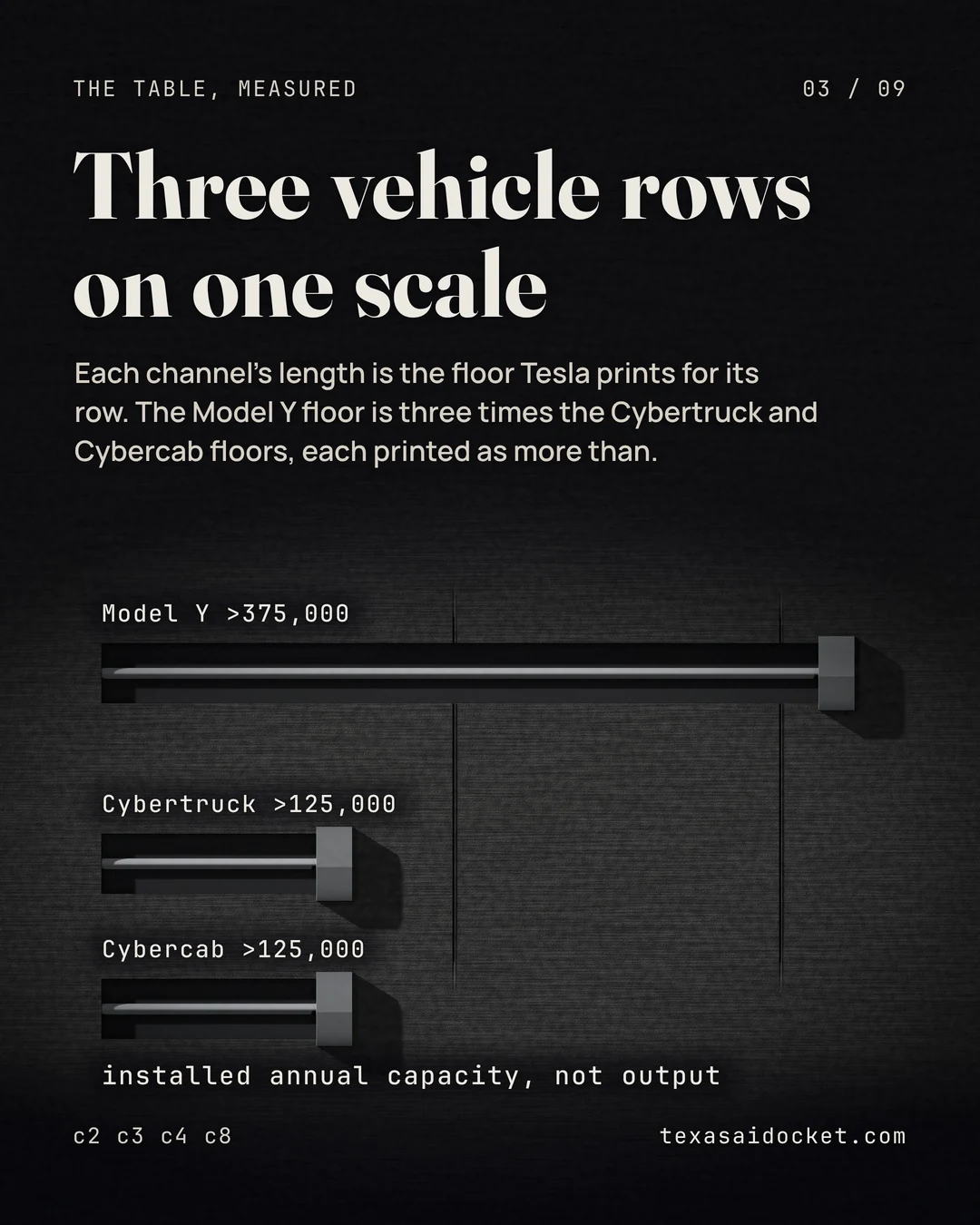
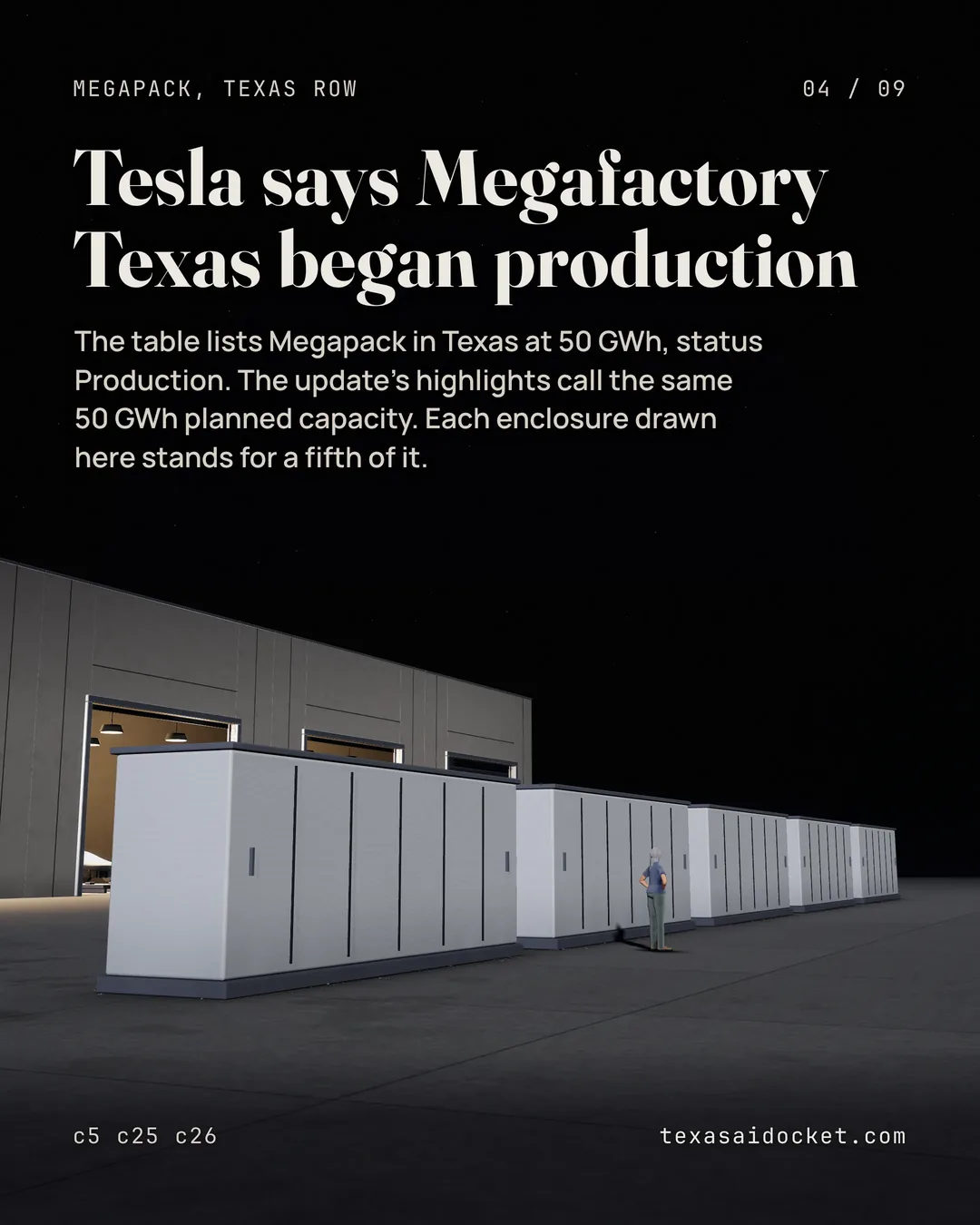
Tesla's update for the third quarter of 2026 was released for a webcast set for October 21st, 2026. Its table of installed annual manufacturing capacity lists Model Y in Texas at more than 375,000 a year, with the status Production. The Cybertruck and the Cybercab sit in the rows under the same Texas label at more than 125,000 each, also Production. Megapack in Texas is listed at 50 GWh.
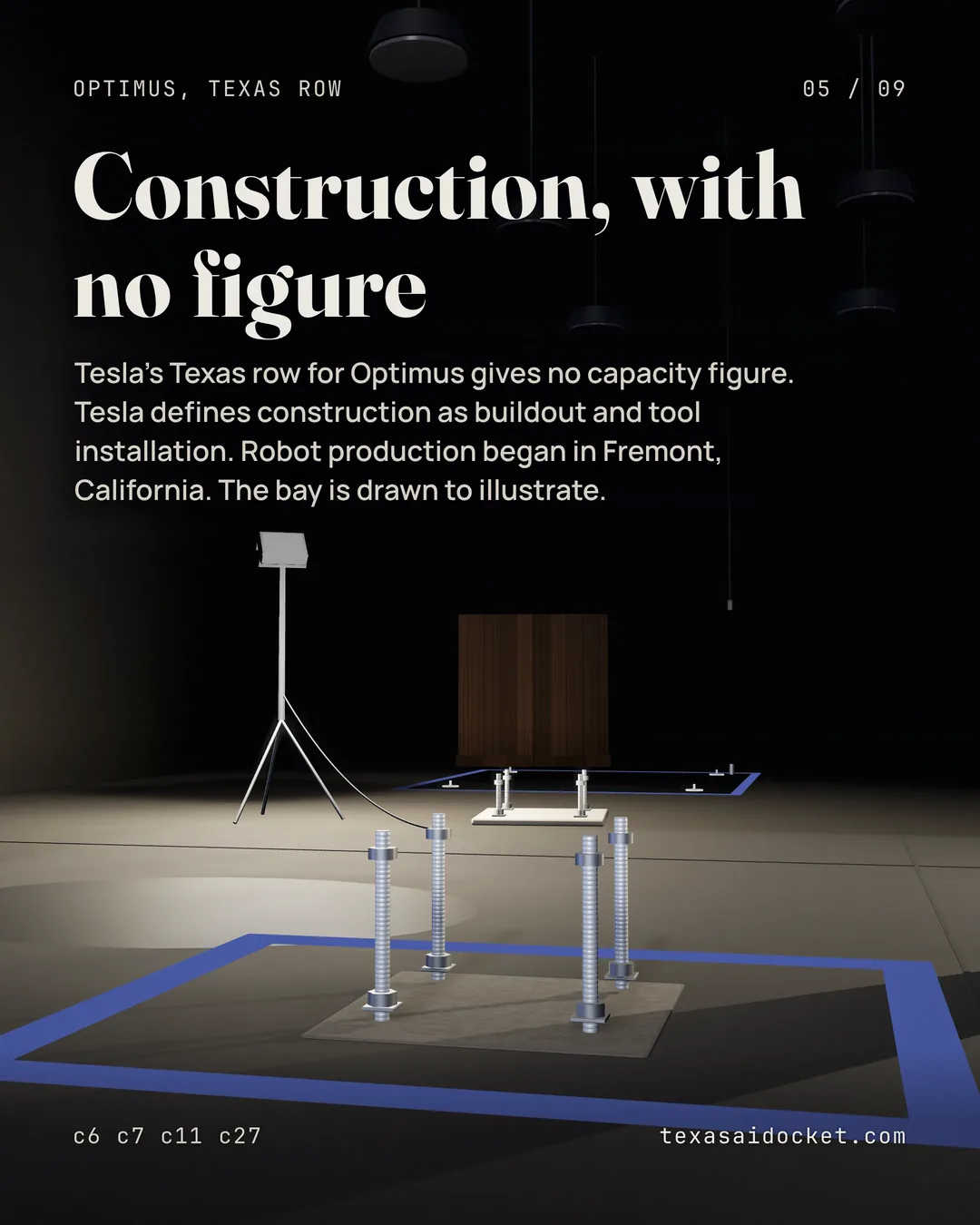
One row is different. The Texas row for Optimus reads Construction and gives no capacity figure. Tesla defines construction as factory and infrastructure buildout plus tool installation. Optimus production began on high volume lines in Fremont, where the California row reads Early Ramp.
The machines that train the software
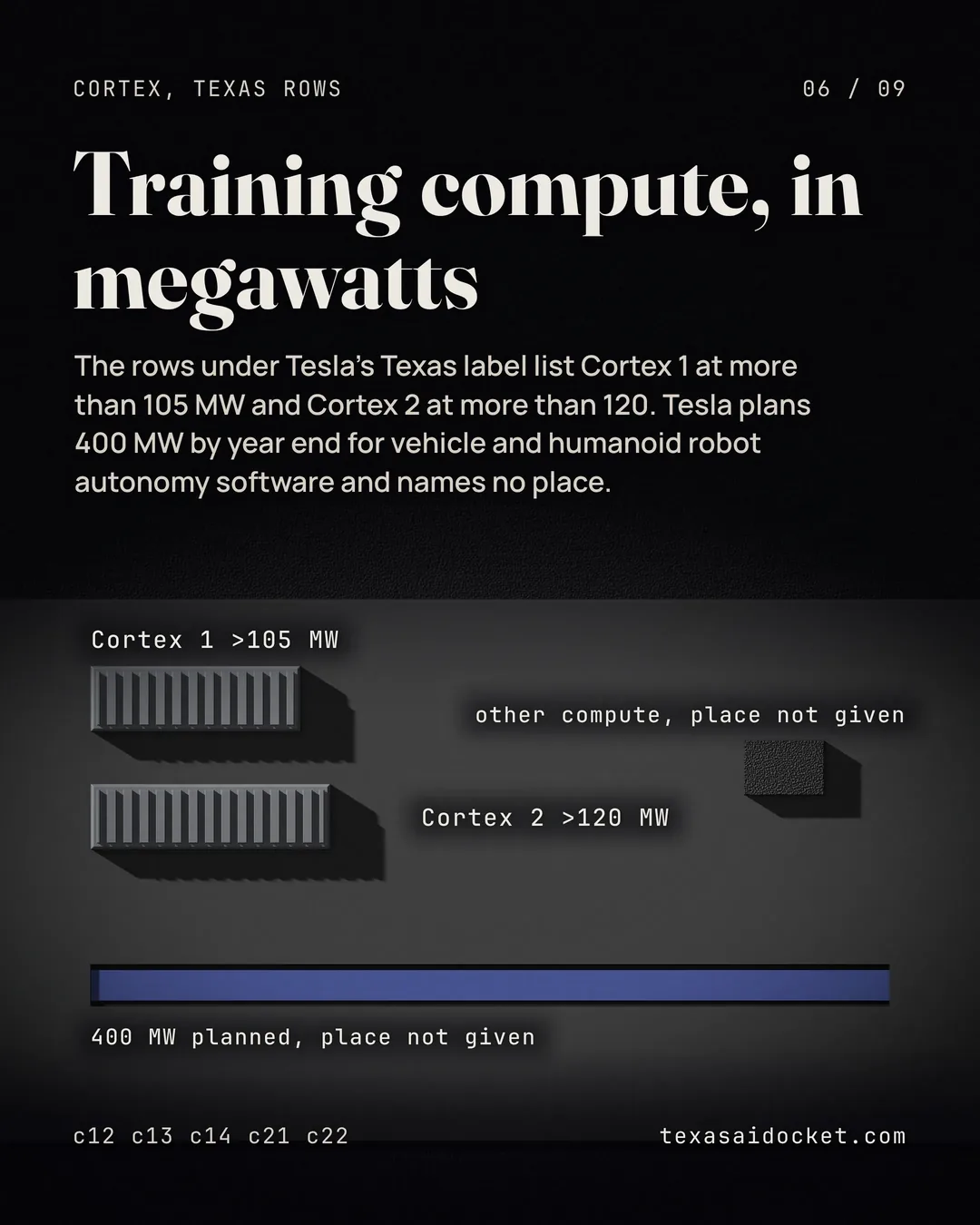
The supporting table lists Cortex 1 in Texas at more than 105 MW of training compute and Cortex 2, in the row under it, at more than 120 MW. Tesla plans to reach 400 MW by the end of the year, supporting both vehicle and humanoid robot autonomy software. The update does not say where that compute will sit.
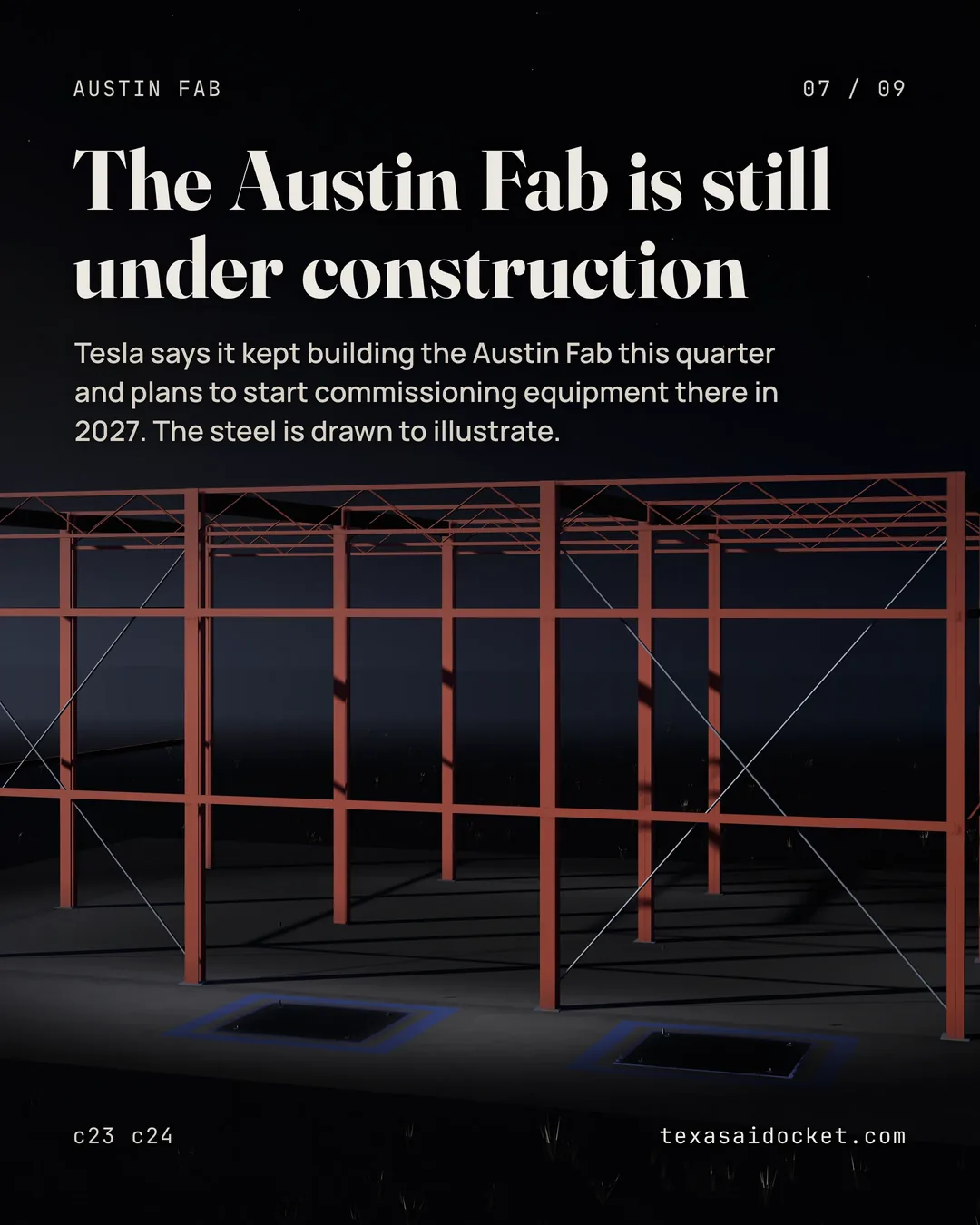
Tesla says it kept building the Austin Fab during the quarter and plans to start commissioning equipment there in 2027. It also says it began production at Megafactory Texas.
What a capacity figure is not
A footnote to the tables says installed capacity is not the current production rate. Tesla says production rates depend on equipment uptime, component supply, downtime for factory upgrades, regulatory considerations and other factors. The update gives no count of Cybercabs built, deployed or carrying riders.
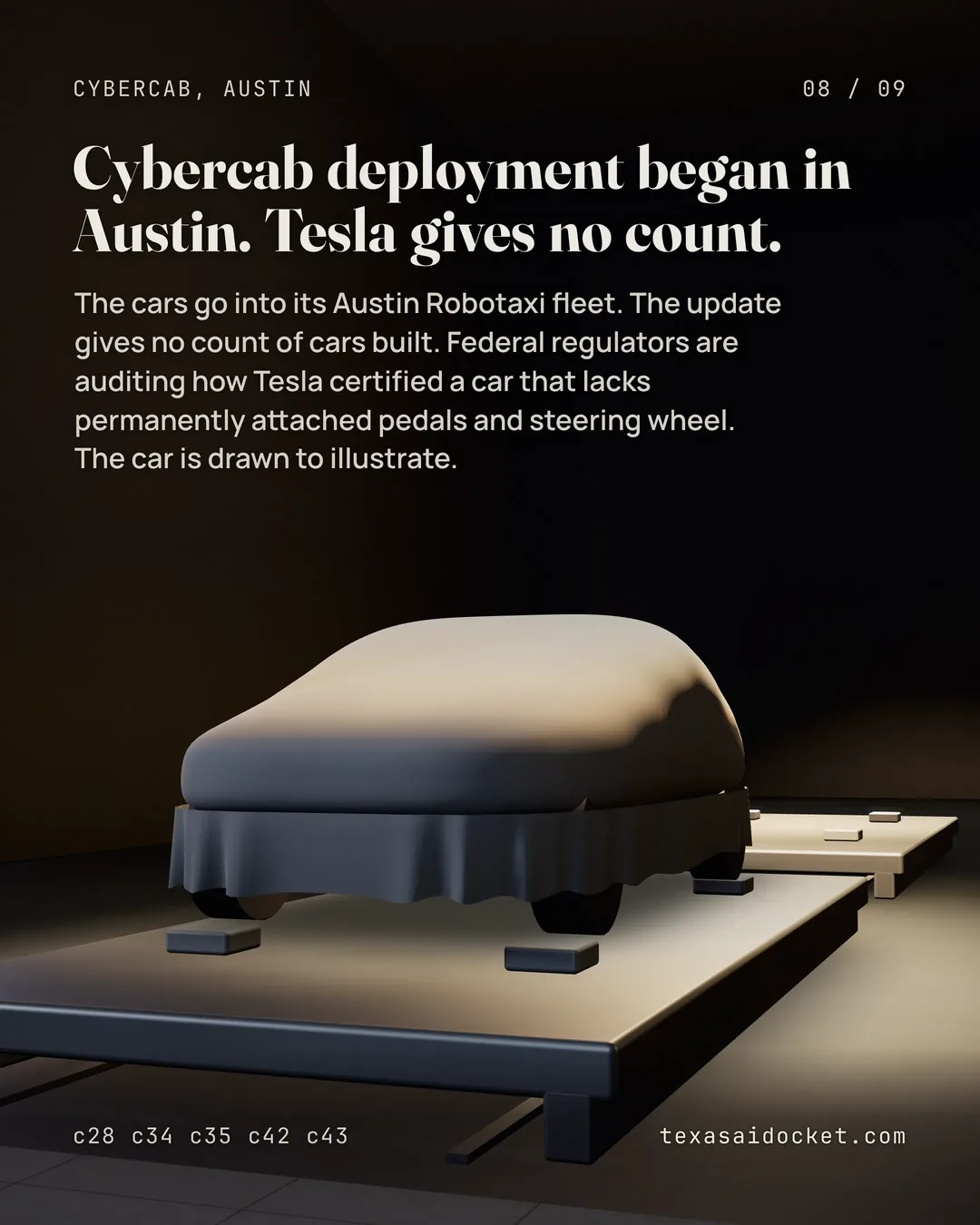
Tesla says it began putting the Cybercab into its Robotaxi fleet in Austin. NHTSA records that commercial deployment began with a small number of Cybercab vehicles in Austin on September 3rd, 2026. The vehicles lack permanently attached conventional controls such as a brake pedal, a gas pedal, a steering wheel and mirrors. NHTSA opened an audit query into the process and data behind Tesla's certification of the car, and its resume still shows that query as open.
Sources for this story
Claim-by-claim verification · 44 claims
Tesla scheduled the live webcast of its third quarter 2026 financial results call for October 21st, 2026.
live webcast of its third quarter 2026 financial results conference call beginning at 4:30 p.m. CT on October 21, 2026
Tesla's installed annual manufacturing capacity table lists Model Y in Texas at more than 375,000 units, status Production.
Texas Model Y >375,000 Production
The same table lists Cybertruck at more than 125,000 units of installed annual capacity, status Production, in the rows under the Texas region label.
Cybertruck >125,000 Production
The table lists Cybercab at more than 125,000 units of installed annual capacity, status Production, in the rows under the Texas region label.
Cybercab >125,000 Production
The table lists Megapack in Texas at 50 GWh of installed annual capacity, status Production.
Texas Megapack 50 GWh Production
The table lists Optimus in Texas with the status Construction and gives no capacity figure.
Texas Optimus - Construction
The table lists Optimus in California with the status Early Ramp.
California Optimus - Early Ramp
A footnote to Tesla's capacity tables says installed capacity is not the current production rate.
Installed capacity ≠ current production rate
The footnote says production rates depend on several factors, including equipment uptime.
Production rates depend on a variety of factors, including equipment uptime,
The other factors it lists are component supply, downtime for factory upgrades and regulatory considerations.
component supply, downtime related to factory upgrades, regulatory considerations and other factors.
Tesla defines the Construction status as factory and infrastructure buildout plus tool installation.
Construction includes factory and infrastructure buildout as well as tool installation.
Tesla's supporting infrastructure table lists Cortex 1 in Texas at more than 105 MW of SI training compute, status Production.
Texas Cortex 1 >105 MW Production
The table lists Cortex 2 at more than 120 MW of SI training compute, status Production, in the row under the Texas region label.
Cortex 2 >120 MW Production
The SI training compute rows exclude 40 MW of other compute that is not part of Cortex 1 or Cortex 2.
(1) Excludes 40 MW of other compute not part of Cortex 1 or Cortex 2.
The table lists 4680 battery cell manufacturing in Texas at more than 40 GWh of annual capacity, status Production.
Texas 4680 >40 GWh Production
The table lists Cathode Materials at 10 GWh, status Early Ramp, in the rows under the Texas region label.
Cathode Materials 10 GWh Early Ramp
The table lists Lithium Refining at 30 GWh, status Early Ramp, in the rows under the Texas region label.
Lithium Refining 30 GWh Early Ramp
Tesla says Early Ramp capacity figures include expected capacity.
Early ramp capacity includes expected capacity.
The update's battery section names cathode material production and lithium refining in Texas among its critical projects.
Critical projects include vehicle pack capacity in Berlin, cathode material production and lithium refining in Texas
The update ties increased 4680 cell production to the ramps of both Cybercab and Tesla Semi.
production of our 4680 cells to support the ramps of both Cybercab and Tesla Semi
Tesla plans to reach 400 MW of SI training compute by the end of the year. The update does not say where that compute will sit.
We plan to reach 400 MW of SI training compute by the end of the year
Tesla says that compute supports development of both vehicle and humanoid robot autonomy software.
development of both vehicle and humanoid robot autonomy software.
Tesla continued construction of the Austin Fab during the quarter.
continued construction for the Austin Fab
Tesla plans to start commissioning equipment at the Austin Fab in 2027.
where we plan to start commissioning equipment in 2027
Tesla says it began production at Megafactory Texas.
We began production at Megafactory Texas.
The update's highlights page also says Megafactory Texas began production.
Megafactory Texas began production, with planned
Optimus production began on high volume lines in Fremont, California, not in Texas.
Optimus production began in Fremont on our high- volume lines.
Tesla says it began deploying Cybercab into its Robotaxi fleet in Austin.
We began deployment of Cybercab into our Robotaxi fleet in Austin.
The highlights say Tesla started providing Robotaxi rides using Cybercabs in Austin on September 3rd.
We started providing Robotaxi rides using Cybercabs on September 3 in Austin.
Tesla's operations highlights list the launch of Cybercab into the Robotaxi fleet in Austin.
Launched Cybercab into the Robotaxi fleet in Austin
Tesla reported nearly two million cumulative unsupervised miles for its whole Robotaxi service as of the end of the quarter. The figure is not broken out for Austin.
nearly two million cumulative unsupervised miles for our Robotaxi service
The highlights say cumulative unsupervised Robotaxi miles grew eightfold quarter over quarter across the service.
unsupervised Robotaxi miles grew eightfold quarter over quarter
Robotaxi operating hours in Austin now run from 6am to midnight.
Operating hours in Austin are now 6am to midnight
Tesla's quarterly update gives no count of Cybercab vehicles built, deployed or carrying riders. Its Cybercab figure is installed capacity, which the update says is not the current production rate.
Installed capacity ≠ current production rate and there may be limitations discovered as production rates
NHTSA's Office of Defects Investigation resume for AQ26002 shows the investigation as open.
Investigation: AQ26002 Open Resume Page 1 of 1
The audit query was opened on September 3rd, 2026, prompted by public information.
Prompted By: Public Information Date Opened: 09/03/2026
The audit query's subject is the FMVSS certification of the Tesla Cybercab.
Subject: Tesla Cybercab FMVSS Certification
NHTSA gives an estimated population of 1,000 vehicles for the audit query.
Population: 1,000 (Estimated)
According to NHTSA, Tesla began commercial deployment with a small number of Cybercab vehicles in Austin on September 3rd, 2026.
On September 3, 2026, Tesla began commercial deployment with a small number of its Cybercab vehicles in Austin, Texas
Tesla notified NHTSA that it certified those Cybercab vehicles as compliant with all applicable Federal Motor Vehicle Safety Standards.
Tesla notified the Agency that it certified those Cybercab vehicles as compliant with all applicable Federal Motor Vehicle Safety Standards (FMVSS)
Tesla also told NHTSA it plans to gradually expand Cybercab deployment to more vehicles and locations.
expand commercial deployment of the Cybercab to include additional vehicles and locations.
The Cybercab vehicles lack permanently attached conventional manual controls, such as a brake pedal, gas pedal, steering wheel and mirrors.
The vehicles lack permanently attached, conventional manual controls, such as a brake pedal, gas pedal, steering wheel, and mirrors.
NHTSA opened the audit query to examine the process and technical data Tesla relied on when certifying the Cybercab.
NHTSA is opening this AQ to examine the process and technical data on which Tesla relied when certifying the Cybercab
NHTSA will consider how far Tesla's certification depended on determinations that certain FMVSS do not apply to the Cybercab.
NHTSA will consider the extent to which Tesla’s certification depended on determinations that certain FMVSS are inapplicable to the Cybercab.