Articles · Universities
Texas A&M plans an AI foundry for new alloys
Texas A&M plans an automated lab where robots mix, melt and test new alloys. A separate NSF platform is funded for six years and open to outside researchers.
Read the story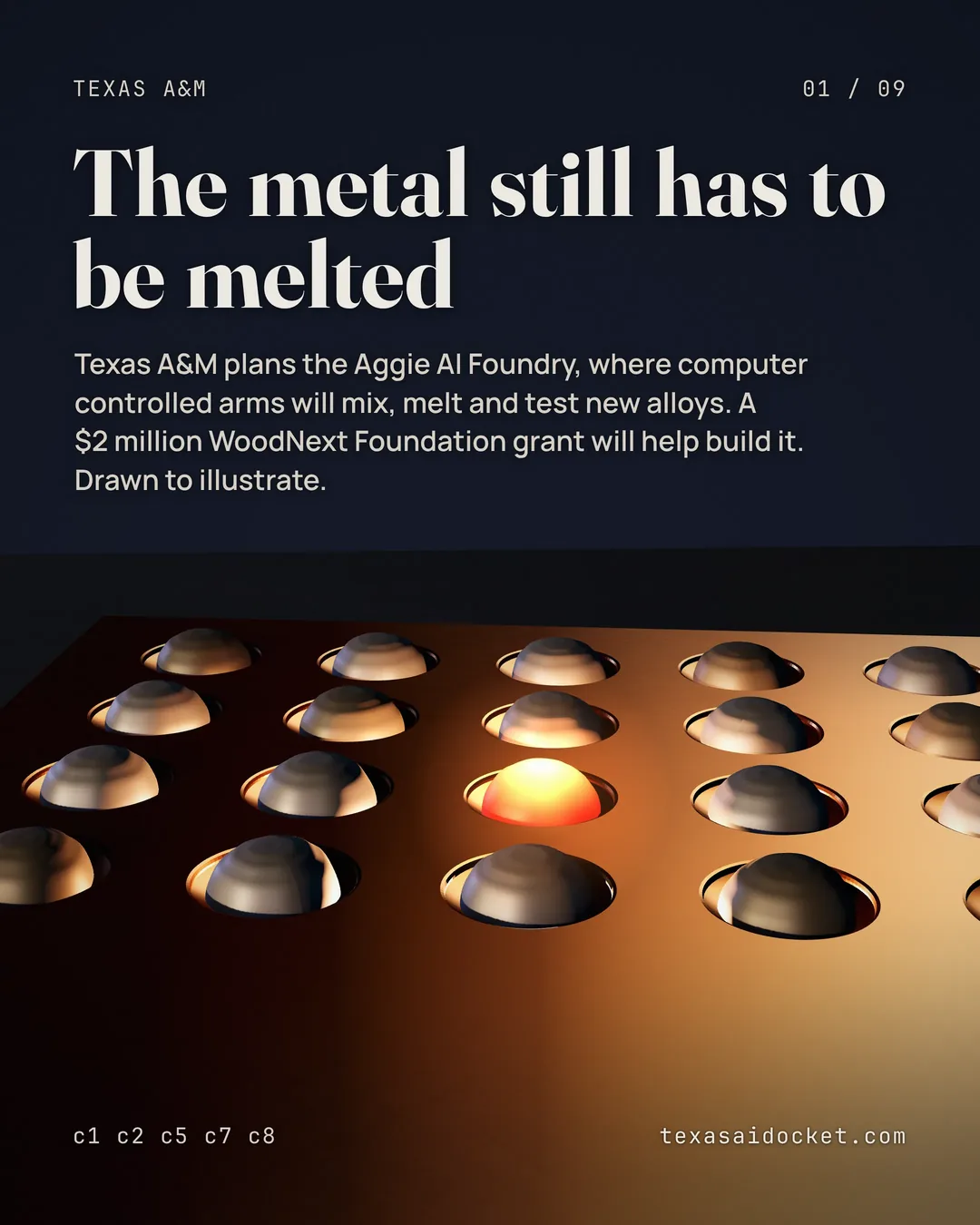
A $2 grant is going to Texas A&M's Department of Materials Science and Engineering. It comes from the WoodNext Foundation and will help researchers build a campus facility meant to use robotics and artificial intelligence to speed up the development of new alloys. The foundation's support will create what the university calls the Aggie AI Foundry.
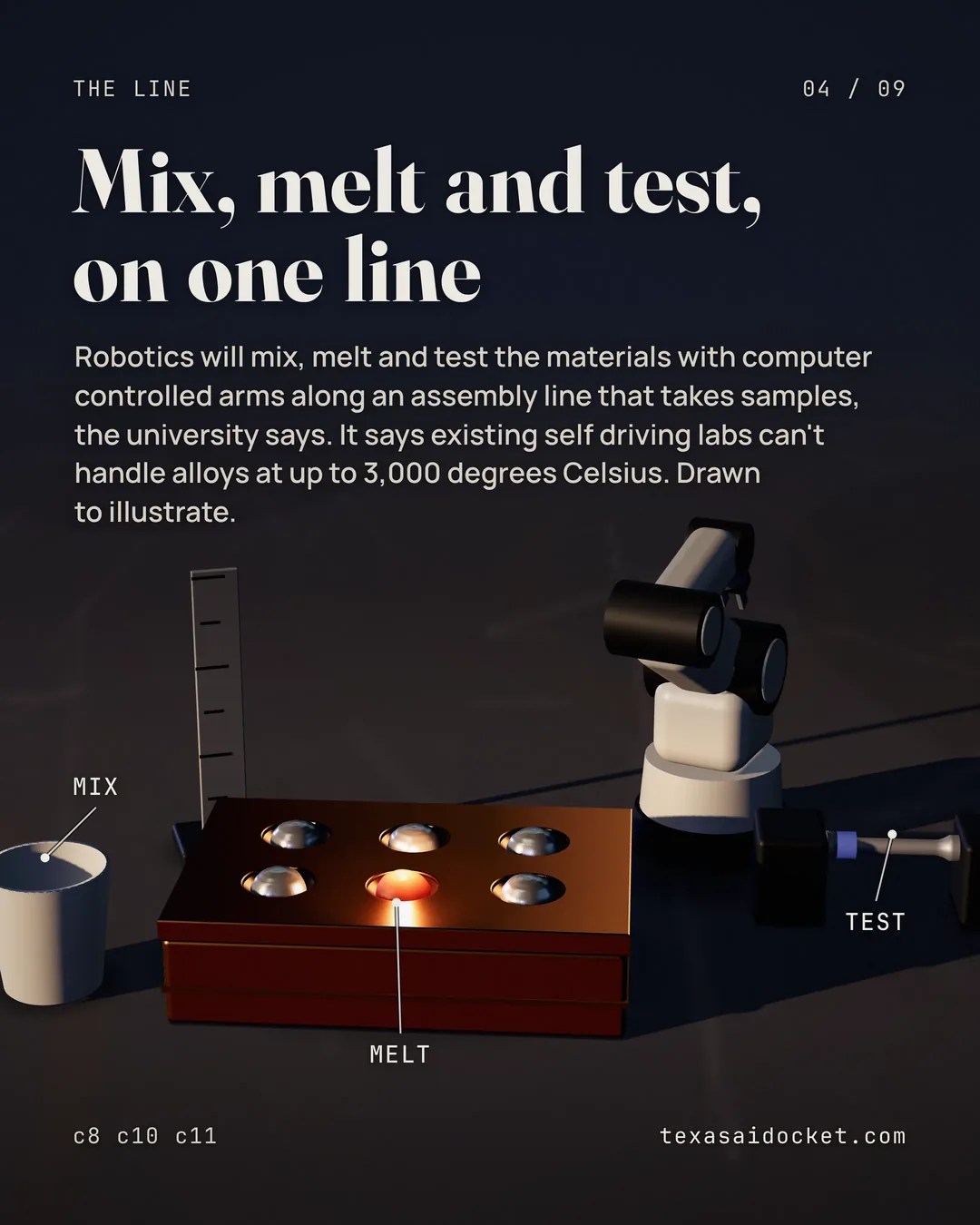
Robots are to mix, melt and test the materials with computer controlled arms along an assembly line that takes samples. The university says existing self driving labs can't handle new metal alloys at temperatures up to 3,000 degrees Celsius. Those labs focus on materials that are relatively easy to make.
Why software alone does not settle it
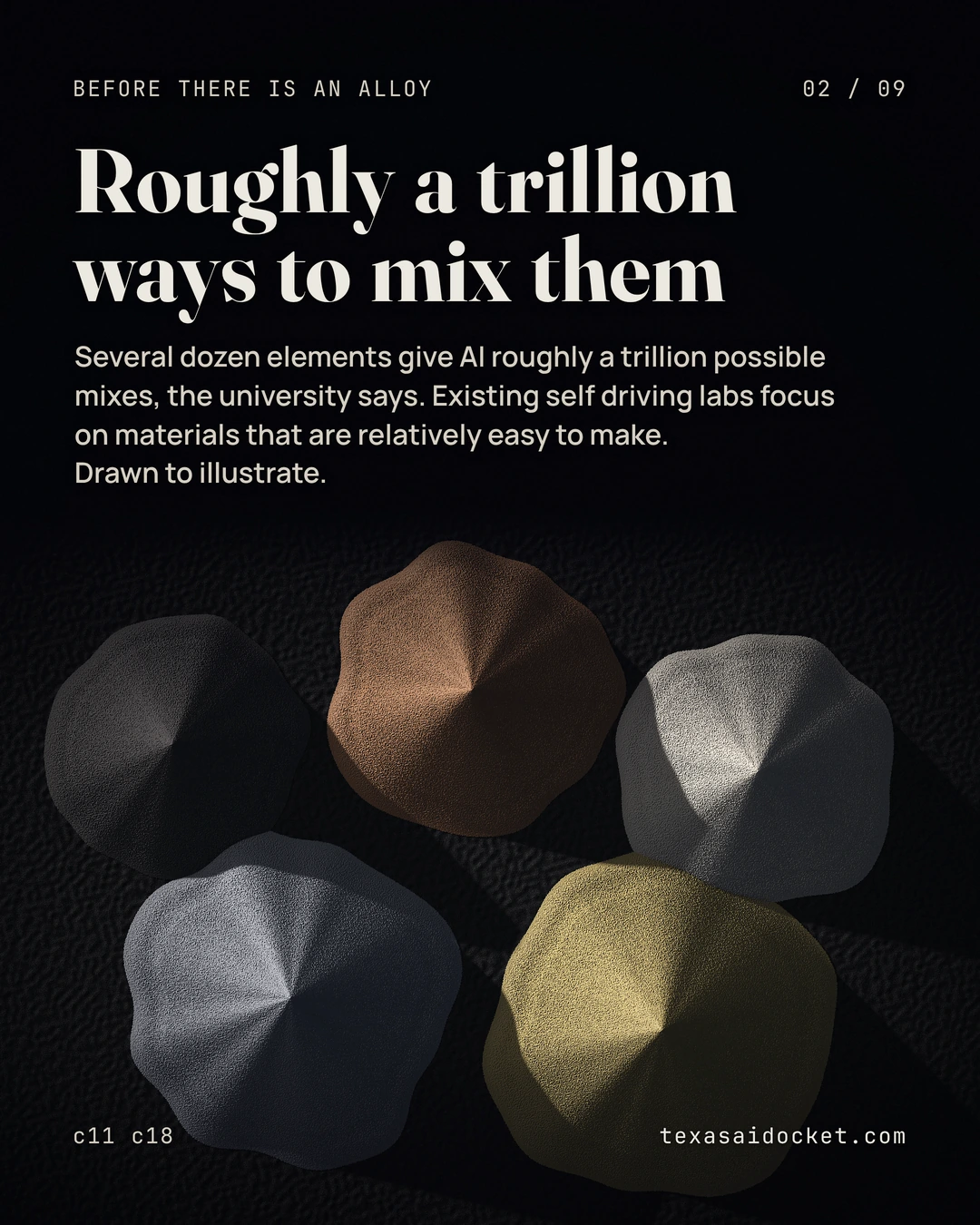
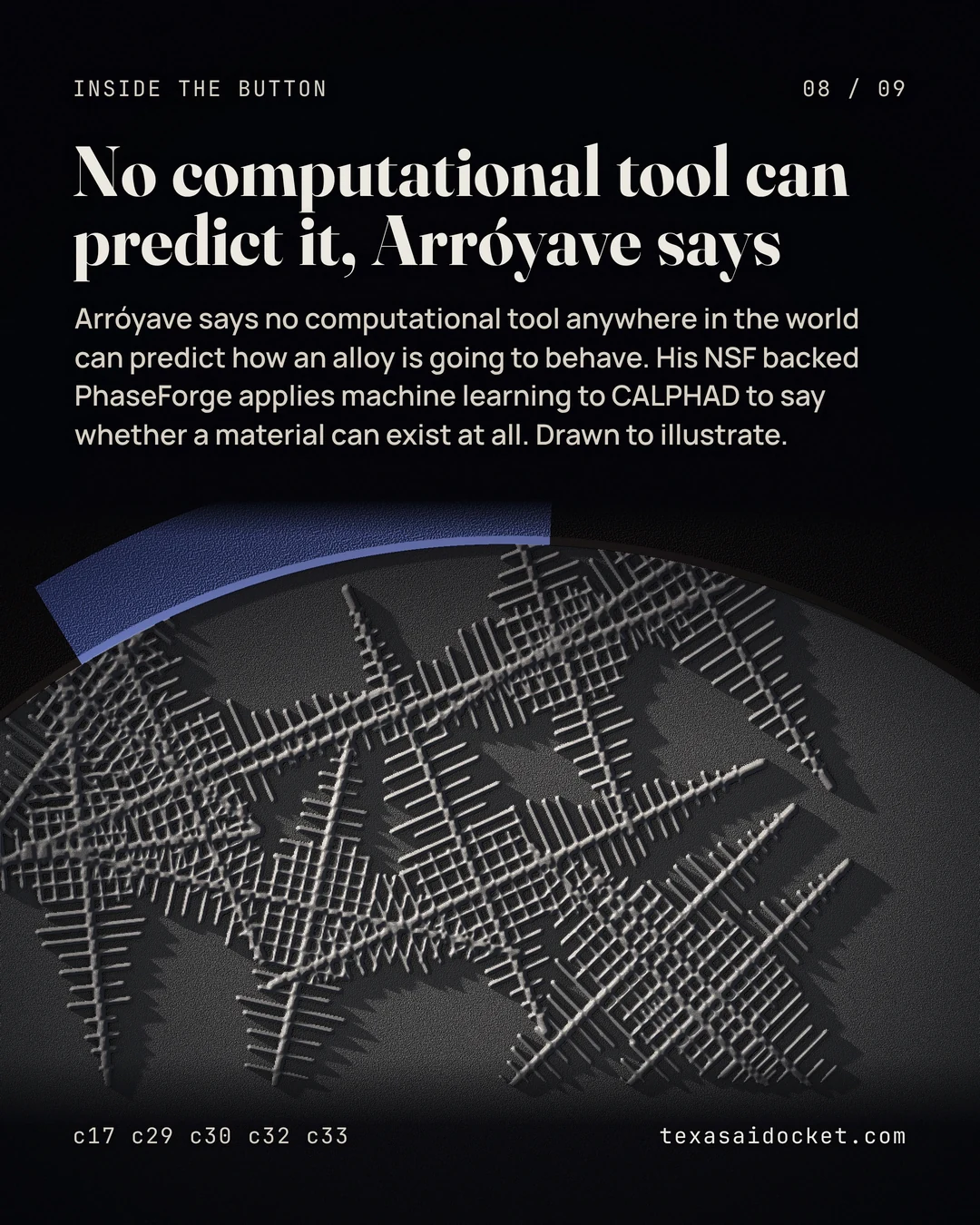
Several dozen elements from the periodic table give AI roughly a trillion possible ways to mix them. Raymundo Arróyave says no computational tool anywhere in the world can predict how an alloy is going to behave. That is the reason the plan ends in a furnace and a test rather than in a prediction.
Arróyave leads PhaseForge, free open software paid for by a National Science Foundation award that uses machine learning. It applies machine learning to CALPHAD, a method that is decades old, and tells researchers whether a material they want to build can exist at all. It is distributed free online and anyone may contribute to it.
Who conceived it and who is paying
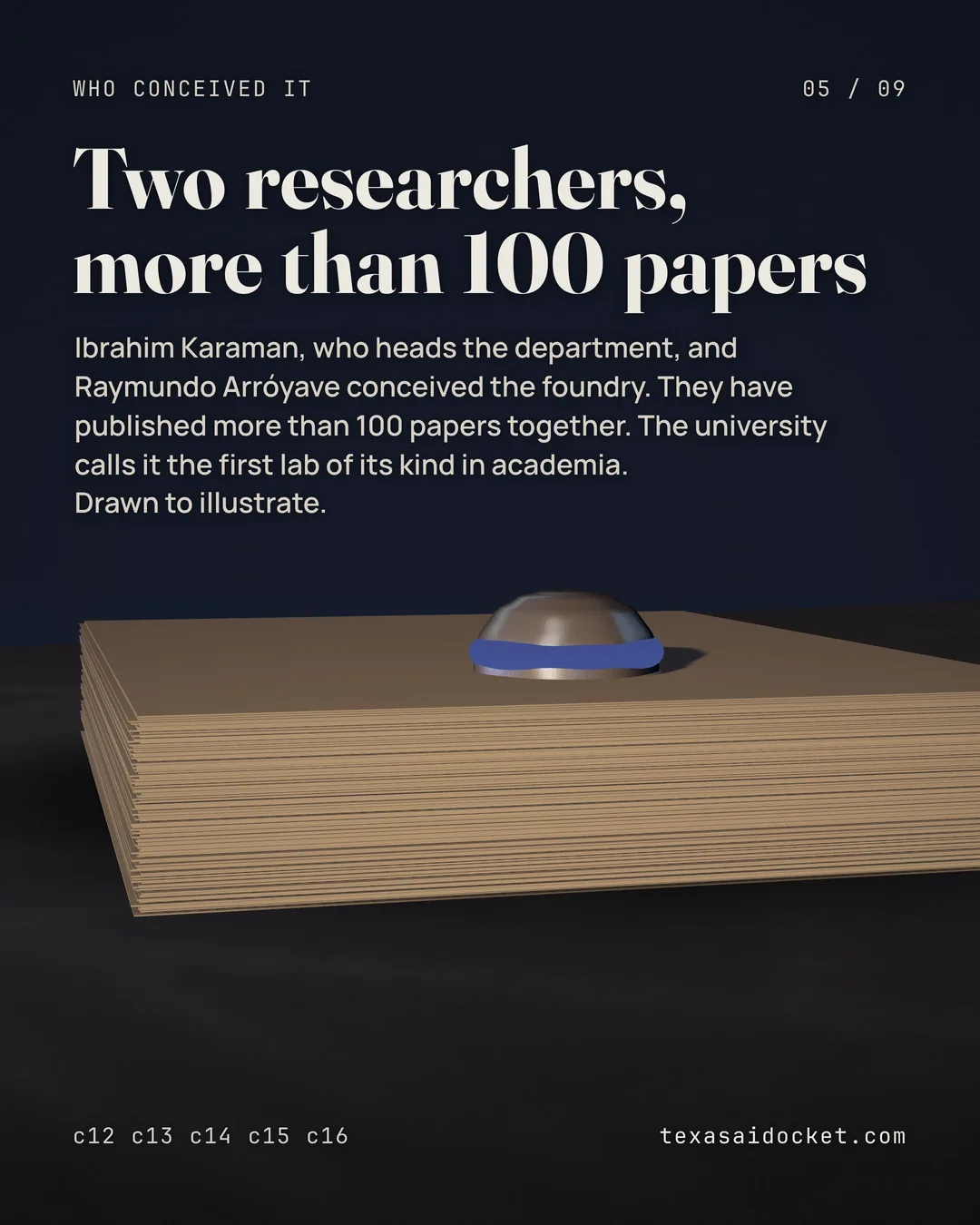
Ibrahim Karaman, who heads the department, is one of the two researchers who conceived the foundry. Arróyave is the other. The two have published more than 100 papers together. The university calls the foundry the first lab of its kind in academia, and that claim is its own.
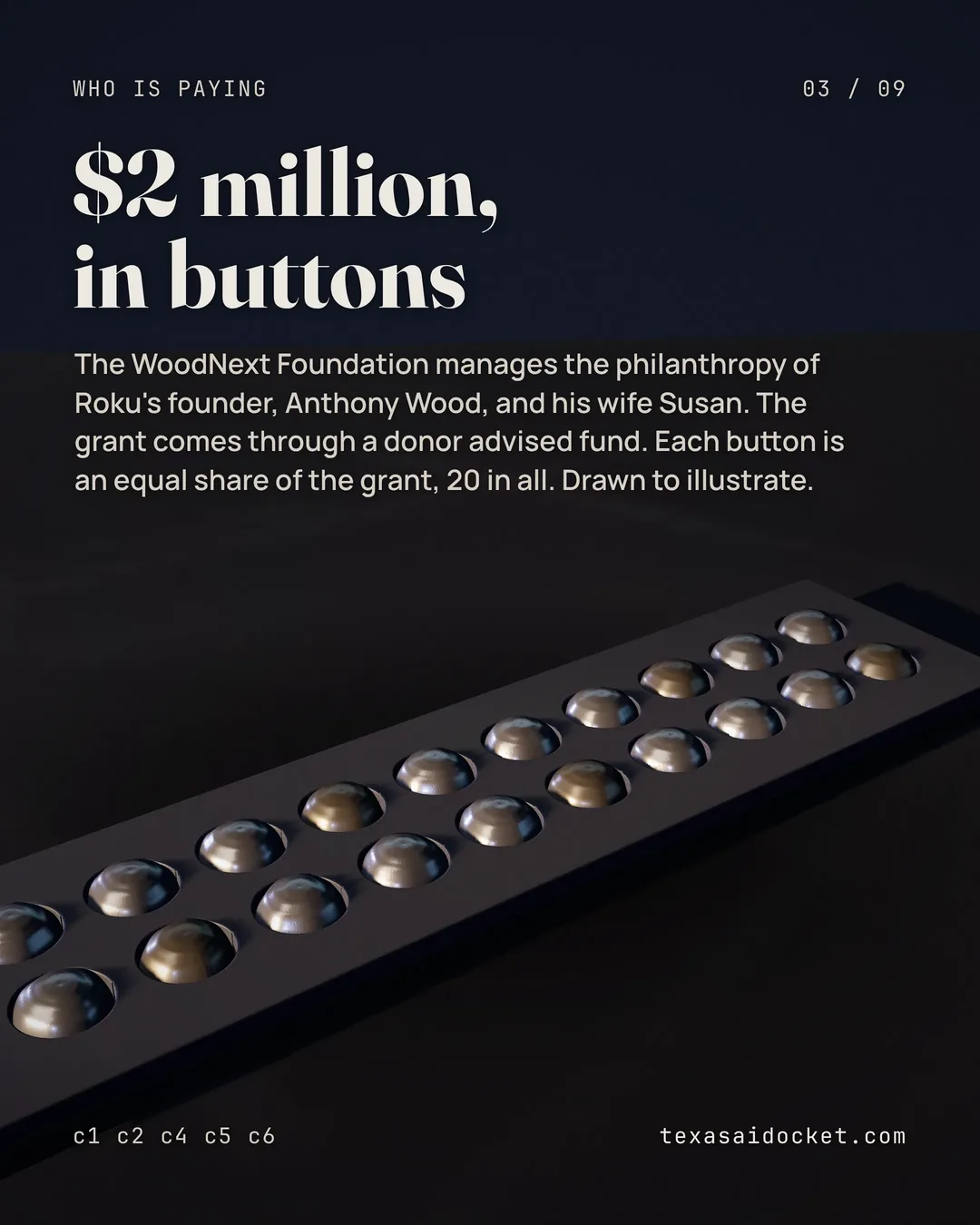
The WoodNext Foundation manages the philanthropy of the founder and chief executive of Roku, Anthony Wood, and his wife Susan. The money flows through a donor advised fund program called the WoodNext TAMU Fund.
A separate federal platform
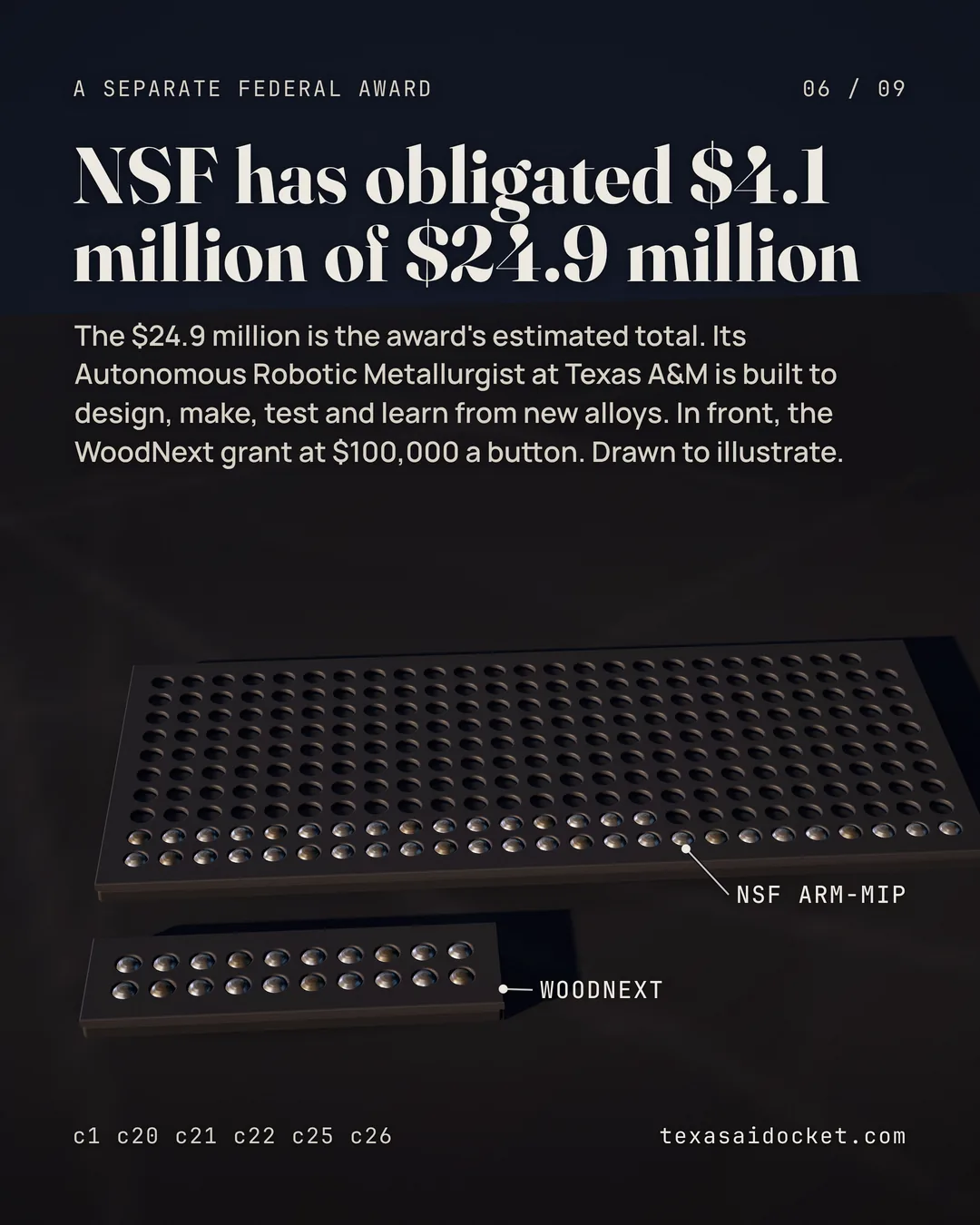
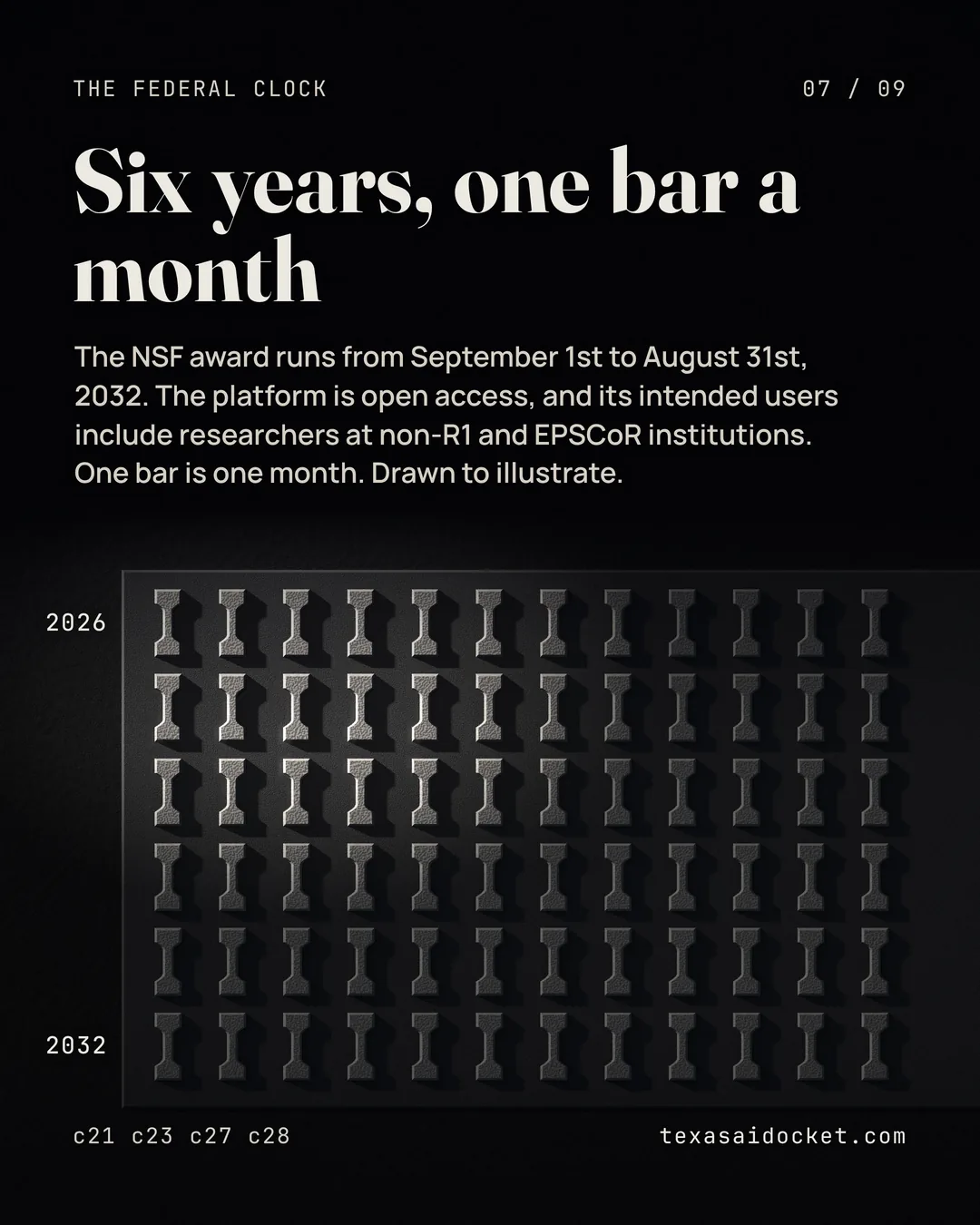
The National Science Foundation has a platform of its own at Texas A&M, the Autonomous Robotic Metallurgist. Its award record names the Texas A&M Engineering Experiment Station as recipient and lists 4100000 dollars obligated of an estimated total of 24900000 dollars. The award runs from September 1st, 2026 to August 31st, 2032.
NSF describes the platform as an open access facility, built to design, make, test and learn from new alloys. Its intended users include researchers at non-R1 and EPSCoR institutions.
What is a goal and what is a result
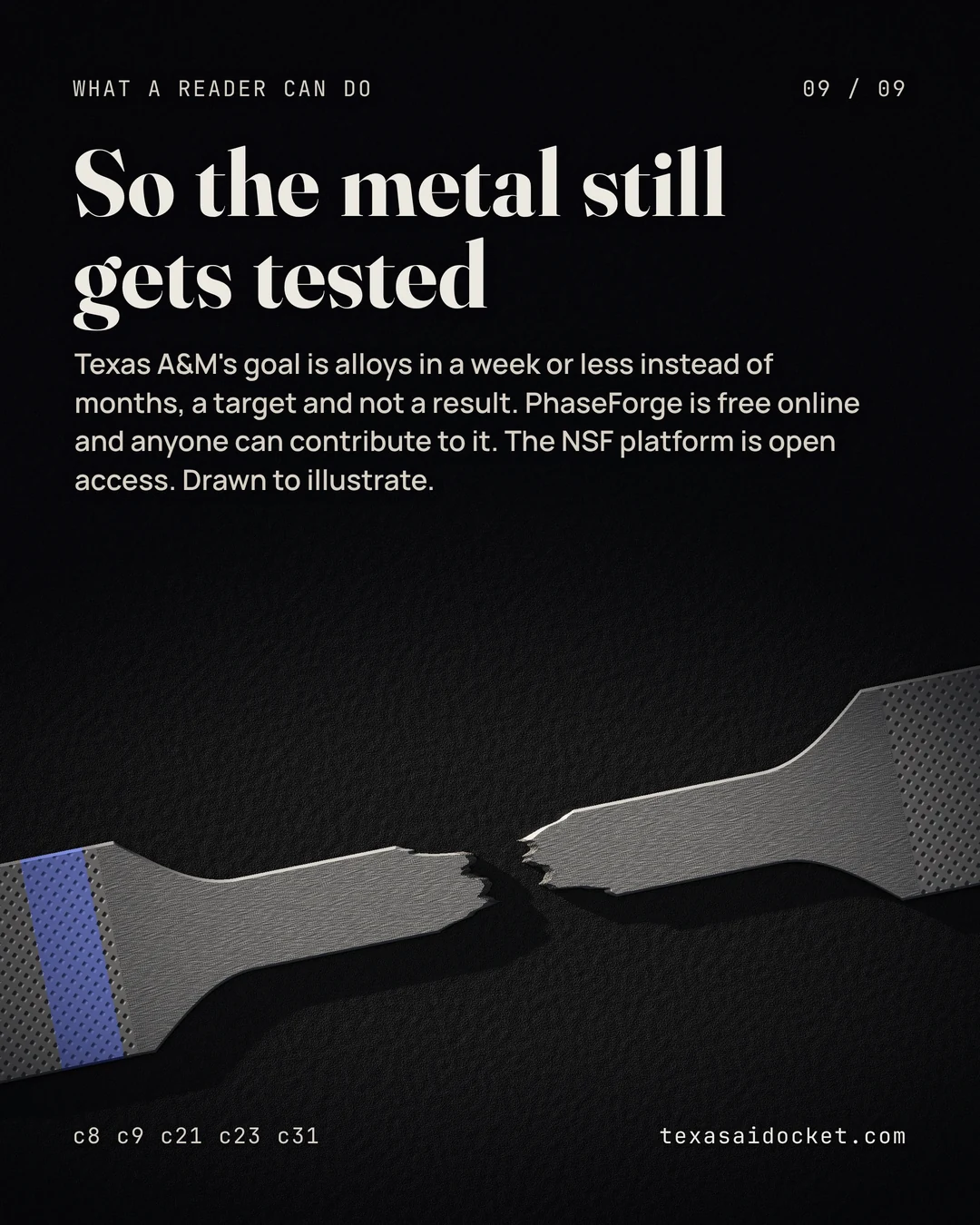
Texas A&M says the automated process will cut alloy development from months to a week or less, which is a stated goal and not a measured result. Neither of the university's two releases on the foundry gives an opening date or a construction timeline. The NSF award record gives its own dates, and those belong to the federal platform rather than to the WoodNext facility.
Sources for this story
- Texas A&M Engineering news, October 22nd, Texas A&M researchers pursue autonomous AI foundry
- Texas A&M Stories, October 26th, Texas A&M to create AI-powered foundry for faster alloy discovery
- NSF Award API, award 2534344
- Texas A&M Engineering news, September 4th, NSF backs Texas A&M tool that speeds materials discovery
Claim-by-claim verification · 34 claims
A $2 million grant is going to Texas A&M's Department of Materials Science and Engineering.
a $2 million grant to Texas A&M University’s Department of Materials Science and Engineering
The grant comes from the WoodNext Foundation and will help Texas A&M researchers build a campus facility.
A $2 million grant from the WoodNext Foundation will help Texas A&M researchers build a campus facility
The facility is meant to use robotics and artificial intelligence to speed up the development of new alloys.
that uses robotics and artificial intelligence to speed the development of new alloys.
The WoodNext Foundation manages the philanthropy of the founder and CEO of Roku.
which manages the philanthropy of tech innovator and Roku CEO and Founder
The foundation is that of Anthony Wood and his wife Susan, and its support will create the Aggie AI Foundry.
Anthony Wood ’87 and his wife Susan ’89, will create the Aggie AI Foundry,
The money flows through a donor advised fund program called the WoodNext TAMU Fund.
This research is supported through the WoodNext TAMU Fund, a donor-advised fund program.
The foundry is planned as a fully automated system that develops new metal alloys from the first idea through testing.
fully automated system for developing novel metal alloys from idea generation through testing
Robots are to mix, melt and test the materials with computer controlled arms working along an assembly line that takes samples.
Robotics will mix, melt and test the materials for the desired qualities using computer-controlled arms that will work along an assembly line that takes samples of materials.
Texas A&M says the automated process will cut alloy development from months to a week or less. That is a stated goal, not a measured result.
The automated process will increase the rate at which metal alloys are developed from months to a week or less.
The university says existing self driving labs can't handle the design and testing of new metal alloys at temperatures up to 3,000 degrees Celsius.
can’t handle the complexities of designing and testing novel metal alloys at temperatures up to 3,000 degrees Celsius.
Existing self driving labs focus on materials that are relatively easy to make.
Existing self-driving labs focus on materials that are relatively easy to synthesize
Texas A&M calls the Aggie AI Foundry the first lab of its kind in academia. The claim is the university's own.
The Aggie AI Foundry will be the first lab of its kind in academia.
Ibrahim Karaman is one of the two researchers who conceived the foundry.
The foundry is the brainchild of Dr. Ibrahim Karaman
Karaman heads the materials science and engineering department and holds a named Chevron professorship.
materials science and engineering department head and Chevron Professor I
Raymundo Arróyave, the foundry's other originator, is associate department head for research and Chevron Professor II.
associate department head for research and Chevron Professor II.
Karaman and Arróyave have published more than 100 papers together.
having published more than 100 papers together.
Arróyave says no computational tool anywhere in the world can predict how an alloy is going to behave.
there’s no computational tool anywhere in the world that can predict how an alloy is going to behave,
Several dozen elements from the periodic table give AI roughly a trillion possible ways to mix them.
Using several dozen elements from the periodic table would provide AI with roughly a trillion possible ways for mixing them.
The researchers say automation would free people to spend more of their time on science.
We want to free human brains and hands to conduct more science
The NSF platform at Texas A&M is the Autonomous Robotic Metallurgist, an NSF Materials Innovation Platform known as ARM-MIP.
"title":"Research Infrastructure: MIP: Autonomous Robotic Metallurgist: An NSF Materials Innovation Platform (ARM-MIP)"
NSF describes the platform at Texas A&M as an open access facility.
The Autonomous Robotic Metallurgist Materials Innovation Platform (ARM-MIP) at Texas A&M University is an open-access
The NSF platform is built to design, make, test and learn from new alloys.
designs, makes, tests, and learns from new alloys
Its intended users include researchers at non-R1 and EPSCoR institutions.
including those at non-R1 and EPSCoR institutions
The NSF award's recipient is the Texas A&M Engineering Experiment Station.
"awardeeName":"Texas A&M Engineering Experiment Station"
The NSF award record lists funds obligated of 4100000 dollars.
"fundsObligatedAmt":"4100000"
The NSF award record lists an estimated total of 24900000 dollars.
"estimatedTotalAmt":"24900000"
The NSF award record gives a start date of September 1st, 2026.
"publicAccessMandate":"1","startDate":"09/01/2026"
The NSF award record gives an end date of August 31st, 2032.
"estimatedTotalAmt":"24900000","expDate":"08/31/2032"
PhaseForge is led by Raymundo Arróyave.
The project — PhaseForge — is led by Dr. Raymundo Arróyave
A National Science Foundation award will pay for the free, open software, which uses machine learning.
A new National Science Foundation award will fund free, open software
PhaseForge is distributed free online and anyone may contribute to it.
PhaseForge is being distributed free and openly online, and anyone can contribute to it.
PhaseForge applies machine learning to CALPHAD, a method that is decades old.
It applies machine learning to a decades-old method called CALPHAD
The method tells researchers whether a material they want to build can exist at all.
that tells researchers whether a material they want to build can exist at all.
Arróyave says that when he was a graduate student, this kind of analysis would have taken an entire Ph.D.
such an analysis would have taken an entire Ph.D.