Articles · Oil and gas
Permian Resources names two AI tools and prints no measured result for either
Permian Resources told investors it now runs an AI system that watches its artificial lift and feeds its subsurface data to language models. The release prints no measured result for either tool.
Read the story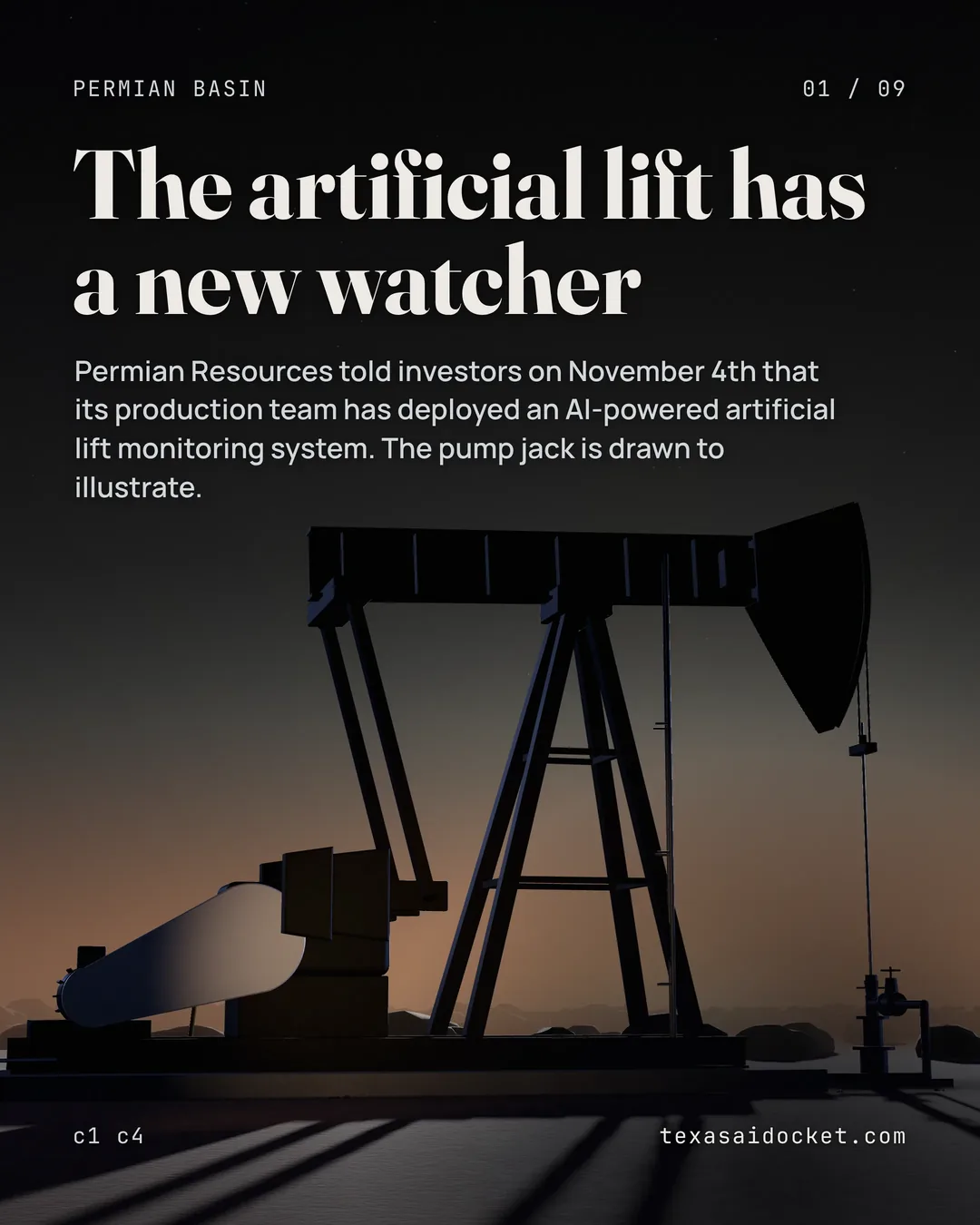

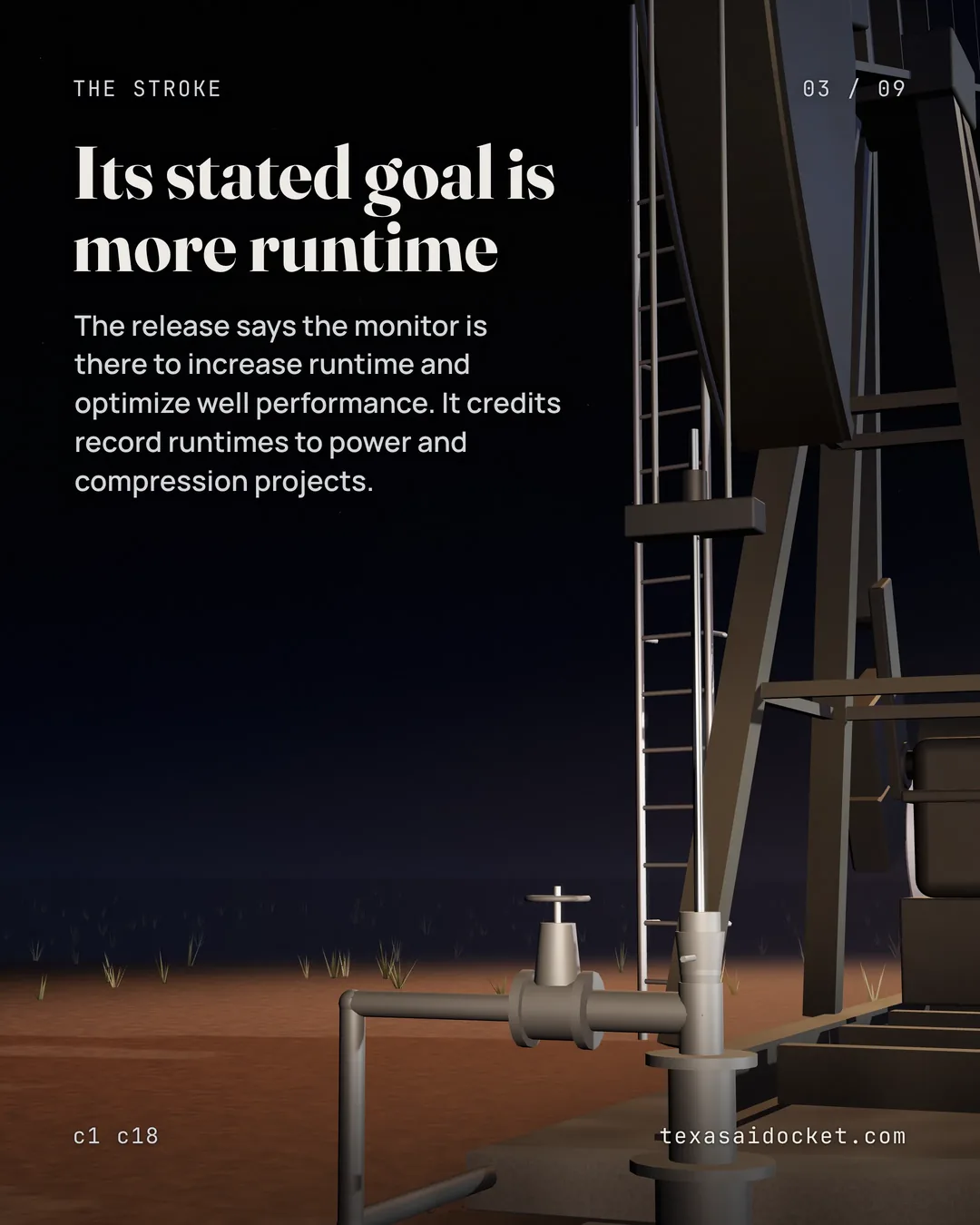
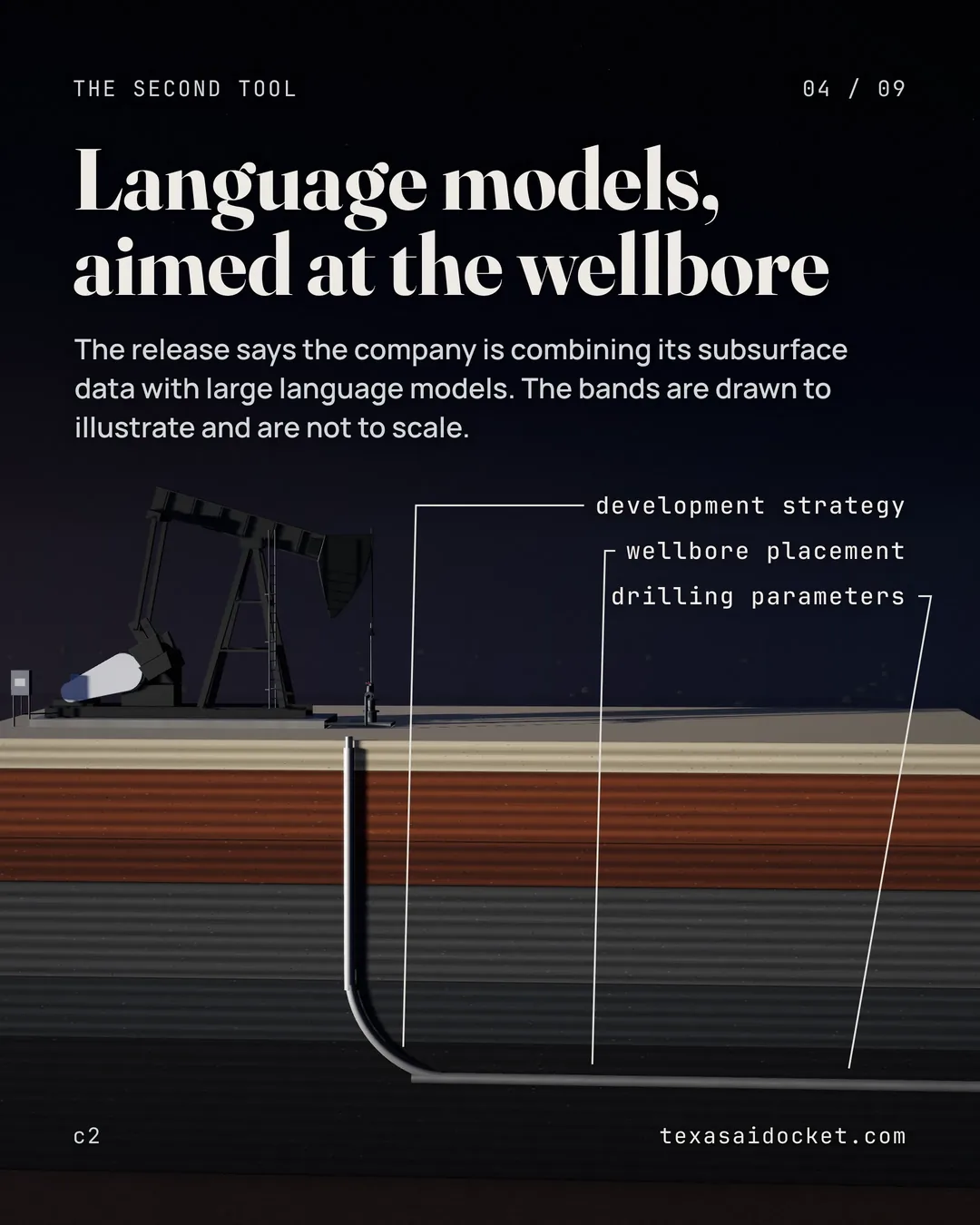

Permian Resources issued its third quarter results release on November 4th, 2026, and two sentences in it describe artificial intelligence at work in its oil fields. The Production Operations team has deployed an AI-powered artificial lift monitoring system to increase runtime and optimize well performance, the release says. The company also says it is integrating its own technical and subsurface data with large language models to evaluate wellbore placement and optimize drilling parameters.
The release frames both tools as part of a broader statement that technology continues to positively impact its operations. It gives no runtime figure, no count of monitored wells and no measured outcome for either tool.
What the quarter shows
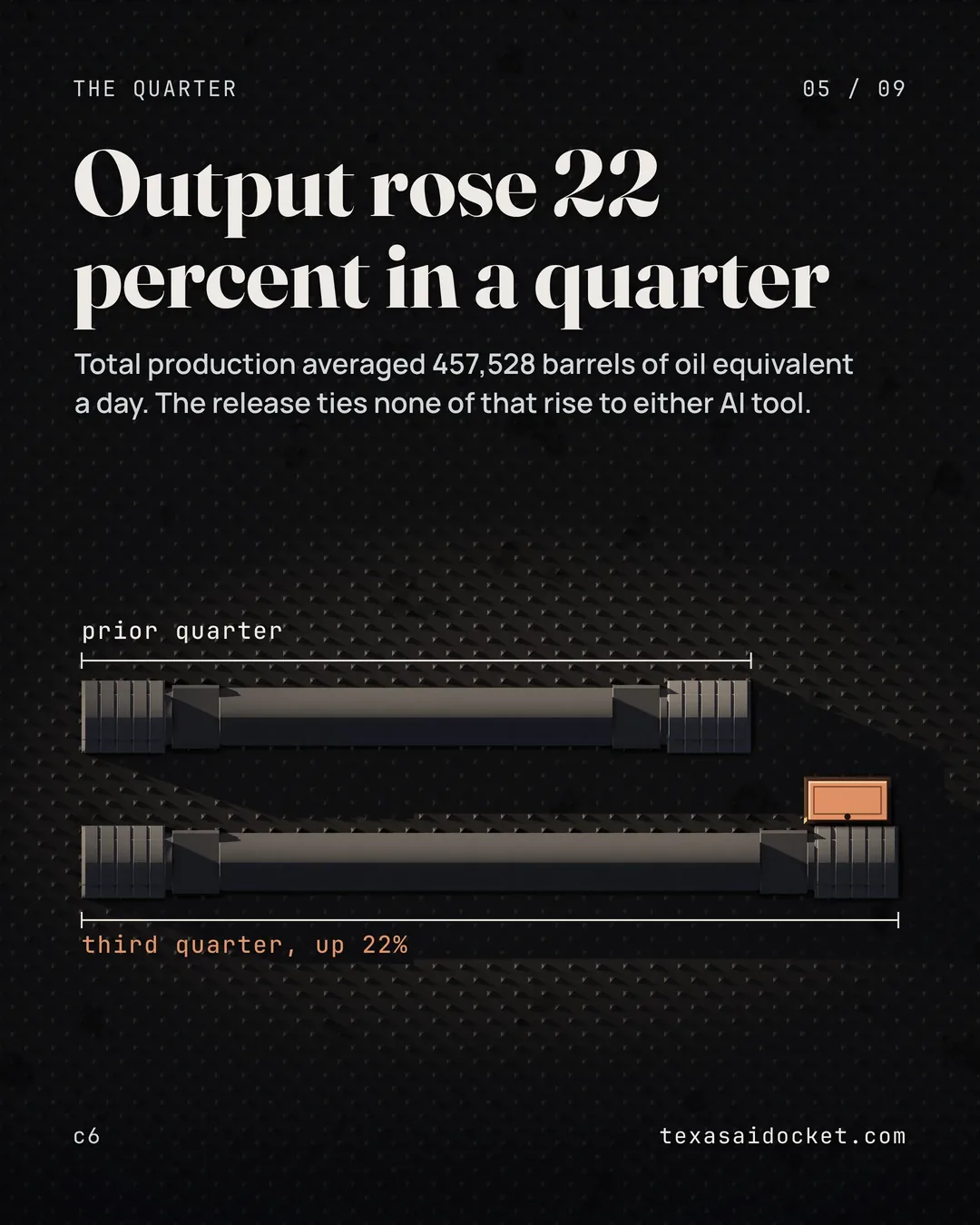
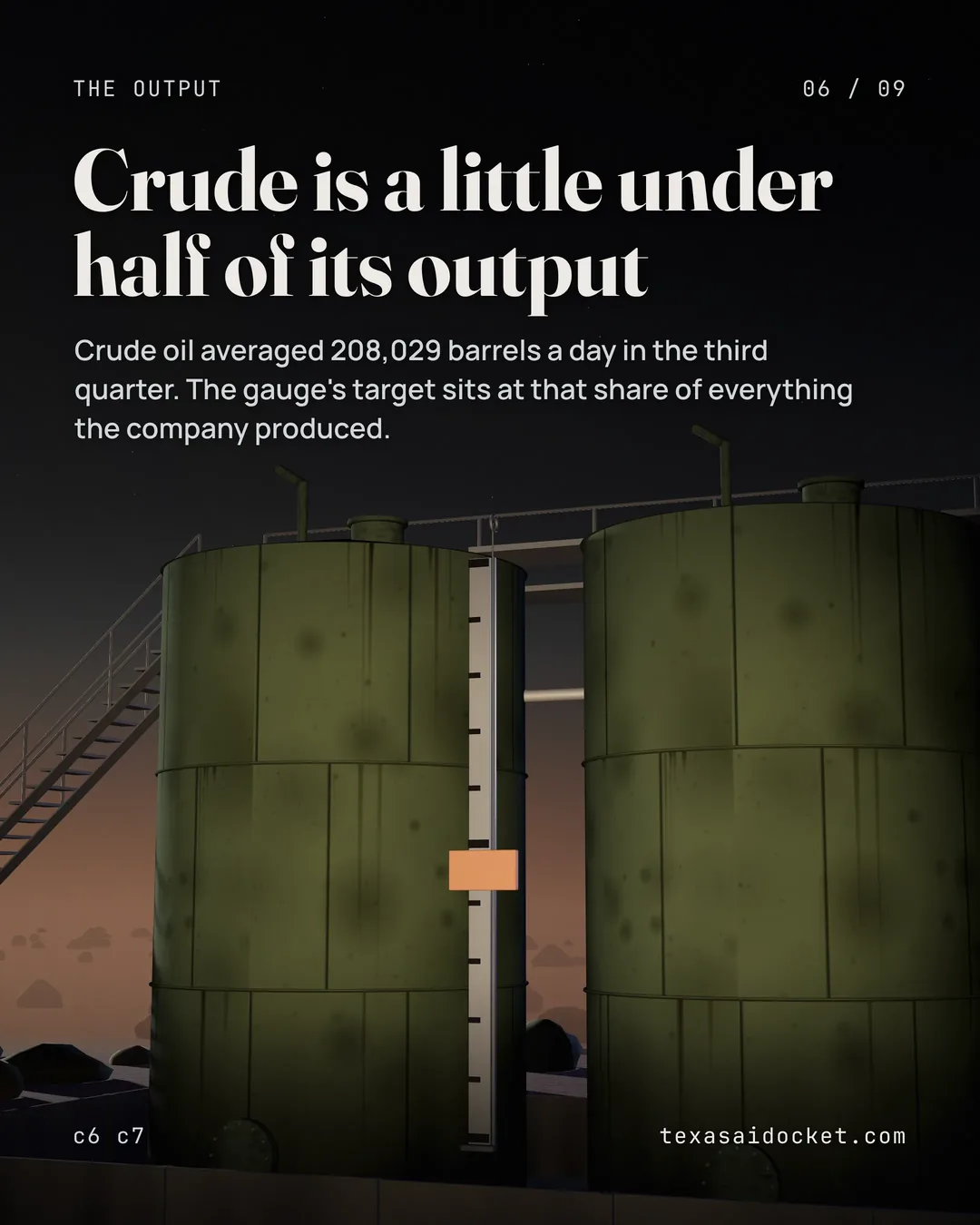
Total production averaged 457,528 barrels of oil equivalent per day, a 22% rise over the prior quarter. Average daily crude oil production was 208,029 barrels. Cash capital spending for the quarter was $518 million. The release ties none of the production rise to either AI tool.
It credits power and compression projects with lower costs and record runtimes. Its drilling team drilled the fastest well in company history during the quarter, averaging over 2,700 feet per day. Those are the operating results the release does attribute, and neither is attributed to AI.
Where in Texas
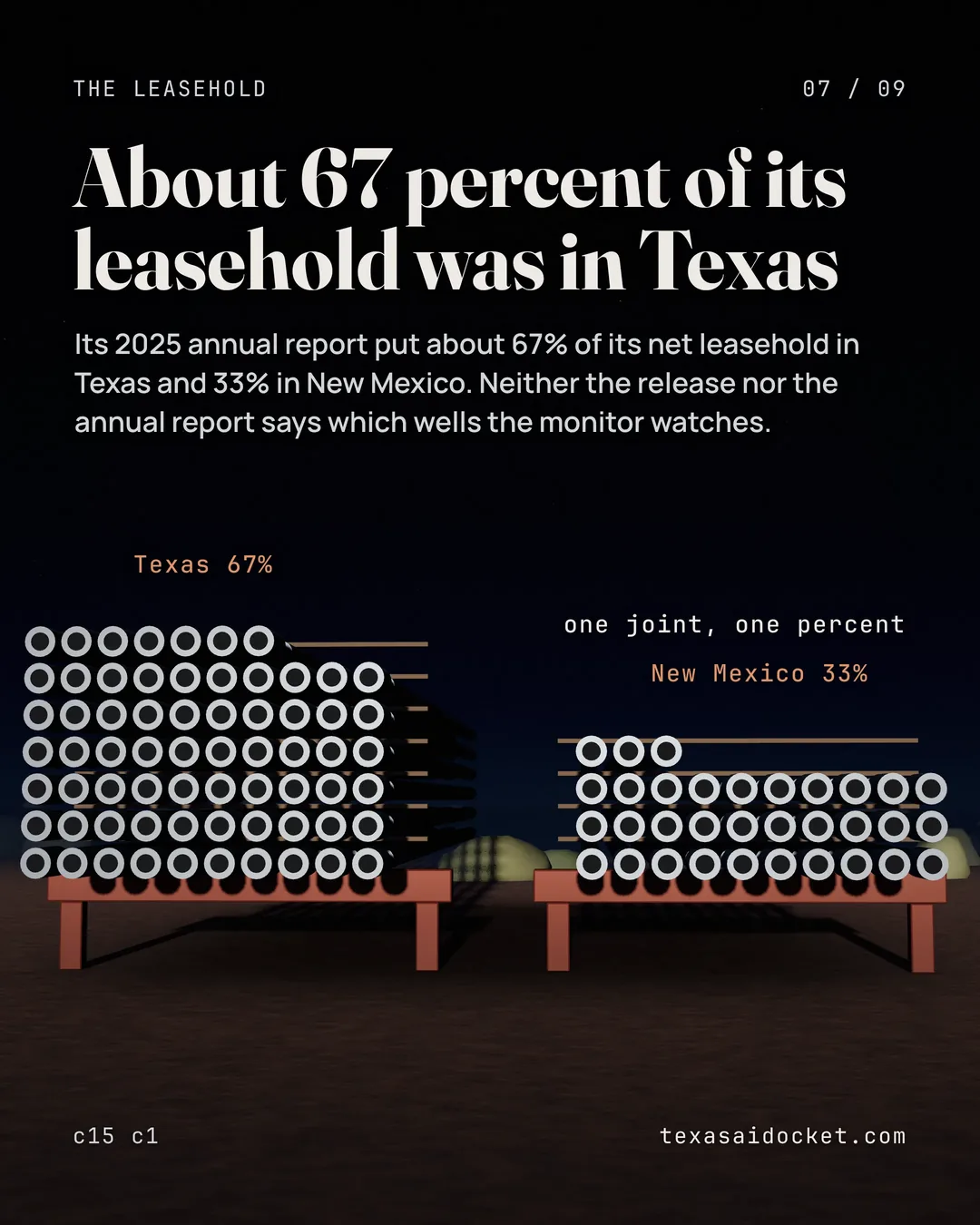
The company describes a position of approximately 560,000 net acres in West Texas and Southeast New Mexico, concentrated in the core of the Delaware Basin. Its 2025 annual report put about 67% of its net leasehold acreage in Texas and the remaining 33% in New Mexico.
The same report names drilling, completion and water connection activity in Reeves County, Texas, the one Texas county the filings tie to future field work. Neither the release nor the annual report says which wells the lift monitor watches or whether any of them are in Texas.
What the regulator said in May
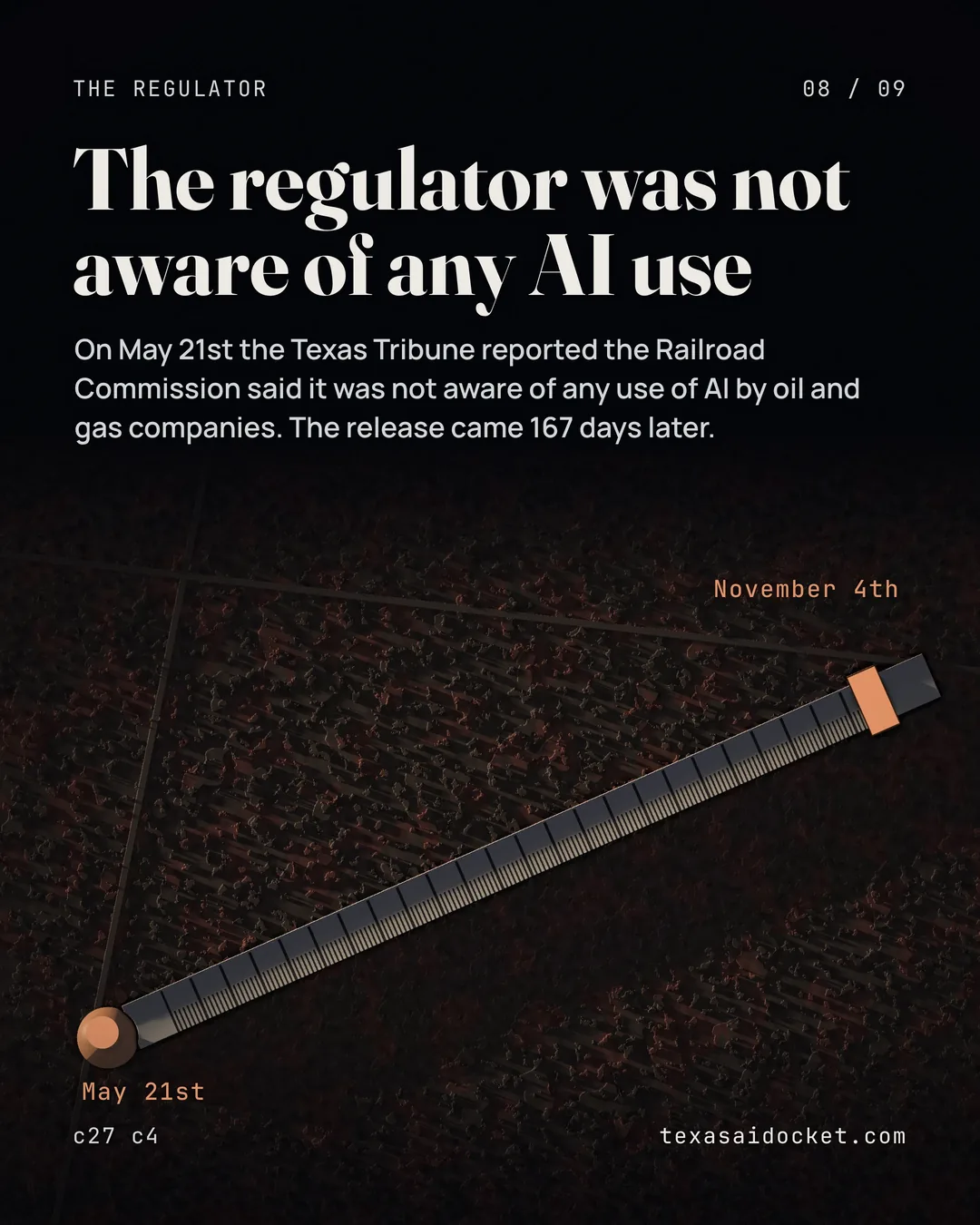
In May the Texas Tribune reported a statement from the Railroad Commission, the state's oil and gas regulator. The Commission said it was not aware of any use of AI by oil and gas companies. The same article reported experts and analysts saying AI is reshaping how oil companies handle produced water in the Permian. Permian Resources has now put two uses in a filing with the SEC. The Commission's statement is the last public position from it that this record has found.
What the release can't establish
Both AI statements are the company's own claims in a document written for investors. Its cautionary note lists technological advancement, including artificial intelligence and machine learning, among the factors in its outlook. The company treats the technology as an uncertainty as well as a tool. Who checks what the lift monitor finds, and whether it raised runtime at all, is not answered by anything the company has published.
The Railroad Commission has scheduled its next open meeting for November 17th, 2026. It is the next public session at which the Commission takes up business in the open.
Sources for this story
- Permian Resources, Third Quarter 2026 Results release
- Permian Resources, 2025 Annual Report on Form 10-K
- In the Permian Basin, AI takes on big oil's dirty water problem
- Railroad Commission of Texas, Office of General Counsel, Open Meetings
Claim-by-claim verification · 29 claims
Permian Resources says its Production Operations team has deployed an AI-powered artificial lift monitoring system meant to raise runtime and optimize well performance.
The Production Operations team has deployed an AI-powered artificial lift monitoring system to increase runtime and optimize well performance.
The company says it is feeding its own technical and subsurface data into large language models to guide development strategy, wellbore placement and drilling parameters in real time.
The Company is integrating its proprietary technical and subsurface data with large language models to improve development strategy, evaluate wellbore placement and optimize drilling parameters in real-time.
The release frames these tools as part of a broader claim that technology is improving the company's operations.
Additionally, technology continues to positively impact our operations.
Permian Resources issued its third quarter 2026 results release on November 4th, 2026.
November 4, 2026 (BUSINESS WIRE)
The same release names technological advancement, including artificial intelligence and machine learning, among the factors in its cautionary note on forward-looking statements.
technological advancement, including artificial intelligence, machine learning and its application in our industry
Permian Resources reported total third quarter production of 457,528 barrels of oil equivalent per day, up 22% from the prior quarter.
Total production was 457,528 barrels of oil equivalent per day (“Boe/d”), a 22% increase compared to the prior quarter.
Its average daily crude oil production in the third quarter was 208,029 barrels.
During the third quarter, average daily crude oil production was 208,029 barrels of oil per day
The company says its drilling team drilled its fastest well yet in the quarter at an average of over 2,700 feet per day.
Permian Resources’ Drilling team drilled the fastest well in Company history during the quarter, averaging over 2,700 feet per day.
Third quarter cash capital spending was $518 million.
Total cash capital expenditures for the third quarter were $518 million, in line with the prior quarter.
Permian Resources describes a position of about 560,000 net acres across West Texas and Southeast New Mexico.
Through its position of approximately 560,000 net acres in West Texas and Southeast New Mexico, Permian Resources is the second largest Permian Basin pure-play E&P.
The company says its assets are concentrated in the core of the Delaware Basin within the Permian.
The Company’s assets are located in the Permian Basin, with a concentration in the core of the Delaware Basin.
The company raised its 2026 oil production target to 202.5 MBbls/d at the midpoint of guidance.
Permian Resources increased its 2026 oil production target to 202.5 MBbls/d, based on the mid-point of guidance.
For the fourth quarter of 2026 the company expects oil production of over 210 MBbls/d.
For the fourth quarter of 2026, Permian Resources expects oil production of over 210 MBbls/d
The release says the company keeps buying acreage to build its core position on the New Mexico side of the Delaware Basin.
Permian Resources continues to enhance its core New Mexico Delaware Basin position through the addition of high-quality assets at attractive valuations.
In its 2025 annual report Permian Resources said about 67% of its net leasehold acreage was in Texas and 33% in New Mexico.
Approximately 67% of our net leasehold acreage is located in Texas and the remaining 33% is located in New Mexico.
The same annual report put the company at about 480,000 net leasehold acres and over 105,000 net royalty acres as of December 31st, 2025.
As of December 31, 2025, we have approximately 480,000 net leasehold acres and over 105,000 net royalty acres.
The annual report ties a development obligation to the company's future drilling, completion and water connection work in Reeves County, Texas.
drilling, completion and water connection activity in Reeves County, Texas
The release credits power and compression projects with lower costs and record runtimes.
optimization of power and compression projects, which delivered lower costs and record runtimes
ExxonMobil says its automated drilling technology could eliminate about one-third of high-consequence drilling incidents.
We believe this technology has the potential to eliminate roughly one-third of high-consequence drilling incidents.
ExxonMobil says it plans to automate more than half of its unconventional drilling fleet by the end of 2028.
with plans to automate more than half of our unconventional drilling fleet by year-end 2028
The ExxonMobil post points to demonstrations of robotic drilling technology from H&P under the FlexRobotics name.
Recent demonstrations of H&P's FlexRobotics
ExxonMobil says handling heavy drill pipe has long required workers on the rig floor.
Activities such as handling heavy drill pipe have historically required workers on the rig floor
ExxonMobil says it expects staffing on automated rigs to stay at similar levels.
We expect to maintain similar staffing levels on automated rigs
The post argues that automating rigs is not meant to replace workers.
Automation is not about replacing people.
ExxonMobil says automated rigs are one of more than 50 technologies it is deploying across its Permian operations.
Automated rigs are just one of more than 50 technologies being deployed across ExxonMobil's Permian operations
The post ties the push to a goal of about 2.5 million oil-equivalent barrels per day of Permian production by 2030.
increasing Permian production to approximately 2.5 million oil-equivalent barrels per day by 2030
The Texas Tribune reported in May on a statement from the Railroad Commission, the state's oil and gas regulator. The Commission said it was not aware of any oil and gas company using AI.
The Texas Railroad Commission, which regulates the state’s oil and gas, said in a statement that it is not aware of any use of AI by oil and gas companies.
The same Tribune article reported experts and analysts saying AI is changing how oil companies handle produced water in the Permian.
AI, experts and analysts said, is reshaping how oil companies handle the saltwater slush, also known as produced water
The Railroad Commission of Texas has scheduled its next open meeting for Tuesday, November 17th, 2026, at 9:30 a.m.
The Railroad Commission of Texas has scheduled an open meeting for November 17, 2026 (Tuesday) (all meetings are normally on Tuesday at 9:30 a.m. unless otherwise noted).