Articles · Research
64 Frontera CPU nodes, 8 Vista GPU nodes, almost the same speed by one lab's account
TACC retired Frontera in October. A UT Southwestern lab says a simulation that ran on 64 Frontera CPU nodes got almost the same speed on eight Vista GPU nodes.
Read the story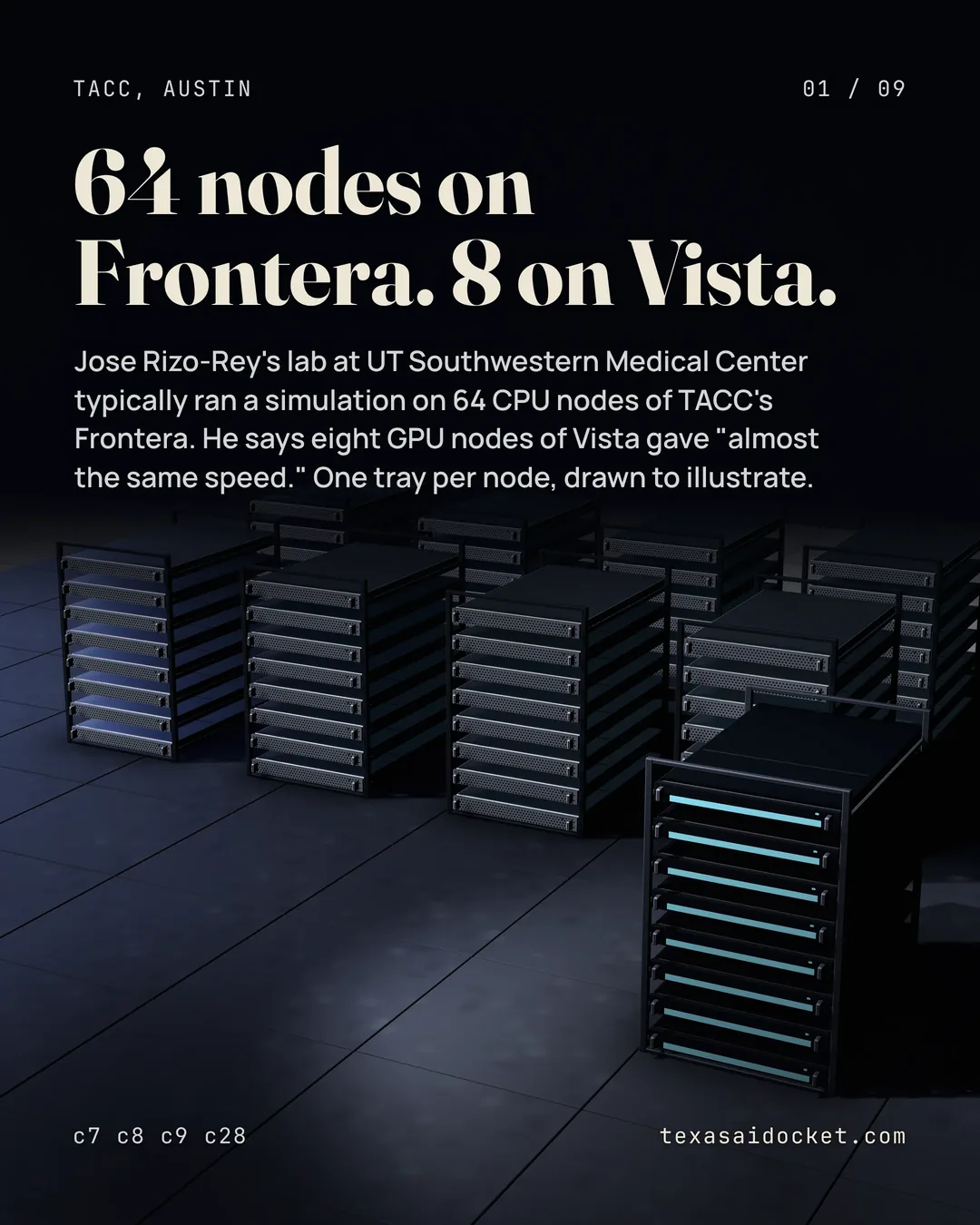
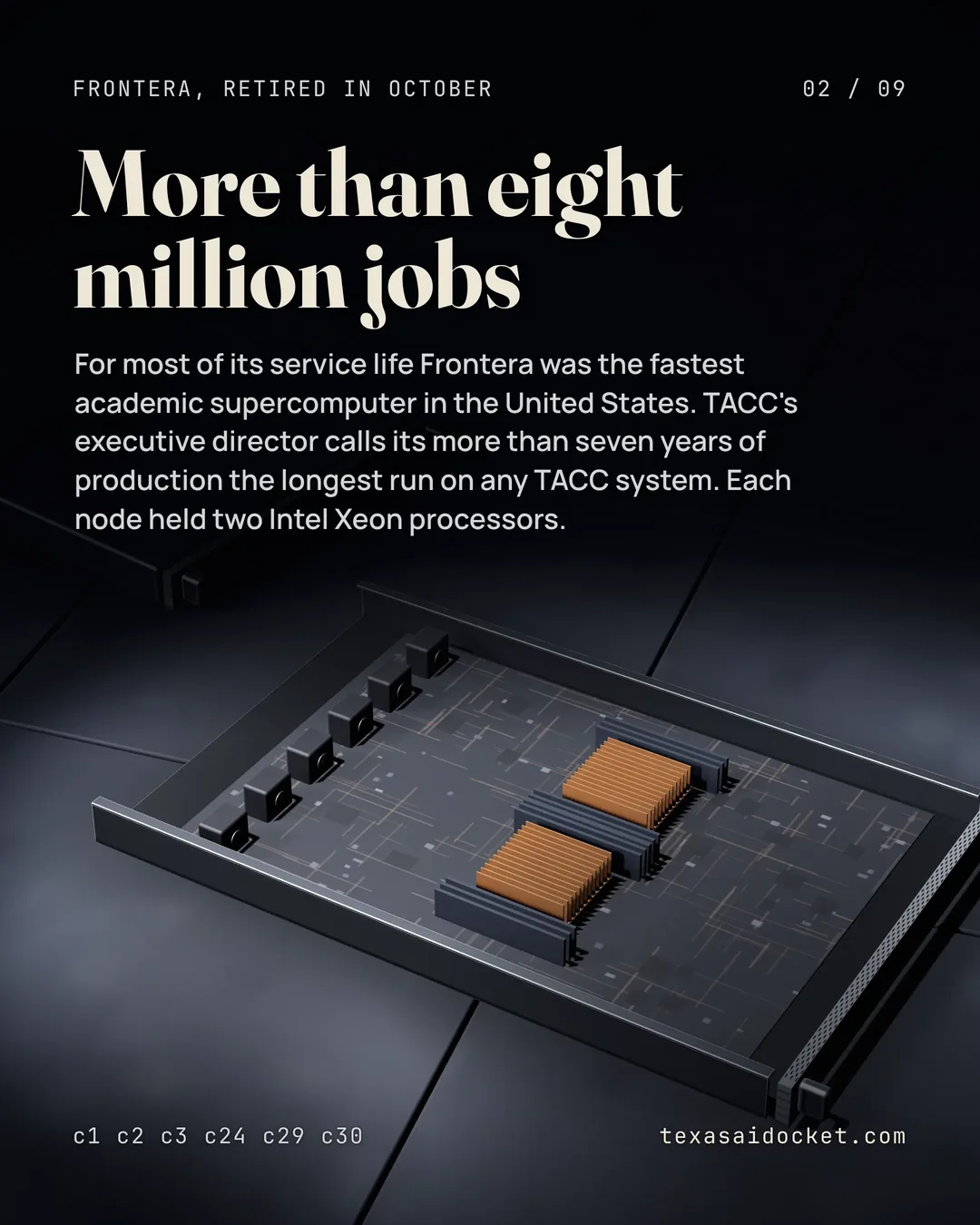


The Texas Advanced Computing Center at UT Austin retired Frontera in October 2026, after the machine had run more than eight million jobs. The center says that for most of its service life Frontera was the fastest academic supercomputer in the United States. Its executive director said its run of more than seven years was the longest of any TACC system.
The center gave that account in its report on a September symposium for Texas researchers, which drew a record turnout. One of the speakers was Jose Rizo-Rey of UT Southwestern Medical Center. His description of moving a large simulation onto newer hardware is the clearest measure the account offers of what the change means for a working lab.
Sixty four nodes, then eight
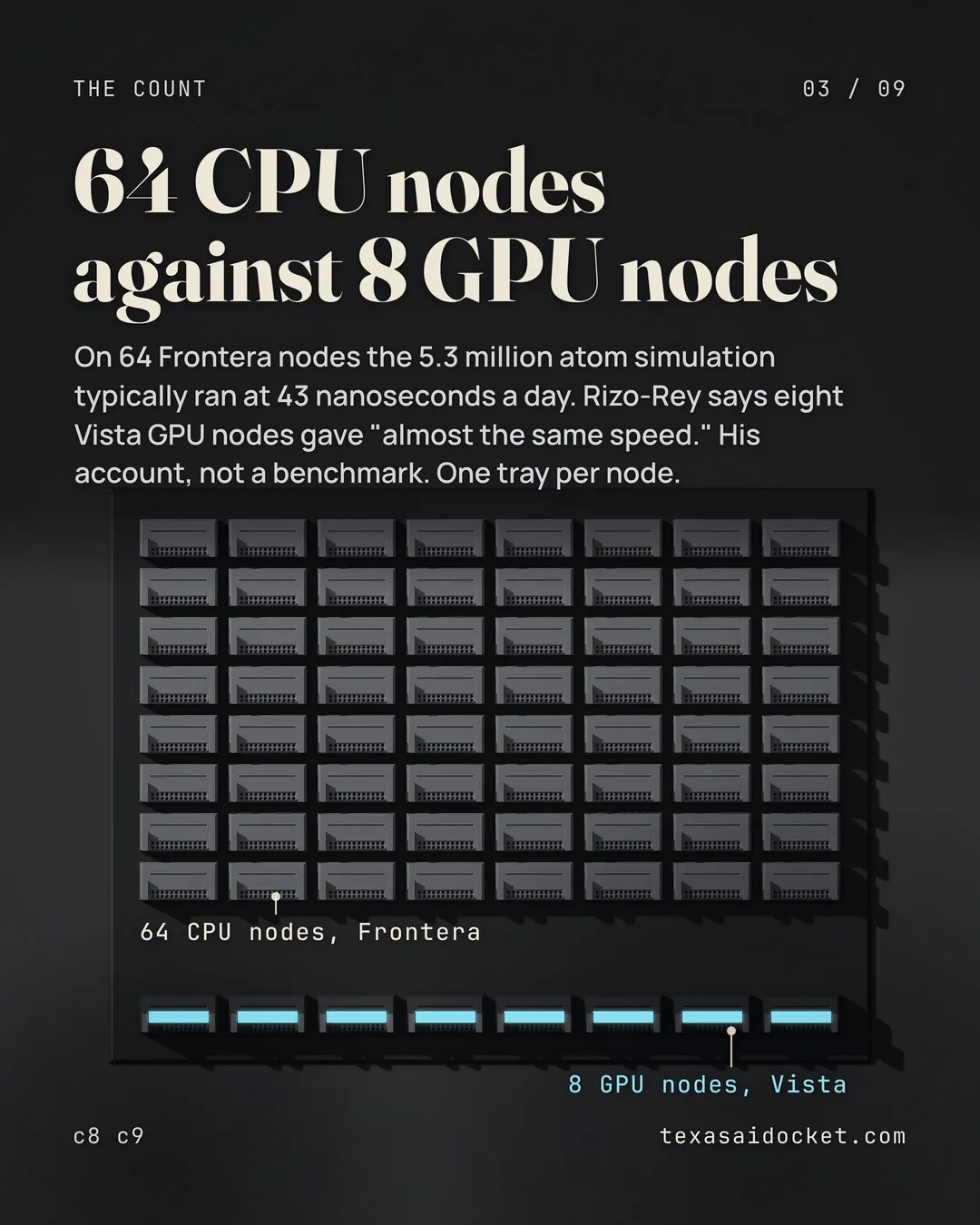
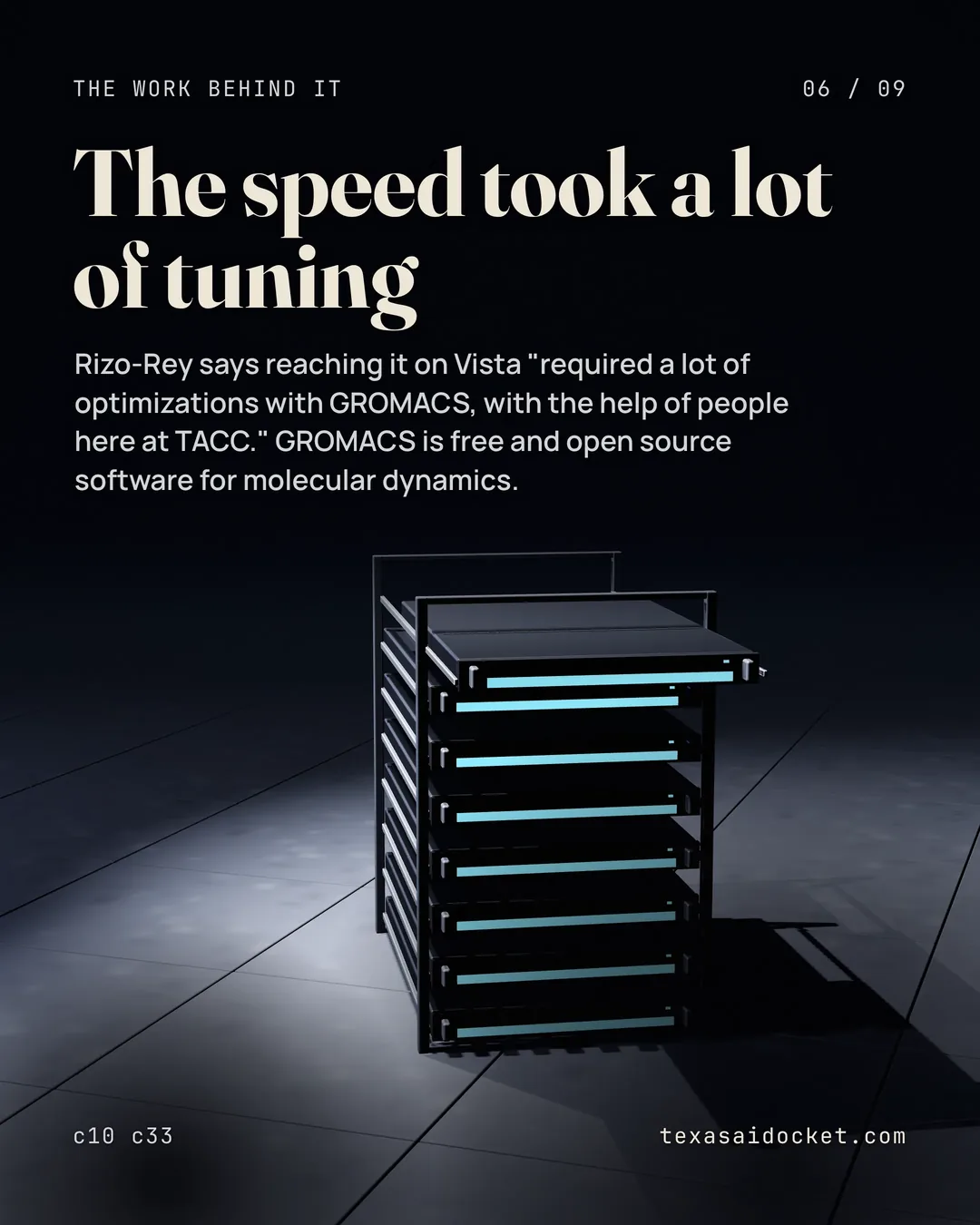
Rizo-Rey said his group typically ran a 5.3 million atom simulation on 64 CPU nodes of Frontera at 43 nanoseconds of simulated time per day. On TACC's Vista system, he said, eight GPU nodes gave him almost the same speed.
He said getting there took a lot of optimization of GROMACS, with help from TACC staff. GROMACS describes itself as free and open source software for high performance molecular dynamics. The comparison is his own spoken account in the center's release. It is not a published benchmark, and the release gives no simulated time per day for Vista.
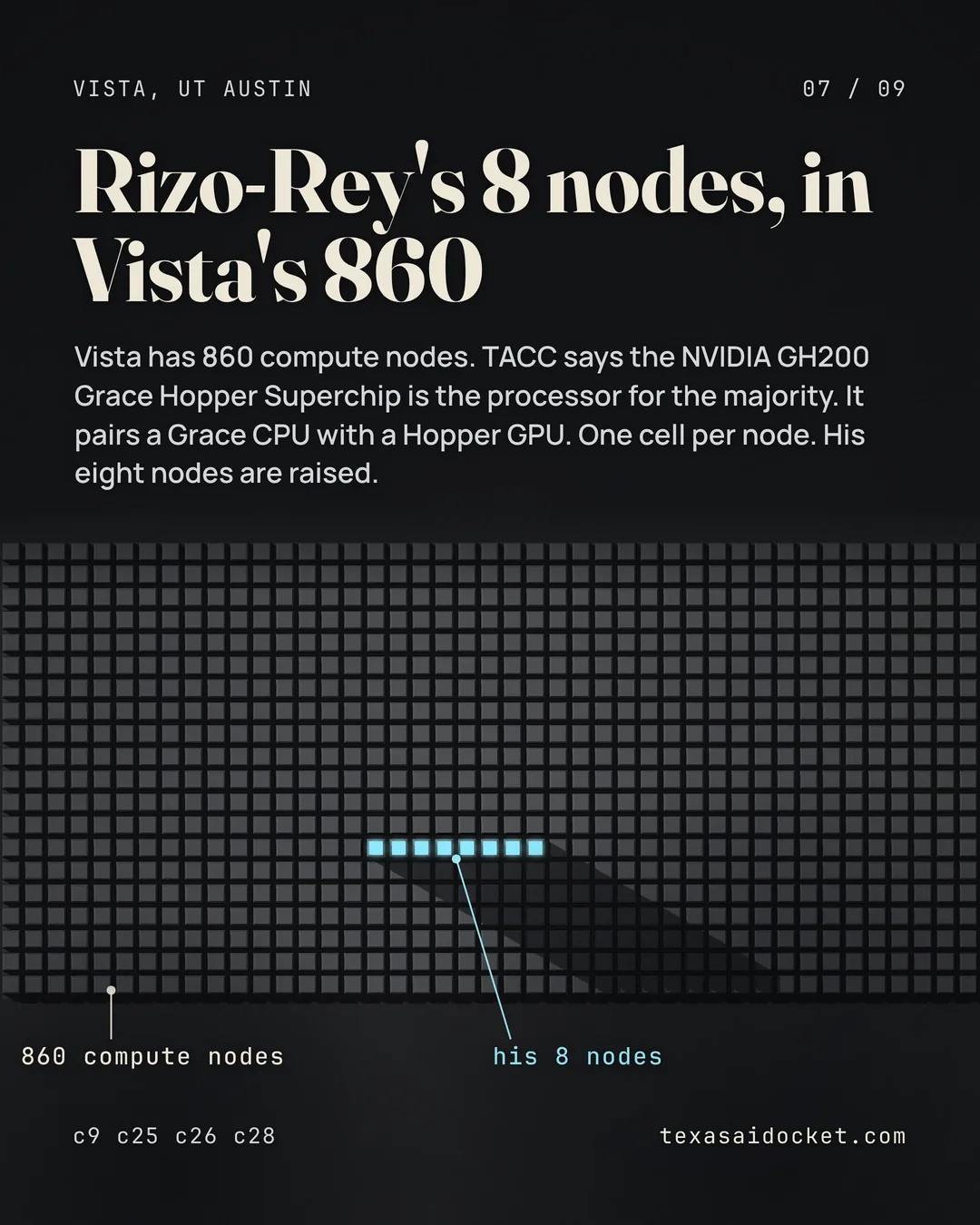
TACC has said the NVIDIA GH200 Grace Hopper Superchip is the processor for the majority of Vista's 860 compute nodes. The chip pairs a Grace CPU with a Hopper GPU. Each Frontera node, by TACC's description of its expansion, held two Intel Xeon Platinum 8280 processors.
What the simulation holds
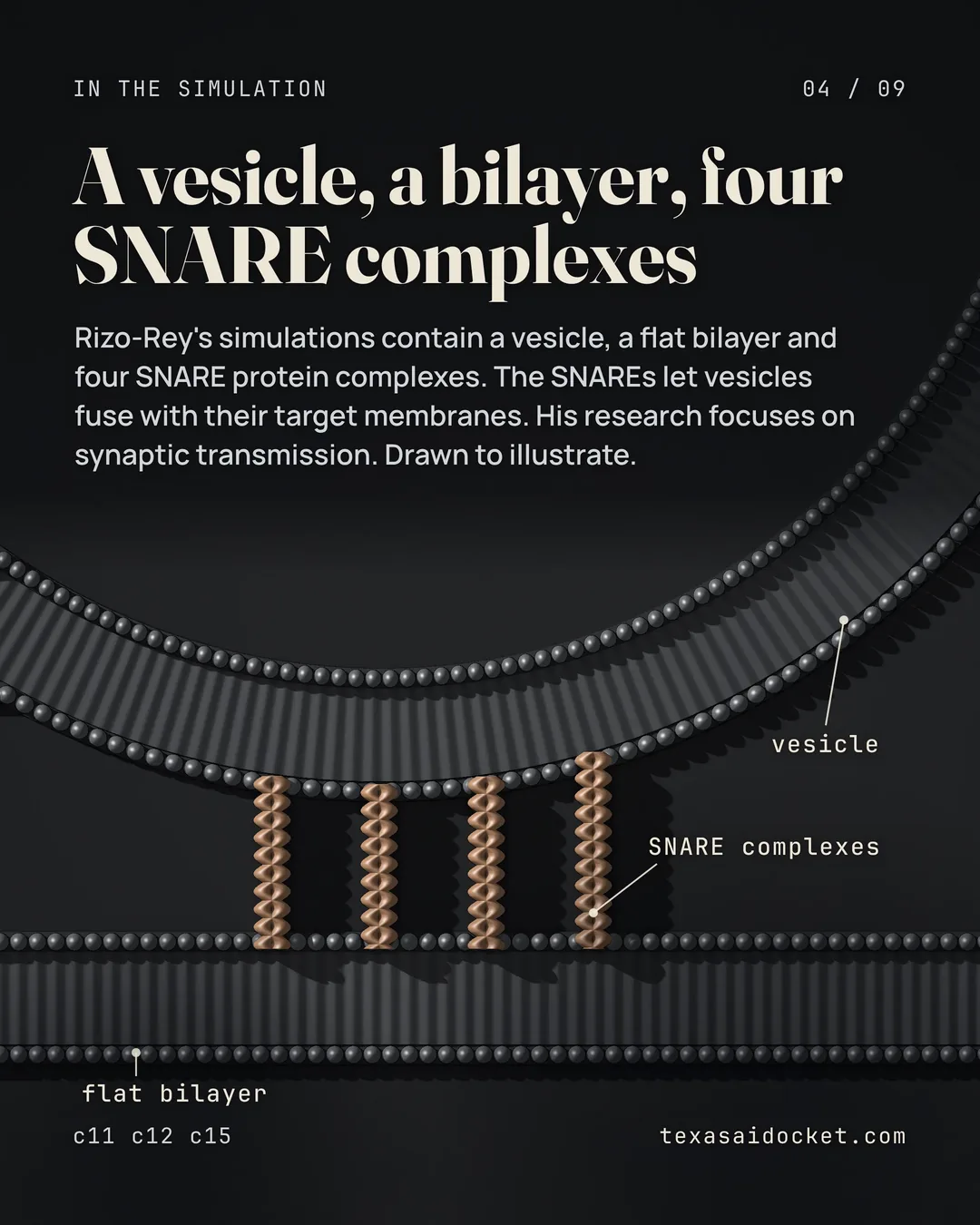
Rizo-Rey studies synaptic transmission. His simulations contain a vesicle, a flat bilayer and four SNARE protein complexes, the proteins that let vesicles fuse with their target membranes.
The key concept the simulations and analysis point to is that the SNAREs act as a local detergent. In that model they catalyze the mixing of the hydrophobic interiors of the two membranes. The account does not say whether that finding has been published in a journal, and it gives no figures for how the simulated fusion compares with experiments.
What comes after Frontera
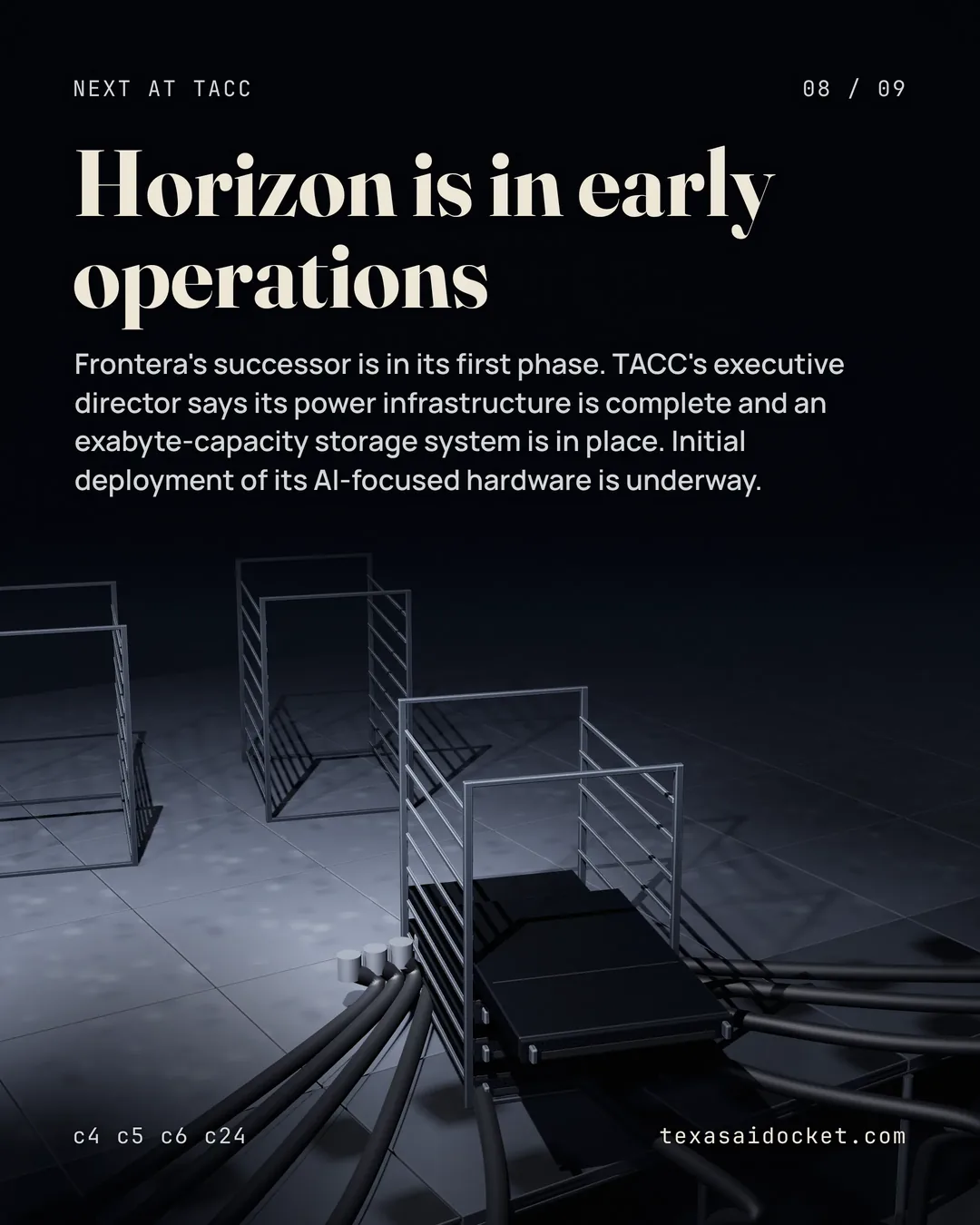
Frontera's successor, Horizon, the centerpiece of the NSF Leadership-Class Computing Facility, has entered its first phase of early operations. The center's executive director said its power infrastructure is complete and an exabyte capacity storage system is in place. The initial deployment of its AI focused hardware is under way.
A researcher from the Oden Institute who had early access said Horizon is entering full production soon. The account gives no date for full production and no figure for how many of Vista's or Horizon's nodes researchers can expect to use. More than 130,000 U.S. researchers have used TACC's systems since 2001,.
Sources for this story
Claim-by-claim verification · 34 claims
Frontera was retired in October 2026 after it had run more than eight million jobs.
Frontera was retired in October 2026, having surpassed eight million jobs.
Stanzione said Frontera had more than seven years of production life, which he called the longest run on any TACC system.
Frontera had over seven years of production life, which is the longest run on any TACC system,
For most of its service life Frontera was the fastest academic supercomputer in the United States.
For most of its service life, TACC’s Frontera supercomputer was the fastest academic supercomputer in the United States,
Horizon, the centerpiece system of NSF LCCF and the successor to Frontera, has entered its first phase of early operations.
As TACC retires Frontera, its successor, Horizon, the centerpiece system of NSF LCCF has entered its first phase of early operations
Stanzione announced that Horizon's power infrastructure is complete and that an exabyte-capacity storage system is in place.
Stanzione announced that the power infrastructure is complete, an exabyte-capacity storage system is in place,
The initial deployment of Horizon's AI-focused hardware is underway.
and the initial deployment of Horizon’s AI-focused hardware is underway.
Jose Rizo-Rey works at UT Southwestern Medical Center.
Chess fascinates Jose Rizo-Rey of UT Southwestern Medical Center
Rizo-Rey said his group typically ran a simulation of a 5.3 million-atom system on 64 CPU nodes of Frontera at 43 nanoseconds per day.
Typically, we’d run a simulation of a 5.3 million-atom system on 64 CPU nodes of Frontera for 43 nanoseconds per day,
In his own spoken account Rizo-Rey said eight GPU nodes on TACC's Vista system gave him almost the same speed. The comparison is his account and not a measured benchmark.
But now with TACC’s Vista system, using just eight GPU nodes, I got almost the same speed.
Rizo-Rey said reaching that speed on Vista took a lot of GROMACS optimization with help from TACC staff.
That required a lot of optimizations with GROMACS, with the help of people here at TACC.
Rizo-Rey's simulations contain a vesicle, a flat bilayer and four SNARE protein complexes.
He has been running simulations with a vesicle, flat bilayer, and four SNARE protein complexes
SNARE protein complexes allow vesicles to fuse with their target membranes.
four SNARE protein complexes, which allow vesicles to fuse with their target membranes.
The key concept uncovered by simulation and analysis is that the SNAREs act as a local detergent.
The key concept uncovered by simulation and analysis is the SNAREs act as a local detergent
In that model the SNAREs catalyze the mixing of the hydrophobic interiors of the two membranes.
catalyzes the mixing of hydrophobic interiors of the two membranes
Rizo-Rey's research focuses on understanding synaptic transmission.
His research focuses on understanding synaptic transmission
Rizo-Rey determines three dimensional structures at atomic resolution.
Rizo-Rey solves three dimensional structures at atomic resolution
His structural work draws on data from NMR spectroscopy, electron microscopy and X-ray crystallography.
using data from NMR spectroscopy, electron microscopy, and X-ray crystallography.
More than 200 scientists, researchers and students from 30 universities, high schools and industry around the state gathered at TACC for the symposium.
More than 200 scientists, researchers, and students from 30 universities, high schools, and industry around the state
The September symposium drew a record turnout.
in September, a record turnout.
Stefan Henneking, an invited speaker, is with the Oden Institute for Computational Engineering and Sciences.
Invited speaker Stefan Henneking of the Oden Institute for Computational Engineering and Sciences
Henneking said his team got early access to Horizon thanks to TACC.
Thanks to TACC, we got early access to Horizon, where both our MFEM-based wave propagation solver
Henneking described Horizon as entering full production soon.
With Horizon entering full production soon, it’s going to be an exciting time for academic research
Since 2001 more than 130,000 U.S. researchers have used TACC's systems.
since 2001, more than 130,000 U.S. researchers have used the center’s systems,
TACC Executive Director Dan Stanzione said in his state-of-the-center address that TACC turned 25 in June.
TACC turned 25 in June of this year,
TACC said the NVIDIA GH200 Grace Hopper Superchip is the processor for the majority of Vista's 860 compute nodes.
The NVIDIA GH200 Grace Hopper Superchip is the processor for a the majority of Vista’s 860 compute nodes.
The GH200 pairs an NVIDIA Grace CPU with an NVIDIA Hopper architecture GPU.
It combines the NVIDIA Grace CPU with an NVIDIA Hopper architecture-based GPU
Vista's other nodes use the NVIDIA Grace CPU Superchip, which TACC describes as two Grace CPUs in a single module.
The NVIDIA Grace CPU Superchip, which contains two Grace CPUs in a single module,
TACC said Vista would arrive at the Texas Advanced Computing Center at The University of Texas at Austin in early 2024.
is arriving at the Texas Advanced Computing Center (TACC) at The University of Texas at Austin in early 2024
A TACC release on Frontera's expansion put Frontera's existing compute nodes at 8,008.
the same configuration as Frontera’s existing 8,008 compute nodes
Each node in Frontera's expansion holds two Intel Xeon Platinum 8280 processors and 192GB of DDR-4 memory, which TACC called the same configuration as the existing compute nodes.
Each node contains two Intel Xeon Platinum 8280 (“Cascade Lake”) processors and 192GB of DDR-4 memory
An expansion added 396 Dell R640 server nodes to Frontera, housed in 11 racks.
The expansion adds 396 Dell R640 server nodes, housed in 11 racks
TOP500 lists Frontera's processor as Xeon Platinum 8280 28C 2.7GHz.
Xeon Platinum 8280 28C 2.7GHz
The GROMACS project's own site describes it as free and open-source software for high-performance molecular dynamics.
A free and open-source software suite for high-performance molecular dynamics and output analysis.
Rizo-Rey said the concept is what his lab calls the local detergent model of membrane fusion.
This is what we call the local detergent model of membrane fusion