Articles · Research
East Texas A&M researchers in Commerce tested AI that checks a drone's location against its own motion sensors, on 96 recorded flights with the in flight test still to come
East Texas A&M researchers in Commerce tested AI that flags a drone fed false GPS by reading only its own motion. Every flight they used was a recording.
Read the story
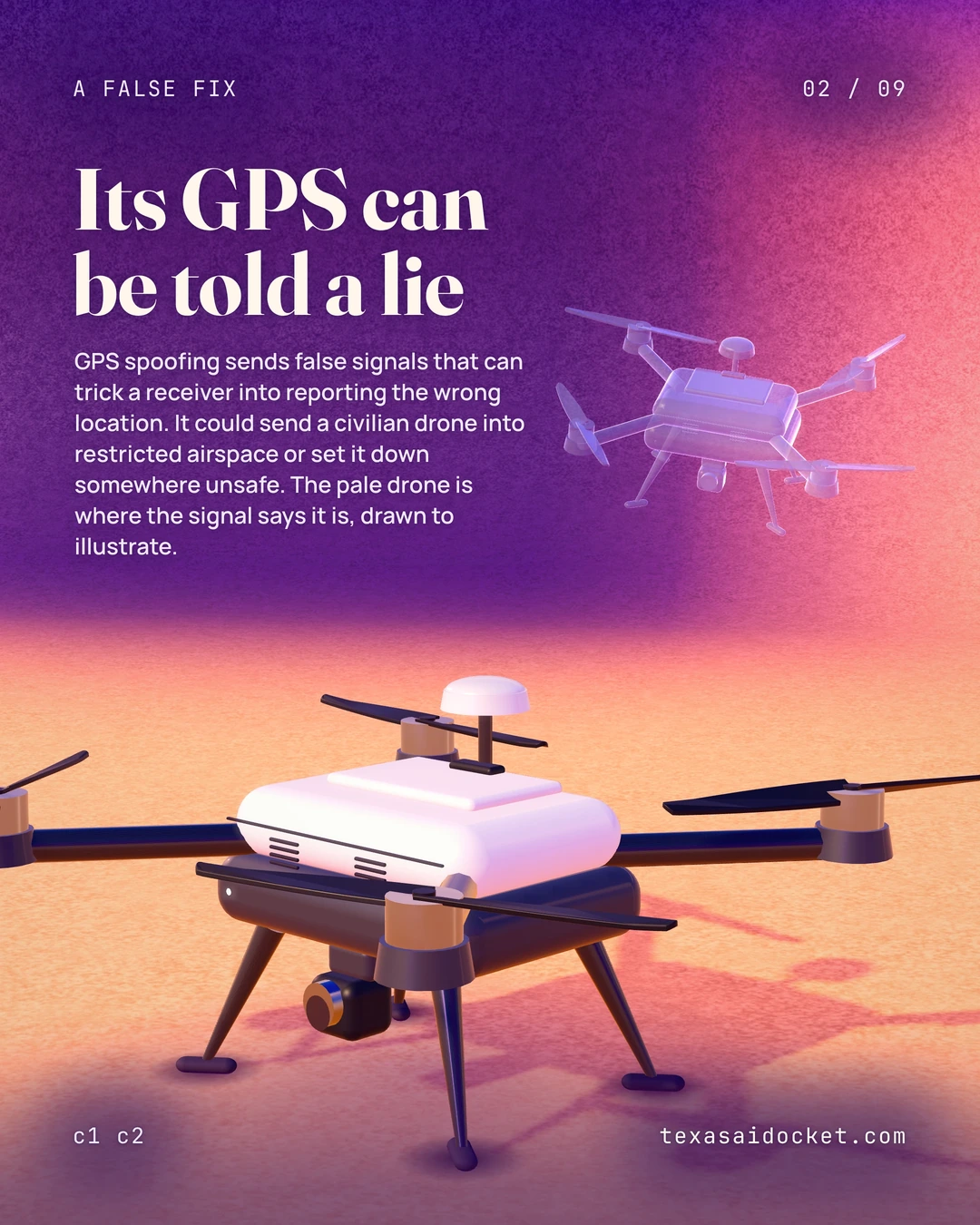




GPS spoofing sends false signals that can trick a receiver into reporting the wrong location. The same trick could send a civilian drone into restricted airspace or set it down somewhere unsafe. A drone pushed off course could miss a threat it was sent to spot, endanger other aircraft or crash near people on the ground.
Researchers at East Texas A&M University tested whether artificial intelligence can spot false location information in a drone's flight records. The university is in Commerce, and the work is led by Jinoh Kim, a professor of computer science and information systems.
Reading motion, not GPS
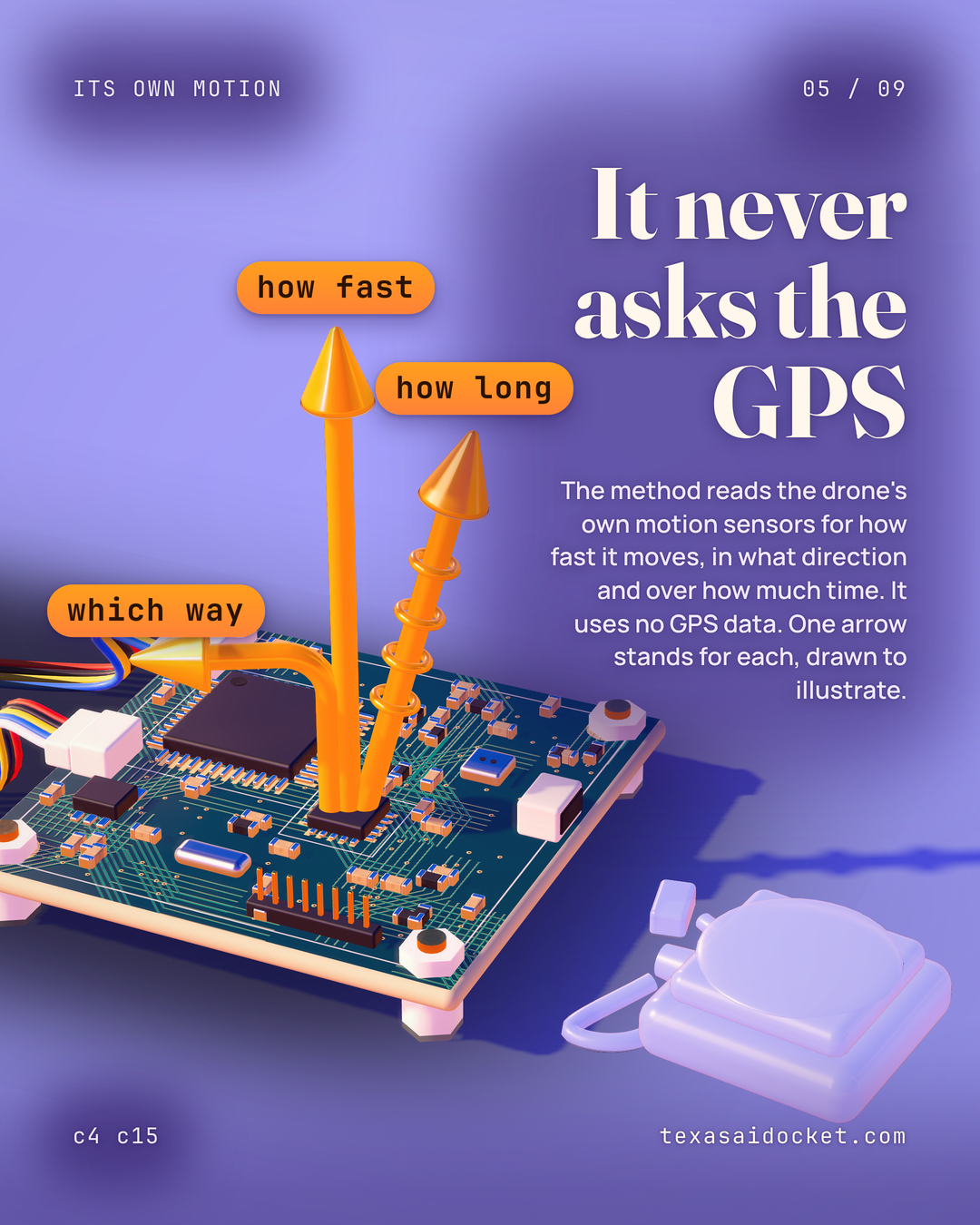
The method reads the drone's onboard motion sensors and looks for inconsistencies in how the aircraft appears to move. Kim said the team refers to no GPS attributes. It looks at how fast the drone moves, in what direction and over how much time.
The release's own example is a search drone sent to sweep a ridge that a false signal sends into the next valley. It is a hypothetical rather than a Texas incident.
The flights and the test
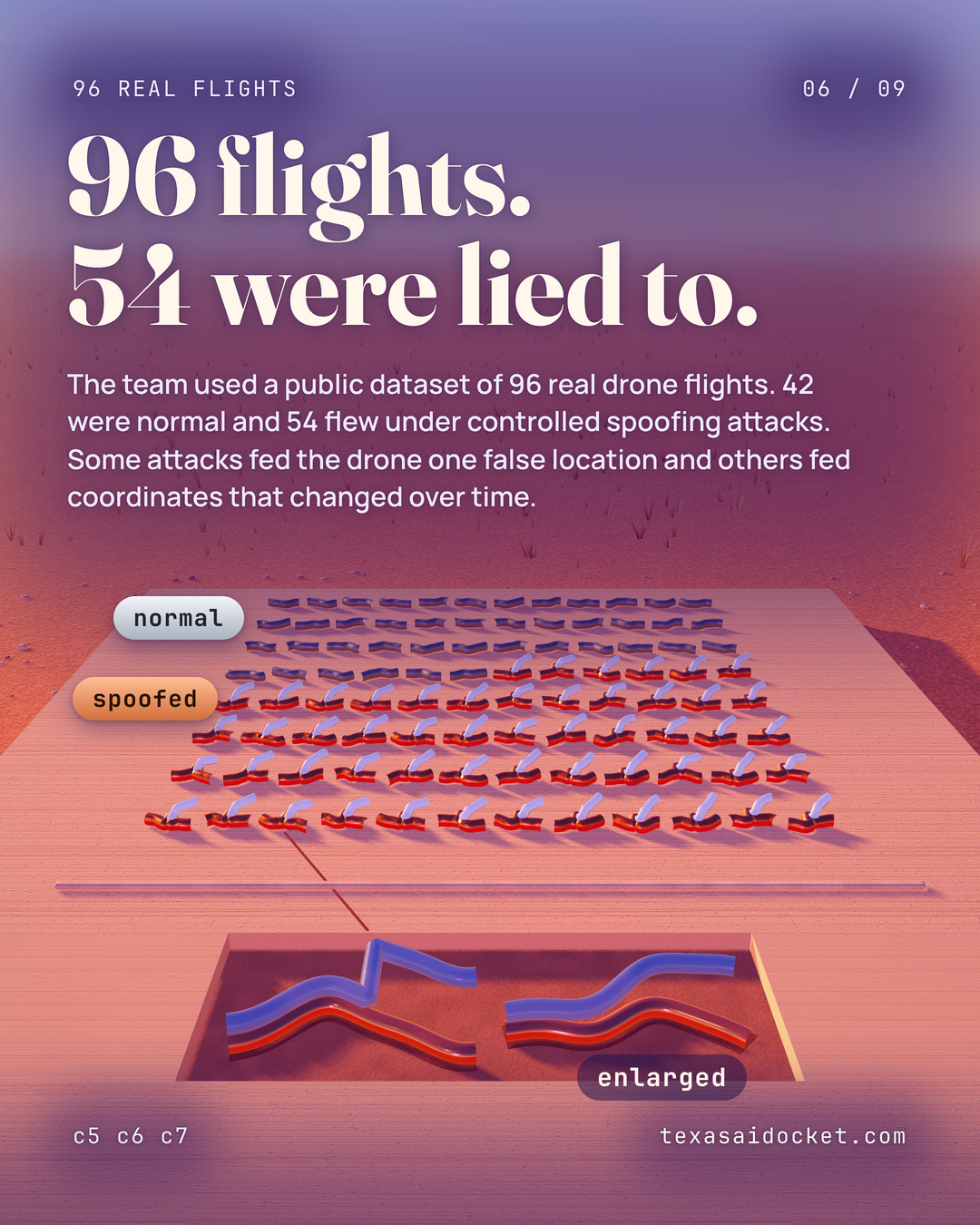
The team used a public dataset of 96 real drone flights. Of those, 42 were normal and 54 flew under controlled spoofing attacks. Some attacks fed the drone one false location. Others fed it coordinates that changed over time.
The team set aside 22 whole flights for testing, so each model was judged on flights it had not seen in training. Eight AI models were compared, and a part of the system sorts short stretches of flight data as normal or abnormal.
Given 10 consecutive readings, a model called Chronos scored 97.5% on a measure that balances how many abnormal stretches it catches against how often its alerts are right. That figure is one score on one measure for one model. It is not a share of attacks caught. The best performers had already learned to read numerical data collected over time, which Kim called a surprise. The release reports no score for the other models.
What the study can't yet show
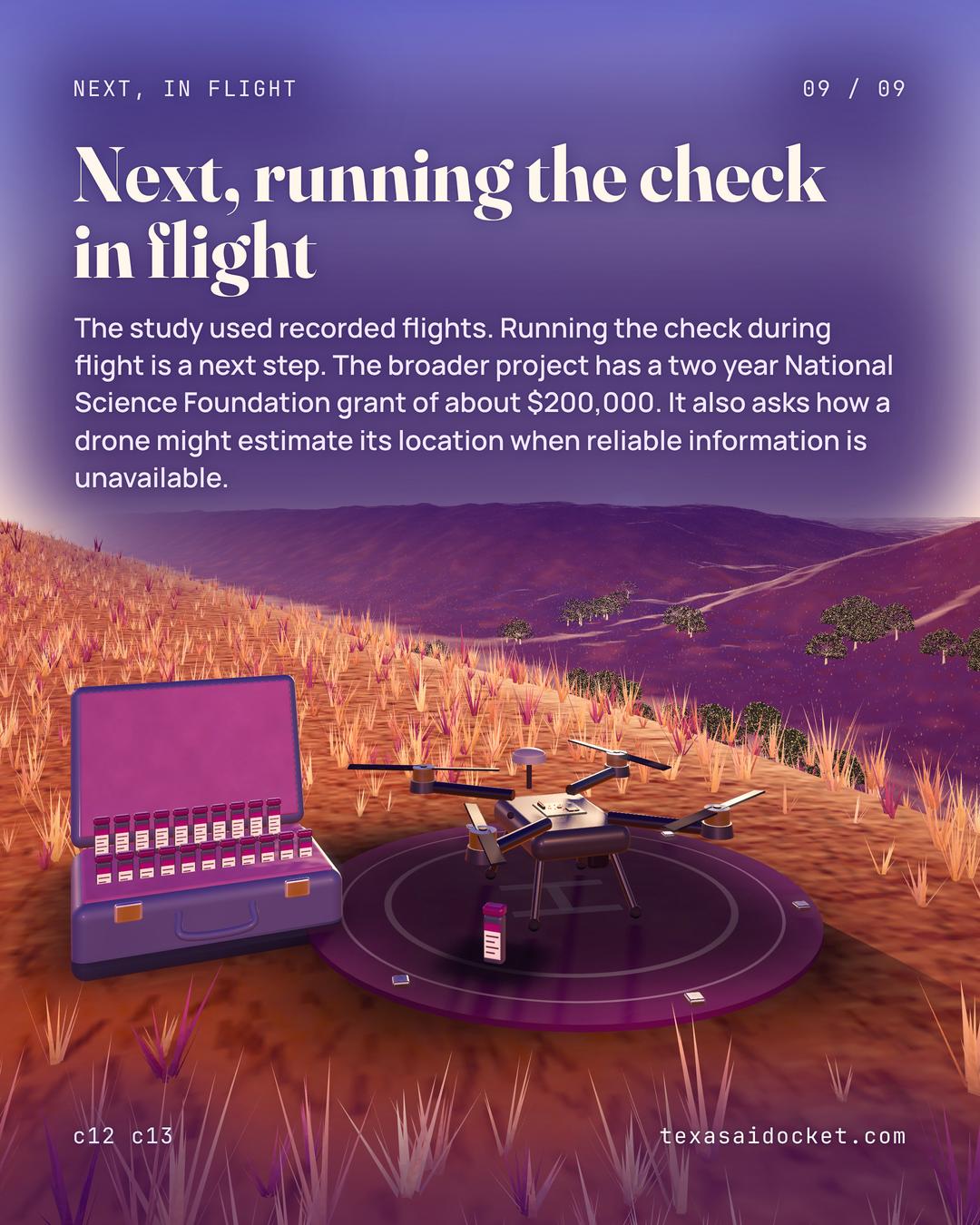
The study evaluated recorded flights. Running the check during flight is the next step. Nothing in the release shows the check working on a drone in the air.
The broader project has a two year National Science Foundation grant of about $200,000. The paper's first author is Iyanuoluwa Alegbeleye, an undergraduate computer science student, and the team includes two undergraduate and two graduate research assistants. The study was accepted at WATCH 2026, a peer reviewed workshop held beside a computer and communications security conference in The Hague.
Sources for this story
- East Texas A&M University, Researchers Test AI to Detect GPS Spoofing in Drones, November 16th, 2026
Claim-by-claim verification · 26 claims
GPS spoofing sends false signals that can trick a receiver into reporting the wrong location.
GPS spoofing involves transmitting false signals that can trick a receiver into reporting the wrong location.
Spoofing could send a civilian drone into restricted airspace or set it down somewhere unsafe.
The same tactic could send a civilian drone into restricted airspace or cause it to land in an unsafe area.
The study was accepted at WATCH 2026. That peer reviewed workshop sits beside the ACM Conference on Computer and Communications Security in The Hague. The study tested whether AI could spot false location information in a drone's flight records.
In a study accepted for presentation at WATCH 2026, a peer-reviewed workshop held alongside the Association for Computing Machinery's Conference on Computer and Communications Security in The Hague, Netherlands, researchers tested whether artificial intelligence could spot signs of false location information in a drone's flight records.
The method reads the drone's onboard motion sensors and looks for inconsistencies in how the aircraft appears to move.
A drone's onboard motion sensors provide information the researchers can use to look for inconsistencies in how the aircraft appears to move.
The team tested the approach on a public dataset of 96 real drone flights.
The researchers tested their approach using a public dataset from 96 actual drone flights.
Of those flights, 42 were normal and 54 flew under controlled spoofing attacks.
Of those, 42 were normal and 54 were conducted under controlled spoofing attacks.
Some attacks fed the drone one false location. Others fed it false coordinates that changed over time.
Some attacks fed the drone a single false location; others fed it false coordinates that changed over time.
The team held back 22 whole flights for testing so each model was judged on flights it had not seen in training.
The team set aside 22 entire flights for testing so the models would be evaluated on flights they hadn't encountered during training.
The researchers compared eight AI models. Some were trained from scratch on flight records and some came with prior training.
The researchers compared eight AI models, including models trained from scratch on flight records and models that came with prior training.
The best performing models had already learned to read numerical data collected over time.
The best performers had already learned to recognize patterns in numerical data collected over time.
Given 10 consecutive readings a model called Chronos scored 97.5% on a measure that balances how many abnormal stretches it catches against how often its alerts are right.
Given 10 consecutive readings, a model called Chronos scored 97.5% on a measure that balances how many abnormal sequences it catches against how often its alerts are correct.
The study used recorded flights. Running the check during flight is the next step.
The study evaluated recorded flights. Running the checks during flight is a next step.
The broader project has a two year National Science Foundation grant of about $200,000. It also explores how a drone might estimate its location when reliable information is unavailable.
The broader project, supported by a two-year National Science Foundation grant of about $200,000, also explores how a drone might estimate its location when reliable information is unavailable.
The university is in Commerce, Texas.
2600 W. Neal St., Commerce, Texas 75428
Kim says the method uses no GPS attributes. It looks at how fast the drone moves, in what direction and over how much time.
We don't refer to any GPS-related attributes,” Kim said. “Instead, we look at how fast the drone moves, in what direction and over how much time to spot signs that its reported location may be wrong.
Jinoh Kim is a professor in the university's Department of Computer Science and Information Systems.
a professor in ETAMU's Department of Computer Science and Information Systems
The study was funded by National Science Foundation Award No. 2502117.
funded by National Science Foundation Award No. 2502117
In the release's own example, a false GPS signal sends a search drone into the next valley instead of the ridge it was meant to sweep.
The drone is supposed to sweep a ridge, but a false GPS signal makes it think it's somewhere else. It adjusts course based on that bad information and flies into the next valley.
In a conflict, spoofing could steer an opposing drone away from the area it was sent to watch.
In a conflict, someone might use spoofing to steer an opposing drone away from the area it was sent to monitor.
A drone pushed off course could miss a threat, endanger other aircraft or crash near people.
A drone sent off course could miss a threat it was sent to spot, endanger other aircraft or crash near people on the ground.
Kim called it a surprise that the pretrained models worked better.
But surprisingly, pretrained models are working better,
The paper's first author is Iyanuoluwa Alegbeleye, an undergraduate computer science student and research assistant.
an undergraduate computer science student and research assistant at ETAMU, is the paper's first author.
Kim's project team includes two undergraduate and two graduate research assistants.
the project team led by Kim includes two undergraduate and two graduate research assistants
The team used flight records to train a part of the system that sorts short stretches of flight data as normal or abnormal.
The team used flight records to train a separate part of the system to sort short stretches of flight data into two categories: normal or abnormal.
The workshop met in The Hague on November 15th.
The Hague, The Netherlands (November 15, 2026)
Chronos was introduced by its authors as a framework for pretrained probabilistic time series models.
We introduce Chronos, a simple yet effective framework for pretrained probabilistic time series models.