Articles · Health and education
UTMB Health adds AI to lung nodule review. About two thirds of its program's nodules came outside screening
UTMB Health uses AI to review lung cancer screening reports and help spot nodules found by chance. UTMB says about two thirds of its program's nodules came from patients not being screened.
Read the story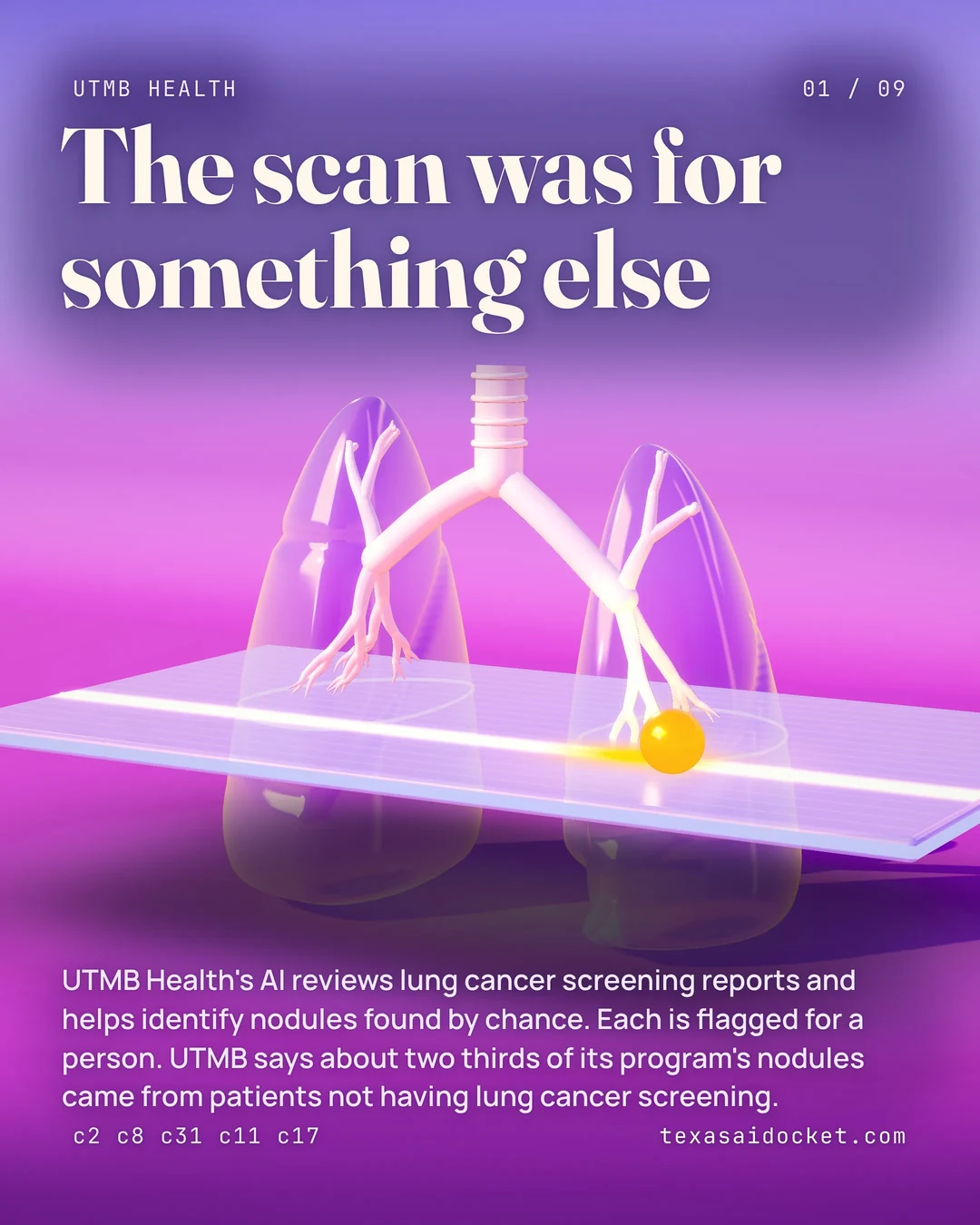

UTMB Health says AI now supports its lung cancer screening work. The current system, developed with the company Bunkerhill, reviews radiology reports, and the release says AI is also helping identify lung nodules found incidentally. Any nodule found on a screening exam or on another imaging study involving any part of the lungs is now flagged for review by the patient navigator.
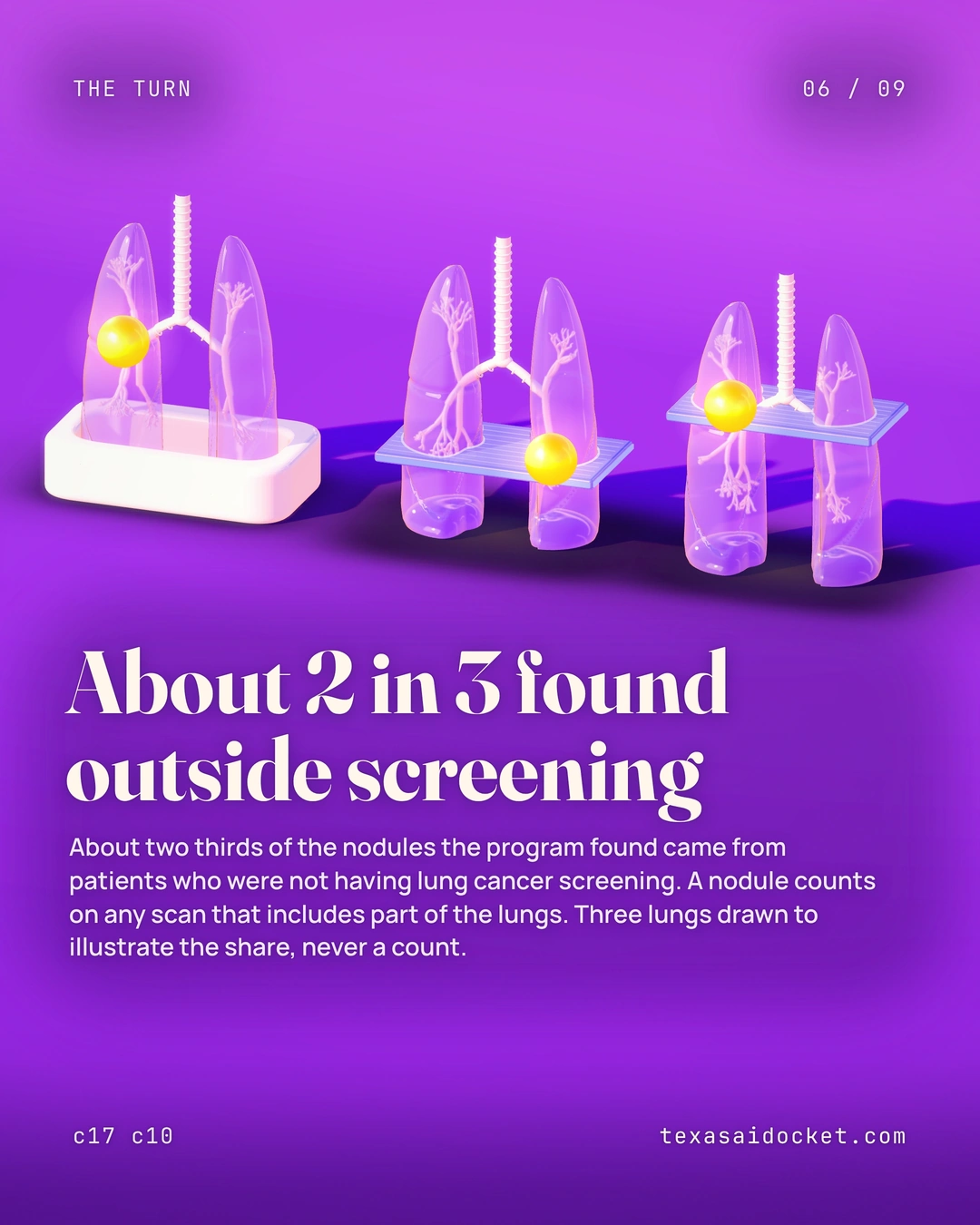
The finding that shapes the program is where those nodules turn up. About two thirds of the nodules the program identified came from patients who were not having lung cancer screening. The scan was ordered for some other reason, and the nodule was a second finding on it.
The old way
UTMB established the program in 2016 to screen patients at high risk for lung cancer. Dr. Shawn Nishi is the medical director of its Comprehensive Lung Cancer Screening and Incidental Lung Nodule Program. Before the AI, the review process sometimes took weeks or even months. Dr. Nishi says that by the time staff navigated the care pathway, the time-critical follow-up window had often closed. Dr. Nishi says the program needed a faster, more sustainable process.
A person on the other end of every flag
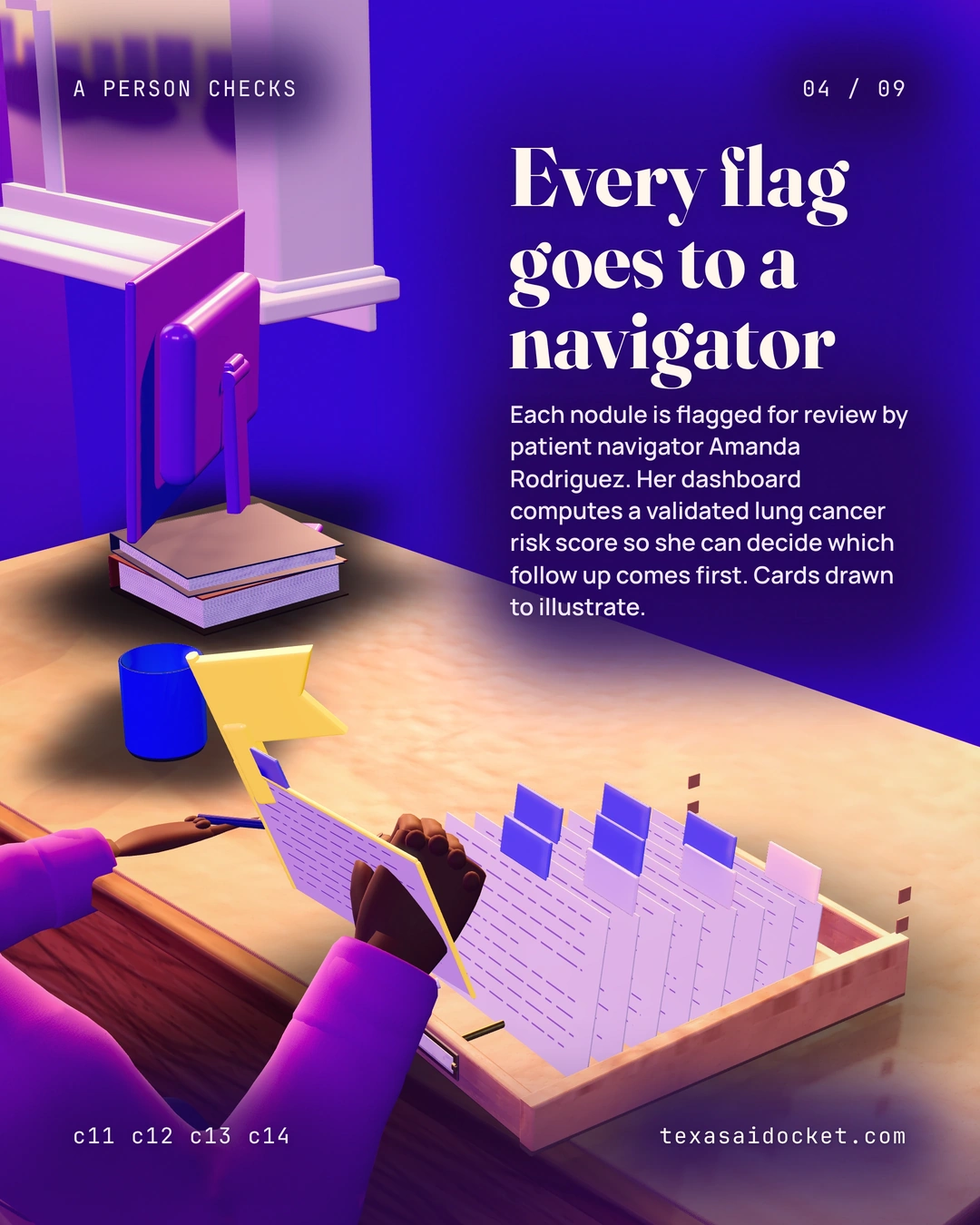
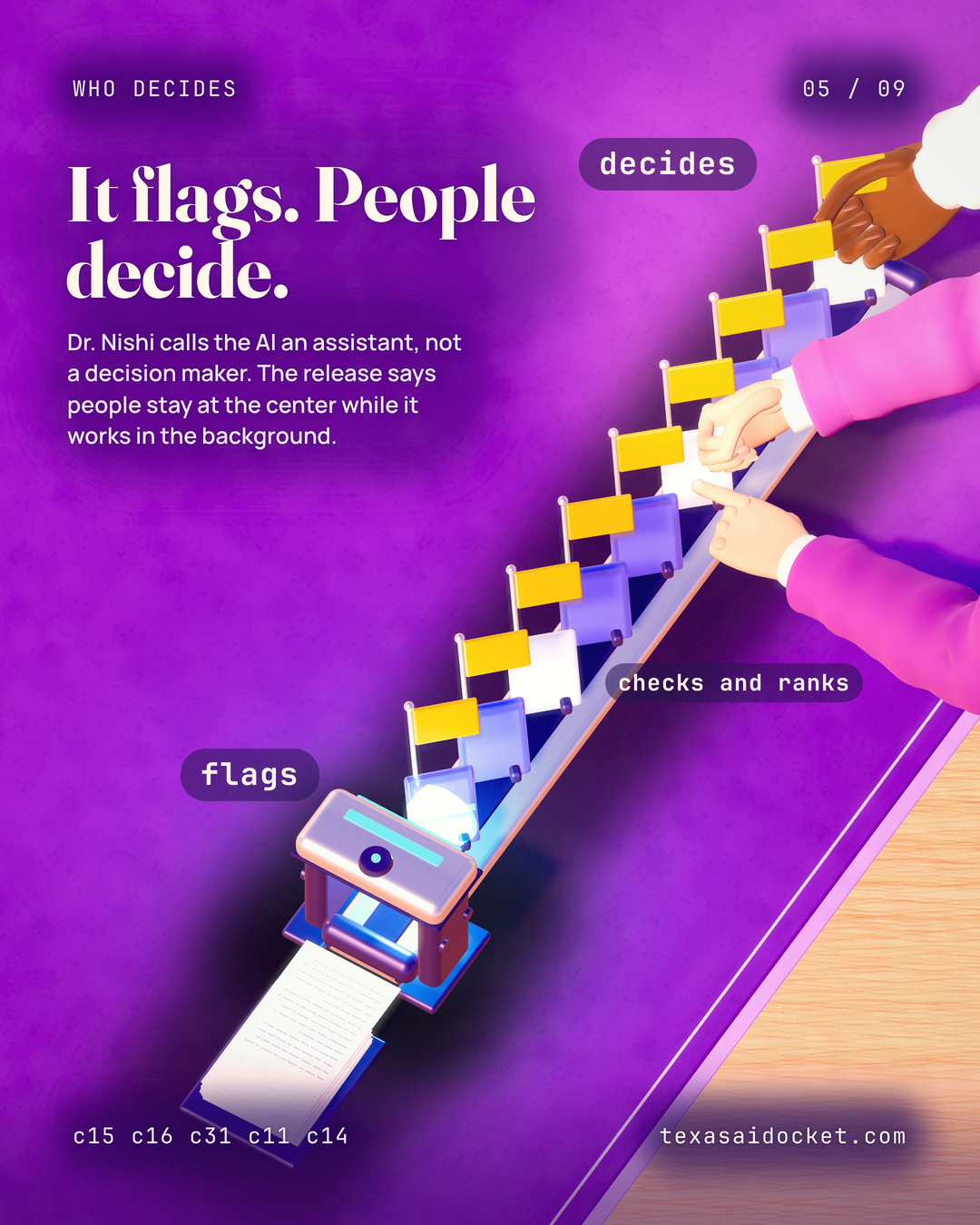
Each flag goes to the patient navigator, Amanda Rodriguez. Her dashboard calculates a validated lung cancer risk score for patients with scan abnormalities, so she can decide which follow-up care comes first. Much of the chart review, once the most time-consuming part of the workflow, has been automated.
Dr. Nishi calls the AI an assistant, not a decision maker. The release says people remain at the center of the process while the AI works in the background. The release gives no accuracy figure for the system, no count of patients or scans, and no measure of how fast follow-up now happens. Bunkerhill's own case study claims faster nodule triage at UTMB and states no baseline, so that figure is the vendor's and not the hospital's.
One patient, as Dr. Nishi tells it
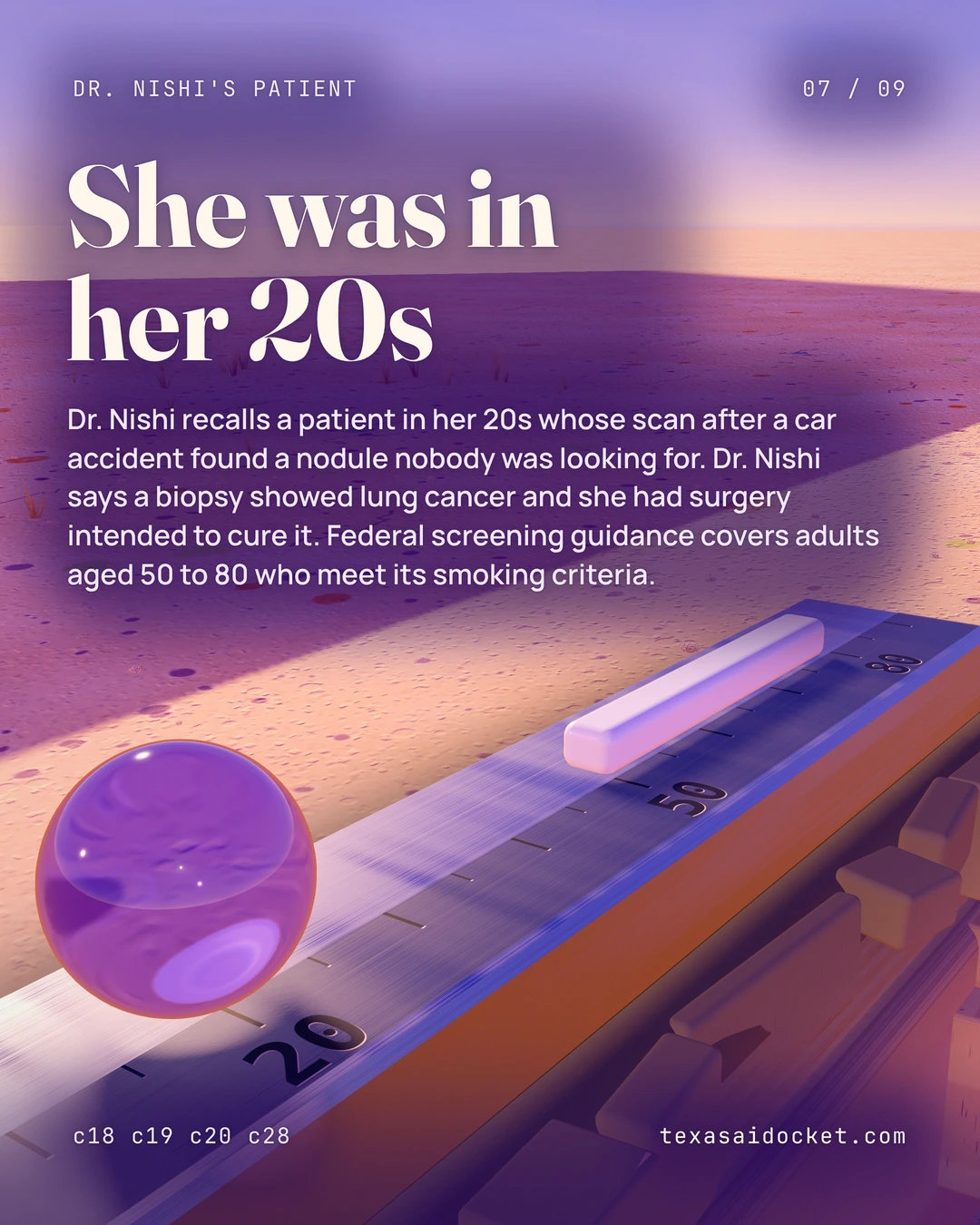
Dr. Nishi recalls a patient in her 20s who had a car accident. Her scan turned up a nodule nobody was looking for. Dr. Nishi says a biopsy showed lung cancer and she had surgery intended to cure it. The release does not say whether the AI system flagged her nodule.
She named seven or eight relatives who had been diagnosed with cancer. In Dr. Nishi's account she had a hereditary disease, which made it important for her family to be tested.
What a reader can ask
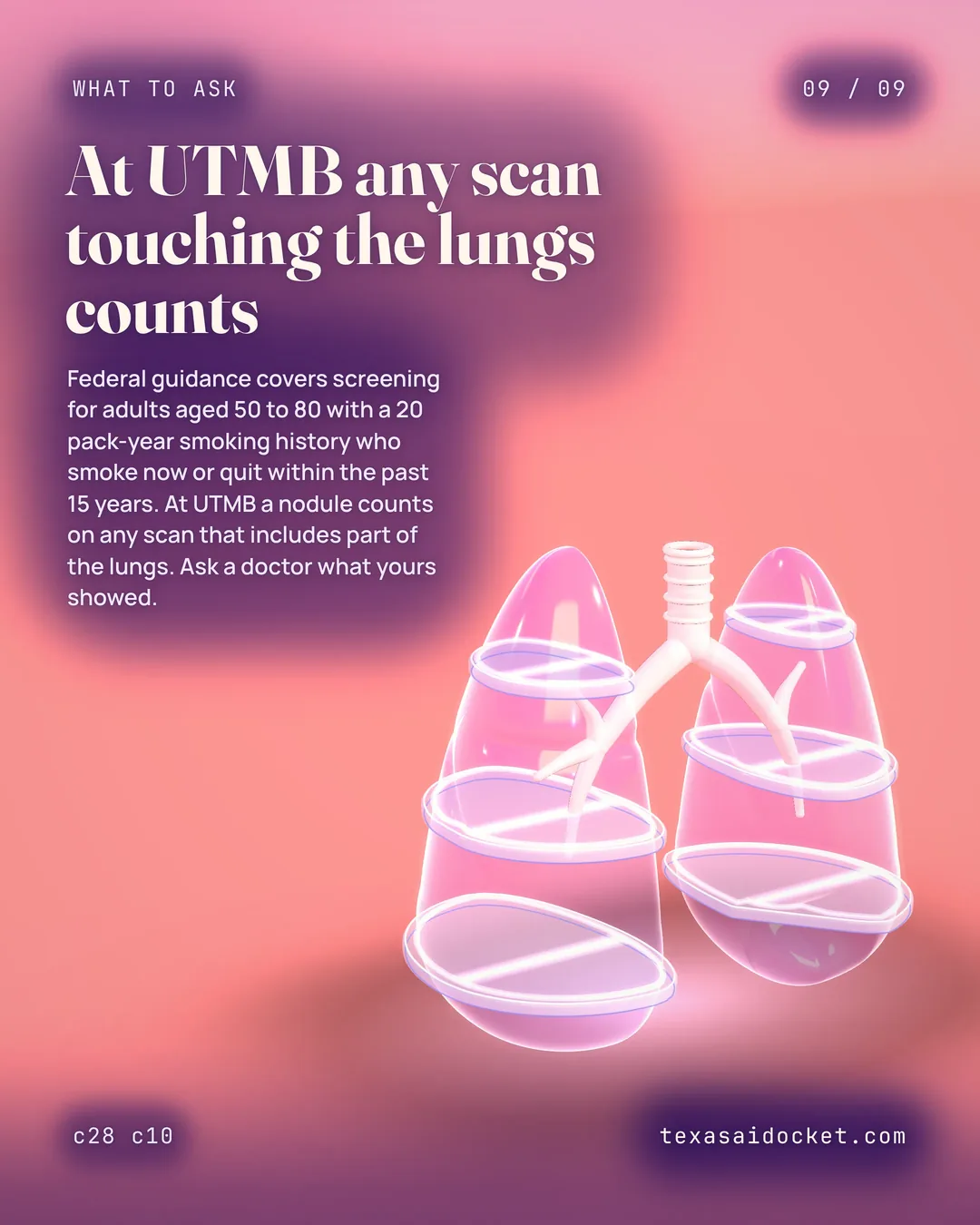
Federal guidance recommends lung cancer screening for adults aged 50 to 80 with a 20 pack-year smoking history who smoke now or quit within the past 15 years. At UTMB a nodule counts on any scan that includes part of the lungs. A patient who has had such a scan can ask what the report said about the lungs.
Sources for this story
- UTMB Health, AI adds a new layer of support to lung cancer screening at UTMB Health
- Bunkerhill Health, Carebricks enables 80% faster lung nodule triage at UTMB Health
- US Preventive Services Task Force, Lung Cancer Screening recommendation
Claim-by-claim verification · 29 claims
UTMB Health announced that artificial intelligence now supports its lung cancer screening work.
AI adds a new layer of support to lung cancer screening at UTMB Health
UTMB Health started its screening program in 2016 for patients at high risk of lung cancer.
UTMB Health established the program in 2016 to screen patients who are at high risk for lung cancer
Dr. Shawn Nishi directs the program that covers both lung cancer screening and incidental lung nodules.
medical director of the Comprehensive Lung Cancer Screening & Incidental Lung Nodule Program
Before the AI, the review process could take weeks or even months.
the original process was time-consuming, sometimes taking weeks or even months
Dr. Nishi said the follow up window for these patients had often closed by the time staff reached them.
By the time we navigated the care pathway for these patients, their time-critical follow-up window had often closed,
Dr. Nishi said the program needed to replace a labor intensive workflow with a faster one.
We needed to replace our labor-intensive workflow with a faster, more sustainable process that prioritizes patient outcomes.
The system was developed with the company Bunkerhill and reviews radiology reports.
The current system, developed in collaboration with Bunkerhill, reviews radiology reports
The reports it reviews belong to patients having lung cancer screening exams.
for patients undergoing lung cancer screening exams
A nodule counts whether it shows up on a screening exam or on any other scan that includes part of the lungs.
Any nodule, whether found on a lung cancer screening exam or another imaging study involving any portion of the lungs
Each such nodule is now flagged for a patient navigator to review.
is now flagged for review by the patient navigator.
Amanda Rodriguez is the program's patient navigator.
Amanda Rodriguez is our patient navigator who is passionate about her work.
The navigator works from a dashboard that computes a validated lung cancer risk score for patients whose scans show abnormalities.
to calculate a validated lung cancer risk score for patients with scan abnormalities.
The dashboard lets the navigator decide which follow up care comes first.
This enables her to efficiently prioritize follow-up care.
Dr. Nishi described the AI as an assistant that makes no decisions.
Nishi emphasized that AI is an assistant, not a decision maker.
The release says people stay at the center of the process while the AI runs in the background.
While AI works in the background, people remain at the center of the process.
About two thirds of the nodules the program found came from patients who were not having lung cancer screening.
Roughly two-thirds of the nodules identified through the program have been found in patients who were not undergoing lung cancer screening.
Dr. Nishi recalled a patient in her 20s who was in a car accident.
I had a patient, in her 20s, who had a motor vehicle accident,
In Dr. Nishi's account, her scan turned up a nodule nobody was looking for.
She got a scan, and we found a nodule incidentally.
Dr. Nishi said a biopsy showed lung cancer and she had surgery intended to cure it.
We performed a biopsy and she did have lung cancer and ultimately underwent resection for cure.
Dr. Nishi said the patient named seven or eight relatives who had been diagnosed with cancer.
she named seven or eight relatives who had been diagnosed with cancer
According to Dr. Nishi, the patient had a hereditary disease, so her family members needed testing too.
She ended up having a hereditary disease, which made it important for her family members to be tested for the same disease
Dr. Nishi called robotic bronchoscopy an AI enabled tool for reaching any area of the lung.
Robotic bronchoscopy is an AI-enabled tool that allows us to navigate virtually to any area of the lung,
Dr. Nishi said these biopsies are highly accurate and safer than some other ways of sampling nodules, without giving a figure.
We can biopsy lesions with a high degree of accuracy and a much better safety profile
Bunkerhill's own case study claims 80% faster lung nodule triage at UTMB Health. It names its product Carebricks and states no baseline or measurement period.
Carebricks enables 80% faster lung nodule triage at UTMB Health
Bunkerhill says its product calculates a Brock risk score from the patient record.
calculates a Brock risk score directly from the
Bunkerhill's case study says UTMB chose to keep a human in the loop for now.
UTMB has chosen to keep a human in the loop for now
Federal screening guidance covers adults aged 50 to 80 with a 20 pack year smoking history who smoke now or quit within the past 15 years.
Adults aged 50 to 80 years who have a 20 pack-year smoking history and currently smoke or have quit within the past 15 years
Much of the chart review, once the slowest part of the work, is now automated.
Much of the chart review process, previously the most time-consuming part of the workflow, has been automated
The release says AI is also helping identify lung nodules found incidentally.
AI is also helping identify incidentally discovered lung nodules.