Articles · Defense and federal
Texas Tech says its AI aircraft maintenance tools have been provided to the Army
Texas Tech built two Army aircraft maintenance tools, one AI enabled and made with a Fort Worth contractor. It says the Army has both. Every result it reports is from testing.
Read the story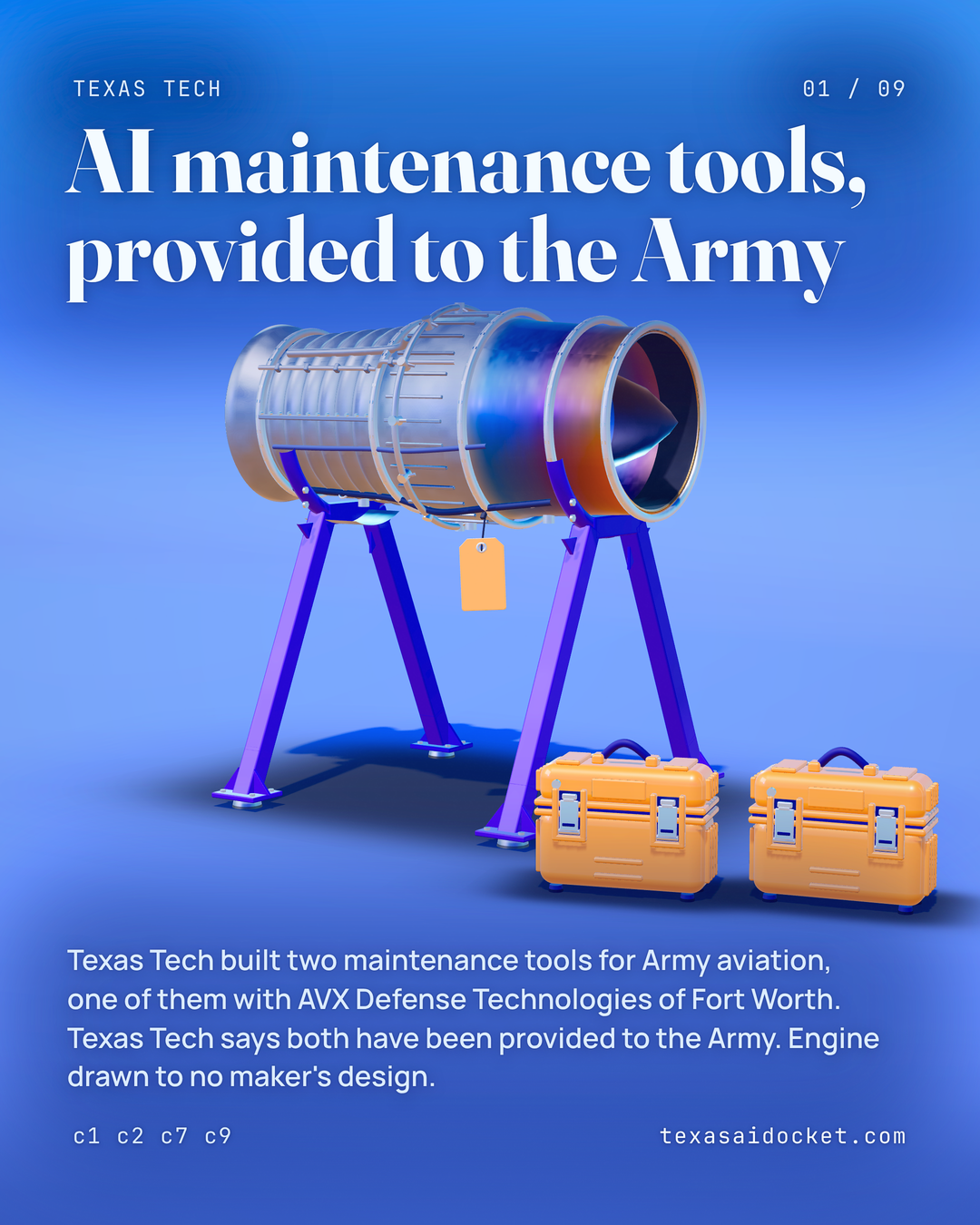




Texas Tech's Institute for Materials, Manufacturing and Sustainment worked with Fort Worth based AVX Defense Technologies under the Army's FleetSpace program. The institute is at Texas Tech in Lubbock. The team built the FleetSpace User Interface, which Texas Tech describes as an AI enabled decision tool for Army aviation operation, maintenance and sustainment planning. A second tool is the Propulsion System Validator. Texas Tech says it tracks the remaining useful life of aircraft engines on its own and recommends maintenance actions tied to the aviation technical manual.
Texas Tech says both tools have been provided to the Army. That is the university's account. The release cites no Army document, names no aircraft type and no unit, and reports no result from either tool in service.
What the networks did in testing
The team built data fusion and flight operations algorithms and a predictive maintenance model driven by data, and the methods use neural networks. In testing, the networks predicted unplanned and 480 hour phase maintenance actions. The release gives no accuracy or error rate for those predictions.
In testing, they also restored 37% of missing and corrupted flight data. They cut data volume by up to 30% and data files by up to 73%. The restored share is not an accuracy grade. It is the part of a damaged record the networks could fill back in. The two reductions are ceilings, not typical results.
Who still does the work
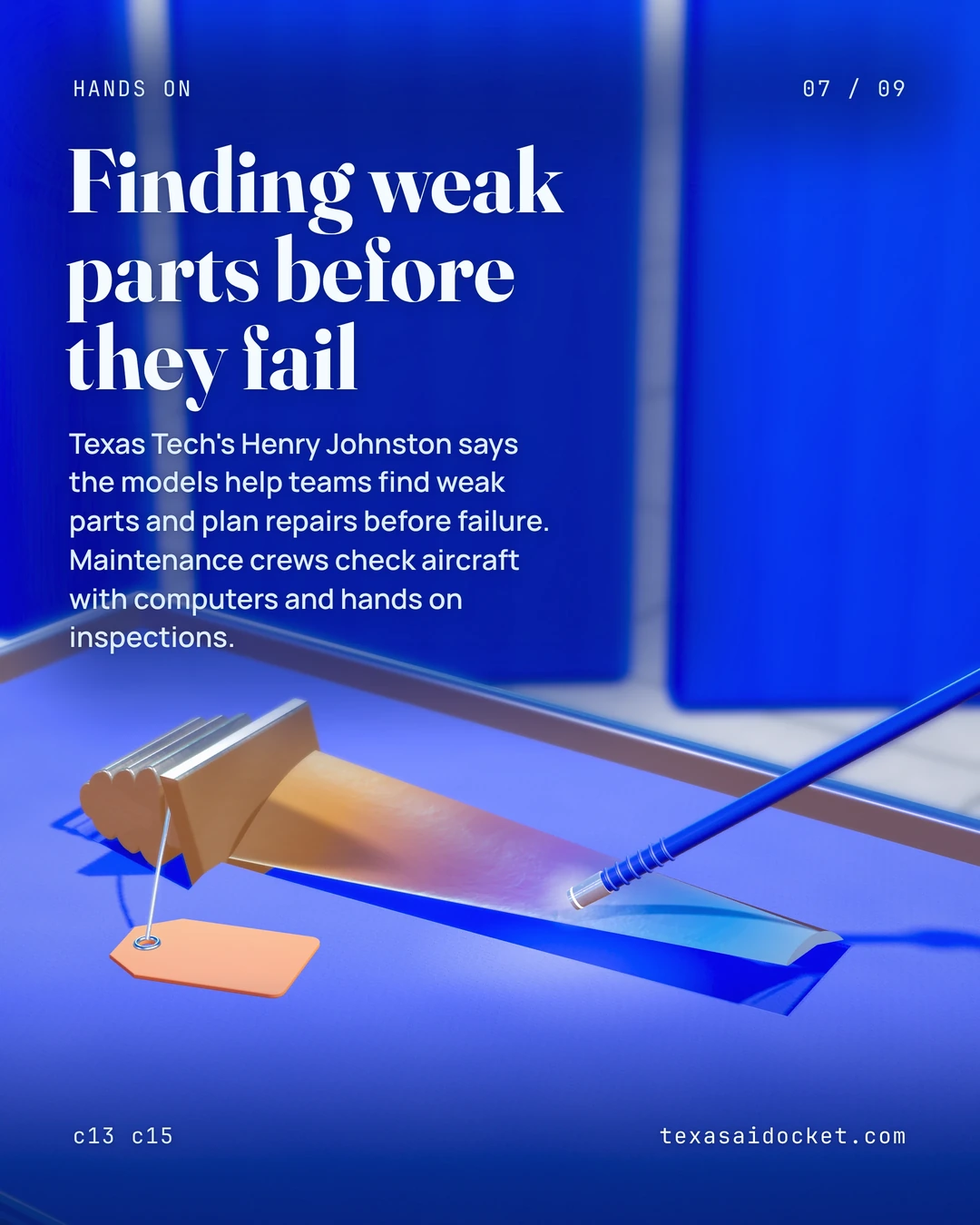
Aircraft maintenance professionals assess aircraft systems with computer technology and hands on inspections. Henry Johnston is a postdoctoral research associate at the institute. He says the models let maintenance teams identify weak components, schedule repairs ahead of failure and reduce downtime. He expects that to raise the availability of the Army aviation fleet. The second point is a forecast. Co-principal investigator Tommy Dang says both technologies give soldiers capability to manage their aviation fleets.
Texas Tech says FleetSpace was demonstrated at the Army's annual Experimental Demonstration Gateway Event and the engine validator at GE Aerospace. The release gives no date or place for either demonstration.
A long partnership
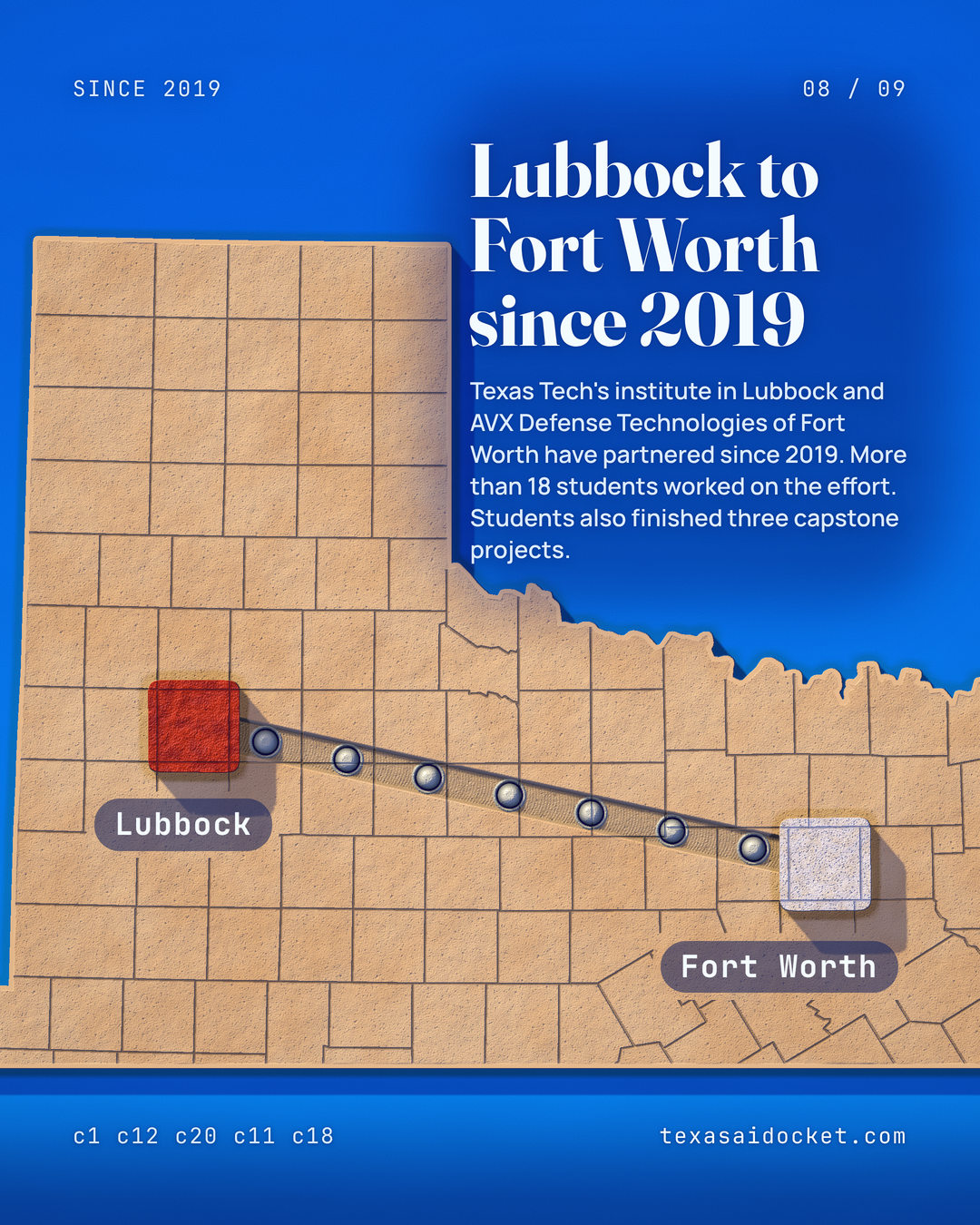
The institute and AVX have partnered continuously since 2019. More than 18 undergraduate and graduate students worked on the effort, and students completed three capstone projects along the way. Texas Tech frames the work as a step toward reducing the billions of dollars civilian and defense agencies spend maintaining aircraft. The release puts no figure on any savings from these tools.
What is still unknown
Every performance figure Texas Tech reports comes from testing. The release doesn't say whether the tools are running on Army aircraft or which aircraft they would serve. It gives no program cost and no comparison of the predictions with what maintainers find. The next public measure would be a result from service.
Sources for this story
- Texas Tech Now, Texas Tech Spearheads U.S. Army Aircraft Resilience
- Texas Tech University, Institute for Materials, Manufacturing, and Sustainment (IMMS)
Claim-by-claim verification · 20 claims
Texas Tech's IMMS worked with Fort Worth based AVX Defense Technologies under the Army's FleetSpace program to develop the FleetSpace User Interface. The Army Aviation and Missile Command funds the program.
partnered with Fort Worth-based AVX Defense Technologies, under the U.S. Army’s FleetSpace program funded by the Army Aviation and Missile Command (AvMC), to develop the FleetSpace User Interface (FSUI), an integrated operations and maintenance platform
Texas Tech describes FSUI as a 3D interactive decision tool enabled by artificial intelligence, meant for Army aviation operation, maintenance and sustainment planning.
FSUI is a 3D-interactive, artificial intelligence-enabled decision-making tool based on digitization, analytics, integration and intuitive display of data from disparate sources, intended for the Army’s aviation operation, maintenance and sustainment planning.
Texas Tech researchers also built data fusion and flight operations algorithms and a predictive maintenance model driven by data.
Texas Tech researchers developed algorithms for data fusion and flight operations and a predictive, data-driven maintenance model.
The methods rely on neural networks.
The methods use neural networks, or simplified models of interconnected units that mimic the processing ability of the human brain
Researchers reported that in testing the networks predicted unplanned and 480 hour phase maintenance actions.
predicted unplanned and 480-hour phase maintenance actions, restored 37% of missing and corrupted flight data and reduced data volume by up to 30% and data files up to 73% in testing.
In testing the networks restored 37 percent of missing and corrupted flight data. They cut data volume by up to 30 percent and data files by up to 73 percent.
restored 37% of missing and corrupted flight data and reduced data volume by up to 30% and data files up to 73% in testing.
The Texas Tech team also built a tool called the Propulsion System Validator.
The Texas Tech team also produced a Propulsion System Validator (PSV).
Texas Tech says the Propulsion System Validator tracks the remaining useful life of aircraft engines on its own and recommends maintenance actions tied to the aviation technical manual.
autonomously tracking the remaining useful life of aircraft engines and recommending maintenance actions interlinked with the aviation technical manual
Texas Tech says both the FSUI and the PSV have been provided to the Army.
The FSUI and PSV have been provided to the Army, with FleetSpace demonstrated at the Army’s annual Experimental Demonstration Gateway Event and PSV at GE Aerospace
According to Texas Tech, FleetSpace was shown at the Army's annual Experimental Demonstration Gateway Event and the PSV was shown at GE Aerospace.
with FleetSpace demonstrated at the Army’s annual Experimental Demonstration Gateway Event and PSV at GE Aerospace
More than 18 undergraduate and graduate students worked on the project alongside Texas Tech researchers and faculty.
more than 18 undergraduate and graduate students contributed to the effort.
IMMS and AVX have worked together without a break since 2019.
IMMS and AVX have partnered continuously since 2019
IMMS postdoctoral research associate Henry Johnston said the techniques and models let maintenance teams find weak components, plan repairs ahead of failure and cut downtime.
allowing maintenance teams to identify weak components, schedule repairs proactively and reduce downtime
Johnston said these benefits will raise the availability of the Army aviation fleet.
All of these benefits will increase availability of the Army aviation fleet.
Aircraft maintenance professionals check aircraft systems with computer technology and hands on inspections.
Aircraft maintenance professionals use computer technology and hands-on inspections to assess aircraft systems and support operational readiness.
Helicopter systems hold complex mechanical parts that need regular inspection and maintenance.
Helicopter systems contain complex mechanical components that require regular inspection and maintenance to ensure reliable operation.
Co-principal investigator Tommy Dang said both technologies give soldiers capability to manage and operate their aviation fleets.
Both technologies provide great capability for soldiers to manage and operate their aviation fleets
Students finished three capstone projects during the effort.
Students completed three capstone projects over the course of the effort
Texas Tech presents the work as a step toward cutting the billions of dollars that civilian and defense agencies spend maintaining aircraft.
toward reducing the billions of dollars civilian and defense agencies spend on maintaining aircraft.
Texas Tech University and its Institute for Materials, Manufacturing and Sustainment are in Lubbock.
Texas Tech University, 2500 Broadway, Lubbock, TX 79409