Articles · State policy
Texas comptroller proposes that AI and cloud computing fall outside the data processing tax
The comptroller proposes treating cloud computing and AI as hosted services outside the data processing tax. His own fiscal note estimates what Texas would stop collecting.
Read the story



Comptroller Don Huffines announced proposed amendments on November 18th to Rule 3.308. They appeared in the Texas Register issue of November 20th. The proposal defines hosted technology services to include cloud computing, artificial intelligence and quantum computing. It says those services are not data processing and are not taxable.
It is a proposal. The earliest the comptroller can adopt it is December 20th, and nothing in the record shows it adopted.
What the tax was written for
Huffines says the Legislature taxed data processing in 1987. Under the proposed definition, a data processing service is one where the provider processes data the customer supplied and returns it in the format the customer asked for. Storing or manipulating data would not by itself count. Neither would a customer using a provider's software, platform or computing to process its own data.
The comptroller says the agency's earlier reading of the tax was too expansive. He intends the amendments to apply only from the date their adoption takes effect.
What the comptroller's own note estimates
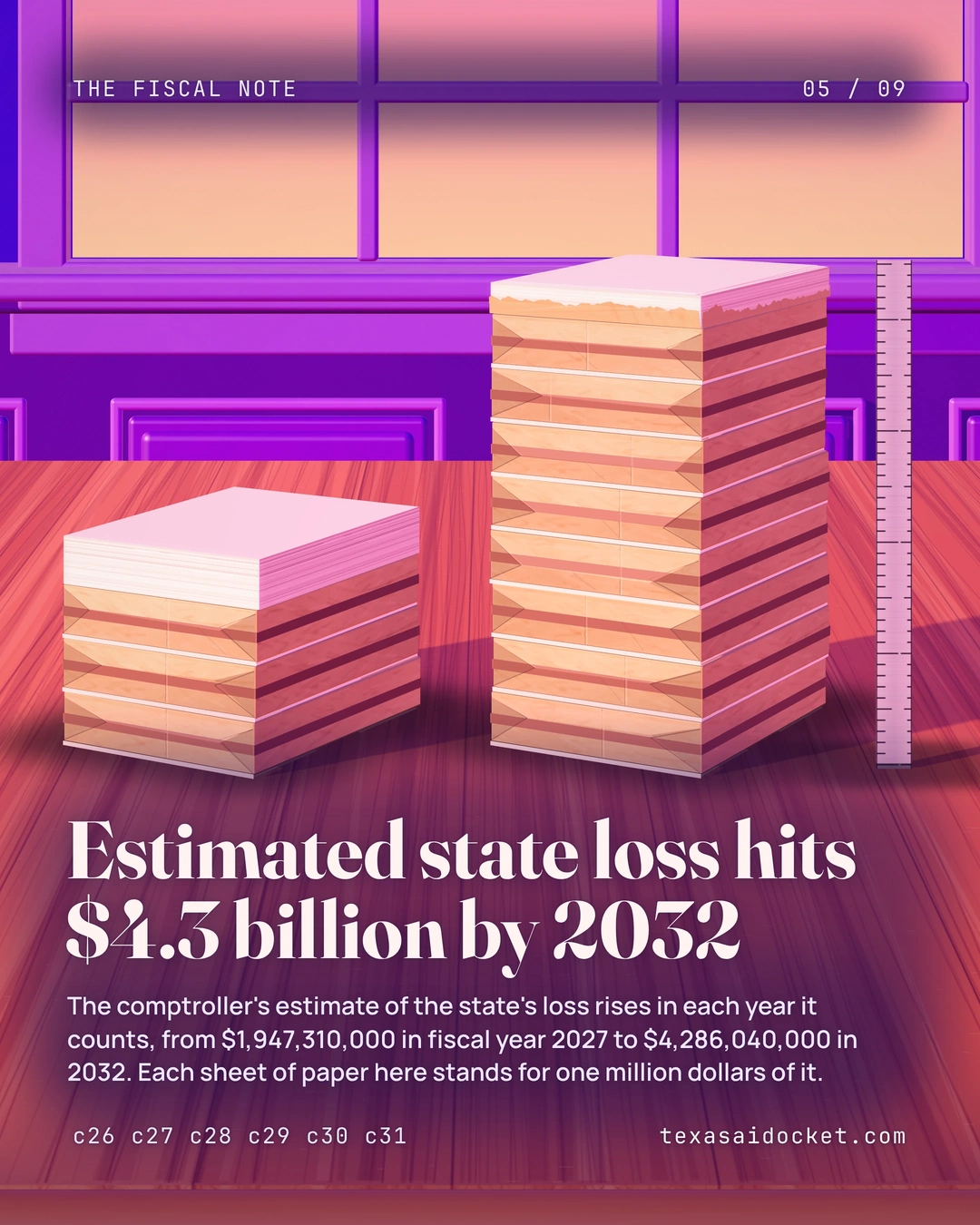
The fiscal note in the Register puts the loss to the state's General Revenue Fund at $1,947,310,000 in fiscal year 2027. The estimate rises in every year it counts. It reaches $4,286,040,000 in fiscal year 2032.
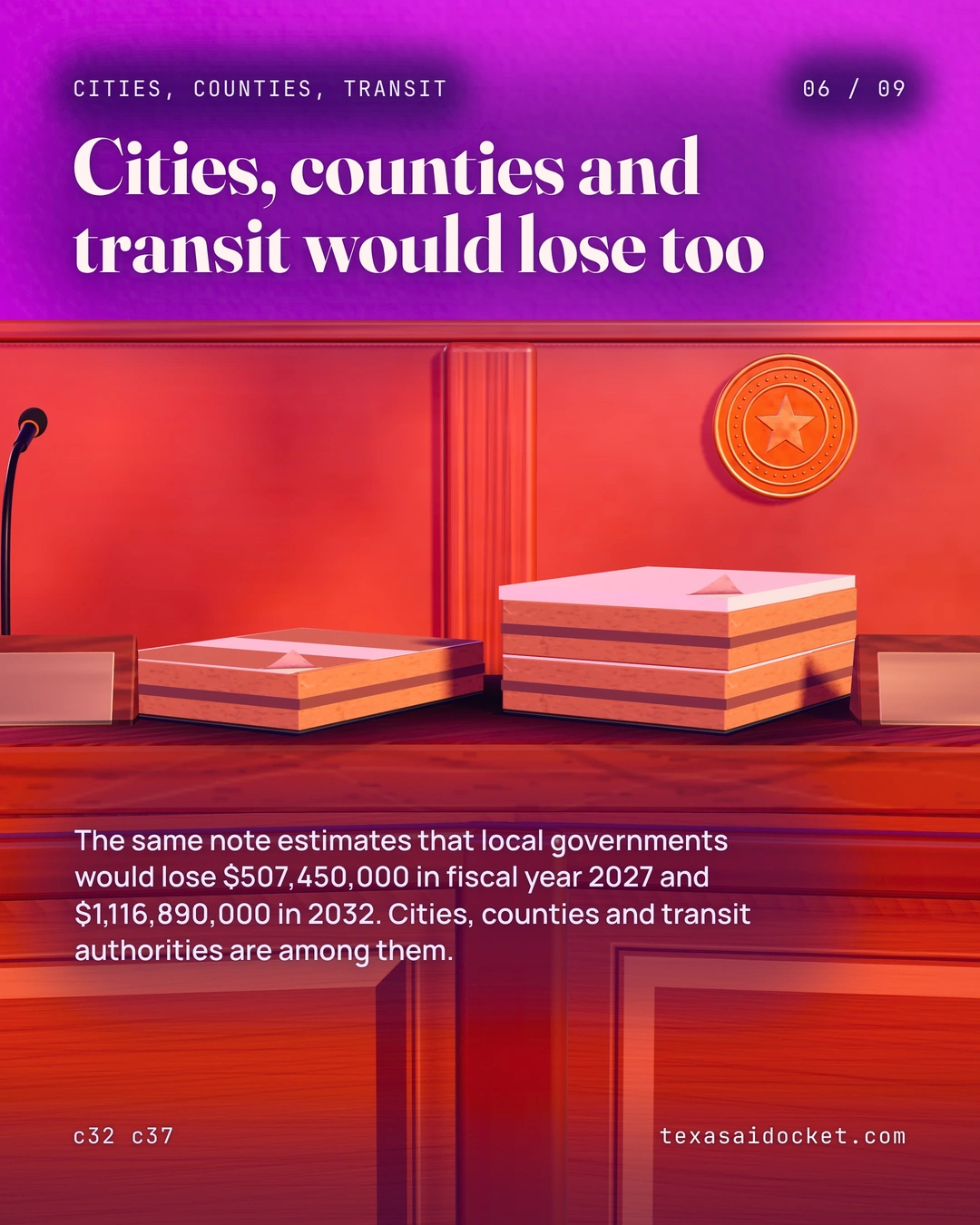
Losses to units of local government, including cities, counties and transit authorities, are estimated at $507,450,000 in fiscal year 2027. They reach $1,116,890,000 in fiscal year 2032.
The same note finds the amended rule will have an insignificant effect on the state's economy. It says one further effect on sales tax remittances can't be estimated. Every figure here is the comptroller's estimate of a proposed rule, not a measured loss. The Texas Tribune's account of the cost rests on the comptroller's own estimates.
How to comment
Comments go to Robin Robinson, the Associate Deputy Comptroller for Tax, by mail or by email. The comptroller must receive them within 30 days of the proposal's publication in the Register. Counted from the issue date, that is December 20th.
Comptroller-elect Sarah Eckhardt takes over the office on January 1st, according to the Tribune. She asked Huffines in a letter to stop pursuing rule changes begun since August 1st, and he replied that he would keep making rules until he leaves office. The record holds no statement of what the new comptroller would do with this rule if it is adopted.
Sources for this story
- Texas Comptroller, news release of November 18th
- Texas Comptroller, GovDelivery bulletin of November 18th
- The Texas Tribune, report of November 19th
- Texas Register, Comptroller of Public Accounts, proposed amendments to Rule 3.308, TRD-202604746
- Texas Register, issue of November 20th
Claim-by-claim verification · 45 claims
The Comptroller's release of November 18th, 2026 carries a headline saying Huffines kills a tax on cloud storage and website hosting. The rule it describes is only proposed.
Comptroller Huffines Kills Tax on Cloud Storage and Website Hosting to Save Texans Money
Texas Comptroller Don Huffines announced the new rules in a release dated November 18th, 2026.
Texas Comptroller Don Huffines today announced new rules confirming that internet hosting,
The Comptroller says the proposed rules treat internet hosting, cloud computing and artificial intelligence as hosted technology services that are not taxable data processing.
cloud computing, artificial intelligence, and other hosted technology services are not taxable
The release names the rule being amended as Comptroller Rule 3.308.
Proposed amendments to Rule 3.308
According to the Comptroller, a data processing service under the amendments is one where the provider takes data the customer supplied and hands it back in a usable format.
supplied by the customer and returns it in an organized, usable format
The Comptroller says the amendments also require software sales to be allocated so Texas taxes only the Texas share.
require that software sales be allocated so Texas taxes only the portion
Huffines said the Legislature taxed data processing in 1987.
The Legislature taxed data processing in 1987,
Huffines said the Legislature never taxed artificial intelligence.
It did not tax artificial intelligence.
The release said the proposed rule would appear in an upcoming issue of the Texas Register.
The proposed rule will be published in an upcoming issue of the Texas Register.
The Texas Tribune reported on November 19th, 2026 that the limit would cost the state $18 billion over six years, based on the Comptroller's own estimates.
will amount to an $18 billion loss over the next six years
The Tribune reported that local government tax losses would total $4.67 billion over the same period.
Tax revenue losses for local governments will total $4.67 billion in that time.
The Tribune reported that the Comptroller's agency projects a $1.9 billion loss in state general revenue.
His agency projects losses of $1.9 billion in state general revenue
The Tribune reported nearly $600 million in lost local sales tax revenue in the first year.
nearly $600 million in local sales tax revenue
The Tribune reported that by fiscal year 2032 the state would lose $4.3 billion and local governments about $1.1 billion.
By fiscal year 2032, the state will lose $4.3 billion and local governments about $1.1 billion, according to the estimates.
Comptroller-elect Sarah Eckhardt asked Huffines in a letter of November 9th to stop pursuing every rule change begun since August 1st.
Eckhardt in a Nov. 9 letter asked Huffines to cease pursuit of all rule changes initiated since Aug. 1
The Tribune describes Huffines as having lost his election this month.
Comptroller-elect Sarah Eckhardt asked Don Huffines, who lost election this month, to cease policy changes
Eckhardt is set to take over the comptroller's office on January 1st, according to the Tribune.
prepares to assume control of the office on Jan. 1
Huffines replied that he would keep making rules until he leaves office.
he would not cease rulemaking until he leaves office
The Tribune reported December 20th as the earliest date the rule could be adopted.
The earliest possible adoption would be Dec. 20
The Comptroller's proposal says it would clarify what a data processing service is and confirm that internet hosting and other hosted technology services are not taxable.
to confirm that Internet hosting and other hosted technology services are not data processing services and are not taxable under Tax Code, §151.0101(a).
The Comptroller concludes the agency's earlier reading of the data processing tax was too expansive.
concludes that the interpretation was too expansive.
Under the proposed definition, a data processing service processes data the customer supplied and returns it to the customer in the format the customer asked for.
defines a data processing service as one in which the provider processes data supplied by the customer and returns that data to the customer in an organized and usable format requested by the customer.
Storing or manipulating data would not by itself be a data processing service.
The storage or manipulation of data, standing alone, is not a data processing service.
A customer using a provider's software or computing to process its own data would not be a data processing service either.
including the customer's use of a provider's software, platform, or computing resources to process the customer's own data, is not a data processing service.
The proposal defines hosted technology service to include cloud computing, artificial intelligence and quantum computing.
New subsection (a)(5) defines hosted technology services, including cloud computing, artificial intelligence, and quantum computing.
The fiscal note puts the loss to the state's General Revenue Fund at $1,947,310,000 in fiscal year 2027.
would result in losses to General Revenue Fund 0001 of $1,947,310,000 in fiscal year 2027
The fiscal note puts the state loss at $2,271,960,000 in fiscal year 2028.
$2,271,960,000 in fiscal year 2028
The fiscal note puts the state loss at $2,655,080,000 in fiscal year 2029.
$2,655,080,000 in fiscal year 2029
The fiscal note puts the state loss at $3,108,360,000 in fiscal year 2030.
$3,108,360,000 in fiscal year 2030
The fiscal note puts the state loss at $3,646,140,000 in fiscal year 2031.
$3,646,140,000 in fiscal year 2031
The fiscal note puts the state loss at $4,286,040,000 in fiscal year 2032.
$4,286,040,000 in fiscal year 2032
The fiscal note puts the loss to cities, counties and transit authorities at $507,450,000 in fiscal year 2027.
Losses to units of local governments, including municipalities, counties, and transit authorities would be $507,450,000 in fiscal year 2027
The local loss is $592,050,000 in fiscal year 2028 by the same note.
$592,050,000 in fiscal year 2028
The local loss is $691,890,000 in fiscal year 2029 by the same note.
$691,890,000 in fiscal year 2029
The local loss is $810,010,000 in fiscal year 2030 by the same note.
$810,010,000 in fiscal year 2030
The local loss is $950,140,000 in fiscal year 2031 by the same note.
$950,140,000 in fiscal year 2031
The local loss is $1,116,890,000 in fiscal year 2032 by the same note.
$1,116,890,000 in fiscal year 2032
The chief revenue estimator found the amended rule will have an insignificant effect on the state's economy.
will have insignificant effect on this state's economy.
The fiscal note says one further effect on sales tax remittances can't be estimated.
would likely have a negative effect on sales tax remittances, however, that impact cannot be estimated.
Comments go to Robin Robinson, the Associate Deputy Comptroller for Tax, by mail or by email.
to Robin Robinson, Associate Deputy Comptroller for Tax, P.O. Box 13528, Austin, Texas 78711 or to the email address
The comptroller must receive comments within 30 days of the proposal's publication in the Texas Register.
The comptroller must receive your comments or other information no later than 30 days from the date of publication of the proposal in the Texas Register
The proposal was filed with the Secretary of State on November 9th, 2026.
Filed with the Office of the Secretary of State on November 9, 2026.
The earliest the comptroller can adopt the rule is December 20th, 2026.
Earliest possible date of adoption: December 20, 2026
The comptroller intends the amendments to apply only from the date their adoption takes effect.
intends them to apply prospectively from the date the adoption of this amendment is effective.
The proposal appears in the Texas Register issue of November 20th, 2026.
Texas Register November 20, 2026