Articles · Education
Texas put AI in a money class.
Texas's financial literacy standards include AI-assisted career research and scrutiny of algorithmic recommendations. Students are asked to question the tools as well as use them.
Read the story
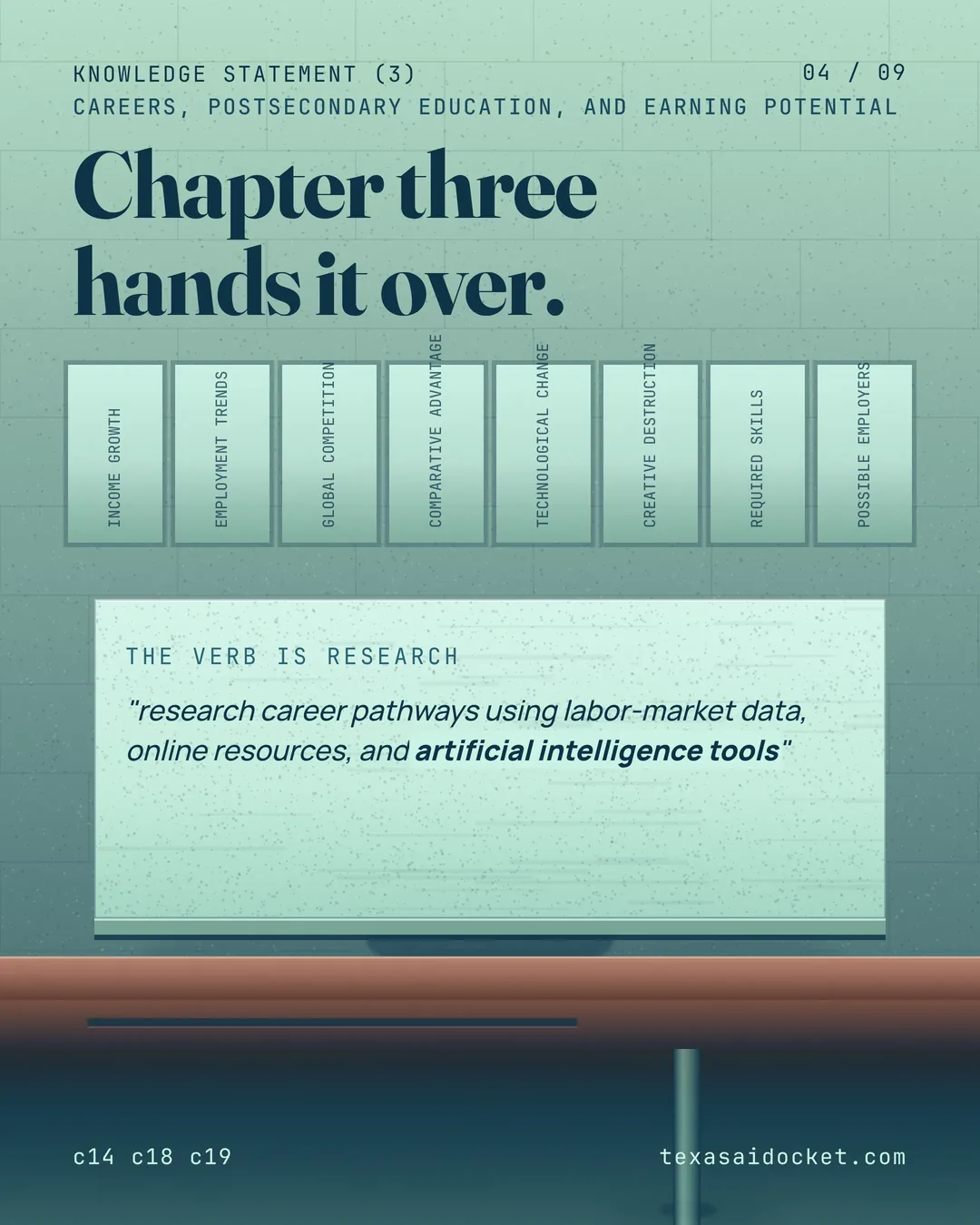
AI enters Texas's personal financial literacy course through ordinary decisions about careers, spending and investing. The published course text asks students to research career pathways using AI alongside labor-market data and other resources.
Other expectations turn the attention back on the tools. Students are asked to explain how algorithm-driven recommendations influence spending and to examine the limitations of automated investment platforms.
Use and scrutiny sit together
The investment expectation includes fees, strategies, algorithmic limitations and suitability for different investor profiles. It is not an endorsement of a particular automated product. The consumer-economics section similarly treats recommendations as an influence to understand.
The careers section also asks students to consider work that may emerge as technology changes. AI is embedded in broader financial decision-making, not described as a stand-alone technical qualification.
Proposal text and adoption evidence
The board item and its attachment describe proposed text for final adoption. A separate board news release reports adoption of the personal financial literacy standards. The adoption claim rests on that release, not on the proposed motion alone.
What the standards do not show
The published expectations describe what students should learn. They do not establish which classroom products districts will use or how instruction will be delivered. Those implementation choices require evidence beyond the curriculum text.
Sources for this story
- Committee of the Full Board Item 3, Texas State Board of Education, second reading and final adoption
- Attachment, Text of Proposed New 19 TAC Chapter 113 Subchapter C Section 113.26
- Texas State Board of Education news release, Completes K-12 Social Studies TEKS Revision, Adopts New Personal Financial Literacy Standards
Claim-by-claim verification · 24 claims
The board item that carried the new course was styled for second reading and final adoption rather than first reading.
Applied Personal Financial Literacy (One-Half Credit), Adopted 2026 (Second Reading and Final Adoption)
The motion put to the board was to approve the new section for second reading and final adoption.
Approve for second reading and final adoption proposed new 19 TAC Chapter 113
The motion asked the board to find the new section takes effect 20 days after filing with the Texas Register.
is necessary and shall have an effective date of 20 days after filing with the Texas Register.
The board item carries one attachment and names it as the text of the proposed new section.
Attachment: Text of Proposed New 19 TAC Chapter 113
The board item prints its own date line above the two bodies listed as acting on it.
September 4, 2026 COMMITTEE OF THE FULL BOARD: ACTION STATE BOARD OF EDUCATION: ACTION
The item states the new rule aligns the course with a bill from the last regular session.
to ensure alignment with requirements in House Bill (HB) 27, 89th Texas Legislature, Regular Session, 2025, and ensure the standards remain current.
The item records that the text changed after first reading.
Changes are recommended since approved for first reading.
The statute the board acts under makes it responsible for graduation requirements.
requires the State Board of Education (SBOE) to establish curriculum and graduation requirements.
The statute treats the half credit in personal financial literacy as a curriculum requirement a student must comply with.
requires the SBOE to allow a student to comply with the curriculum requirement for a one-half credit in personal financial literacy by successfully completing an advanced placement (AP) course
The board had pulled this one course out of the wider social studies package earlier in the year.
At the April 2026 meeting, the SBOE removed
The attachment heads itself as the text of a proposed new section rather than as adopted text.
Text of Proposed New 19 TAC
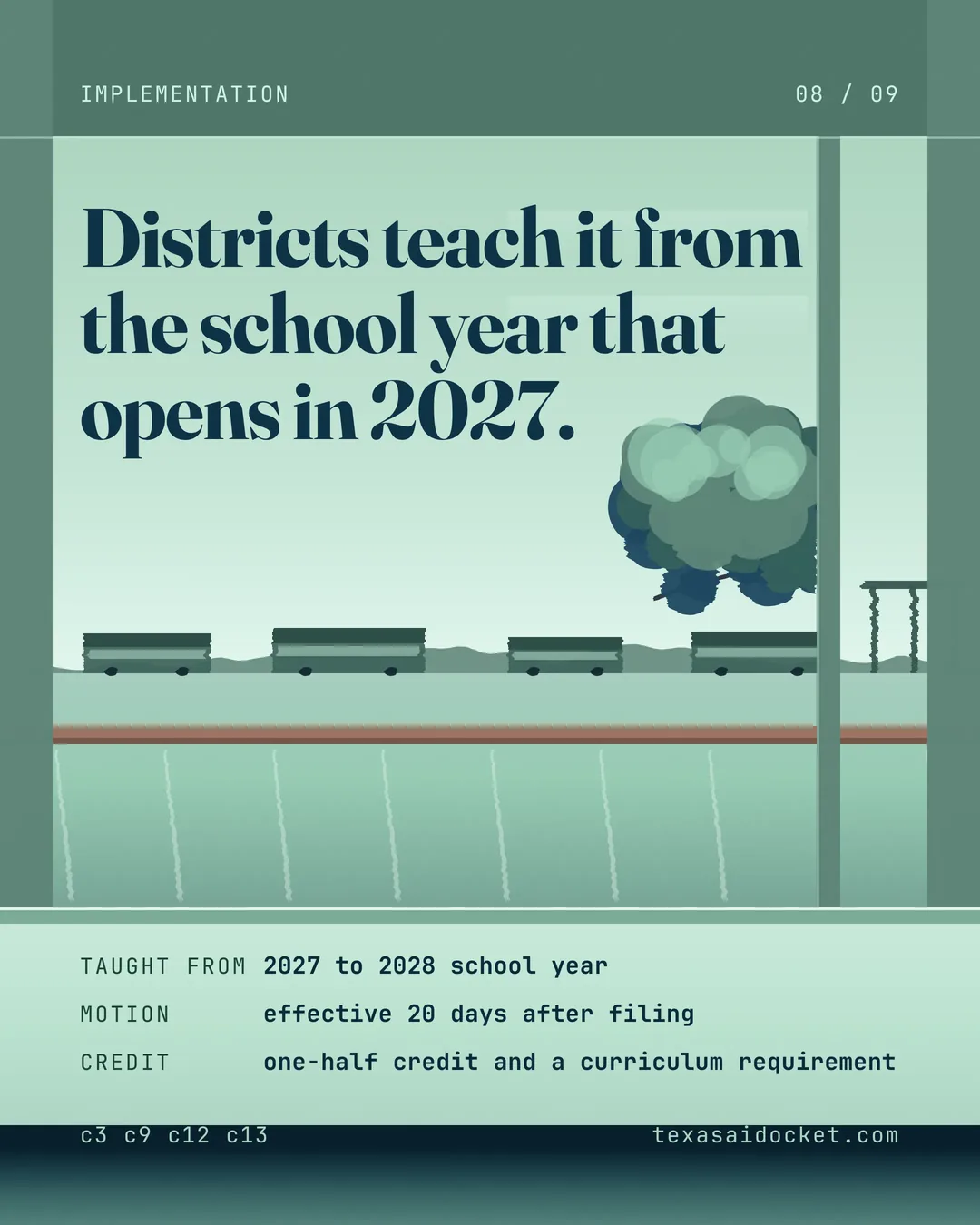
The course text directs districts to implement the section from the school year that opens in 2027.
The provisions of this section shall be implemented by school districts beginning with the 2027-2028 school year.
The course carries one half credit on successful completion.
Students shall be awarded one-half credit for successful completion of this course.
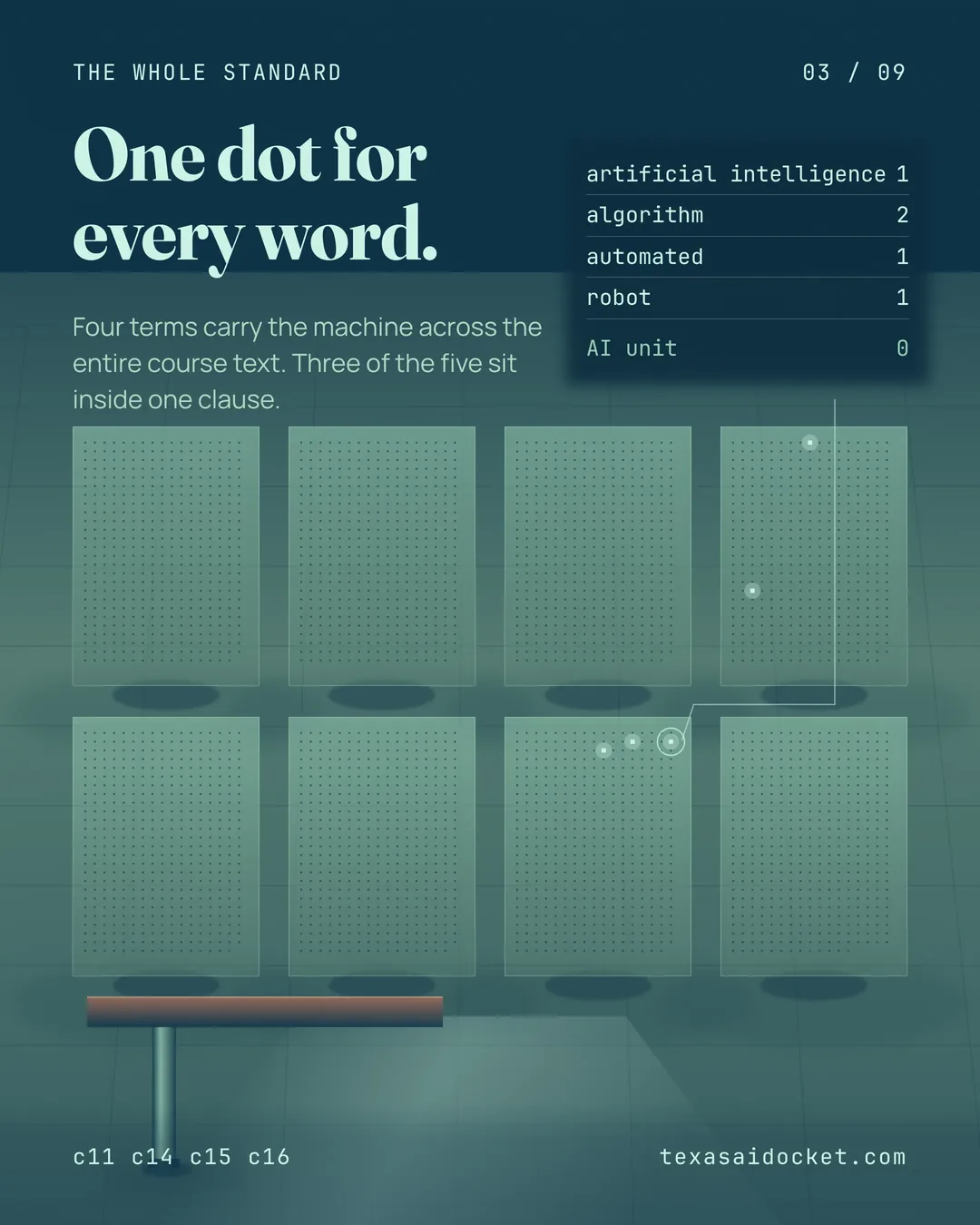
One student expectation has students research career pathways using artificial intelligence tools.
research career pathways using labor-market data, online resources, and artificial intelligence tools to evaluate income growth, employment trends, global competition, comparative advantage, technological change, creative destruction, required skills, and possible employers (E, S);
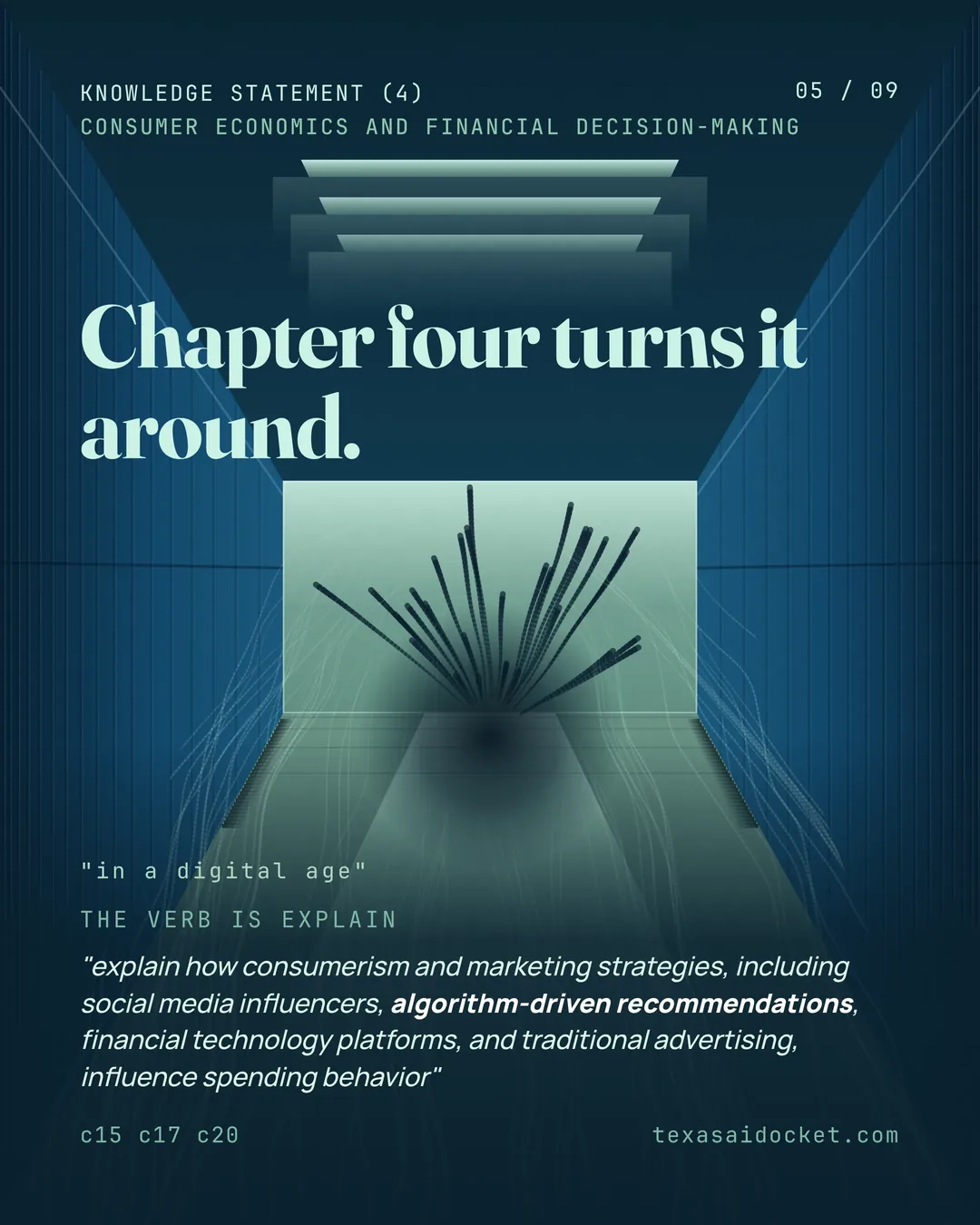
A second student expectation has students explain how algorithm driven recommendations influence spending behavior.
explain how consumerism and marketing strategies, including social media influencers, algorithm-driven recommendations, financial technology platforms, and traditional advertising, influence spending behavior and financial decision-making (Geo/C, E, S);
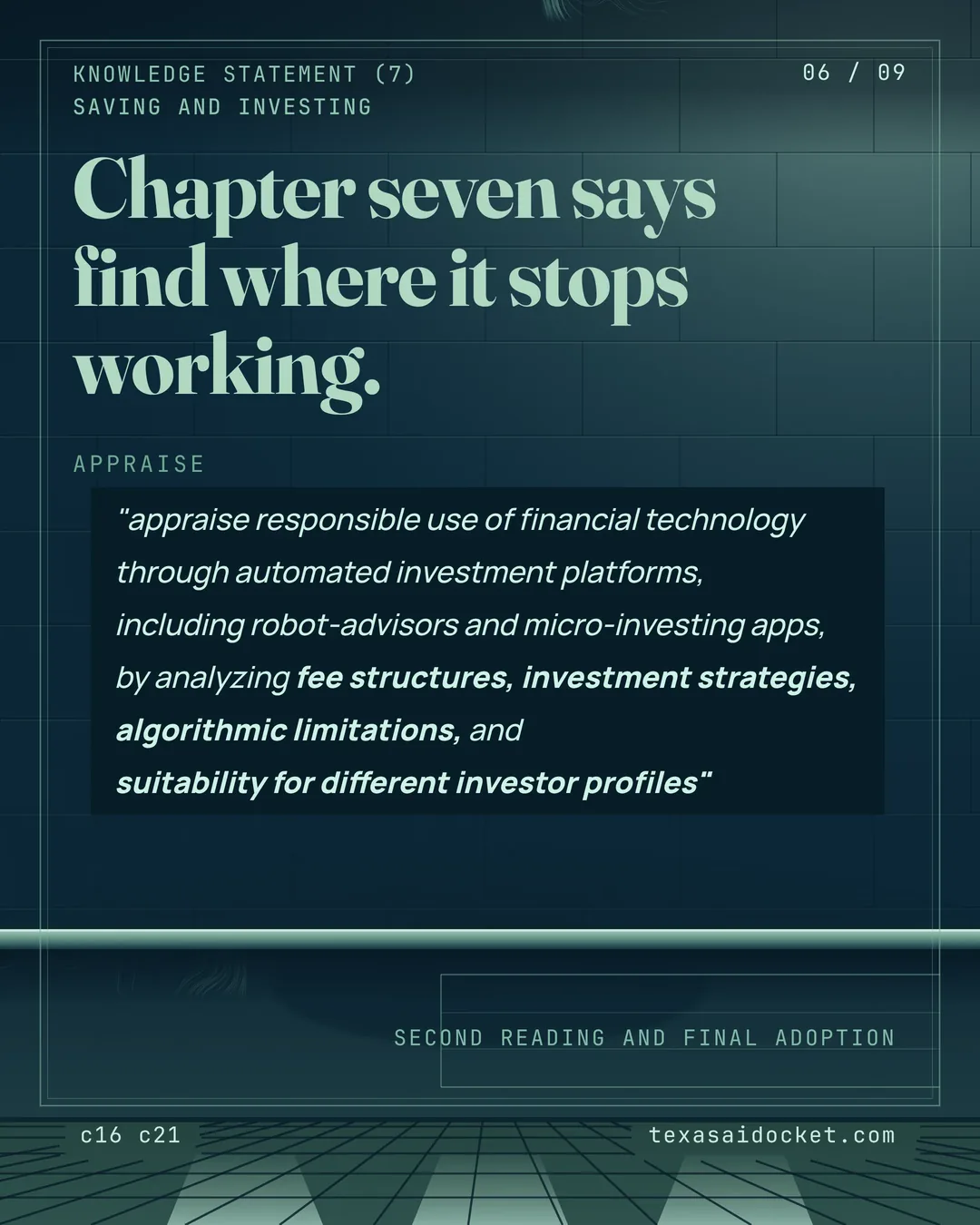
A third student expectation has students appraise automated investment platforms by analyzing their algorithmic limitations.
appraise responsible use of financial technology through automated investment platforms, including robot-advisors and micro-investing apps, by analyzing fee structures, investment strategies, algorithmic limitations, and suitability for different investor profiles (E, S);
The knowledge statement over the consumer economics expectations frames the whole work as decision making in a digital age.
responsible, ethical, and informed financial decision-making in a digital age
The expectation immediately before the artificial intelligence one asks about careers that do not exist yet.
including careers that may emerge as technology and the economy change (E, S);
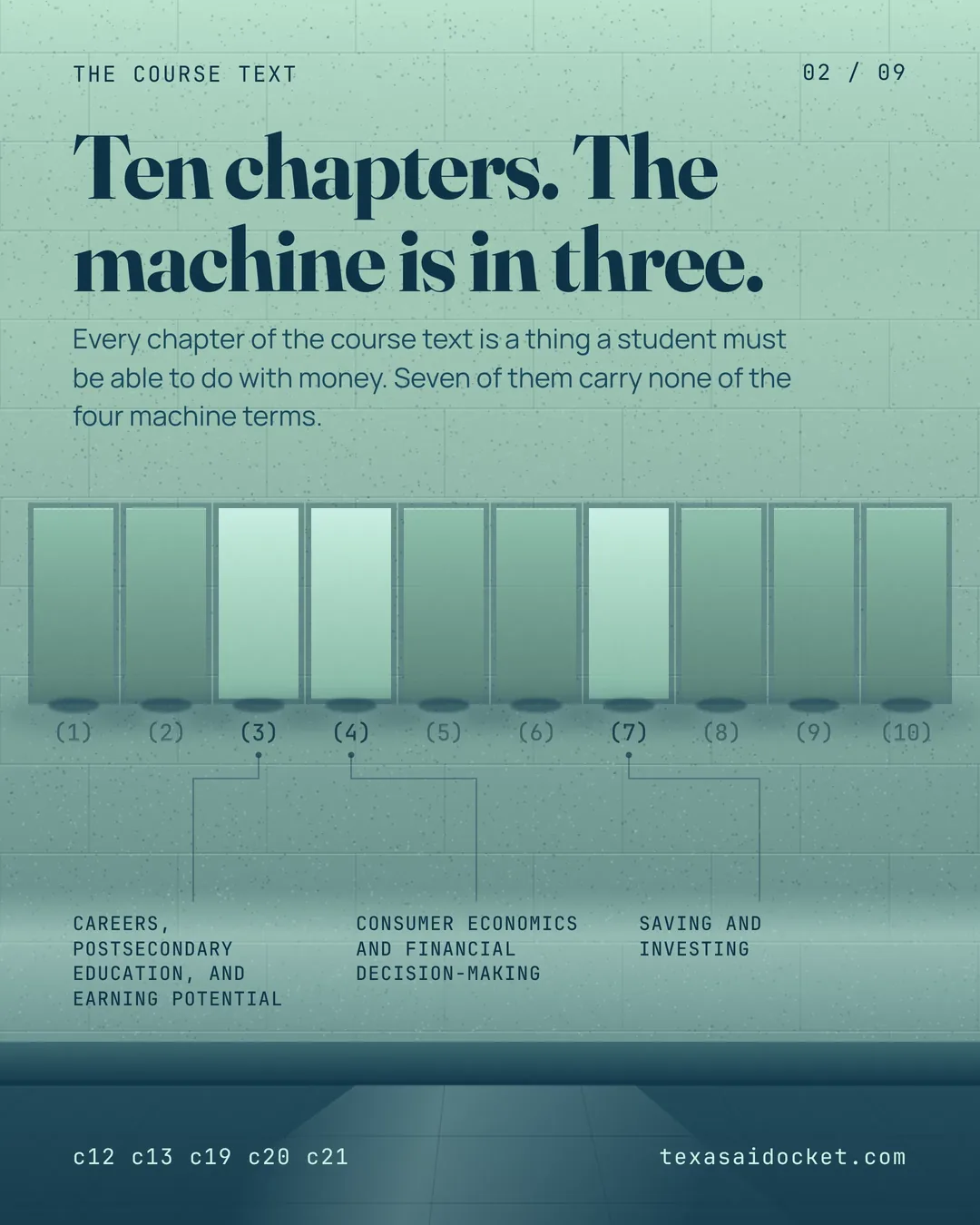
The chapter that carries the artificial intelligence expectation is about careers and earning potential.
(3) Careers, Postsecondary Education, and Earning Potential
The chapter that carries the algorithm expectation is about consumer economics and financial decision making.
(4) Consumer Economics and Financial Decision-Making
The chapter that carries the automated investment expectation is about saving and investing.
(7) Saving and Investing. The student understands that saving and investing are essential components of building wealth, financial security, and long-term independence
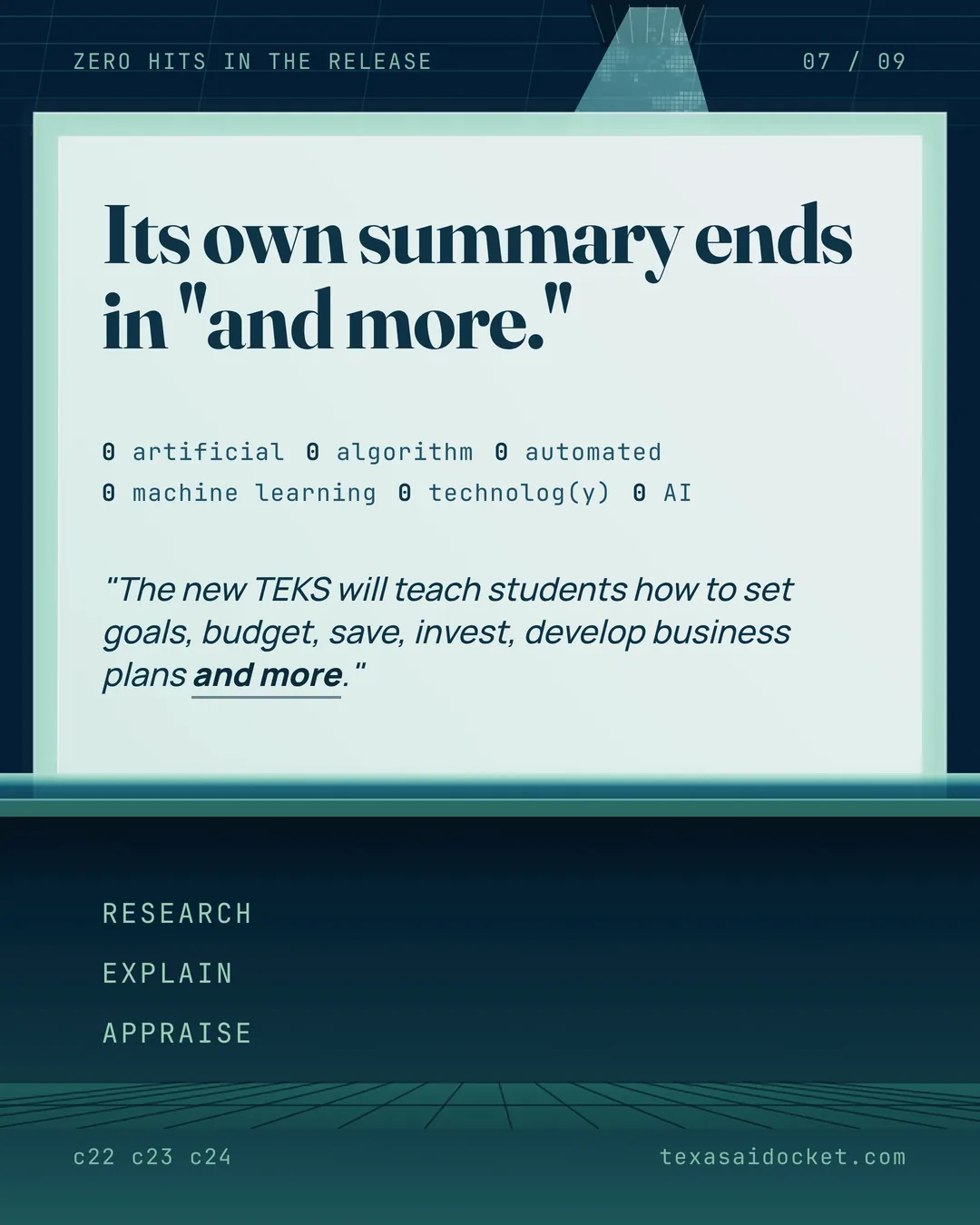
The board's news release describes what the new standards teach without naming any technology.
The new TEKS will teach students how to set goals, budget, save, invest, develop business plans and more.
The release places the financial literacy adoption beside the wider social studies work.
In addition to the social studies TEKS, the SBOE adopted new Personal Financial Literacy (PFL) standards.
The release quotes the board chairman on what he calls the vital aspect of the new standards, and it is not the machine.
One of the vital aspects of our PFL standards is that students understand the financial impact on their economic future under capitalism compared to socialism and communism.